Troubleshoot the system before you change the inputs.
Symptoms
- Leaf edges are thickened, pale yellow and rolled downward, often on only half of the leaf, and the damaged part later dries brown.
- Small greyish white insects or a white waxy material sit under or near the curled edge.
- Shell-like bumps sit on the stems or the underside of leaves, and the leaves above feel sticky or carry a black film.
- Foliage browned or damaged after a frost or a spell of cold wind, with nothing living in the leaves.
Possible causes
- Bay sucker nymphs feeding on young leaves between spring and autumn.
- Scale insects feeding on the leaves and stems, leaving honeydew that sooty mould can colonise.
- Frost or cold winter wind damaging the foliage, which is more likely for a pot than for a plant in the ground.
- Roots that are too damp, or a plant that needs repotting, which the RHS links to spotted or yellowing leaves.
Quick fixes
- Unroll one curled edge and look inside before deciding anything.
- If the insects are bay sucker, tolerate them; the RHS says control is not necessary.
- If you find scale or sticky leaves, follow the scale insect guide instead.
- If the damage follows cold weather, wait for spring growth before cutting out what stays dead.
- If the leaves are yellow or spotted rather than curled, check whether the pot drains and whether the plant has outgrown it.
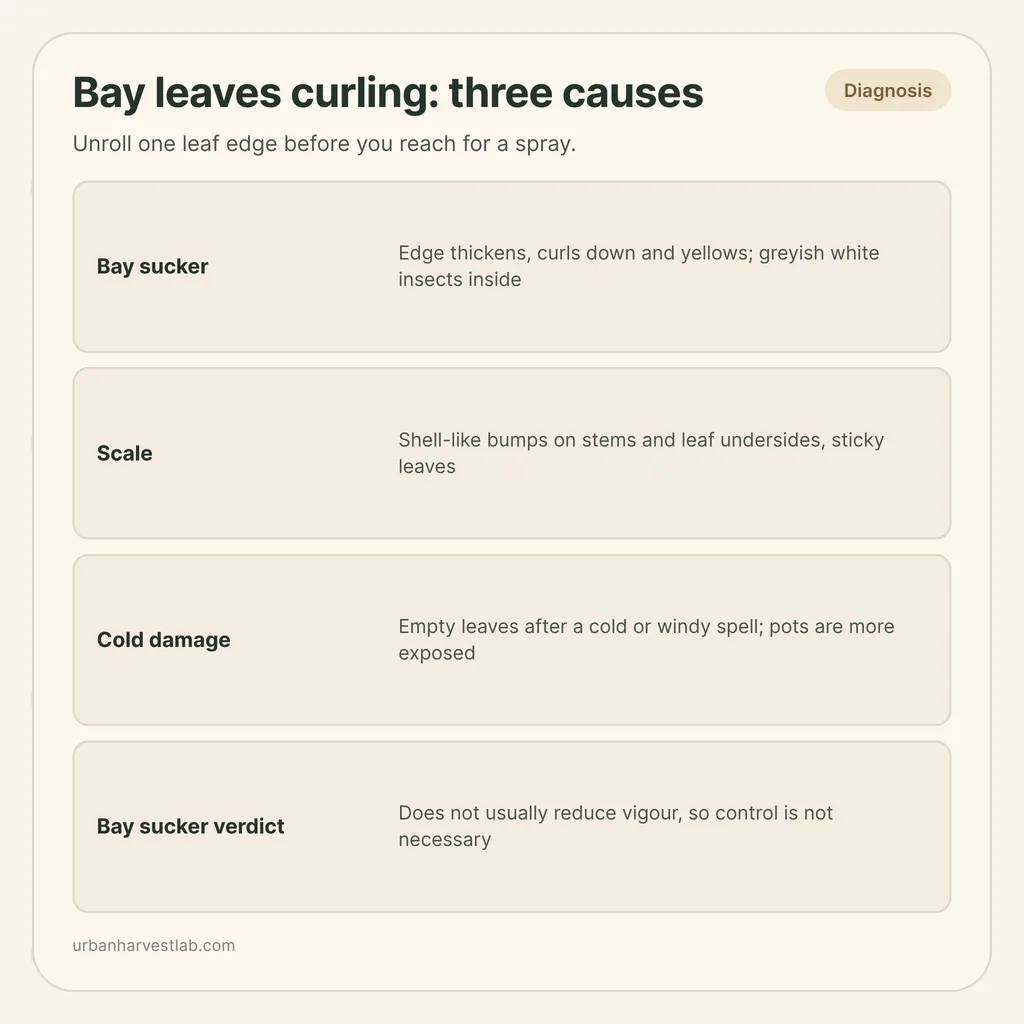
Curled, thickened, yellowing edges on bay leaves are almost always bay sucker, a small sap-feeding insect that the RHS says does not usually reduce the vigour of the plant. Unroll one leaf edge to confirm. If it is empty and the stems carry bumps instead, you are looking at scale, and if the damage followed a cold snap, you are looking at weather.
The whole job is telling those three apart before you reach for scissors or a spray. For growing care in general, see how to grow bay laurel in a pot.
Unroll one leaf first
The RHS describes the signs of bay sucker as leaves that thicken, curl downward at the margins and turn yellow, often with only half of the leaf affected. The yellowed area later dries up and turns brown.
Open the roll gently. The RHS says small greyish white insects may be seen underneath or near the curled edge, and that the nymphs usually produce a white waxy material. Its biology notes describe the nymphs as grey, flattened and wingless, with bodies covered in a white fluffy material. Finding that fluff and those flat grey nymphs settles the question.
The calendar helps too. The RHS lists May to October as the period when bay sucker is most active. Winged adults, which it gives as greenish brown and about 2 mm long, overwinter in sheltered places and emerge in April to May. They start feeding, the leaf margins begin curling over, and eggs are laid under the curling edge. The RHS counts two or three overlapping generations between May and September, so new curls can keep appearing through the summer.
Why you can usually leave it alone
This is the part that surprises people. The RHS says bay sucker can affect the appearance of bay but does not usually reduce its vigour, so control is not necessary. It also says the long-term health of the plant is usually unaffected, and that natural enemies such as birds, ladybirds, wasps and ground beetles help keep damage to a minimum.
What about the ugly leaves? The RHS says distorted leaves can be removed if necessary, but that this may cause more damage than the insect does. The RHS does not describe curled leaves flattening out again, so judge the plant by its new growth. Pruning and general care are covered in the bay laurel guide.
There is no spray recommendation here, and none is needed on the basis of what the RHS says. Bay is an edible herb, so reaching for a pesticide for a cosmetic problem is a poor trade.
If the leaf is not rolled: look for scale
Scale looks different. The RHS lists scales or shell-like bumps on plant stems and the underside of leaves as the symptom. Some species excrete honeydew, which settles on the upper surface of leaves and can be colonised by a black, non-parasitic fungus called sooty mould. University of Wisconsin-Madison Extension says bay has few pests, but scale can be a problem, particularly indoors, and that the bump-like insects occur on both leaves and woody parts.
So the test is simple: curl with insects inside the roll is sucker, and bumps on the stem with sticky leaves is scale. The scale insect guide for rosemary and other woody herbs covers what to do, and the sticky leaves guide helps when the stickiness is all you can see. The RHS’s own first suggestion for scale is to tolerate it where possible, because well-tended plants can cope with light populations, and it notes that removing adults and egg masses may not reduce large populations.
If nothing is living there: think cold
Bay is hardy, but a pot is more exposed than open ground. The RHS says bay can withstand temperatures down to -5°C (23°F), but that frost and cold winter winds can damage the foliage. It adds that harsh frosts and cold winds can kill some or all of the top growth, and that plants in containers are particularly vulnerable to winter cold and damp. In the ground, it says, cold or wind damage to the current season’s growth can be pruned out in the spring.
Three clues point to weather rather than insects:
- The damage appeared after a cold or windy spell, not gradually through summer.
- The leaves are empty when you open or inspect them, with no white fluff and no bumps on the stems.
The timing is an inference from the RHS account, not a test the RHS describes, so combine it with the empty-leaf check. For deciding what is dead and what to cut, see frost-damaged container plants.
Yellow or spotted but not curled
Leaves that are spotted or yellow without a rolled edge are a different problem. The RHS says spotted or yellowing leaves may indicate that the roots are too damp or that a containerised plant needs repotting. Check the drainage holes and how tight the roots are before you suspect an insect.
Sources
Keep your bay healthy
Growing care for bay in a pot, plus the guides for the other things that mark its leaves.
Common questions
Why are the edges of my bay leaves curling and turning yellow?
The usual cause is bay sucker. The RHS describes bay leaves that thicken, curl downward at the margins and turn yellow, often with only half of the leaf affected, and says the nymphs feeding in the curl are responsible. Unroll one edge to look for small greyish white insects.
Do I need to treat bay sucker?
The RHS says bay sucker can affect the appearance of bay but does not usually reduce its vigour, so control is not necessary, and that the long term health of the plant is usually unaffected. It adds that natural enemies such as birds, ladybirds, wasps and ground beetles help keep damage down.
Should I pick off the curled leaves?
The RHS says distorted leaves can be removed if necessary, but that doing so may cause more damage than the insect. Picking them mainly improves looks, and the damaged parts dry up and turn brown regardless.
How do I tell bay sucker from scale?
Bay sucker rolls the leaf edge and hides small greyish white insects inside the curl. The RHS describes scale as shell-like bumps on stems and the underside of leaves, sometimes with sticky honeydew and black sooty mould on the leaf above.
Related guides
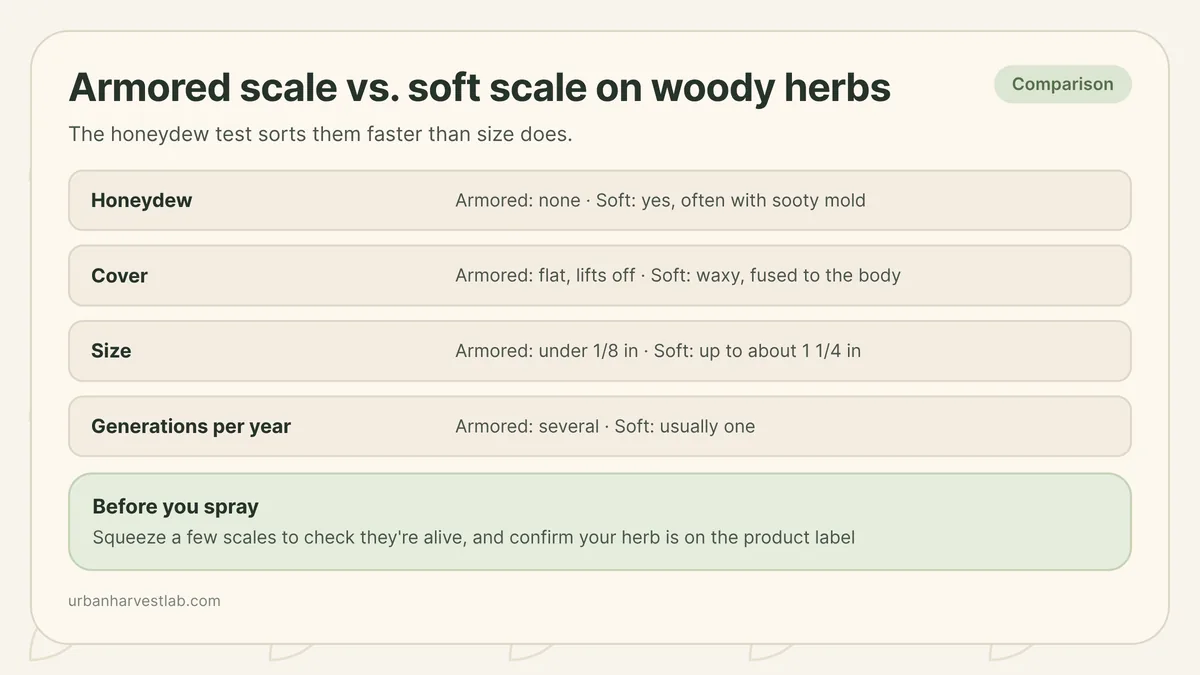
Scale insects on rosemary and other woody herbs
Scale on a woody herb often goes unnoticed until the leaves turn sticky or a stem starts to die back, and the right treatment depends on which kind of scale you have.
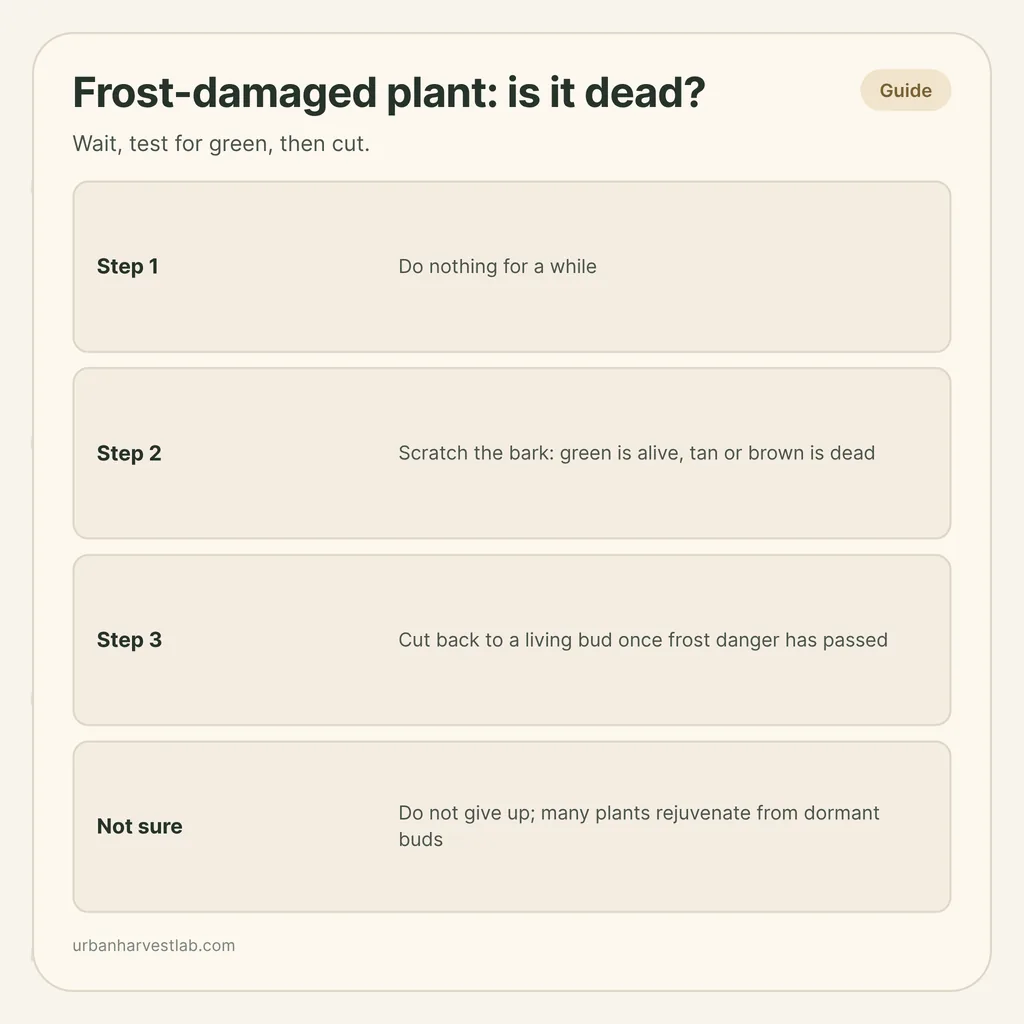
Frost-damaged container plants: is it dead, and what to cut
The morning after a frost, a potted plant can look finished and still regrow. Here is how to check, when to cut, and when to give up.
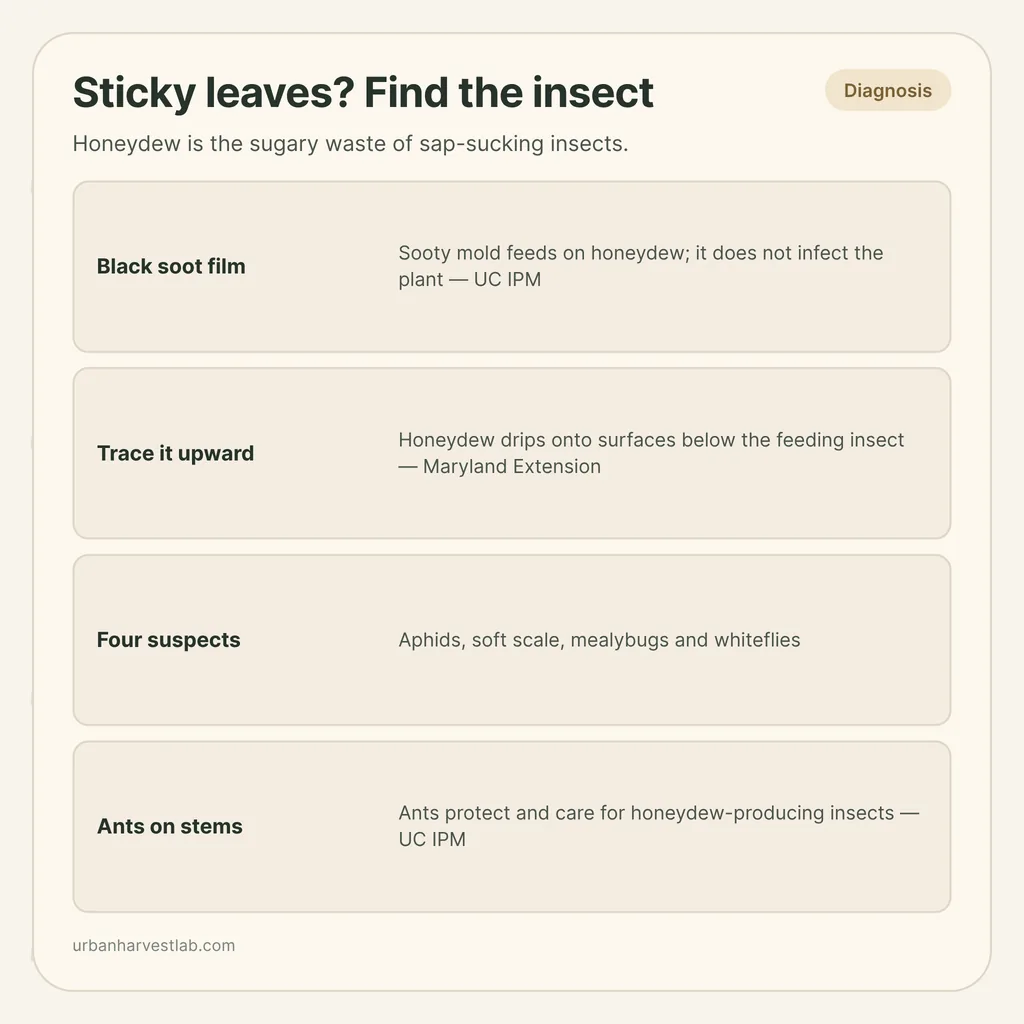
Sticky leaves on plants: finding the insect behind the honeydew
Tacky leaves, a glossy film, or a black soot-like coating all point to honeydew. Here is how to trace it to aphids, soft scale, mealybugs or whiteflies.