Troubleshoot the system before you change the inputs.
Symptoms
- Fuzzy grey-brown mold on dying or damaged leaves, stems, or flowers.
- Small black flecks (sclerotia) on older infected material.
- Soft, water-soaked tissue near the mold, often where a leaf touches soil or another leaf.
Possible causes
- Spores landed on a wound, a spent flower, or tissue already stressed or dying.
- Crowded foliage held humid, still air around the plant for long periods.
- Overhead watering kept leaf surfaces and the canopy interior wet.
Quick fixes
- Remove and bag affected material rather than shaking or brushing it loose.
- Space pots and prune the canopy so air moves through it.
- Water the soil, not the foliage, and let the leaf surface dry between waterings.
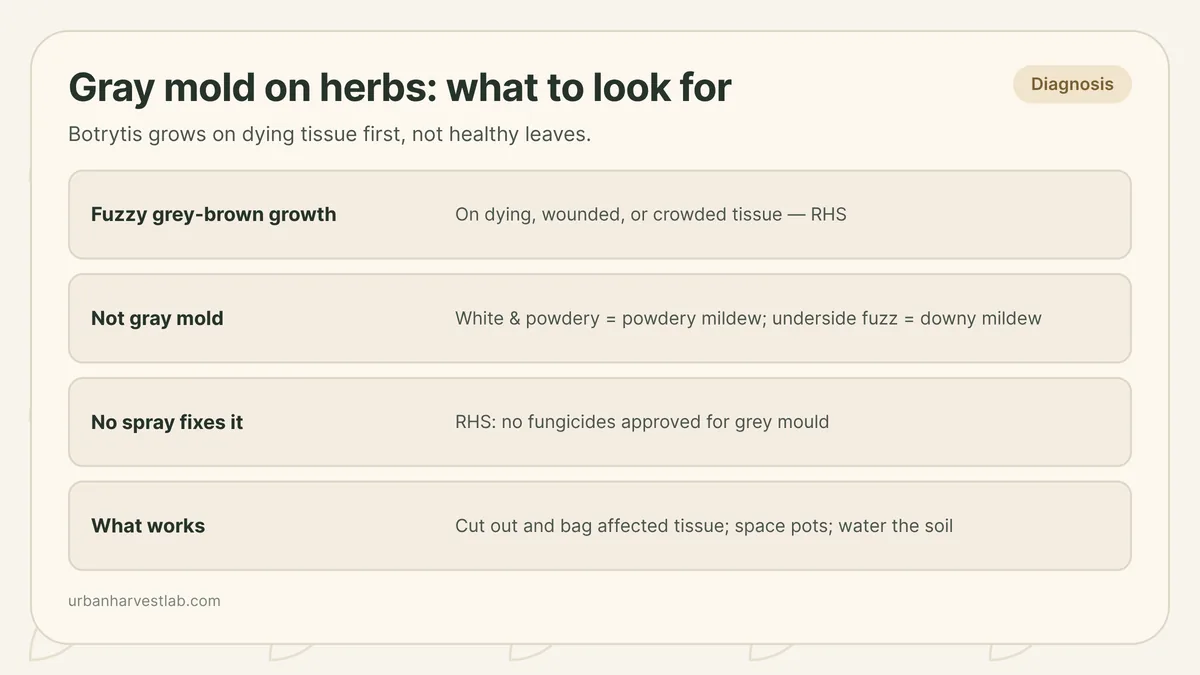
Gray mold on herbs is fuzzy grey-brown growth, called Botrytis or grey mould, that spreads across dying, damaged, or crowded tissue rather than healthy leaves. It thrives in humid, still air, and the fix is removing the affected material and opening up the space around the plant, not spraying a fungicide.
Start with the general potted herb diagnosis if you are not sure gray mold is what you are looking at. Yellowing, wilting, and weak growth have several causes, and gray mold is only one of them.
Where gray mold actually starts
The RHS describes grey mould as “fuzzy grey-brown mould” that “grows on decaying buds, leaves, flowers or fruit” under humid conditions, with small black sclerotia forming on infected material over time. It typically enters through a wound or stressed tissue, but the RHS is clear that it “will infect healthy plants as well, especially under humid conditions” once established nearby.
Look at where the growth starts before anything else: a spent flower, a bruised stem, a leaf pressed against wet soil, or a cutting left in a humid tray are the usual entry points, not the middle of an intact healthy leaf. Fuzzy growth on the potting-mix surface itself, rather than on plant tissue, is a different and mostly harmless thing — usually saprophytic soil fungus, which white mold on plant soil covers on its own.
Gray mold, powdery mildew, or downy mildew?
Three different fungal problems on herb leaves get lumped together as “fuzzy” or “moldy,” and the fix is not the same for any two of them. Botrytis is grey-brown and fuzzy, with a soft, collapsing feel to the tissue underneath, and it sits on dying, wounded, or crowded tissue rather than the middle of a healthy leaf. Powdery mildew is a dry, powdery white coating across otherwise normal, living leaves — powdery mildew on container herbs covers it in detail, including why it does not need free water on the leaf to establish. Downy mildew looks different again: Clemson Cooperative Extension and Penn State Extension both describe a purplish-gray to gray, downy growth specifically on the underside of the leaf, usually under a matching yellow patch bounded by the leaf veins on top — basil downy mildew covers identifying and managing it.
So the quick sort is: fuzzy on dying or wounded tissue, anywhere on the plant, is Botrytis; dry and powdery on living leaf tops is powdery mildew; gray fuzz specifically on the leaf underside, paired with yellowing on top, is downy mildew.
The crowded, humid pocket that lets it spread
Dense pots of basil, mint, or other leafy herbs create exactly the conditions grey mould favors: many leaves close together, little air movement between them, and a humid pocket that does not clear between waterings. Add a spent flower stalk, a leaf that got knocked and bruised, or a cutting sitting in a shared tray, and there is tissue already weakened enough for spores to establish.
Overhead watering compounds the problem: it wets foliage directly, and crowded leaves then block the airflow that would otherwise dry the canopy interior back out. Root and crown tissue is not immune either — Clemson Cooperative Extension names Rhizoctonia, Pythium, Botrytis, and Phytophthora together as the fungi behind houseplant root and stem decay, and the same crowding-and-overwatering pattern that invites gray mold on leaves is what keeps that root zone wet at the base. The general potted herb guide covers root and crown symptoms directly, so correcting airflow and watering habit pays off beyond this one disease.
Cut it out and bag it
Cut out affected material before doing anything else. Use clean scissors or shears, take the cut back into tissue that looks healthy, and bag the removed material as you go rather than dropping it loose in the pot or carrying it past other plants. The small black sclerotia the RHS describes on infected tissue are a resting stage of the fungus, and shaking affected leaves releases spores into the air around your other pots.
Clear fallen leaves and spent flowers from the soil surface at the same time. They are the softest, most vulnerable tissue on the plant and a common starting point for a new infection, so they should not stay in the pot once they have dropped.
Do not strip a plant bare trying to remove every trace. If more than a small portion of a cheap annual herb is affected, replacing it is usually more sensible than keeping a heavily infected plant beside healthy ones while you try to save it leaf by leaf.
Break up the humid pocket
Space pots so leaves are not touching their neighbors — on a crowded windowsill or shelf, this alone often does more than any product would, because it is the still, humid pocket between touching leaves that the fungus actually needs. Prune to open the plant’s interior rather than only trimming the outer edge; a dense clump of stems traps damp air at the center even if the outside of the plant looks open enough already.
A small fan run for part of the day, or cracked windows in mild weather, moves that trapped air out without the leaf-drying stress of a jet aimed continuously at one plant. If growth also looks soft and stretched rather than just crowded, weak light is adding to the problem in the same shape — more leaf tissue packed into less space — and how much light herbs need covers correcting that side of it.
Get water off the leaves, not just off the schedule
Water the soil directly and avoid wetting the foliage, especially late in the day when leaves have less time to dry before conditions cool and humidity rises overnight. How often to water potted herbs covers the underlying schedule; the change specific to gray mold is where the water lands, not how often it is applied. A pot whose surface stays damp for days at a time is holding exactly the humid microclimate that lets grey mould persist between one wave of removal and the next.
No spray fixes this
In the UK, the RHS states that no fungicides are approved for gardeners to use against grey mould, so control there relies entirely on removing infected material and improving spacing and airflow. That approvals detail varies by country, but the rule that actually travels does not: a product may only be applied if its label names both your crop and this disease. Do not substitute a product intended for a different disease, and do not treat a “natural” label as a reason to skip checking whether it is even labeled for that use — an edible herb makes an unlabeled application a real problem, not a shortcut.
Keep the next outbreak from starting
Give new plants space from the start rather than crowding a full tray or windowsill and thinning it out later. Remove spent flowers and fading leaves as routine maintenance, not only after mold appears, since that soft tissue is the most common entry point.
Keep a consistent watering routine that lets the topsoil and canopy dry between sessions, and avoid letting cuttings sit in a shared humid tray longer than necessary. Clean pots, trays, and tools between plants, particularly after handling anything that had visible mold.
Common mistakes
- Treating any fuzzy or discolored patch as gray mold without checking whether it started on dying tissue.
- Confusing it with powdery mildew and reaching for the wrong prevention advice.
- Shaking or brushing off affected leaves instead of cutting and bagging them.
- Increasing airflow around one plant while leaving its own foliage tightly crowded.
- Watering overhead out of habit after the source of infection has already been removed.
- Assuming a product exists to spray, rather than adjusting spacing and watering.
Sources
Correct the conditions before you treat anything
Airflow, spacing, and watering habit decide whether gray mold returns; check these first.
Common questions
What is gray mold on herbs?
It is a fungal disease, commonly called Botrytis or grey mould, that produces fuzzy grey-brown growth on decaying or wounded plant tissue and can spread onto nearby healthy growth under humid, still conditions.
Is there a fungicide for gray mold on herbs?
In the UK, the RHS states that no fungicides are approved for amateur gardeners to use against grey mould. Approvals vary by country, but the rule that travels everywhere is that a product may only be used if its label names both your crop and this disease, so control on herbs relies mainly on removing infected material and improving spacing and airflow.
Is gray mold the same as powdery mildew?
No. Gray mold is grey-brown and fuzzy, starts on dying or damaged tissue, and favors humid, still conditions. Powdery mildew is white and powdery, spreads across otherwise healthy leaves, and does not need free water on the leaf surface to infect.
Is gray mold the same as downy mildew on basil?
No. Gray mold is grey-brown, fuzzy, and sits on dying or wounded tissue anywhere on the plant. Downy mildew shows as a gray to purplish-gray downy growth specifically on the underside of the leaf, usually under a yellow patch bounded by the leaf veins on top, per Clemson Cooperative Extension and Penn State Extension. Basil downy mildew covers identifying and managing it separately.
Can I still eat herbs from a plant with gray mold?
Discard visibly moldy or degraded leaves and any tissue touching them. Sources covering grey mould address plant management, not the edibility of nearby harvest, so treat visibly affected material as waste rather than something to wash and use.
Related guides
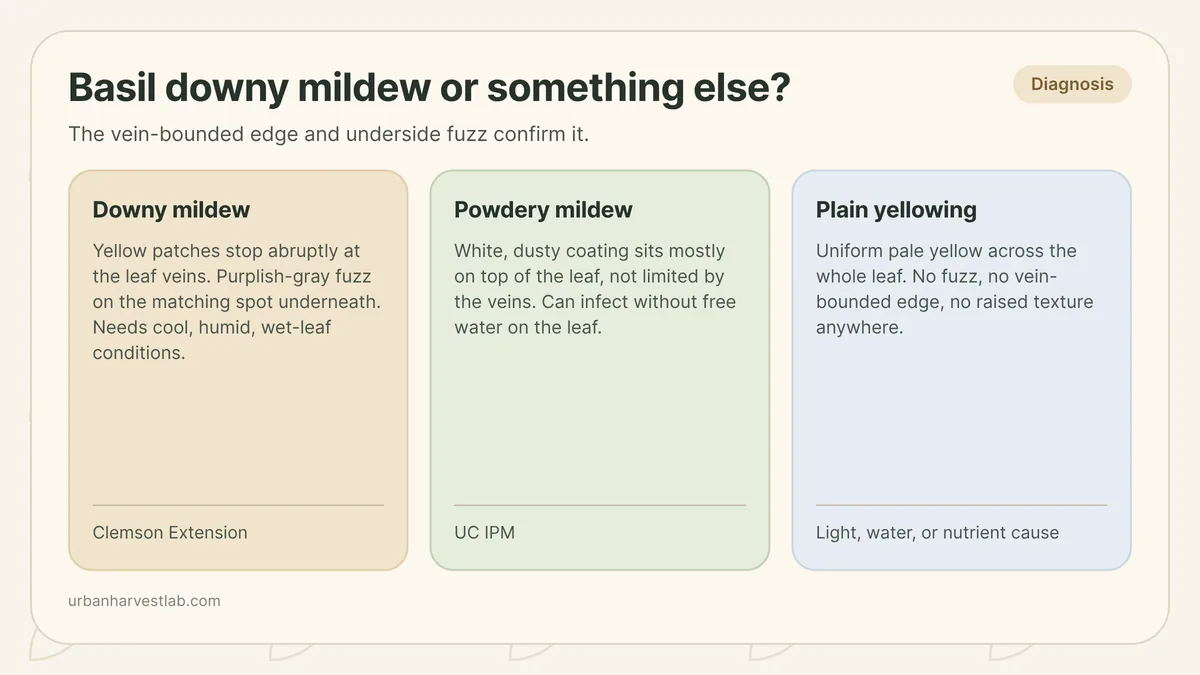
Basil downy mildew: reading the vein-bounded yellowing
Vein-bounded yellowing on top with purplish-gray fuzz underneath means downy mildew, not a feeding problem and not powdery mildew.
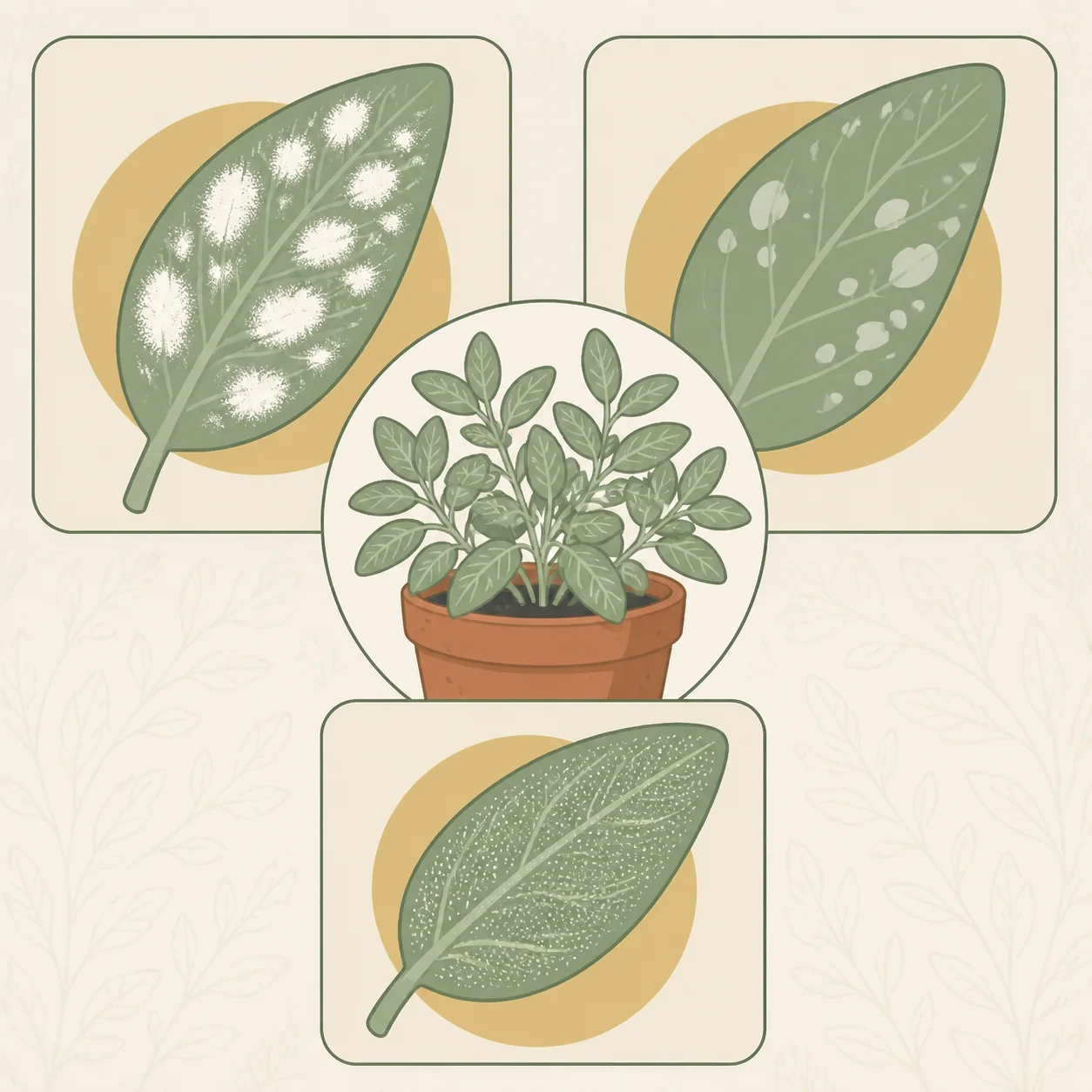
Powdery mildew on container herbs: diagnosis and control
A white mark is not automatically mildew. Confirm whether patches recur and spread on living tissue before changing the entire care routine.
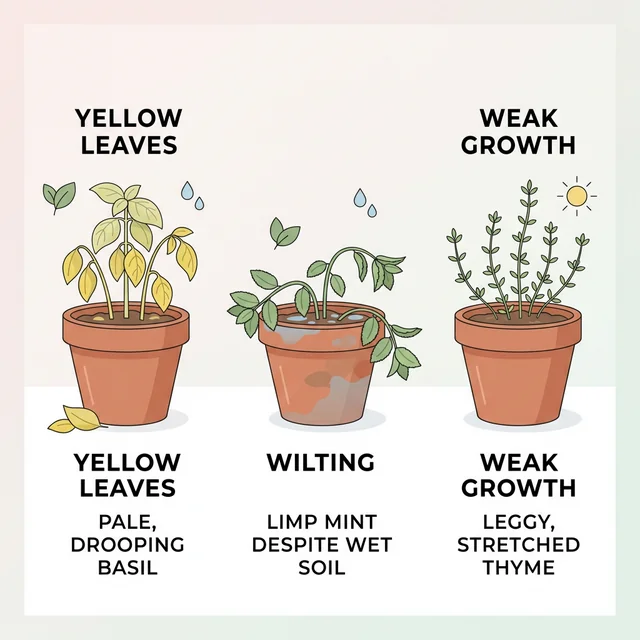
Common potted herb problems: yellow leaves, wilting, and weak growth
Common potted herb problems usually show up as yellow leaves, wilting, or weak growth, but the useful diagnosis starts with light, drainage, and root stress.