Troubleshoot the system before you change the inputs.
Symptoms
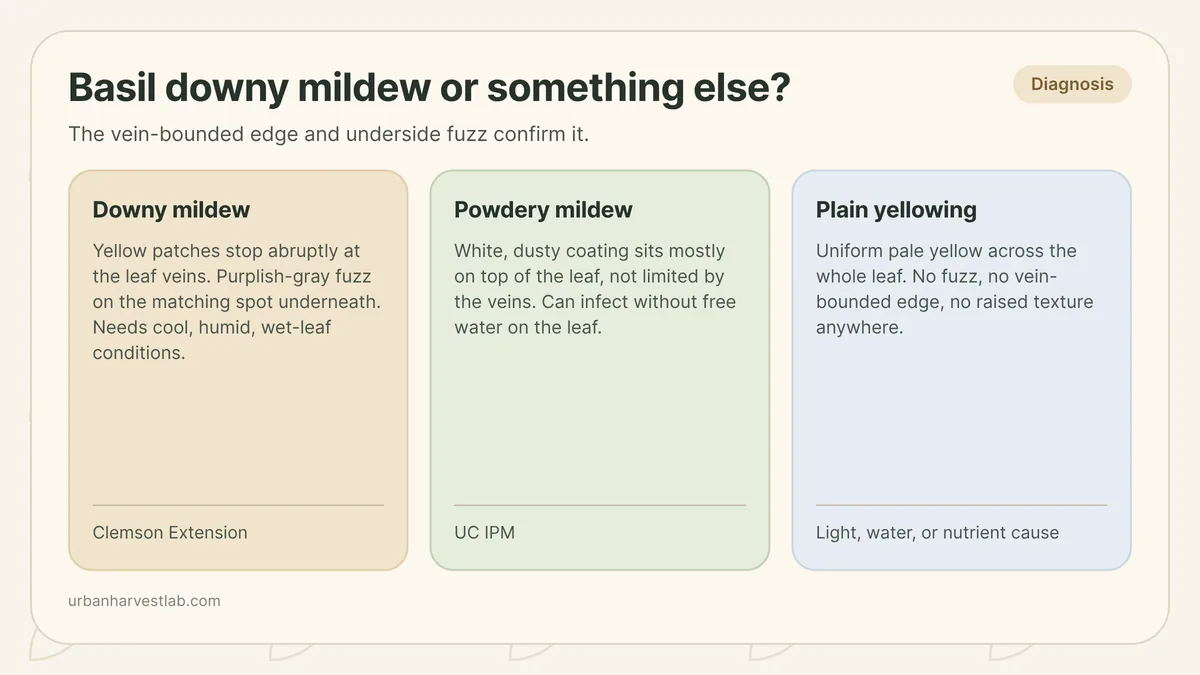
- Yellow patches on the top of the leaf that stop at the major veins instead of fading smoothly.
- Purplish-gray fuzzy growth on the underside, directly beneath each yellowed patch.
- Symptoms appear first on sweet basil grown in cool, humid, still air with wet foliage.
Possible causes
- An airborne pathogen established under low temperatures, high humidity, and free moisture on the leaf surface.
- Overhead watering or crowded spacing kept leaves wet and air still long enough for the pathogen to spread.
- A highly susceptible sweet basil variety was grown without the airflow or spacing that limits infection.
Quick fixes
- Turn the leaf over and check for purplish-gray fuzz before assuming the yellowing is a feeding problem.
- Water at the base, space plants further apart, and improve air movement around the canopy.
- Switch to a less susceptible basil type, such as Thai or lemon basil, or a resistant cultivar, for the next planting.
Basil leaf problems, quick differentiation
| Pattern | Confirming sign | Likely cause |
|---|---|---|
| Yellow patches boxed in by leaf veins on top | Purplish-gray fuzz on the matching spot underneath | Downy mildew |
| White or gray dusty coating, not vein-bounded | Coating sits mostly on top, partly wipes off then returns | Powdery mildew |
| Flat white or bleached patch, or silvery stippling | No fuzz underneath; check instead for frass or a change in light exposure | Sunscald or thrips |
| Uniform pale yellowing across whole older leaves | No fuzz, no powder, no vein-bounded edge | Light, watering, or nutrient issue |
Yellow patches on basil that stop abruptly at the leaf veins, with a purplish-gray fuzz on the matching spot underneath, are basil downy mildew, not a feeding problem and not powdery mildew. The vein-bounded edge is what separates it from ordinary yellowing, and the underside fuzz is what separates it from powdery mildew’s white, dusty coating.
If the yellowing on your basil does not follow that pattern, run through light, watering, and nutrient causes in the potted herb diagnosis guide before treating it as disease.
The tell is the vein-bounded edge, not the yellow itself
Plain yellowing on basil gets blamed on hunger more than anything else, but Clemson Extension’s basil factsheet describes downy mildew’s first symptom precisely: “slight yellowing of the foliage, with a spread that is limited by the major leaf veins.” Ordinary nitrogen shortage looks different — UC IPM describes it as uniformly pale green to yellowish across the whole leaf, with no such boundary. An angular, blocky yellow patch that stops at the vein lines is the shape to look for on basil, not a smooth, even fade.
Confirm it on the underside
Turn the leaf over. Clemson states that “sporulation occurs on the lower leaf surfaces that correspond to the yellowed areas above. The spores are purplish-gray.” Penn State Extension describes the same sign as “a gray downy growth on the undersides,” and notes that the disease travels through the air rather than surviving in the soil. That fuzzy underside patch, lined up directly beneath the yellow spot on top, is the confirmation step. A plant that is simply underfed or underlit shows no such growth on either surface. If the fuzz is faint, check under bright, indirect light with a hand lens.
Why it is not powdery mildew
Powdery mildew and downy mildew get confused constantly, but UC IPM lays out the two organisms as near-opposites. Powdery mildew “can germinate and infect without water on the plant’s surface” and favors “moderate temperatures of 60° to 80°F and shady conditions.” Downy mildew needs “low temperatures of 50° to 70°F, a relative humidity of 90% or higher, and free moisture”; its spores “grow on branched stalks and look like tiny trees” under magnification, and it shows up “mostly on lower leaf surfaces.”
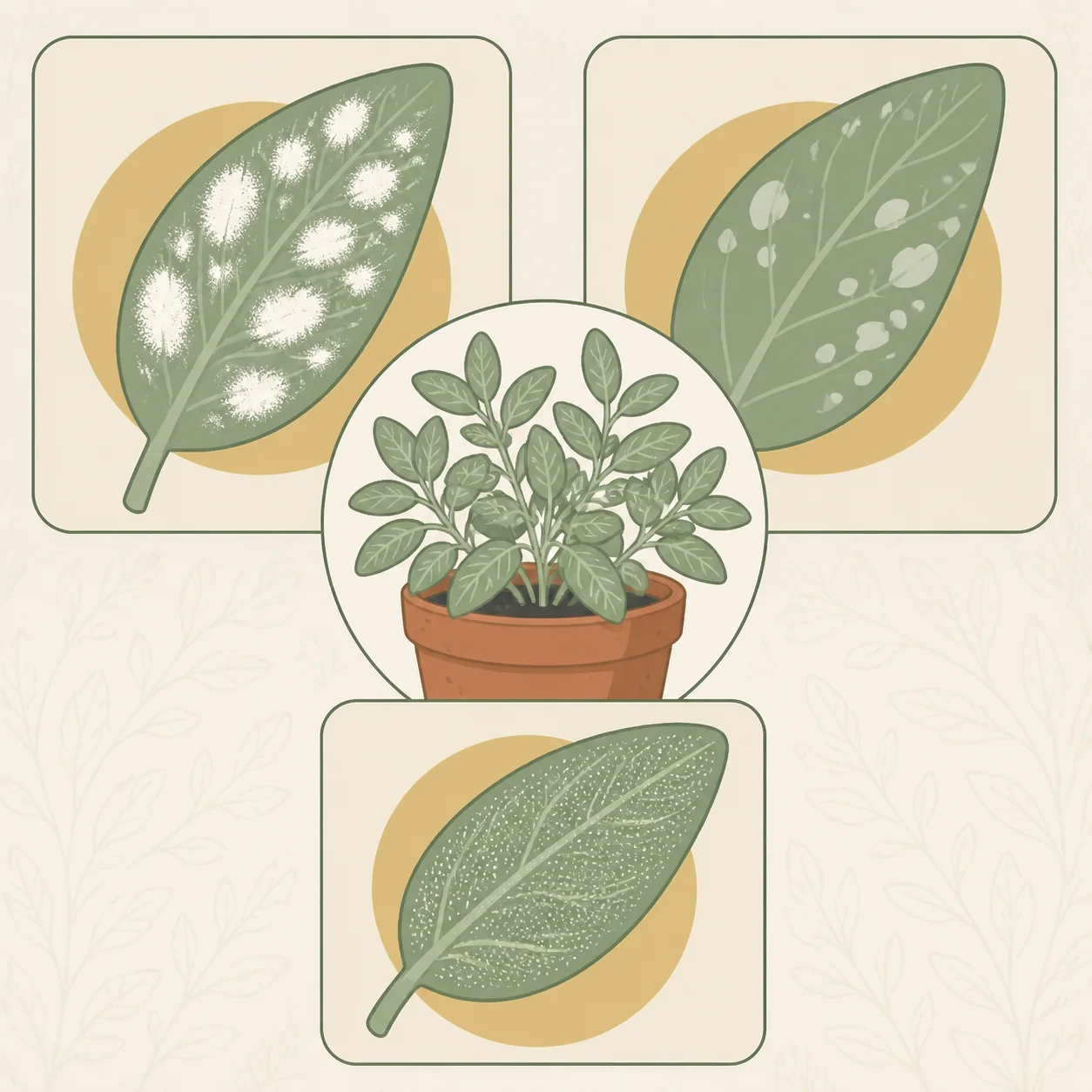
In practice, a white, dusty coating that sits mainly on top of the leaf and is not limited by the veins is powdery mildew; the full diagnosis and control sequence is in powdery mildew on container herbs. A yellow, vein-bounded patch with purplish-gray fuzz underneath is downy mildew.
Why it is not a white spot, sunscald, or thrips
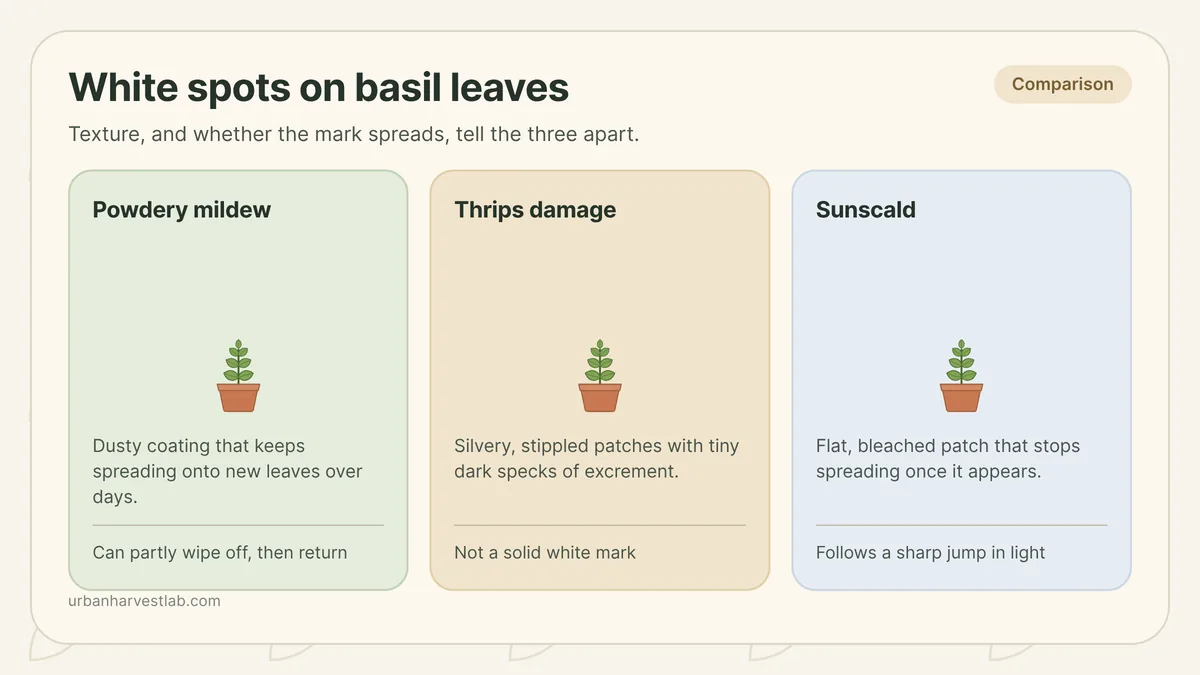
None of the causes behind white spots on basil produce a yellow field bounded by veins. A dusty coating, a flat bleached patch, and silvery stippling with dark flecks of excrement are pale or white marks on otherwise green tissue, not yellowing. If your basil shows a white or silvery mark instead of a yellow patch, work through white spots on basil leaves instead. The growth downy mildew produces is on the leaf underside and purplish-gray in Clemson’s description, not a white dusty coating on top.
Why it is not a general nutrient or light problem
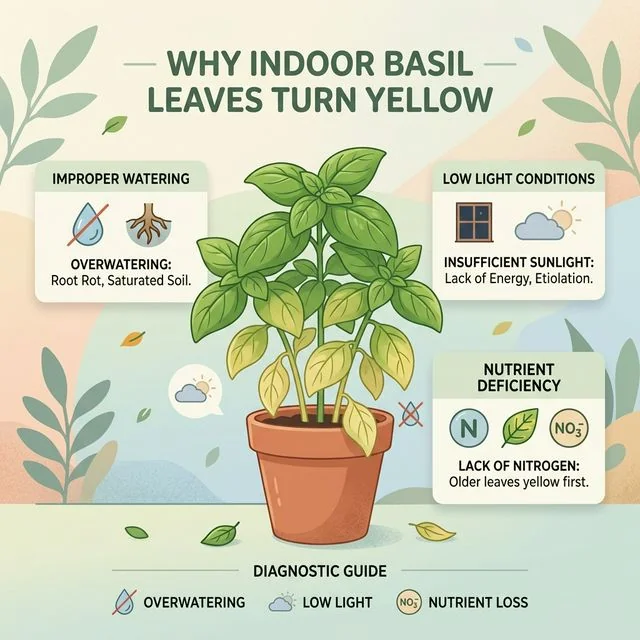
General yellow-basil troubleshooting starts with light, watering, and feeding, in that order, and that is the right sequence for basil fading evenly or from the bottom up — see why basil leaves turn yellow indoors. Downy mildew does not follow that sequence. The yellowing shows up in vein-bounded patches, often on upper leaves as much as lower ones, and no amount of feeding, brighter light, or drier soil clears the fuzz on the underside. Check the underside before changing the fertilizer routine.
Susceptibility depends on which basil you are growing
Penn State Extension is specific about which basil is at risk: sweet basil varieties are highly susceptible, while Thai, lemon, lime, purple, and spicy basil are less susceptible. Clemson names three cultivars bred for resistance: Prospera, Rutgers Devotion, and Rutgers Obsession. If sweet basil keeps developing the same vein-bounded yellowing season after season in the same spot, switching the variety is a more durable fix than repeating the same care routine with a different product. Container growers who buy transplants rather than raising basil from seed have less control over which type they start with, so checking the plant tag or asking which basil it is becomes part of prevention rather than an afterthought.
Cut off the conditions that let it establish
Penn State’s cultural guidance for limiting the disease is airflow, sunlight, and avoiding overhead watering, because leaf wetness and humidity are what drive it. Space plants so leaves dry between waterings, and water at the base rather than the canopy — see how often to water potted herbs for the base routine. Field spacing figures for basil disagree by institution: Penn State Extension spaces plants 10 to 12 inches apart, Clemson 2 feet between plants. Neither is a container figure, but both point the same direction — give the canopy more room than a crowded windowsill tray usually allows; herb pot size guide covers spacing for potted basil specifically. Watering in the morning rather than the evening also matters, because it gives wet foliage more hours to dry before the cooler night air that favors the disease sets in.
Because Penn State notes that the pathogen spreads through the air rather than surviving in the soil, starting over in the same pot with better spacing and drier foliage is reasonable. The risk sitting behind a repeat infection is airborne humidity and crowding, not the growing medium itself.
Track whether it is spreading
Mark two or three yellowed leaves with a small tag or a dated photograph, and note a nearby leaf that still looks clean. Downy mildew keeps producing new vein-bounded patches and fresh fuzz on the underside as it spreads, so a plant that is genuinely active keeps producing new patches and fresh fuzz on leaves that were clean when you tagged them; leaves that stay exactly as they were, with nothing new nearby, point at a past episode rather than a spreading one. Judge the plant by what the new growth does, not by whether the already-yellowed leaves turn green again — damaged tissue stays damaged whatever the cause.
Common mistakes
- Fertilizing a plant with vein-bounded yellow patches instead of turning the leaf over first.
- Judging recovery by whether already-yellowed leaves turn green again, rather than by what the new growth does.
- Watering overhead in the evening, which keeps leaves wet through the cool night hours the disease favors.
- Reaching for a powdery mildew material (sulfur, horticultural oil, potassium bicarbonate) expecting it to help — UC IPM lists those for powdery mildew fungi specifically, and the extension sources here give cultural control for basil downy mildew rather than a spray.
- Replanting the same susceptible sweet basil variety in the same crowded, shaded spot without changing spacing or airflow.
When it is a signal to start over
For a fast, cheap annual like sweet basil, heavy vein-bounded yellowing across most of the canopy, with fuzz still spreading to new leaves, is usually a signal to start over rather than nurse the plant through a full cycle. Remove affected leaves into a bag rather than carrying them past other plants, since the disease is airborne. A light infection on a plant worth keeping is a different call than a badly yellowed one you were already planning to replace. Start the next planting with a less susceptible variety, wider spacing, and base watering from day one.
Sources
Rule out the look-alikes first
Confirm the vein-bounded pattern, then check what it is not before you change your care routine.
Common questions
What does basil downy mildew look like?
Yellow patches on the top of the leaf that stop where the major veins run, giving an angular, blocky look rather than a smooth fade. The underside of the same spot develops a purplish-gray fuzzy growth, which is the confirming sign.
Is basil downy mildew the same as powdery mildew?
No. Powdery mildew is a white, dusty coating that sits mostly on top of the leaf and is not limited by the veins. Downy mildew is yellow on top, fuzzy and purplish-gray on the underside, and needs cooler, more humid conditions with wet leaves to establish.
Can I fix basil downy mildew by fertilizing?
No. The first symptom looks like plain yellowing, so feeding is the common reaction, but the cause is an airborne pathogen, not a nutrient shortage. Check the underside for fuzzy growth before changing your fertilizer routine.
Is basil safe to eat if it has downy mildew?
Extension sources describe how to manage the disease but do not address whether affected leaves are safe to eat. Discard visibly yellowed or fuzz-covered leaves and judge the remaining harvest on its own condition.
Related guides
White spots on basil leaves: mildew, thrips, or sunscald
White spots on basil usually come from one of three different causes, and a hand lens plus a few days of watching tells you which.
Powdery mildew on container herbs: diagnosis and control
A white mark is not automatically mildew. Confirm whether patches recur and spread on living tissue before changing the entire care routine.
Why are basil leaves turning yellow indoors?
Yellow basil rarely has a single universal cause. The pattern of yellowing, the growing medium, and the recent care routine usually tell the story.