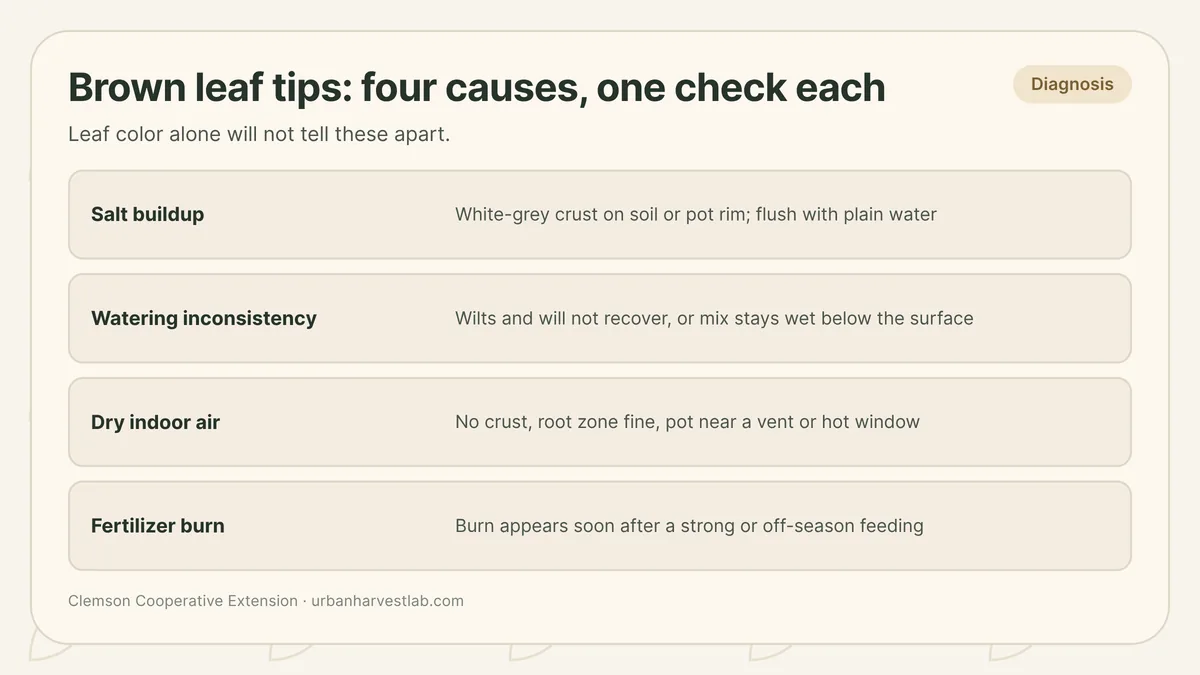
Troubleshoot the system before you change the inputs.
Symptoms
- Leaf tips and margins turn brown, dry, and papery while the rest of the blade stays green.
- A white to grey crust forms on the soil surface, the pot rim, or around the drainage hole.
- The burn follows soon after a feeding, or shows up gradually with no clear trigger.
Possible causes
- Mineral salt from fertilizer and tap water has built up in the potting mix.
- The root zone has swung between too dry and too wet, or root damage is limiting water uptake.
- The air around the plant is hot and dry, often near a heating vent or a sunny window in winter.
- A recent feeding was too strong, too frequent, or applied during winter dormancy.
Quick fixes
- Check the soil surface and pot rim for a crust before touching the fertilizer schedule.
- Push a finger into the mix to the first knuckle to judge real root-zone moisture.
- Move the pot away from heating vents and direct hot drafts.
- Flush the pot with plain water and hold off feeding until the schedule matches the season.
Brown tip discriminators, cause by cause
| Cause | Field discriminator | What to check first |
|---|---|---|
| Salt buildup | White to grey crust on the soil surface or pot rim; no single feeding you can point to as the trigger | Scrape the crust, then flush with plain water |
| Watering inconsistency | Wilts and does not recover after watering, or the mix stays wet below the surface | Finger-test the root zone before adding water or fertilizer |
| Dry indoor air | No crust, root zone tests fine, pot sits near a vent or a hot window | Move the pot away from the heat source |
| Fertilizer burn | Burn appears soon after a feeding, often a full-strength or off-season one | Check the last feeding date against label rate and season |
Brown, papery tips on a potted herb usually trace to one of four causes: mineral salt buildup, an inconsistent watering routine, hot dry air, or a recent overfeeding. None of them look different enough at a glance to diagnose from color alone, so the useful step is checking the soil surface, the root zone, and your feeding calendar in that order.
Clemson Cooperative Extension’s own list of causes behind houseplant tip and margin burn covers exposure to hot, dry air, improper watering, insect feeding, and salt accumulation, and treats none of them as diagnostic on its own. That last point matters more than it sounds: a reader who fixes the wrong one usually watches the tips keep browning while the plant does something else entirely, which is the same trap covered in more general terms in common potted herb problems. Clemson’s tip-burn list gives three of the four causes covered here — hot dry air, improper watering, and salt accumulation — and the fourth, a recent overfeeding, comes from Clemson’s separate overfertilizing guidance.
Check the soil surface and the pot rim first
Salt buildup is caused by dissolved minerals from fertilizer and tap water that get left behind as the mix dries between waterings, not by anything the plant has eaten or absorbed. Colorado State University Extension’s PlantTalk service names the sources plainly: the potting mix itself, the fertilizer, and water that is high in dissolved minerals, concentrated further when a pot sits in a saucer of standing water that wicks back up.
The mechanism is osmotic, not a change in soil chemistry: dissolved salt in the root zone pulls moisture out of root cells faster than the roots can replace it, and the visible result is wilting, yellowing, and marginal or tip scorch, not a shift in soil pH. The field sign is a white to grey crusty deposit on the soil surface or the rim of the pot, which is a different texture from the fuzzy, filamentous mold that sometimes grows on wet mix and gets mistaken for it.
The fix is leaching. University of Maryland Extension gives the volume: pour at least twice the physical volume of the pot through the mix and let it drain completely, repeated as routine maintenance every four to six months and ideally done before a feeding rather than after. Colorado State’s guidance adds one step first: scrape off any visible crust, then rinse by filling the pot to the top a couple of times, letting it drain fully between each pour. The full walkthrough, including when a flush is not enough and a repot is the better call, is covered in salt buildup in herb pots.
The water itself is worth checking too. Clemson advises against watering containers with softened water, because the process adds sodium and chloride to the mix and can damage the plant. Where tap water is hard, Clemson’s suggestion is rainwater where possible, watering until it runs out of the bottom of the pot, and emptying the saucer afterward rather than letting the pot sit in it and reabsorb what just leached out.
Test the root zone before blaming the watering can
Clemson’s tip-burn list names improper watering on its own, separate from salt, and the direction of the error matters. Chronic underwatering results in wilting, leaf curling, and eventual death, and lower leaves yellow when the mix is allowed to stay too dry for an extended stretch. But a plant that has been sitting wet can burn at the tips too, because root injury of any kind, including rot from too much water, reduces how much water the roots can actually take up regardless of how wet the mix looks on the surface.
The discriminator is not the leaf, it is the root zone. Push a finger into the mix to the first knuckle: dry at the fingertip means the plant needs water, and a definite loss in weight is also a sign the mix has dried out. Unglazed clay pots sound hollow when dry, and the mix itself lightens in color as it loses moisture. The second discriminator is response: a wilted plant that recovers within a few hours of watering was dry, and one that does not recover was not, because the root system itself is compromised rather than thirsty. Rosemary, thyme, and sage are grown in soil that is meant to stay dry between waterings, so a watering-linked burn on those plants points somewhere different than the same symptom on basil or mint, which want more consistent moisture. The wider overlap between wilting from too little water and wilting from too much is worked through in overwatered vs. underwatered.
Rule out hot, dry air near vents and windows
Hot, dry air is on Clemson’s tip-burn list too, and it is easy to miss because it does not leave a mark on the soil the way salt or a bad watering routine does. The pattern to look for is placement rather than a soil symptom: a pot sitting close to a heating vent, a radiator, or a sunny window that runs hot in winter, with the root zone testing fine on the finger test and no crust anywhere on the mix or pot rim.
This cause is easiest to confirm by elimination rather than by a specific number, since Clemson names hot, dry air as a cause without attaching a humidity percentage to it. If the crust test and the root-zone test both come back clean and the burn correlates with a spot near a heat source, moving the pot a few feet away and watching the newest growth over the following weeks is the practical test.
A recent feeding can burn tips before salt ever builds up
Fertilizer burn and salt buildup share the same underlying mechanism, but they run on different timelines. Salt buildup accumulates gradually, from ordinary feeding and ordinary tap water, with no single trigger you can point to. Fertilizer burn is the acute version: a single overly strong dose, feeding too often, or feeding through a season when the plant should be resting.
Clemson’s guidance on overfertilizing gives the acute symptom set directly: reduced growth, brown leaf tips, dropping of lower leaves, and wilting, often alongside the same white film on the soil surface or crust on the pot rim that marks chronic salt buildup. Their recommended schedule is one of three options, not a single rule: full label rate every two to three months, or diluted to roughly one-tenth the recommended rate at every watering, or a full-strength dose every seventh watering. During winter dormancy, the same guidance is to skip fertilizer entirely, since a dormant plant cannot use the extra nutrient and the salt simply accumulates instead. Water-soluble fertilizers are generally preferred over concentrated feeds specifically because a dilute solution reduces the odds of burning the plant in the first place. A newly potted herb’s feeding window, and how to tell if the mix already includes a starter charge, is covered in best fertilizer for herbs in pots.
The practical discriminator against plain salt buildup is timing: fertilizer burn shows up soon after a specific feeding, especially an off-season or full-strength one, where salt buildup creeps in slowly with no single trigger you can point to.
Insects leave a different kind of mark
Insect feeding is on Clemson’s list of tip-burn causes too, and it is worth ruling out even though it is not the focus here, because the fix is completely different from any of the four above. Aphid feeding tends to distort and curl new growth rather than crisp the tips of mature leaves, and spider mite damage shows up as fine pale stippling before any browning appears. Neither leaves a crust on the soil. If the plant also has sticky residue, visible insects, or fine webbing on the undersides of leaves, start with aphids on indoor herbs or spider mites on indoor herbs instead of working through the causes above.
Match the cause to the fix
Work the checks in order: crust on the soil or pot rim first, then a finger test of the root zone, then the plant’s placement relative to heat sources, then the date and strength of the last feeding. Two causes can stack, most often a plant that has been fed on schedule near a hot window with hard tap water, so finding one clear answer does not always rule out the others. Fixing the wrong one first is the most common way this drags on for weeks: a flush solves salt buildup but does nothing for a pot sitting on a radiator, and moving a pot away from a heat vent does not undo a feeding given at double strength.
Sources
- Clemson Cooperative Extension, HGIC — Houseplant Diseases & Disorders
- Clemson Cooperative Extension, HGIC — Indoor Plants: Watering
- Clemson Cooperative Extension, HGIC — Indoor Plants: Cleaning, Fertilizing, Containers & Light Requirements
- Clemson Cooperative Extension, HGIC — Herbs
- Colorado State University Extension, PlantTalk Colorado — Whitish Crust on Potting Mixes
- Colorado State University Extension, PlantTalk Colorado — Leaching Salts From Potting Mixes
- University of Maryland Extension — Watering Indoor Plants
Rule out the neighboring problems
Brown tips overlap with pest damage and feeding routine questions covered in more depth elsewhere.
Common questions
What is the most common cause of brown tips on potted herbs?
Clemson lists four causes and does not rank them — hot dry air, improper watering, insect feeding and salt accumulation all produce the same crisped tip. Check the soil surface and pot rim for a white crust first, then the root zone, then the date of the last feeding.
Does a white crust on my pot mean the same thing as brown leaf tips?
A crust on the soil surface or pot rim is a sign of mineral salt buildup, not mold, and it often shows up before or alongside brown tips rather than instead of them. Scrape it off and flush the pot with plain water rather than waiting for it to resolve on its own.
Should I stop fertilizing if the leaf tips are turning brown?
Pause feeding until you know why the tips are burning. If a feeding happened recently, especially a full-strength one or one given during winter dormancy, hold off until the plant is back on a normal schedule and the pot has been flushed with plain water.
Can dry indoor air alone cause brown leaf tips?
Yes. Hot, dry air near a heating vent or a sunny winter window is one of the four causes Clemson Cooperative Extension lists for tip and margin burn, and it can act on its own even when watering and feeding are both fine.
Related guides
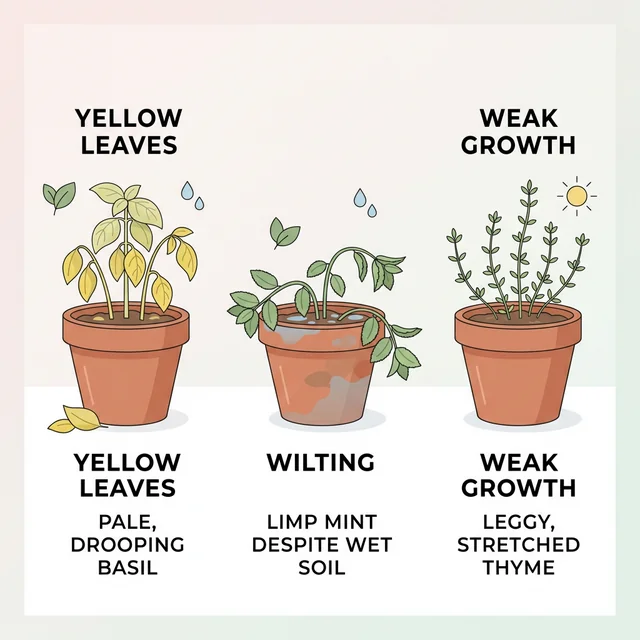
Common potted herb problems: yellow leaves, wilting, and weak growth
Common potted herb problems usually show up as yellow leaves, wilting, or weak growth, but the useful diagnosis starts with light, drainage, and root stress.
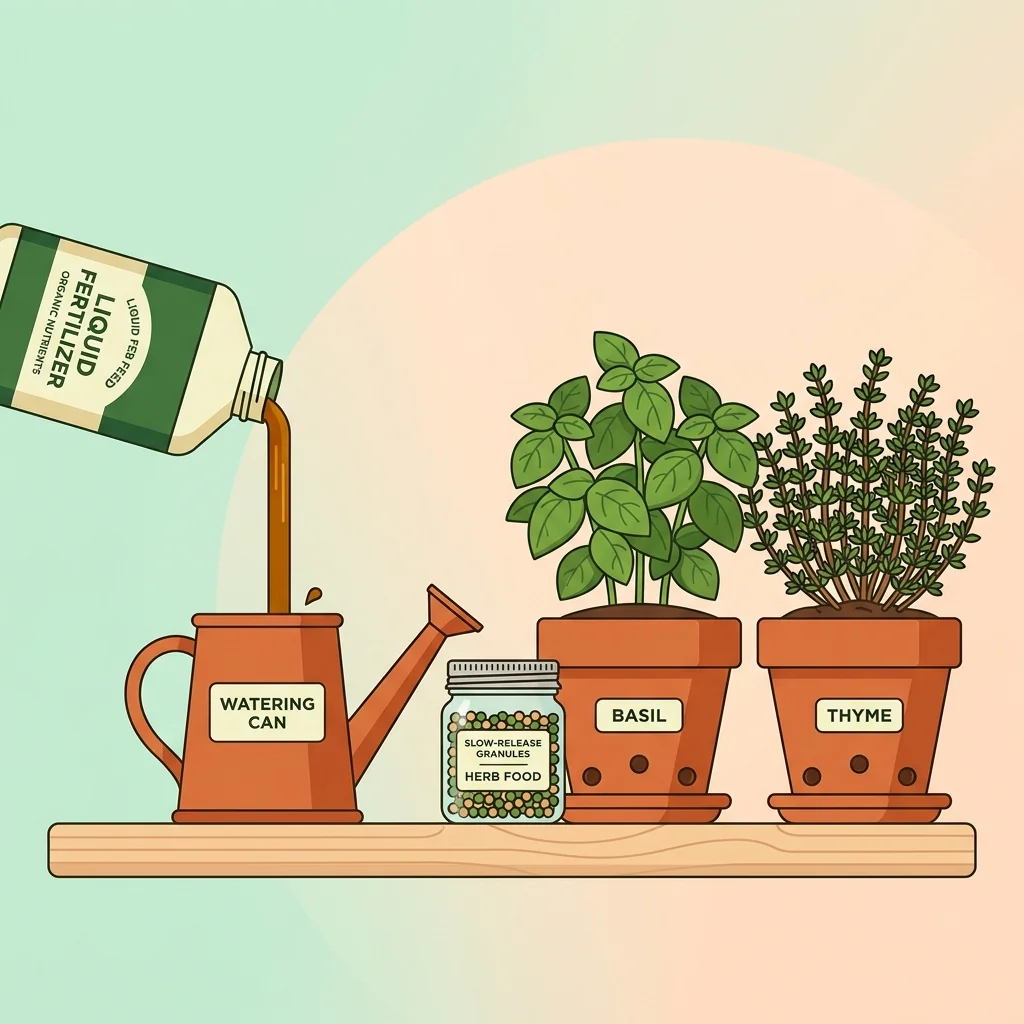
Best fertilizer for herbs in pots: a label-first guide
A practical, label-first guide to complete liquid and controlled-release fertilizers for potted herbs, with a decision table and a safer first application.
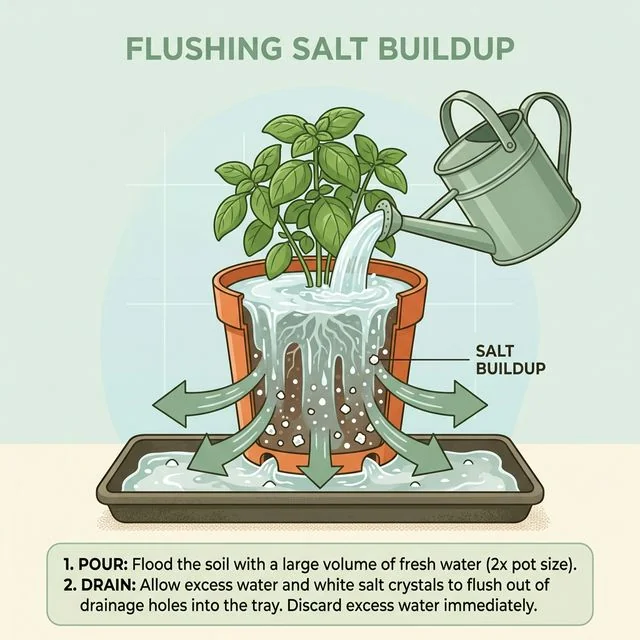
Salt buildup in herb pots: when to flush and when to repot
Every time you water your plants with liquid fertilizer, you are leaving heavy chemical salts behind. If you don't periodically wash them out, your herbs will suffer from chemical burn and nutrient lockout.