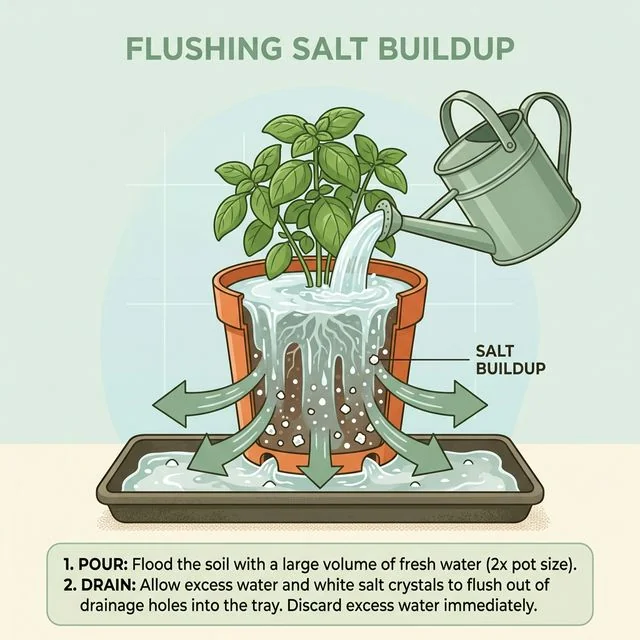
The Salt Rescue Decision Matrix
| Symptom Check | Recommended Action | The Process |
|---|---|---|
| Minor crusting on terracotta, plant is healthy | Status Quo | Scrub the outside of the pot with a vinegar/water solution. Maintain normal watering habits. |
| Heavy topsoil crusting, plant has crispy brown leaf tips | The Flush | Pour 3x the container's volume in pure water through the soil profile into a sink. |
| Pot is fully root-bound, water instantly runs down the sides, plant is yellowing | The Full Repot | Massage roots and move to a larger pot with 100% fresh, clean potting mix. |
If you keep an indoor herb garden alive for more than six months, you will inevitably encounter a strange white substance forming on your pots.
It might appear as a powdery snow on the surface of your potting mix. It might form a hard, white crust ringing the bottom drainage holes of your plastic containers. Or, most commonly, it will appear as a heavy, frosty stain creeping up the outside walls of your unglazed clay pots.
Many beginners panic, assuming their plant has contracted a severe mold or fungus infection.
The vast majority of the time, this isn’t mold at all. It is efflorescence—the accumulation of toxic chemical salts left behind by your fertilizer and your tap water. While it isn’t an infectious disease, if left untreated, this salt buildup will chemically burn your roots and kill your plants.
Here is exactly how to clean the slate and rescue your soil.
Where Does the Salt Come From?
Your plant acts like a massive biological water filter.
When you water an indoor plant correctly, whether with liquid nutrients from Do Potted Herbs Need Fertilizer? or just straight municipal tap water, you are pouring dissolved minerals into the dirt.
The plant absorbs the liquid water and evaporates it (transpires) out of its leaves. However, the heavy mineral salts contained in that water—the Calcium, Magnesium, Nitrates, and Phosphates—are left behind in the soil profile.
Over the months, as this evaporation cycle repeats endlessly, those trace minerals accumulate until they physically crystalize into a visible white crust.
Why is Salt Buildup Dangerous?
A minor ring of efflorescence on the outside of a pot is harmless—it just proves that the Terracotta is Doing Its Job by evaporating moisture.
However, heavy salt buildup inside the soil is a severe emergency. A high concentration of salt dramatically alters the pH of the soil, making it highly acidic. When the pH drops, the plant suffers from Nutrient Lockout. Even if there is plenty of food in the soil, the extreme acidity chemically blocks the roots from absorbing it.
Furthermore, as outlined in Signs You’re Overfertilizing Herbs, a high concentration of salt will literally suck the moisture out of the plant’s roots via reverse osmosis, causing the tips of the leaves to turn crispy, brown, and dead.
The Cure: How to “Flush” a Plant
If your plant is suffering from fertilizer burn and salt buildup, you must wash the soil clean. You cannot simply scoop the top layer of dirt off (although that is a good start). You must forcefully physically wash the toxic minerals out of the container through the bottom drainage holes.
This process is called Flushing.
- Wait for a Dry Cycle: Do not flush a plant that was heavily watered yesterday; let the soil dry out to its normal watering threshold.
- Move to the Sink/Shower: Pick the plant up out of its decorative drip tray and place it in a sink or shower drain.
- The Deluge: Pour pure, room-temperature water directly into the pot. You must use a massive amount of water—typically three or four times the physical volume of the container. If it is a 1-gallon pot, slowly pour 3 to 4 gallons of water through it.
- Let it Drain: The water pouring out the bottom will likely be yellowish or brown, carrying the dissolved salts away. Let the pot sit in the sink for at least an hour to completely drip-dry before returning it to its tray.
(Pro Tip: If you have aggressively hard tap water, try to use distilled water or rainwater for your flush if possible).
When Flushing Fails: The Reset Repot
Flushing only works if the water can gently and relatively evenly perk through the soil matrix.
If your plant has been in the same pot for two years, the soil has likely become highly compacted, anaerobic, and 90% filled with a massive, tangled root ball. In this scenario, pouring 4 gallons of water over the top will accomplish nothing; the water will hit the hard crust of roots, immediately run down the plastic sides, and pour out the bottom holes without ever touching the toxic salts trapped inside.
If your soil has degraded into a hard block and your plant is suffering from salt toxicity, a flush is a waste of time. You must perform a full rescue repotting.
Follow the exact steps in How to Repot Herbs Without Slowing Growth. Remove the plant, gently massage away as much of the salty, old, dead dirt from the roots as you safely can, and place it into a slightly larger container filled with 100% fresh, clean, unfertilized potting mix. The plant will thank you with a massive burst of fresh green growth.
Time to upgrade the pot?
If the salt buildup has completely ruined the existing soil structure, it may be time to perform a full rescue repotting.
Common questions
Can I use tap water to flush my plants?
Yes, but if your municipal tap water is extremely "hard" (heavy in calcium and magnesium), you are slightly defeating the purpose. Distilled water or rainwater is ideal for a thorough flush.
Will flushing my plant drown it?
Not if you do it properly. Roots drown from a *lack of oxygen* over many days, not from being temporarily submerged in flowing water. As long as your pot has excellent drainage holes and you don't water it again until it dries out, flushing is safe.
Should I scrape the white crust off the top of the soil?
Yes. Physically removing the top half-inch of crusted soil removes a massive portion of the accumulated salts before you begin flushing the rest of the profile.
Related guides
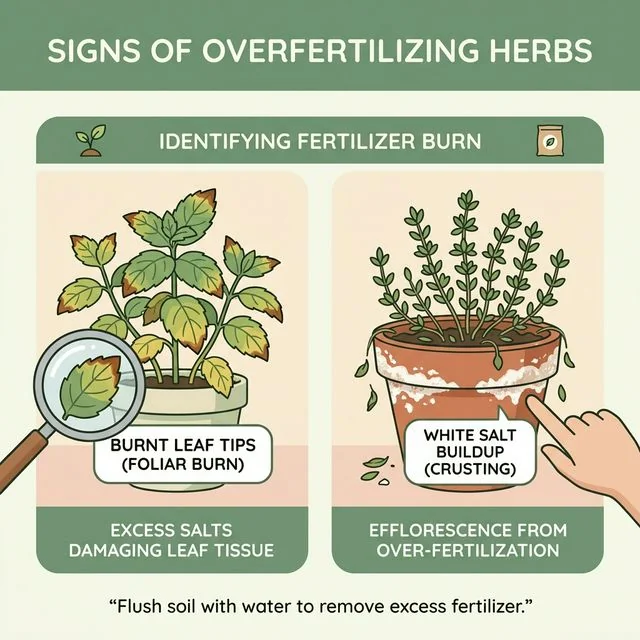
Signs you're overfertilizing herbs: yellow tips, salt buildup, and stalled growth
It is incredibly tempting to pour extra fertilizer on a slow-growing herb plant. But unlike humans, plants don't 'eat' fertilizer—they 'eat' sunlight. Forcing excess chemical salts into the soil will burn the roots and kill the plant.
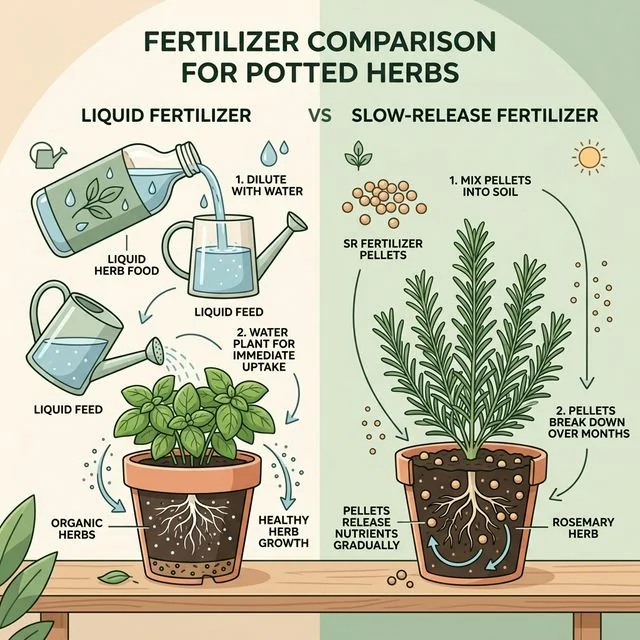
Do potted herbs need fertilizer? When to feed and avoid burn
Most potted herbs need fertilizer eventually, but timing matters. This guide explains when to feed, how often to do it, and how to avoid burning stressed roots.
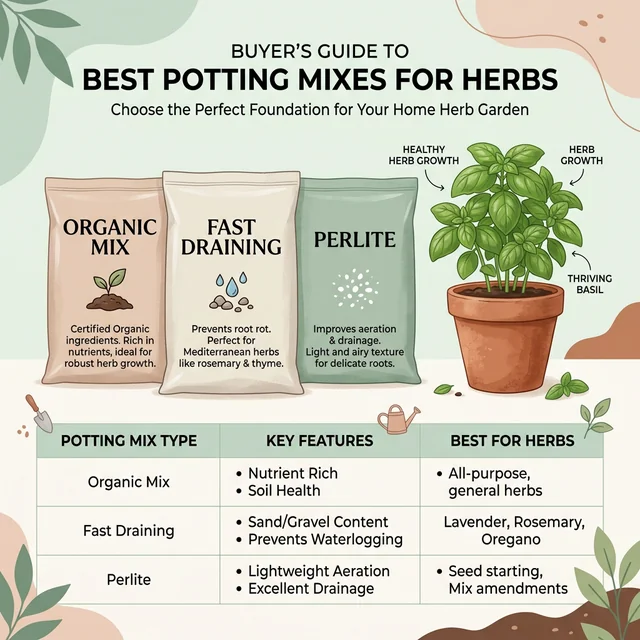
Best potting soil for potted herbs: how to pick the right mix
A practical buyer's guide to choosing potting mix for potted herbs, from richer blends for basil and parsley to faster-draining options for rosemary and thyme.