Best fertilizer types for potted herbs
| Type | Best for | Frequency | Burn risk |
|---|---|---|---|
| Complete water-soluble | Adjustable feeding and fast correction | Use the product label; reassess growth | Easy to stack through frequent use |
| Controlled-release granules | Convenience over a labelled release period | Use the product and mix labels | Can be overapplied or combined accidentally |
| Organic liquid | Growers who prefer an organic-labelled input | Composition and label vary by product | Not automatically complete or low-salt |
| No new feed yet | Fresh mix with starter fertilizer or stressed roots | Reassess after establishment | Deficiency if delayed after reserves run out |
Editorial note: The retailer link is an untracked shopping reference; Urban Harvest Lab does not currently receive a commission from it. The selection method works with local and online products, and no purchase is required to use it.
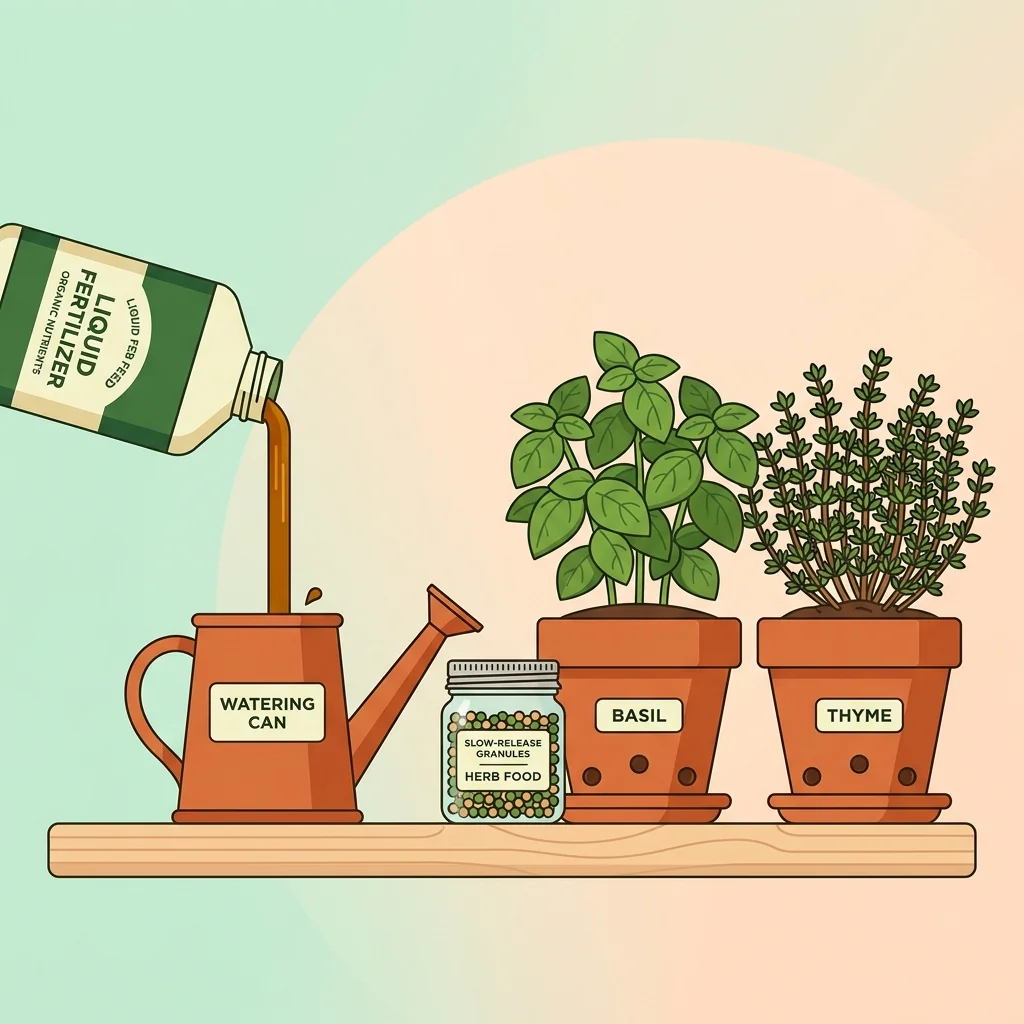
There is no single N-P-K number or bottle that is best for every potted herb. The most reliable starting choice is a complete fertilizer labelled for container-grown edible plants, selected after checking what the potting mix already contains. Use a water-soluble product when you want control over each application, or a controlled-release product when convenience matters more.
First confirm that feeding is actually the next step in do potted herbs need fertilizer; pale leaves can also come from wet roots, insufficient light, cold, or an exhausted root-bound plant.
Start with the potting-mix label
Many commercial mixes contain a starter or controlled-release fertilizer. Adding another product immediately can stack nutrients without solving a real shortage.
Before buying or applying anything, record:
- Mix contents: look for “starter charge,” “feeds up to…” or a controlled-release fertilizer in the ingredient panel.
- Plant age in that mix: a recently repotted herb and a plant that has occupied the same container for months do not start from the same nutrient reserve.
- Water movement: frequent watering and drainage can leach soluble nutrients, while a pot that stays wet may have a root problem rather than a feeding problem.
- Growth rate: actively harvested basil uses resources differently from slow winter rosemary.
If the mix includes fertilizer, respect its stated feeding window. Utah State University Extension notes that compost-amended mixes may also supply nutrients initially, so compost is another input to account for rather than a nutritionally blank ingredient.
What “complete” means on a fertilizer label
The three prominent numbers are the percentages of nitrogen (N), available phosphate (P₂O₅), and soluble potash (K₂O). A 10-10-10 is more concentrated than a 5-5-5 even though the ratio is identical. “Balanced” describes a ratio; it does not prove that a product supplies every nutrient or that its dose fits a herb pot.
For a general container feed, check for:
- a label that explicitly permits use on edible plants and in containers;
- nitrogen, phosphorus, and potassium;
- listed secondary nutrients or micronutrients such as magnesium, iron, manganese, and zinc;
- clear mixing and reapplication directions;
- a net quantity and guaranteed analysis, rather than vague “plant food” claims.
Choose by the guaranteed analysis and directions, not by the front-label picture. Apply only as permitted by the label in your country.
Compare complete fertilizers labelled for potted herbs
Water-soluble or controlled-release?
Choose water-soluble fertilizer when
- you want to adjust or stop applications quickly;
- frequent container watering is likely to leach nutrients;
- the mix does not already contain a long-term feed;
- you can measure water and concentrate accurately.
The nutrient is available quickly, but that also makes repeated, unrecorded doses easy to stack. Penn State Extension gives a low-dose, every-two-weeks example for indoor herbs; treat that as a reference for that system, not permission to override a different product label.
Choose controlled-release fertilizer when
- you prefer fewer applications;
- the herb will remain in the same container for the product’s labelled release period;
- no equivalent controlled-release feed is already present;
- you can measure the amount for the container volume.
Release is affected by the product design and conditions. “Slow release” does not mean zero burn risk, and adding liquid feed on top is not automatically beneficial. Record the date and product so another person does not dose the pot again.
A safer first-application workflow
- Rule out a water or root problem. Do not feed a pot that is waterlogged, sour-smelling, severely wilted, or unable to drain.
- Read both labels. Check the potting-mix feeding window and the fertilizer instructions.
- Measure the container and water. Guessing by eye is a common way to increase concentration.
- Use the labelled container-plant rate. If a university crop guide or the manufacturer specifies a reduced rate for that herb and setup, follow that crop-specific direction.
- Write down the application. Product, concentration, volume, and date are enough.
- Wait and observe new growth. Do not redose because an old yellow leaf fails to turn green.
Avoid the earlier shortcut “always use half strength.” Some extension crop guides do recommend half-label rates for particular container herbs, but products vary in concentration and directions. A universal dilution can underfeed one formulation and still be too much when layered over a pre-fertilized mix.
Match feeding to growth, not herb stereotypes
Fast, repeatedly harvested leafy herbs often remove more nutrients than a slowly growing woody herb. That makes basil, mint, or parsley more likely to need regular assessment during active growth. Rosemary, thyme, oregano, and sage often need less when growth is slow, but their name alone does not set a dose.
Use these signals together:
| Situation | Sensible next check | Do not assume |
|---|---|---|
| Healthy new growth in fresh mix | Continue observing the mix’s feeding window | More fertilizer will speed growth |
| Older leaves pale while new growth continues | Review watering, light, roots, and feeding history | Yellow automatically means nitrogen |
| White crust on mix or pot rim | Review water quality and accumulated salts | The plant needs a stronger feed |
| Soft, stretched growth | Check light and total nitrogen input | Every lush leaf is healthy growth |
| Growth stalls in a root-filled pot | Inspect roots and container volume | Fertilizer can replace root space |
If leaf edges scorch, growth stalls after an application, or a surface crust develops, stop adding fertilizer and use signs of overfertilizing herbs to investigate before flushing or repotting.
The substrate still sets the ceiling
Fertilizer cannot compensate for a dense, airless, or persistently saturated root zone. A structurally sound potting mix for potted herbs should accept water, drain excess, and retain enough moisture for roots to use dissolved nutrients. The overall light, pot, watering, pruning, and feeding routine is covered in potted herb care.
For most growers the practical answer is simple: inventory the nutrients already in the pot, choose one complete system, apply it measurably, and change only after observing the result. That process is safer than combining a granular base, compost, and a liquid booster because each sounds gentle in isolation.
Sources and further reading
If you are feeding potted herbs, also read
These guides cover when to feed, how to avoid overfeeding, and the potting mix your fertilizer works with.
Common questions
What is the best fertilizer for herbs in pots?
A complete water-soluble or controlled-release fertilizer labelled for container-grown edible plants is a sound starting point. Check whether the potting mix already contains feed, follow its label, and choose a formulation that includes micronutrients rather than shopping by N-P-K alone.
What NPK is best for potted herbs?
There is no universal best ratio. A complete all-purpose formulation can work, but concentration, micronutrients, release type, existing nutrients in the mix, and application rate matter as much as the three headline numbers.
How often should I fertilize herbs in pots?
Follow the product and potting-mix labels. As one evidence-based indoor-herb reference, Penn State suggests a low dose of water-soluble fertilizer every two weeks, but a pre-fertilized mix, slow growth, or a controlled-release product changes that interval.
Is liquid or slow-release fertilizer better for potted herbs?
Neither is universally better. Liquid feed offers quick, adjustable applications; controlled-release fertilizer is convenient and releases nutrients over time. Both can be overapplied, so do not combine them without accounting for the total dose.
Can I use tomato or all-purpose fertilizer on herbs?
An all-purpose product labelled for edible container plants is usually the clearer starting point. A tomato formulation may be designed around fruiting crops rather than leafy growth; use only products whose label covers your crop and container use.
Related guides
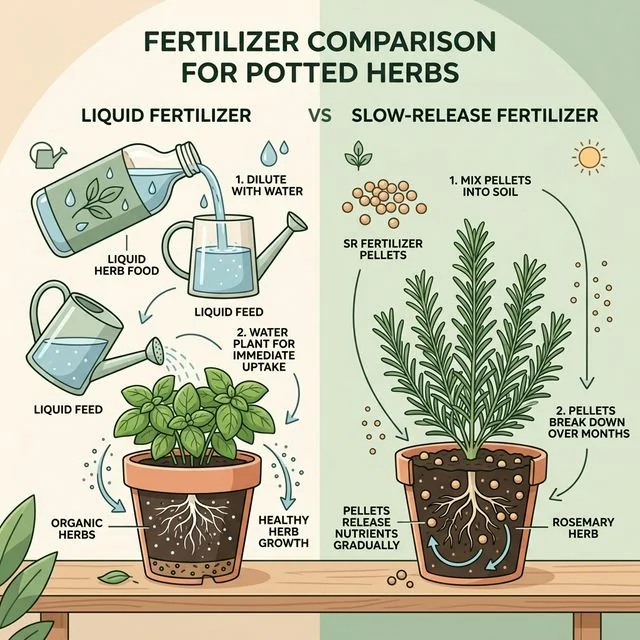
Do potted herbs need fertilizer? When to feed and avoid burn
Most potted herbs need fertilizer eventually, but timing matters. This guide explains when to feed, how often to do it, and how to avoid burning stressed roots.
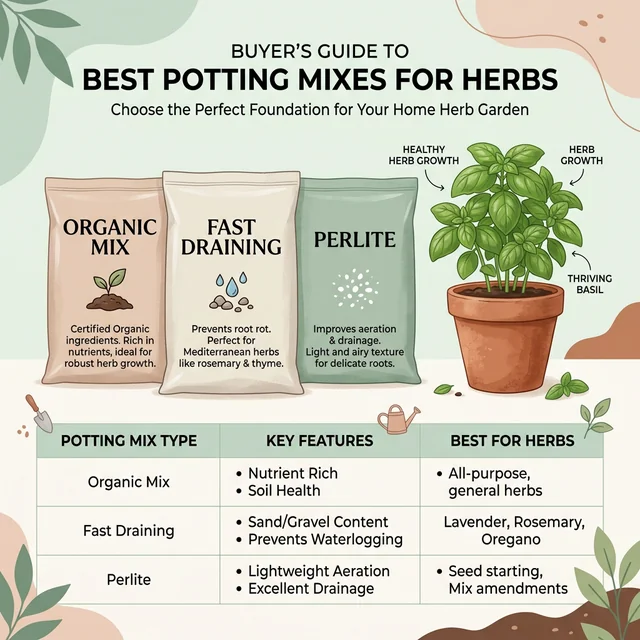
Best potting soil for potted herbs: how to pick the right mix
A practical buyer's guide to choosing potting mix for potted herbs, from richer blends for basil and parsley to faster-draining options for rosemary and thyme.
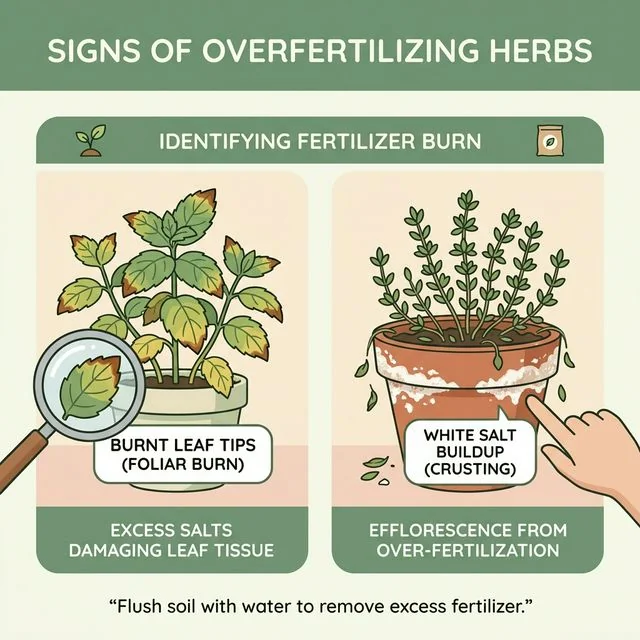
Signs you're overfertilizing herbs: yellow tips, salt buildup, and stalled growth
It is incredibly tempting to pour extra fertilizer on a slow-growing herb plant. But unlike humans, plants don't 'eat' fertilizer—they 'eat' sunlight. Forcing excess chemical salts into the soil will burn the roots and kill the plant.