Troubleshoot the system before you change the inputs.
Symptoms
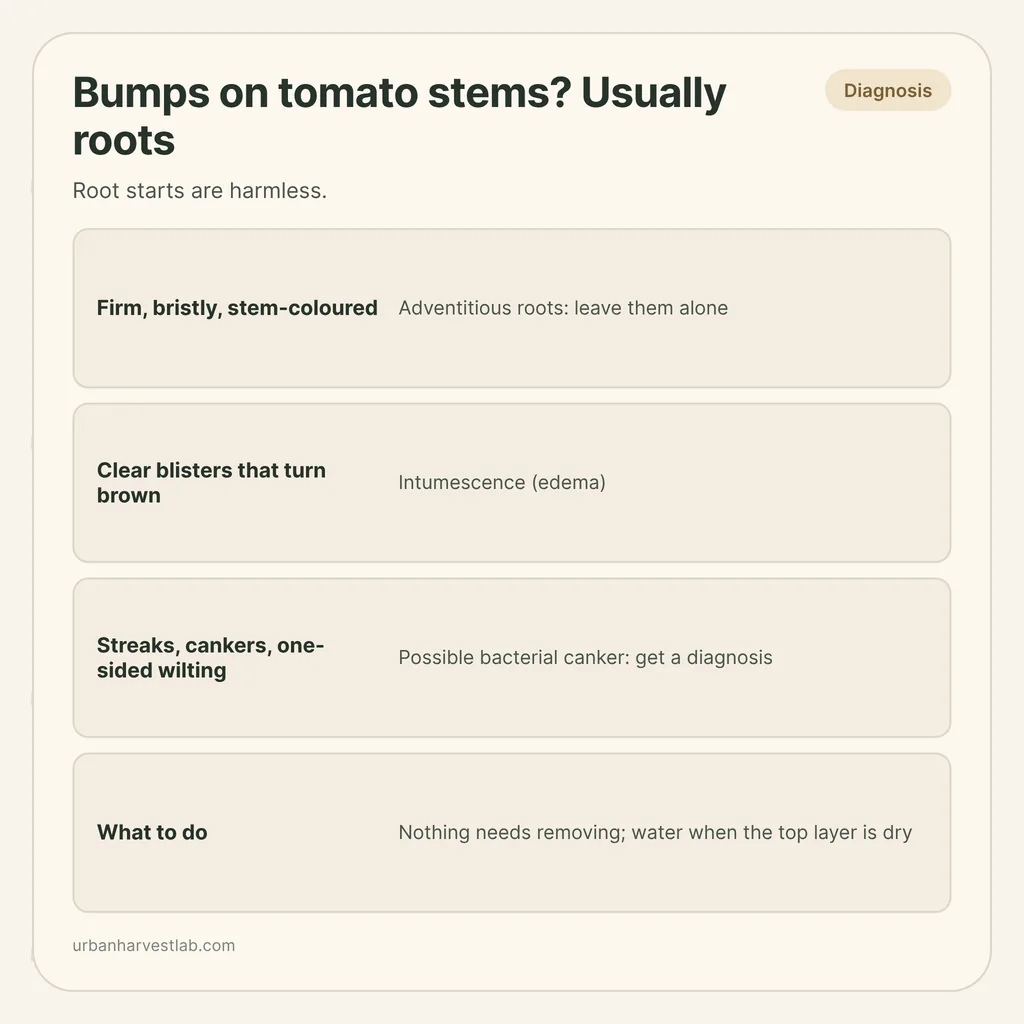
- Small fleshy or bristly knobs along the stem, often at nodes or on older stem, the same colour as the stem.
- Clear or whitish-green blisters on a stem or leaf stalk that turn brown and dry.
- Light streaks or open cankers on the stem, with leaflets wilting on one side only.
Possible causes
- Adventitious root starts, shaped by variety, weather and growing conditions.
- Wet root zone with low oxygen, which prompts more root starts.
- Intumescence (edema) after wet media, high humidity and low light.
- Bacterial canker, if streaks, cankers or a pulling-out pith are present.
Quick fixes
- If the bumps are firm, same-coloured and bristly, leave them alone.
- Water only when the top layer of the mix is dry, and make sure the pot drains.
- If you see streaks, cankers or one-sided wilting, avoid pruning or handling it when wet and get a diagnosis.
Small, fleshy, bristly bumps along a tomato stem are almost always root starts, and they are harmless. They are called adventitious roots. Leave them alone, and check for the few look-alikes below only if the bumps are not firm, stem-coloured and bristly.
University of Maryland Extension describes them this way: tomato plants, particularly heirloom varieties, and tomatillos may produce small growths with short, fleshy bristles. They would grow into normal roots if placed in contact with the soil. How many you see depends on variety, weather and how you grow the plant, according to the same page. The wider picture of why a tomato droops or yellows lives in tomato plant wilting, while the bumps themselves are covered here.
How to tell root starts from something else
| What you see | Where | What it is |
|---|---|---|
| Firm knobs or short bristles, same colour as the stem | Along the stem, often on older growth | Adventitious roots |
| Clear or whitish-green blisters that turn brown and dry | Stem, leaf stalks and leaf undersides | Intumescence (edema) |
| Light streaks or open cankers, one-sided wilting | Stem, leaf stalks, midribs | Possible bacterial canker |
A root start is attached and part of the stem, the same green as the tissue around it, and often bristly. Edema blisters begin glassy and watery. Cankers are streaks or splits rather than bumps.
Why a tomato makes them
Virginia Tech notes that adventitious roots can develop from a tomato stem, particularly when it meets the soil. That is also why gardeners bury part of a tall transplant stem: roots can form along it. A bump in mid-air is the same tissue with no soil to push into.
Wet soil can push the plant to make more. In a 2010 study in The Plant Journal, researchers describe how tomato’s ability to produce adventitious roots increases plant survival when oxygen is low in the root zone. A pot that stays soggy leaves the roots short of oxygen, and the stem responds by starting new roots near the base. Maryland adds that bumps can also be a plain feature of the plant’s genetics, so a few bumps on a healthy, dry-ish plant mean nothing.
The practical reading: bumps alone are not a diagnosis. If the plant also wilts, yellows or sulks in a pot that stays wet, check the roots and drainage using overwatered vs underwatered. If the plant looks well, ignore the knobs.
What to do about them
Nothing needs removing. Maryland states that no action needs to be taken. Cutting them off only creates wounds.
- Water when the top layer of the mix is dry rather than on a fixed day, and keep the saucer empty.
- If a leggy plant is going into a bigger pot, bury more of the stem. The bumps show where roots will form.
- Keep them if you stake or tie the stem; they do no harm.
When it is not a root start
Edema (intumescence). UConn Extension describes intumescence as a physiological disorder, not an infectious disease, also called edema. Blisters start as small, clear, watery bumps or whitish-green bumps and turn brown as they dry. Stems and leaf stalks can be affected as well as leaves. UConn ties it to excess moisture in the growing media combined with high humidity, which lowers transpiration. Its fact sheet is aimed at greenhouse growers, but the advice carries over: avoid overwatering in cool, overcast weather and give plants room for air to move. Leaf blisters have their own page in edema on plant leaves.
Bacterial canker. This is the one worth taking seriously. The Pacific Northwest Plant Disease Handbook lists stem streaks or cankers, wilting of leaflets on one side only, yellow to reddish-brown discoloration of the stem’s vascular tissue, and a pith that often pulls out when the stem is broken. The bacterium spreads when plants are handled or pruned. The handbook advises disinfecting pruners between plants or snapping off suckers by hand, and not handling plants when wet. Streaks and one-sided wilting is a different picture from a few bumps, and Fusarium also shows as browning under scraped stem skin, per University of Maryland Extension.
If you see canker signs, stop pruning it and avoid handling it when wet, and get a diagnosis from your local extension service before you decide what to do. Bumps without those signs do not call for that.
Common mistakes
- Reading root-start bumps as an infection. University of Maryland Extension calls them usually harmless.
- Cutting them off.
- Cutting back on water on a plant that already drains well because of a few bumps.
- Ignoring streaks and one-sided wilting because bumps are “normal”.
Sources
- University of Maryland Extension, Bumps or swelling on vegetable stems
- University of Maryland Extension, Key to common problems of tomatoes
- Virginia Tech, Basic tomato physiology and morphology (SPES-508)
- Vidoz et al. 2010, Hormonal interplay during adventitious root formation in flooded tomato plants, The Plant Journal
- UConn Extension, Intumescences (edema) on greenhouse tomatoes
- Pacific Northwest Plant Disease Handbook, Tomato bacterial canker
Check the water side
If the bumps appeared after a wet spell, read these next.
Common questions
What are the little bumps on my tomato stems?
Most often they are adventitious roots: small, fleshy growths with short bristles. University of Maryland Extension notes that tomato plants, particularly heirloom varieties, may produce them, and that they would grow into normal roots if they touched soil.
Are the bumps on my tomato stem a disease?
Root-start bumps are not. University of Maryland Extension calls small knobs and swellings on stems usually harmless and says no action needs to be taken. Look for streaks, cankers, one-sided wilting or internal browning before suspecting disease.
Should I cut the bumps off?
There is no reason to. They are part of the plant, and they cause no damage. Cutting leaves a wound that does nothing for the plant.
Do bumps mean I am overwatering?
Sometimes. Research on flooded tomato plants shows that low oxygen in the root zone prompts adventitious roots, so a plant in soggy soil may make more of them. Many plants make a few with no watering problem, so judge by the soil and the rest of the plant, not the bumps alone.
Related guides

Tomato plant wilting even though you water it: heat, roots, or disease
Midday droop that clears by evening is usually heat. Wilt that stays after watering points to rotting roots or a vascular disease, and a cut stem tells you which.

Bumps on the underside of leaves: is it edema?
Raised bumps under the leaves that start clear and turn tan and corky are usually edema, caused by too much water and too little evaporation, not an insect.
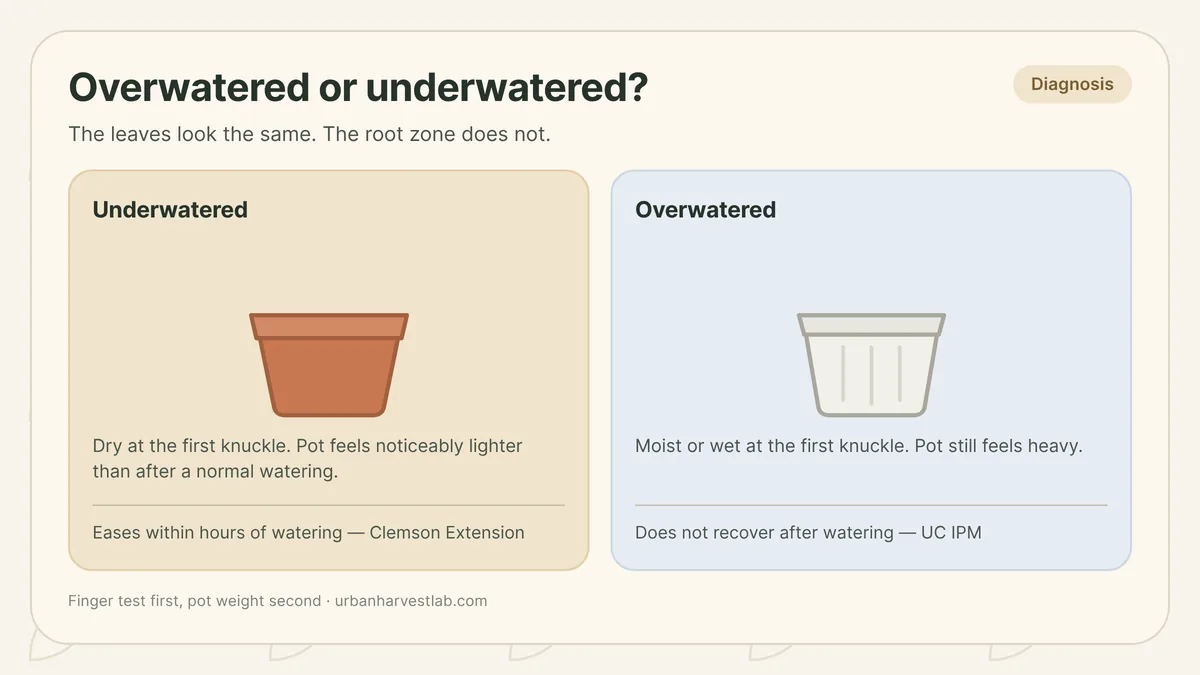
Overwatered vs underwatered: how to tell which one you have
Reading the root zone directly, with a finger test, pot weight, and how the plant responds to being watered, settles what the leaves alone cannot.