
Troubleshoot the system before you change the inputs.
Symptoms
- Leaves droop in the afternoon heat, either recovering by morning or staying limp however much you water.
- The mix is dry, or it is wet and the plant still wilts.
- Lower leaves yellow, sometimes on one side of the plant, or a green plant collapses within days.
Possible causes
- Heat and a small or dark pot: the root zone gets hot and dries faster than the roots can keep up with.
- Waterlogged mix: roots lose oxygen, die back and rot, so they stop delivering water.
- A soil-borne fungus (Fusarium or Verticillium) or bacterium (bacterial wilt) blocking the water-carrying tissue in the stem.
Quick fixes
- Push a finger into the mix to the first joint before you water, and water early in the day if it is dry.
- Shade the pot, group containers together, and use light-coloured containers in full sun.
- Cut the stem of a plant that keeps failing; if it shows brown vascular tissue, remove the plant and do not reuse the mix for tomatoes.
Tomato wilt: what you see and what it usually is
| What you see | Quick check | Most likely cause |
|---|---|---|
| Droops mid-afternoon, upright by morning | Mix is dry a finger-joint down, or the pot is dark and in full sun | Heat and a hot, drying root zone |
| Wilts with soggy mix, does not lift after watering | Roots brown and soft, mix stays wet, drainage poor | Waterlogging and root rot |
| Daytime wilt that recovers at night at first, then worsens; lower leaves yellow | Brown vascular tissue in a lengthwise stem cut | Fusarium or Verticillium wilt |
| Whole green plant wilts fast in hot, wet weather | Brown stem with yellowish ooze, or a white stream in water | Bacterial wilt |
A container tomato that wilts despite watering is in one of three situations: heat is outrunning its roots, the roots are drowning, or a soil-borne disease has blocked the stem. Midday droop that clears by morning is usually the first. Wilt that stays after a drink is usually the second or third, and a cut through the lower stem separates them.
If the plant wilted within days of being planted out, start with transplant shock instead. Everything below assumes an established plant.
Start with the mix, not the leaves
Wilted leaves do not tell you whether the plant is thirsty. Clemson HGIC puts it plainly for potted plants: the symptoms of overwatering and underwatering are similar, and both damage the roots. Push a finger into the mix to the first joint, as Clemson advises. Dry at your fingertip means water. Lift the pot, too; Clemson notes a definite loss of weight as mix dries.
Then watch the response.
- Perks up within hours of watering: it was dry. The fix is rhythm, not rescue.
- Still limp and the mix is wet: the problem is below the surface. Go to the root section.
- Droops only in the afternoon and is fine by morning: the next section.
The full finger, weight and recovery routine lives in overwatered vs underwatered.
Midday droop and the hot root zone
Some afternoon drooping is normal. UC Cooperative Extension, writing about a container tomato trial, says “some drooping of leaves in mid-afternoon is not cause for alarm,” and advises watering in the early morning or evening.
What turns normal droop into a daily problem in a pot is the pot. The same UC article warns that large black plastic pots attract heat and have no insulation, which is hard on tomato roots confined in them, and suggests painting them white so they reflect heat. University of Illinois Extension makes the same point about dark and metal containers: they absorb more heat, which heats the soil and can damage plants.
A tomato has a lot of leaf for a small block of mix. Virginia Cooperative Extension says container plants that wilt every day are a sign the soil is getting excessively dry, and that watering daily or even twice daily may be necessary once plants are established. It suggests grouping containers so the foliage shades the soil and keeps it cooler. If you are already watering twice a day and the plant still wilts, the pot is probably too small; the tomato pot size guide gives volumes by growth habit. A mulch layer also slows evaporation from the surface, and the heatwave protection guide covers shading the pot through a hot spell.
A plant that droops every afternoon but keeps putting out new growth is short of root room or shade, not sick.
Wilting in wet mix: waterlogged roots
Roots need air. In saturated mix they run short of oxygen, and Missouri Botanical Garden notes that the longer the air is cut off, the greater the root damage. Dying roots stop supplying water, so the leaves wilt even though the pot is full of it. Overwatering is the easy mistake to make while chasing a wilting plant: you water the droop, the roots drown, and the droop worsens.
UC IPM describes the pattern with Phytophthora root and crown rot: leaves wilt and turn dull green, yellow, red or purplish, and “plants don’t recover when irrigated.” It says Phytophthora can establish in as little as 4 to 8 hours of soil saturation, so a blocked drainage hole or a saucer left full is a real risk. Virginia Cooperative Extension asks for drainage holes in the bottom so roots do not stand in water.
To check, slide the plant out of the pot. Firm white roots are healthy; brown, soft ones mean rot. Repot into fresh mix in a pot with drainage, or replace the plant if most roots are gone. The full root-rot picture is in overwatered vs underwatered. A tomato that is simply root-bound behaves differently; the root-bound signs are written for herbs but the roots-circling check is the same.
Wilting that is not about water: Fusarium and Verticillium
Both are soil-borne fungi. Iowa State Extension says they invade tomato plants through injured roots and block water flow in the stem, so watering does not fix them. The early symptom is easy to mistake for heat: Iowa State describes wilting during the heat of the day, with plants often recovering in the evening or overnight. The difference is the trend. The wilting gradually gets worse, and many plants die.
University of Maryland Extension describes Fusarium wilt as yellowing and browning of foliage, stunting and wilting with some recovery at night, with lower leaves turning yellow, sometimes on one side of the plant or one side of a branch. UConn’s integrated pest management program says that in a lengthwise cut the brown discoloration runs less far up the stem with Verticillium than with Fusarium, and does not reach the leaf stalks; Verticillium also tends to hit plants nearing maturity, while Fusarium can strike at any growth stage. The two overlap, and neither has a cure, so the distinction matters less than recognising a wilt.
The cut-stem check. Split the lower stem lengthwise. Maryland says infected stems show browning of the vascular tissue. UConn describes a brown ring with a white centre in a crosswise cut. It is destructive, so do it only on a plant you are ready to lose.
What you do next is the same for both:
- Iowa State says there is no treatment for infected plants, and advises removing and destroying those that die.
- Maryland notes the wilt fungi can persist for many years in soil even if no host plants are grown there. Treat the used mix as contaminated for tomatoes.
- Resistant varieties carry a V and/or F after the name, according to Iowa State. UConn says resistance is very important in the control plan.
Maryland also suggests growing tomatoes in containers as one way to keep infected soil out, which is a point for fresh potting mix each season.
Fast collapse in a green plant: bacterial wilt
Bacterial wilt works differently. Clemson HGIC says it causes rapid wilt of the plant while the leaves stay green, and that disease development is favored by high temperatures and high moisture. NC State Extension puts the temperature at over 85°F with moist soil. If a lush plant flops in a few days after a hot, wet spell and the leaves are still green, think of this before blaming the watering can.
Clemson says an infected stem cut crosswise looks brown and tiny drops of yellowish ooze may be visible. NC State describes a second check: place a freshly cut stem base in water and look for a stream of white slimy substance, a strong sign the bacterium is in the vascular tissue. Both sources say no chemical control is available, and NC State calls the bacterium very persistent if introduced. Remove the plant and discard the mix.
Yellow leaves with a wilt are common to several of these; tomato leaves turning yellow separates the yellowing patterns. For a basil that droops on a windowsill, the basil wilting guide is the right page.
Sources
- Clemson HGIC: Tomato diseases and disorders
- Clemson HGIC: Indoor plants, watering
- NC State Extension: Bacterial wilt of tomatoes
- Iowa State Extension: Why are my tomato plants wilting?
- University of Maryland Extension: Fusarium wilt of tomatoes in a home garden
- UConn Integrated Pest Management: Vascular wilts of tomato
- UC Cooperative Extension: Tomatoes in containers, trial progress
- Virginia Cooperative Extension: Vegetable gardening in containers
- University of Illinois Extension: How to grow fruits, vegetables, herbs in container gardens
- UC IPM: Phytophthora root and crown rot in the garden
- Missouri Botanical Garden: Overwatering
Narrow down the wilt
Settle the water question first, then check heat, roots and the stem.
Common questions
Why is my tomato plant wilting when the soil is wet?
Roots sitting in saturated mix cannot get oxygen, and damaged or rotting roots cannot lift water to the leaves, so the plant wilts with water all around it. A wilt that does not lift after watering, with soft brown roots, points to root rot. Wet soil with high heat can also favor bacterial wilt, which collapses a green plant quickly.
Will a wilted tomato plant recover?
If the wilt is heat or dry mix, yes: UC Cooperative Extension says some mid-afternoon drooping is not cause for alarm, and a plant that was simply dry perks up after watering. A plant with Fusarium, Verticillium or bacterial wilt does not recover. Iowa State Extension says there is no treatment for infected plants and recommends removing and destroying those that die.
How can I tell Fusarium wilt from underwatering?
Watering settles it. An underwatered plant lifts within hours of a drink. A plant with Fusarium wilt droops in the heat of the day, recovers at night at first, then worsens over days even with moist soil. Lower leaves often yellow, sometimes on one side only, and a lengthwise cut through the stem shows brown vascular tissue.
Is the cut-stem test safe and does it work?
It is destructive, so do it only on a plant you are ready to lose. Cut the stem base crosswise. Brown inside with yellowish ooze points to bacterial wilt (Clemson). NC State Extension describes placing a freshly cut stem base in water and watching for a stream of white slimy substance. Brown streaks inside a lengthwise cut point to Fusarium or Verticillium.
Related guides

Tomato leaves turning yellow in pots: read the pattern first
Which leaves yellow, and in what pattern, tells you whether a potted tomato is hungry, waterlogged, short of magnesium or diseased.

Transplant shock in seedlings: wilting after you plant them out
Wilting after transplanting is common and usually temporary. Prevention is mostly hardening off and watering; recovery is measured in days to a couple of weeks.
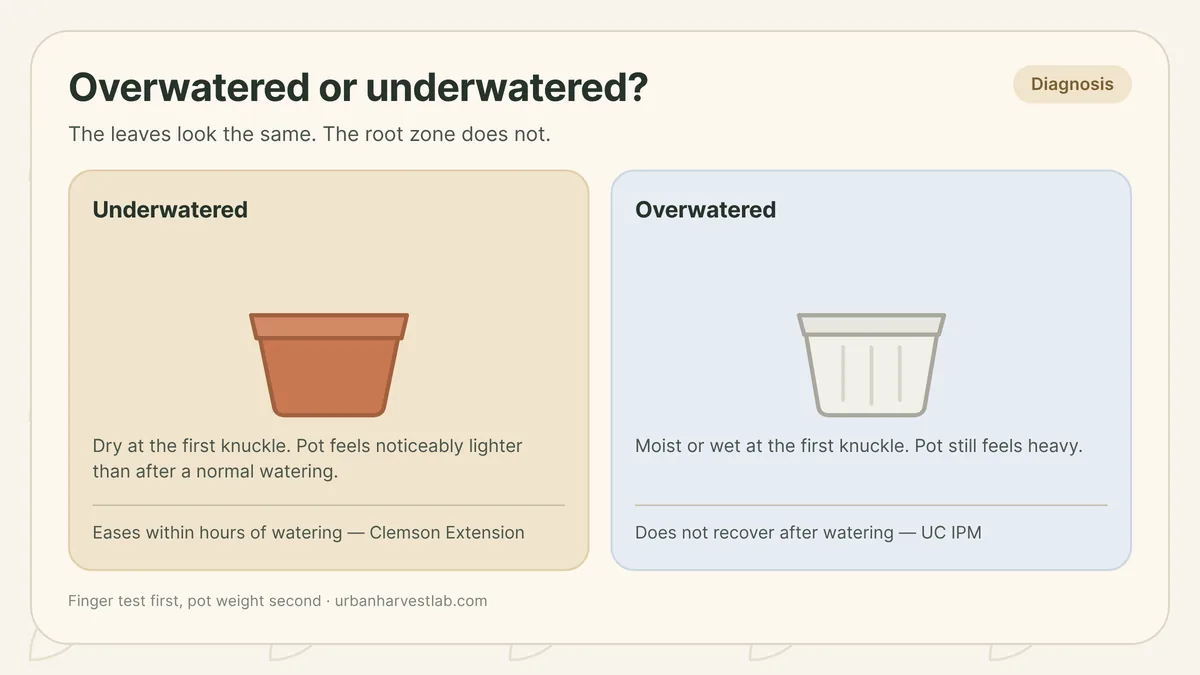
Overwatered vs underwatered: how to tell which one you have
Reading the root zone directly, with a finger test, pot weight, and how the plant responds to being watered, settles what the leaves alone cannot.