
Troubleshoot the system before you change the inputs.
Symptoms
- Raised bumps on the underside of leaves or on petioles and stems, clear or green when young and tan and corky when old.
- Bumps are fixed in place and uniform in texture, with no insect, shell, powder or fuzz.
- Affected leaves may later yellow, droop and drop if conditions stay the same.
Possible causes
- Soil stays wet for long stretches, often in a pot with poor drainage or a saucer left full.
- Low light and cool temperatures, usually in winter or after a run of cloudy days, so the plant uses little water.
- Plants packed close together or kept under plastic, which slows air movement.
Quick fixes
- Water less often and let the top layer dry before the next drink.
- Give the plant more light and keep it out of a cold, still corner.
- Empty saucers, check the drainage holes and repot into a freer-draining mix if the soil stays soggy.
Raised bumps on the underside of leaves that start clear or greenish and turn tan and corky are most likely edema: a reaction to too much water in the soil and too little light and warmth for the plant to use it. It is not an insect and not an infection. The leaves already marked will not heal, but the plant itself can recover.
Before you change anything, check that you are looking at edema and not a pest. The table below sorts the common look-alikes, and overwatered vs underwatered covers the wider question of how to tell soggy roots from dry ones.
What edema looks like
University of Maine Extension describes it plainly: “Edema usually manifests as raised bumps on stems or the lower side of leaves.” The bumps are “initially clear or greenish but will become tan and corky over time.” So a leaf can carry blisters of different ages at once, glassy ones and dry brown ones.
Missouri Botanical Garden lists “water-soaked spots and blisters (Oedema)” among the symptoms of overwatering, which matches the glassy early stage. On succulents the pattern can differ: the University of Maine bulletin notes that the corky areas may not be raised and instead look like spotty lesions. Clemson Cooperative Extension calls the condition oedema, a physiological condition in which rough corky swellings form on the petioles and lower leaf surfaces. If the leaf stays stressed, the leaves turn yellow, droop and fall.
Why the bumps form
Edema is a symptom of excessive watering, according to University of Maine Extension. Clemson adds the other half: excessive soil moisture together with poor lighting and low temperatures predisposes plants to it. A cold, dim plant uses little water. Roots keep supplying what the leaves cannot release, and the surplus ends up in the leaf tissue; University of Maine Extension puts it as a plant that is “not able to transpire quickly enough to relieve itself of excess moisture”.
That explains who gets it. Clemson says it occurs most often on succulent plants and during the winter. University of Maine says it is most common on houseplants, plants grown in greenhouses or under plastic, and plants grown too close to one another. A windowsill pot in January, watered on a fixed Saturday schedule, is the classic setup.
Tell it from pests and disease
Edema has no living part. Run these checks in daylight, with the leaf tilted toward you.
| What you see | Quick test | Likely cause |
|---|---|---|
| Raised bumps, clear or green then tan and corky, fixed in place | Nothing lifts off: the bump is part of the leaf surface, not a shell sitting on it | Edema |
| Brown or tan domes sitting on stems and along veins | A fingernail lifts a shell off the leaf; live ones ooze when crushed, dead ones may not | Scale insects |
| White coating or flecks on top, fuzz underneath | Wipe test, then a hand lens on the underside | Mildew or thrips damage |
| Orange pustules that shed powder | Powder rubs off onto tissue | Rust |
Scale deserves the closest look, because both are bumps. UC IPM notes that dead scales “fail to exude fluid when squished”, so a squash test on a single bump can mislead; check whether the shell lifts off the leaf and whether the bumps cluster along stems and veins rather than across the blade. The full set of signs is in scale insects on rosemary and other woody herbs. White flecks on basil are covered in white spots on basil leaves. If something is moving, sticky or leaving honeydew, use the herb pest identification chart instead.
What to change
Clemson’s advice is short. Leaves showing oedema will not recover, but you can halt the decline of a plant by improving light and watering less often. Repotting to improve soil drainage may also help, and houseplants should not stand in a saucer full of water.
In practice:
- Check the soil with a finger before each watering and wait until the top layer is dry. Water on the condition of the soil, not the day of the week.
- Move the plant to the brightest spot you have, away from cold glass.
- Empty any saucer after watering, and make sure the drainage hole is open.
- If the mix stays wet for days, repot into a freer-draining mix.
- Space plants so air can move between them.
Marked leaves will not heal, but there is no need to strip them; take them off when they yellow, or when you harvest, and compost them.
If the bumps keep appearing on new leaves after a few weeks of drier soil and brighter light, look again at the roots and at the pest list above. The cause may not be what you assumed.
Sources
Rule out the look-alikes
Confirm the bumps are corky tissue, then check the water side and the pest side.
Common questions
What are the bumps on the underside of my plant leaves?
If they are raised, start clear or greenish and turn tan and corky, and they cannot be scraped off as an insect would, the likely cause is edema. University of Maine Extension describes it as raised bumps on stems or the lower side of leaves, and ties it to excessive watering.
Is edema contagious or caused by a fungus?
Edema is a physiological condition, a reaction to growing conditions, not an infection. Clemson Extension lists excessive soil moisture, poor light and low temperatures as the predisposing factors. It does not spread from plant to plant, though plants in the same damp, dim spot will tend to show it together.
Will the bumps go away?
No. Clemson Extension states that leaves showing edema will not recover. The aim is to stop new bumps by watering less often, improving light and drainage; new leaves should then grow clean.
Can I still eat leaves that have edema bumps?
The extension sources describe edema as a growing-condition problem and do not address eating affected leaves. The corky patches are tough and unappealing, so pick unaffected leaves and compost marked leaves as you remove them.
Related guides
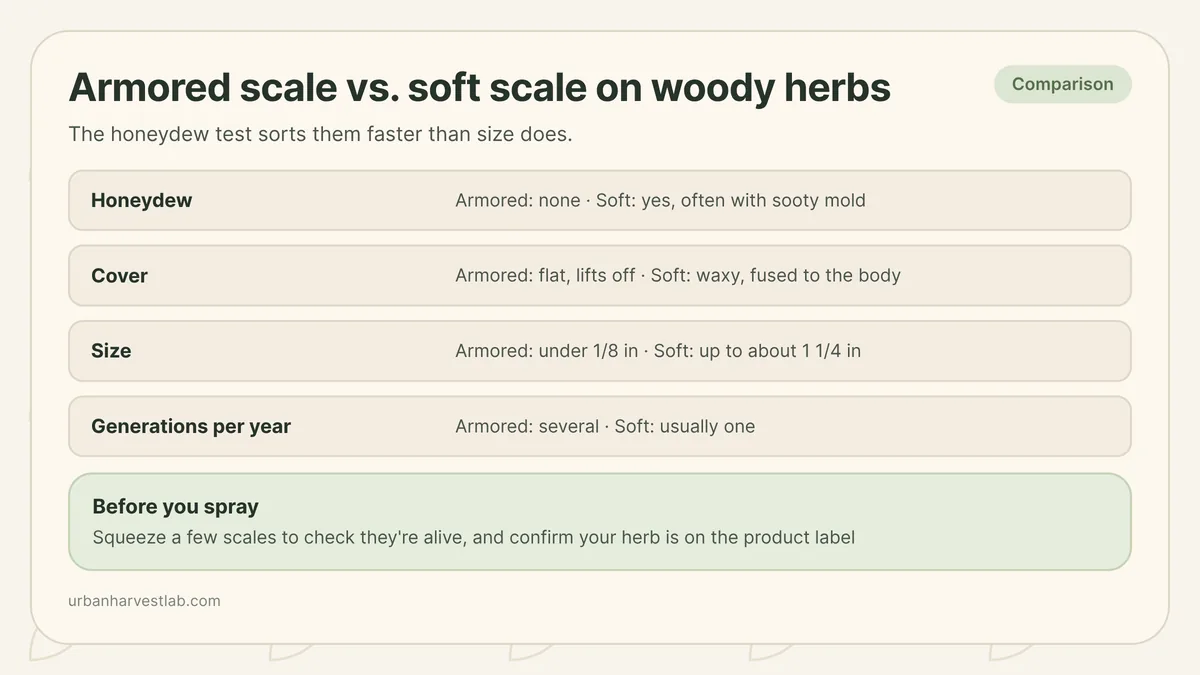
Scale insects on rosemary and other woody herbs
Scale on a woody herb often goes unnoticed until the leaves turn sticky or a stem starts to die back, and the right treatment depends on which kind of scale you have.
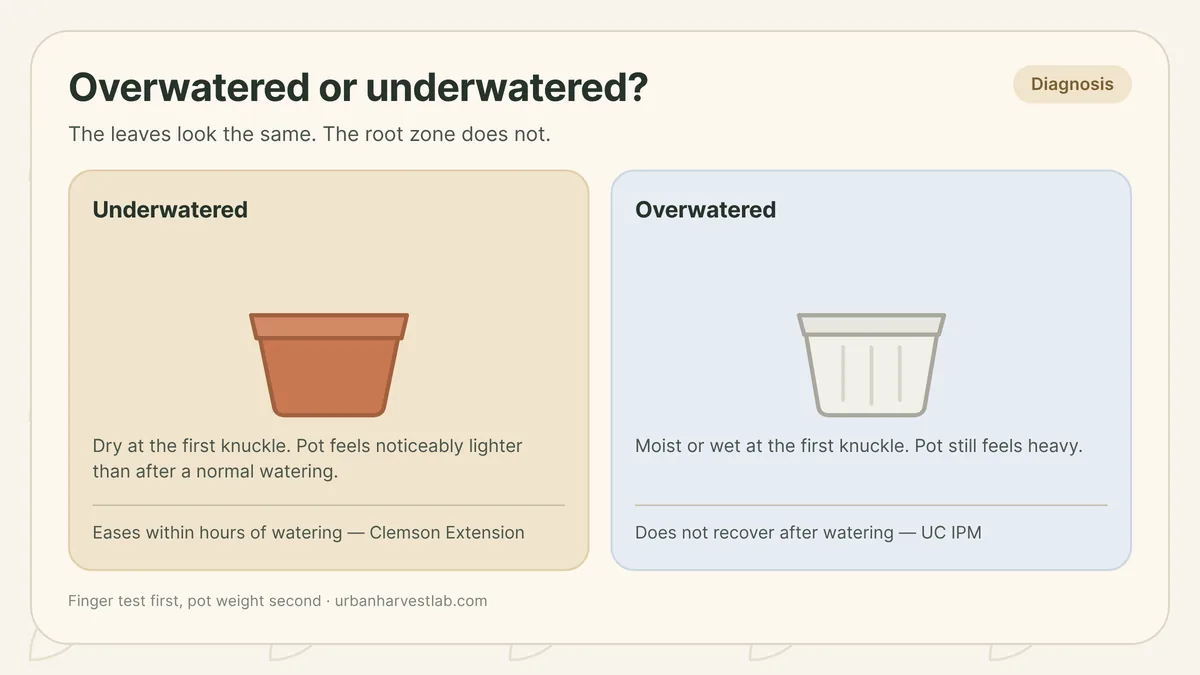
Overwatered vs underwatered: how to tell which one you have
Reading the root zone directly, with a finger test, pot weight, and how the plant responds to being watered, settles what the leaves alone cannot.
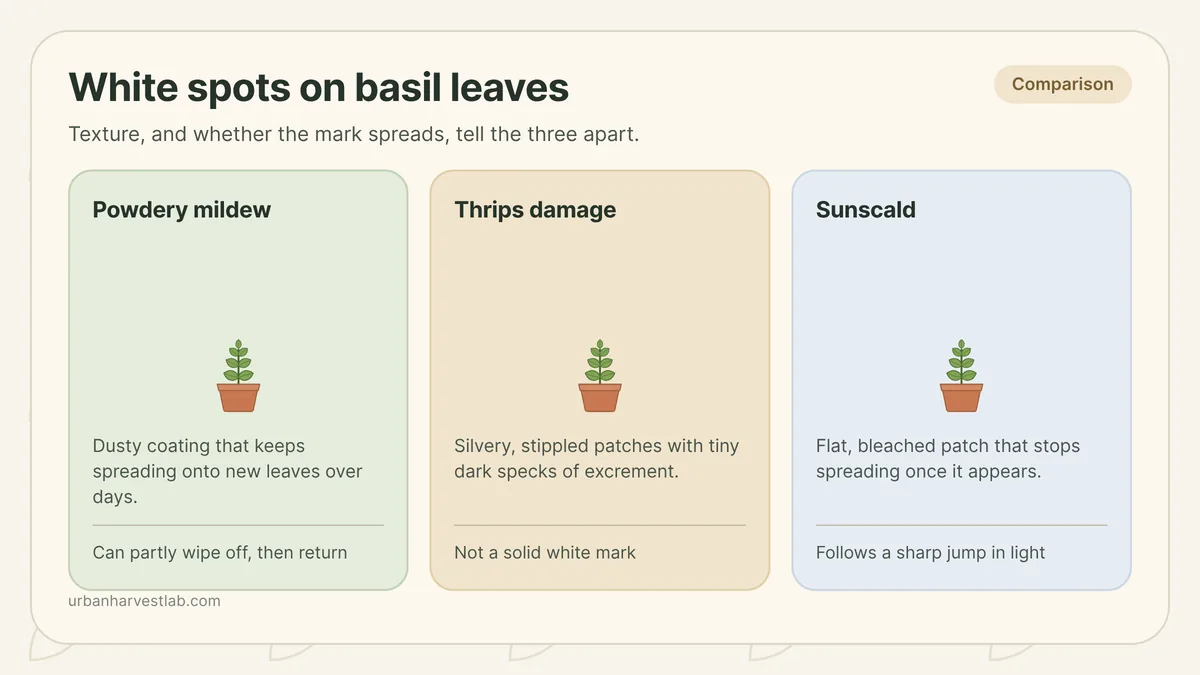
White spots on basil leaves: mildew, thrips, or sunscald
White spots on basil usually come from one of three different causes, and a hand lens plus a few days of watching tells you which.