Troubleshoot the system before you change the inputs.
Symptoms
- Rusty brown scars or tunnels on the surface of the root, sometimes with slender creamy-yellow maggots inside.
- Roots scarred and prone to rot. UC IPM reports no aboveground symptoms, so check the roots rather than the foliage.
- Damage that appears in summer or autumn on carrots, parsnips, parsley or celery grown nearby.
Possible causes
- Carrot fly larvae feeding on the root after eggs were laid at the base of the plants.
- Foliage disturbed by thinning, which releases a smell that attracts egg-laying females.
- Overwintered pupae in reused soil, now emerging under your netting.
Quick fixes
- Cover the whole pot with insect-proof netting from sowing, using fresh mix.
- Sow sparsely so you do not have to thin (RHS).
- Time sowing and harvest to miss the egg-laying periods in your climate.
- Lift carrots in one go rather than leaving them in the pot over winter.
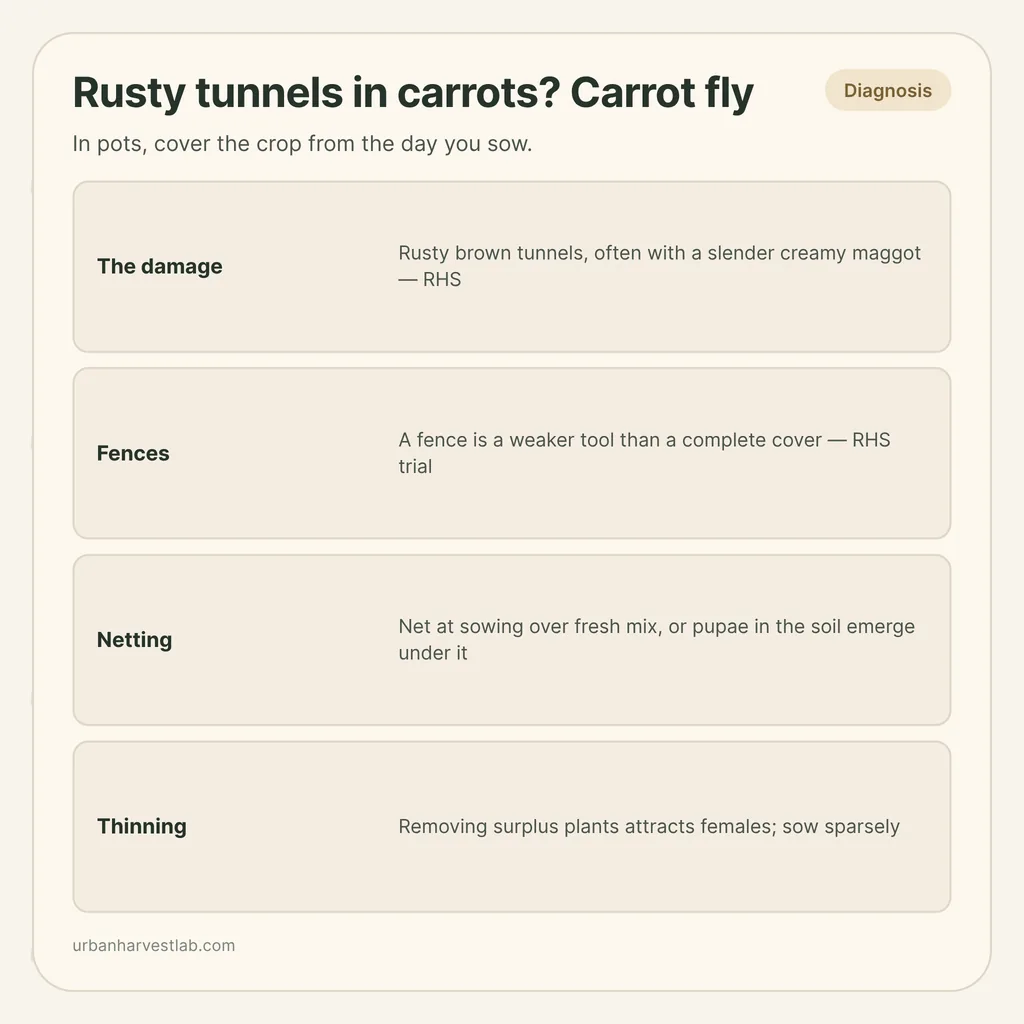
Rusty brown tunnels in a carrot root, often with a slender creamy maggot inside, mean carrot fly. In pots the fix that the research supports is a complete cover of insect-proof netting over fresh mix from the day you sow, plus sowing or harvesting outside the fly’s egg-laying windows.
The RHS lists carrot, parsnip, parsley, celeriac and celery as the plants affected, and describes the adult as a small black-bodied fly. The damage is done by its larvae, which first feed on fine roots and later bore into the tap root. The brown scars are where tunnels near the surface have collapsed. Rutgers Extension notes the tunnels turn rusty red from the frass the larvae leave, and that the open holes make the root easier prey for soft rot bacteria.
If the carrots are misshapen rather than tunnelled, the cause is different: see why carrots turn out forked or stunted.
Does a tall pot or a balcony stop it?
Not on its own, as far as the research shows. The RHS describes carrot fly adults as weak fliers, which is why fences around carrot beds are widely recommended. It tested fences at 60 cm, the height most usually recommended for home gardeners, and 90 cm, alongside a complete netting cover and no protection. The published result from the RHS and University of Warwick was that some vertical barriers protected early-season carrots usefully, but under the cumulative pressure of several generations of carrot fly they provided insufficient protection.
That trial used fences around beds, not raised pots, so it does not tell you how high is high enough for a container. What it does tell you is that a fence is a weaker tool than a cover. Its authors concluded that gardeners should completely cover the crop, which mattered most for carrots harvested later in the season. The RHS repeats this in its pest profile: a complete covering is more effective than a barrier.
So a tall planter or a high balcony may help, but it is a gamble you do not need to take. A cover over the pot is the option the trial supports. If you are choosing one, browse insect netting on Amazon and look for a fine, insect-proof mesh that is big enough to drape over the whole pot.
Netting only works on clean soil
Cover the pot at sowing, before any fly has laid eggs. The RHS adds a condition that matters in containers: crop rotation is essential with netting, otherwise adult carrot flies may emerge within the protected crop from overwintered pupae in the soil. Rutgers lists rotation after 3 years and removing plant residue among its measures.
In practice that means fresh potting mix for carrots, or a pot that did not hold carrots, parsnips, parsley or celery last season. If the pot was attacked, do not simply net it again with the same mix.
Rutgers also calls floating row covers highly effective, and UC IPM says covering seedbeds with row cover, or individual plants with protective cones, may help prevent infestations.
Thinning calls the flies in
The RHS says females searching for egg-laying sites are attracted by the smell released when surplus plants are removed. Its advice is to sow sparsely to avoid thinning.
Time the crop to miss the flies
The windows depend on where you live, and the sources give different dates because they describe different climates.
- United Kingdom (RHS): eggs are laid in late May to June and again in August to September, and two or three generations can develop between late spring and autumn. Carrots sown after mid-May avoid the first generation, and carrots harvested before late August avoid the second.
- New Jersey (Rutgers): delaying sowing until after mid-June avoids the peak egg-laying period, though the page says this has to be balanced against potential yield reductions.
- California guidance (UC IPM): plant to avoid the egg-laying periods. In cold areas that means early summer; in milder areas, late winter or late summer.
Whichever applies to you, lift the crop as soon as it is ready. UC IPM advises harvesting carrots as soon as possible, in blocks rather than selectively, and not leaving them in the ground over winter. It also says damaged areas can be peeled off before using the carrots. If you want a long harvest window on a balcony, season extension on a balcony covers netting and timing more broadly, and the right pot size is in how deep a container carrots need.
Varieties help, but only partly
The RHS names ‘Fly Away’, ‘Maestro’, ‘Resistafly’ and ‘Sytan’ as less susceptible to carrot fly, and stresses they are less susceptible rather than fully resistant. Treat them as an extra layer under netting, not a substitute for it.
If you grow leeks, onions or garlic nearby and see a different pattern of damage, that is a separate pest: allium leaf miner.
Sources
Carrots in pots, start to finish
Root shape, pot depth and protecting the crop on a balcony.
Common questions
What do carrot fly tunnels look like?
The RHS describes tap roots with rusty brown tunnels and slender creamy-yellow maggots up to 9 mm long. Rutgers adds that the tunnels turn rusty red from the frass the larvae leave, and the open holes let soft rot bacteria in.
Does a tall pot or balcony keep carrot fly away?
Not reliably. The RHS describes carrot fly adults as weak fliers, which is why fences are sold as barriers, but a University of Warwick trial found that vertical barriers gave insufficient protection once several generations built up. The advice from that work is to cover the crop completely.
When should I sow carrots to avoid carrot fly?
It depends on your climate. The RHS says carrots sown after mid-May avoid the first generation and carrots harvested before late August avoid the second. Rutgers says delaying sowing until after mid-June avoids the peak egg-laying period in New Jersey. UC IPM suggests early summer sowing in cold areas.
Can I reuse the soil after a carrot fly attack?
Treat it with suspicion. The RHS warns that if you net a crop over soil holding overwintered pupae, adult flies may emerge inside the protected crop. Use fresh mix or move to a different pot, and rotate carrots to a new position each year.
Related guides

Why are my carrots deformed? Forked, stunted and hairy roots
A carrot root takes the shape of whatever it meets on the way down. Read the deformity, find the cause, and fix it before the next sowing.
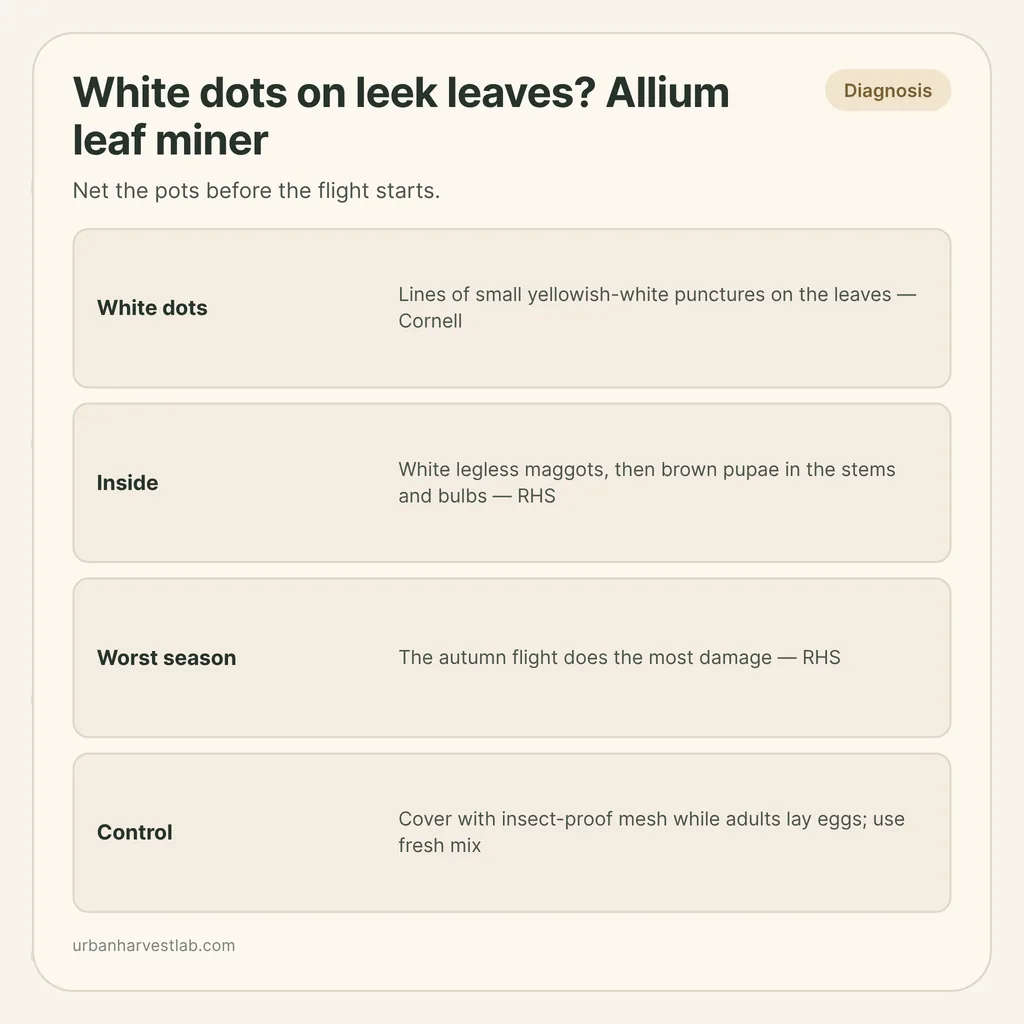
Allium leaf miner: white dots on leeks, rotting shanks and when to net
Lines of white dots on leek or chive leaves, brown pupae in the shank, rot in autumn. How to confirm allium leaf miner and keep the flies off.
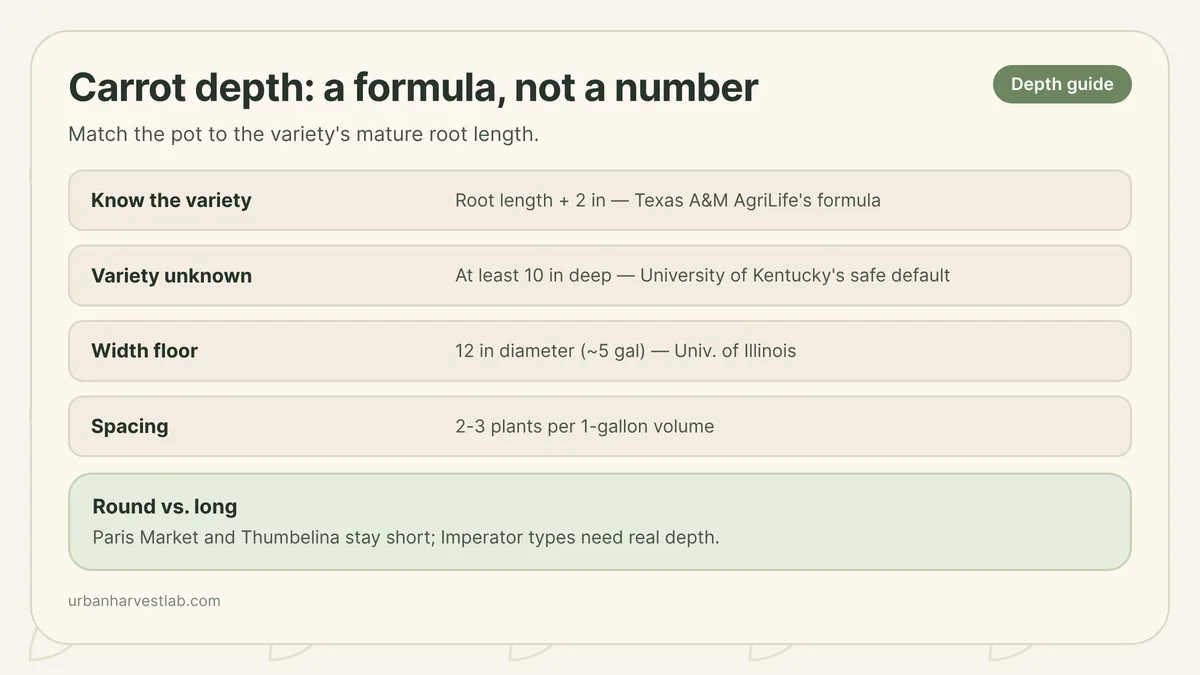
Growing carrots in containers: how deep the pot needs to be, by variety
A round baby carrot and a long, tapering Imperator need very different container depths. Match the pot to the variety instead of guessing one number for every carrot.