Troubleshoot the system before you change the inputs.
Symptoms
- Roots split into two or more legs near the tip.
- Short, stubby roots, or lush tops over a tiny root.
- Fine hair-like side roots along the carrot, sometimes with yellow or purplish tops.
Possible causes
- Hard, compacted or stony growing medium that blocks the taproot.
- Fresh manure or too much nitrogen.
- Seedlings left unthinned, or carrots transplanted.
- Uneven watering, nematodes or aster yellows.
Quick fixes
- Sow again in loose, stone-free mix and sow in place rather than transplanting.
- Thin to 2 to 3 inches apart while the foliage is 3 to 4 inches tall.
- Skip fresh manure and heavy feeding; keep moisture even.
- Look for galls on the roots, and replace the soil if you find them.
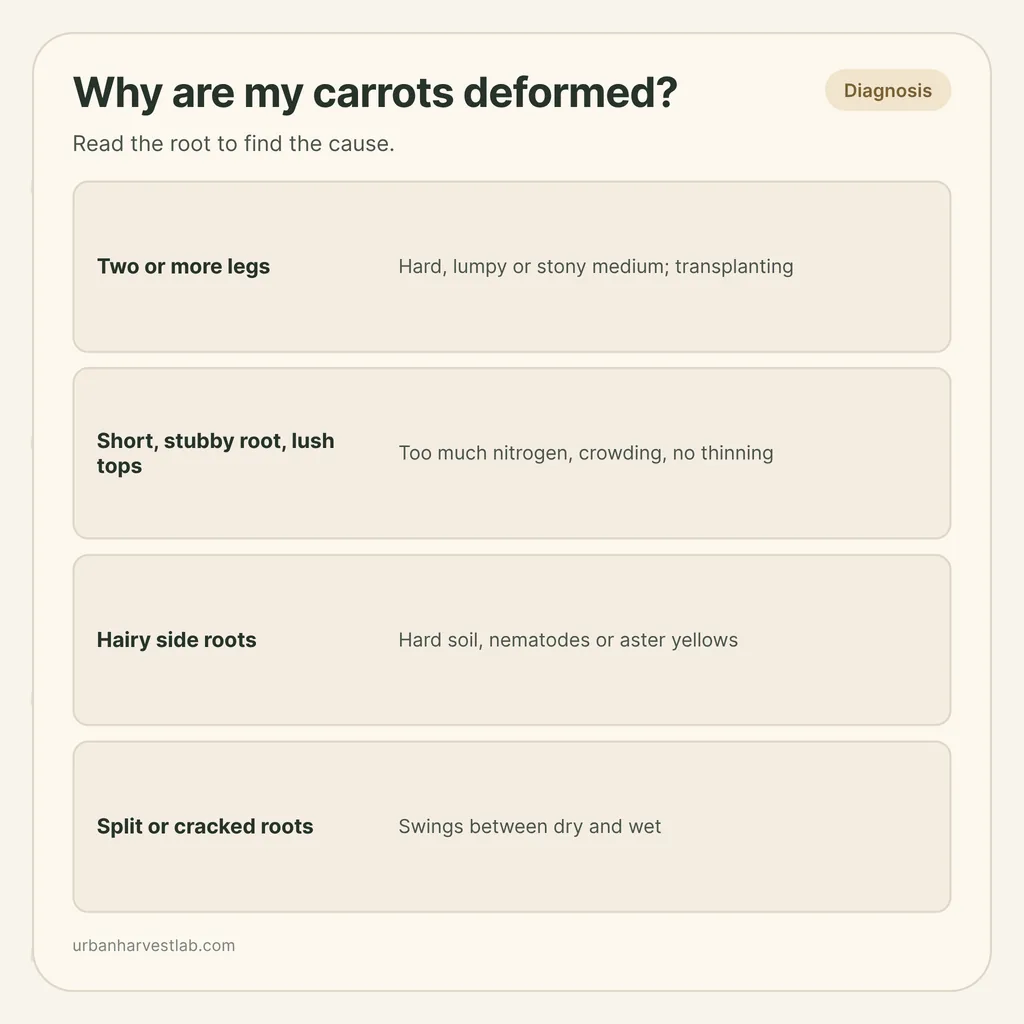
A deformed carrot is almost always a root that met resistance or competition: hard or stony growing medium, fresh manure or too much nitrogen, crowding, or uneven water. The shape tells you which. Forks point to obstruction, a short root under lush tops points to nitrogen or crowding, and hair points to hard soil or disease.
If the problem is that the pot was simply too shallow for the variety, the carrot container depth guide has the sizing rule. Everything below is about what else bends a root. For the wider set of crop problems, start from the plant problems hub.
Read the root
| What you see | Most likely cause | Check |
|---|---|---|
| Two or more legs near the tip | Hard, lumpy or stony medium; transplanting | Squeeze the mix; did you move seedlings? |
| Short, stubby root, big lush tops | Too much nitrogen, crowding, no thinning | Feeding history; spacing |
| Hairy side roots | Hard soil, nematodes or aster yellows | Galls on roots; yellow or purple tops |
| Split or cracked roots | Swings between dry and wet | Watering pattern |
Hard, stony or lumpy medium
Iowa State Extension says carrots and parsnips grown in compacted or heavy soils produce stunted, forked or twisted roots. UC IPM adds that carrots planted in hard soil may be hairy, forked and misshapen, and its fix is a light soil such as sandy loam with the rocks removed.
In a pot the equivalent is dense, clumpy or crusted mix, bark chunks, perlite lumps, or old compacted mix from last season. Penn State’s PlantVillage guide has you remove rocks and break up hard lumps to at least 12 inches deep (30 cm) before sowing. A fine, loose, evenly textured mix gives the taproot a clear run. The DIY potting mix for container vegetables covers building one, and reusing potting mix explains why last year’s mix needs loosening and sieving before it holds roots again.
Fresh manure and too much nitrogen
Iowa State says fresh manure will reduce or stunt root development because of its high nitrogen levels. Penn State’s guide says to avoid fresh manure because it can cause forking. Iowa State also says excessive nitrogen or overcrowding may produce plants that are all tops with lush foliage but little or no root development, and South Dakota State says too much nitrogen will decrease root growth.
So a carrot bed or pot that looks wonderful above ground and disappointing below is a feeding clue. Cut back on fertiliser and leave out raw manure. Iowa State adds a second reason to avoid it: carrots are often eaten raw and fresh manure can carry disease-causing microorganisms.
Late or skipped thinning
South Dakota State says all tops and no roots, or small roots, is usually caused by planting too close or not thinning. It thins carrots once they reach a small edible size, with foliage 3 to 4 inches tall, to about 2 or 3 inches apart, or the roots will not develop properly. Penn State thins earlier, at 1 inch of seedling height, to a final 3 inches, snipping with scissors to avoid damaging the roots of neighbours.
Snipping rather than pulling matters for the same reason: yanking one seedling out of a crowded row drags its neighbours. The timing and method are in how to thin seedlings in pots.
Transplanting
South Dakota State says carrots should not be transplanted, because as they develop the roots will fork. Sow the seed where the carrot will grow. By that reasoning, moving thinnings to another pot is likely to fork them too.
Uneven water
Iowa State says inconsistent moisture can cause roots to split or crack, and that crusting of the soil surface and dry soil may result in poor germination. UC IPM says to keep soil moisture uniform at seed depth until the seedlings emerge. South Dakota State says carrots in dry soil may become misshapen. UC IPM also lists overwatering among the causes of forking and stubbing, so the target is even moisture rather than more water. How often to water container vegetables covers the schedule.
When it is not the mix
Two diseases can mimic a bad-soil carrot.
- Root-knot nematodes. Utah State Extension says their feeding causes the root to become forked, distorted or stunted, and the University of Maryland Extension says affected carrots may be deformed or have hairy roots with nodules. If you see galls or nodules, the soil is the problem. If the mix came from a garden bed, replace it.
- Aster yellows. South Dakota State describes hairy roots with yellow or purplish tops, spread by aster leafhoppers. Yellow or purple foliage on a hairy carrot points here rather than to hard soil.
What to do next sowing
- Fill the pot with loose, stone-free mix, broken up to the full depth.
- Skip fresh manure and heavy feeding.
- Sow where the carrots will stay.
- Keep the mix evenly moist through germination and after.
- Thin early, by snipping, to the spacing above.
Carrots that have already set their shape will not straighten out. Thin the rest so the survivors have room.
Sources
Fixing the pot behind the problem
Pot depth, mix and watering decide most carrot shapes.
Common questions
Why are my carrots forked?
The growing tip hit something. UC IPM says carrots planted in hard soil may be hairy, forked and misshapen, and Iowa State links compacted or heavy soil to stunted, forked or twisted roots. Stones, lumps, fresh manure and transplanting are the usual triggers.
Why are my carrots short and stubby with big tops?
Too much nitrogen or too little room. Iowa State says excessive nitrogen or overcrowding can give plants that are all tops with little or no root, and South Dakota State blames planting too close or not thinning.
Why are my carrots hairy?
Hard soil can do it (UC IPM). Root-knot nematodes give hairy roots with nodules (University of Maryland Extension), and aster yellows gives hairy roots with yellow or purplish tops (South Dakota State). Check the tops and look for galls.
Can I fix deformed carrots that are already growing?
No. A root keeps the shape it grew into. Thinning the rest early helps the survivors, and the cause has to be fixed at the next sowing.
Related guides
Growing carrots in containers: how deep the pot needs to be, by variety
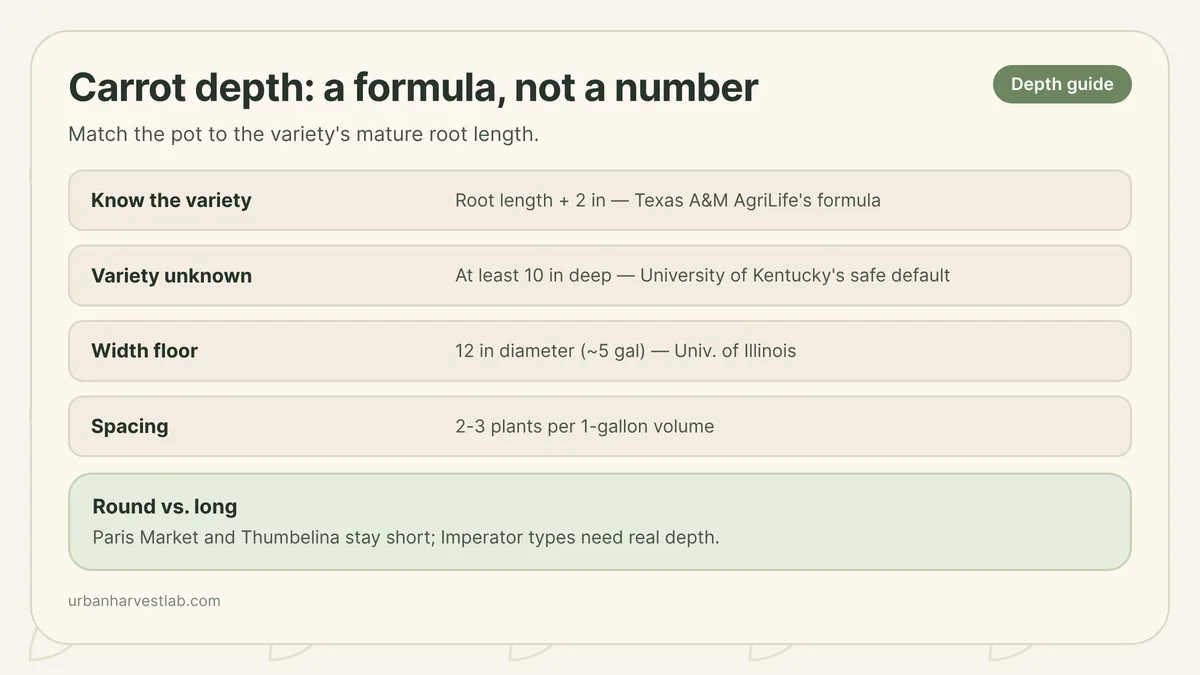
A round baby carrot and a long, tapering Imperator need very different container depths. Match the pot to the variety instead of guessing one number for every carrot.

How to thin seedlings in pots: when to cut, what to keep
Seed packets ask you to sow thick and then remove most of what comes up. Here is when to do it in a pot, how to cut without hurting the keepers, and what to do with the extras.

Earwigs in potted plants: harmless, helpful, or pest?
Earwigs in a pot are usually sheltering, and they eat aphids. They only earn a trap when you can show they are chewing seedlings, lettuce, or soft fruit.