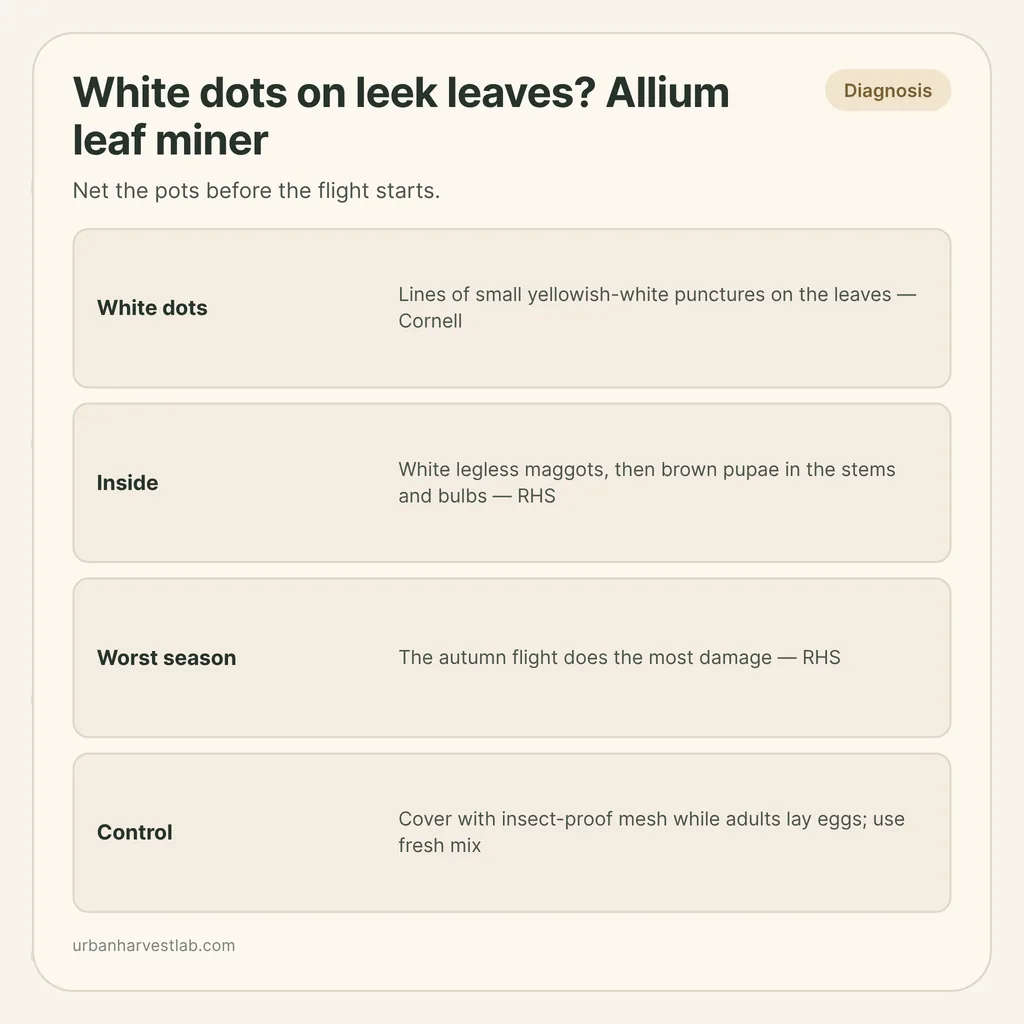
Troubleshoot the system before you change the inputs.
Symptoms
- Lines or clusters of small white or yellowish-white dots near the leaf tips
- Leaves that twist, curl or look wavy and distorted
- Small brown, seed-like pupae inside the leaf bases, shank or bulb
- Yellowing leaves and soft rot at the base, mostly in autumn
Possible causes
- Allium leaf miner (the dots are the first sign; pupae and rot follow)
- Leek moth, onion fly or black onion fly (similar rot, different larvae)
- Spring weather stress (RHS notes it can cause similar leaf distortion)
Quick fixes
- Peel back the outer leaves of a suspect plant and look for maggots or brown pupae
- Pull and destroy infested plants
- Cover remaining alliums with fine insect netting before the next flight
- Do not replant alliums in the same pot mix if it held infested plants
White dots in lines on leek, onion, chive or garlic leaves, with brown pupae or rot at the base, mean allium leaf miner (Phytomyza gymnostoma). Once larvae are inside, the practical fix is to remove infested plants and net the rest before the next flight.
The RHS lists the hosts as leeks, onion, chives, shallot and garlic. The adult is a small fly, about 3 mm, and you will probably not spot it. You see what it leaves behind. If you grow alliums in pots, the same pests turn up on your balcony as in a field. For growing the crops themselves, see leeks in containers and garlic in containers.
What you will see, in order
White dots first. Cornell Cooperative Extension calls them small yellowish-white leaf punctures, made only by the female. The RHS adds that the female feeds on the sap that leaks from these punctures before laying eggs, which is why they show up as lines of dots. University of Maryland Extension notes the punctures may be the first sign of damage.
Twisted leaves. Cornell says the larval feeding can make onion and leek leaves wavy, curled and distorted. The RHS warns that in spring this can look like distortion caused by changing weather, so dots plus distortion is the combination to look for, not distortion alone.
Maggots, then pupae. The RHS describes the larvae as white, headless maggots without legs that tunnel through foliage, stems and bulbs. University of Maryland Extension gives final-stage larvae as up to 8 mm. The pupae are cylindrical and brown, about 3 mm according to the RHS, embedded in the stems and bulbs. Cornell notes that on leeks and garlic you often have to peel back leaves to find them.
Rot. The RHS says the most obvious signs come when rotting sets in, particularly in autumn. Cornell explains why: the feeding creates entry routes for bacterial and fungal pathogens. A leek that looked fine from outside can be soft at the base.
| What you find | Likely cause | Check |
|---|---|---|
| Lines of white dots, white legless maggots, brown pupae | Allium leaf miner | Peel back the leaves around the shank |
| Creamy white larvae with brown heads and small legs | Leek moth | The RHS separates them by the brown head and legs |
| Rot at the base with no dots | Onion fly, black onion fly or plain rot | Cornell lists both flies as causing similar rotting |
Why the autumn flight matters most
Two flights a year, and the two sources give slightly different windows:
- The RHS gives March to June and September to November overall, with peak activity in March to April and September to November. It calls the second generation usually the most damaging.
- Cornell gives spring emergence from March through early June, lasting about six weeks, and autumn emergence from late August through October, lasting six to eight weeks. It says the potential for damage is higher in autumn across all alliums.
Cornell’s susceptibility ratings are useful if you choose what to plant. In the spring flight, garlic rates medium, shallots and direct-seeded onions low, and scallions and chives high. In the autumn flight, leeks, bunching onions, scallions and chives all rate high. University of Maryland Extension also describes leeks as tending to be the most damaged host.
The flies overwinter as pupae in plant tissue or the surrounding soil, according to University of Maryland Extension, and the first-generation pupae rest through summer. That is why an allium crop that looked fine in July can be riddled by October.
Netting is the control to plan around
The RHS says plants can be effectively protected by covering them with insect-proof mesh while adult flies are active and laying eggs. Cornell says to cover before or just after adult emergence in both flights. University of Maryland Extension goes earlier: cover in February before spring emergence and keep covering through it, and cover autumn plantings during the second flight.
A practical sequence for pots:
- Inspect before you plant. Cornell advises checking transplants and bulbs for punctures, larvae and pupae.
- Cover the pots before the flight starts, and watch the dates above. Cornell recommends looking for adult flies and punctures from late March and again in early September.
- Keep the cover on through the flight, then reassess. Cornell cautions that higher levels of certain allium diseases such as Botrytis have been observed with row cover, so check under it.
- If you see punctures on more than one or two plants, Cornell says it is probably too far into the flight for exclusion to work well.
If you are shopping for the cover, browse insect netting on Amazon. The sources describe “insect-proof mesh” and “insect netting” without giving a hole size, so look for netting sold for insect exclusion.
One catch matters for container growers. The RHS says adults might emerge from pupae underneath the covering if susceptible plants grow in the same ground in successive years, and Cornell says exclusion will not work if infested alliums, including wild onion grass, grew in the same plot the previous season. Fresh potting mix and cleaned pots are the pot-sized version of crop rotation; that is a reasonable inference from those warnings rather than something either source tests.
If plants are already infested
Cornell advises destroying infested plant material by burning, solarizing or burying it as deep as possible. The RHS notes that pupae can end up in the soil where plants have rotted off, so the debris is part of the problem. University of Maryland Extension notes pupae may move into the soil. Treat the spent mix from infested pots the same way.
On sprays, the extension sources are cautious. Cornell says to look for spinosad-based products labelled for dipteran leafminers, some of which are labelled for organic gardening. Its field trials found that two applications timed in the second and fourth weeks after first observed activity reduced damage significantly. University of Maryland Extension names azadirachtin and spinosad for organic growers and says to follow label instructions. It also notes that EPA registrations vary among allium crops, so confirm that your crop is on the label and check the days-to-harvest interval. Neither page gives a rate for a home gardener, so the label is the only dose to follow. For choosing between options on edible plants, see choosing a pest treatment for edible plants.
University of Maryland Extension also suggests keeping leeks as far as possible from chives, and Cornell suggests delaying planting to avoid the spring egg-laying period or harvesting early to avoid the autumn one. With pots, you can move them; whether distance helps on a balcony is not tested in these sources.
Not the same as broadleaf leaf miners
Allium leaf miner is a different fly from the ones that scribble trails across basil or spinach leaves. Those are covered in leaf miners on basil and greens. The allium fly’s larvae move down toward the bulb and base, which is where the damage that matters happens.
Sources
Growing alliums and handling leaf-mining pests
Container allium guides and the broadleaf leaf miner page.
Common questions
What are the rows of white dots on my leek leaves?
Cornell Cooperative Extension describes small yellowish-white punctures made only by the female fly, and the RHS describes distinctive lines of white dots on the foliage. They are the first sign of allium leaf miner, and they appear before the larvae do.
When do I need to cover alliums against allium leaf miner?
The RHS gives peak adult activity as March to April and September to November. Cornell puts the spring emergence at March through early June and the autumn emergence at late August through October. Cover before the flight starts, and inspect from late March and again in early September.
Is it allium leaf miner or leek moth?
Both cause similar rot. The RHS says leek moth larvae are creamy white with brown heads and small legs, while allium leaf miner maggots are white, headless and legless. Cornell adds onion fly and black onion fly as other causes of the same rotting.
Can I just spray it?
Cornell says to look for spinosad-based insecticides labelled for dipteran leafminers, and University of Maryland Extension names azadirachtin and spinosad for organic growers, both with the instruction to follow label directions. Neither source gives a home-gardener dose, so use only what the label of a product registered for your allium crop says.
Related guides
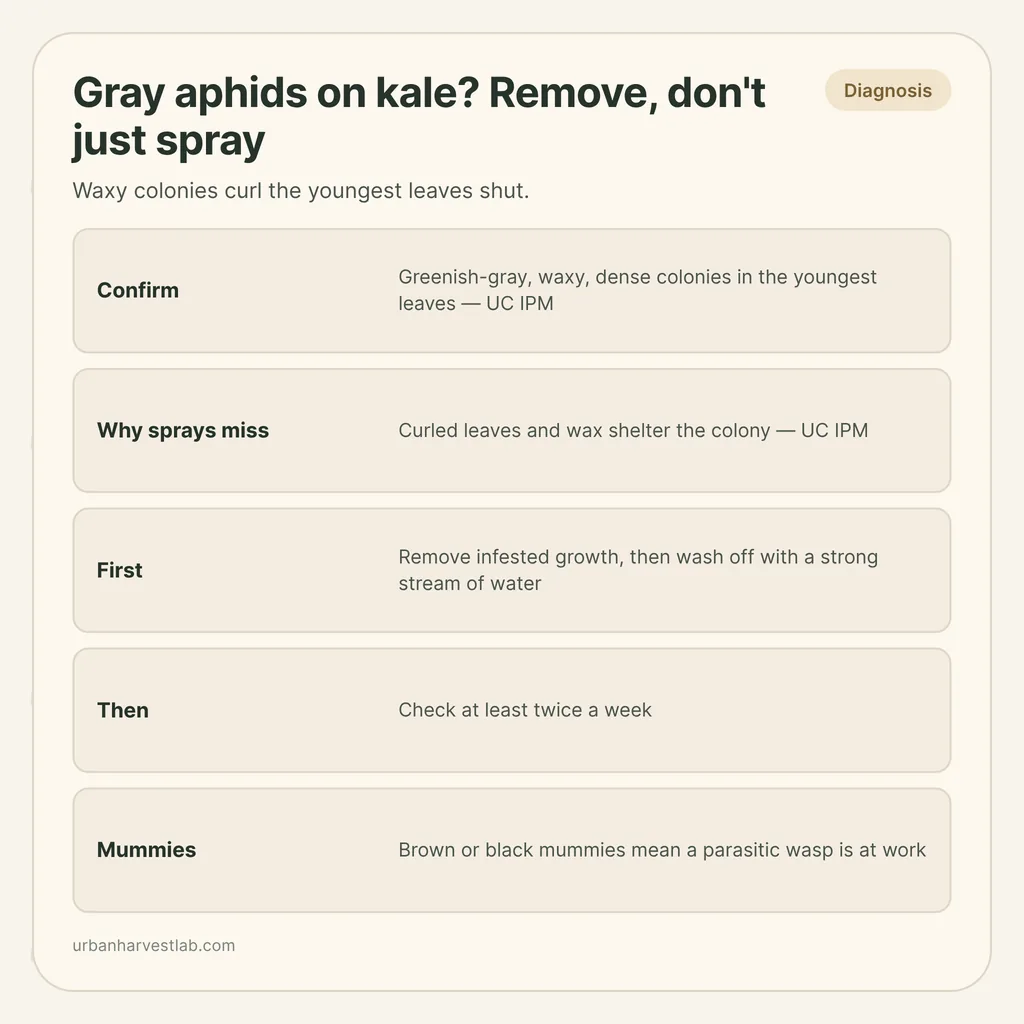
Gray aphids on kale, broccoli and cabbage: why soap struggles and what works
Cabbage aphids pack into the youngest leaves, curl them shut and wear a waxy coat that makes sprays unreliable. Here is how to confirm them, what UC IPM says to do, and when to stop eating from the plant.
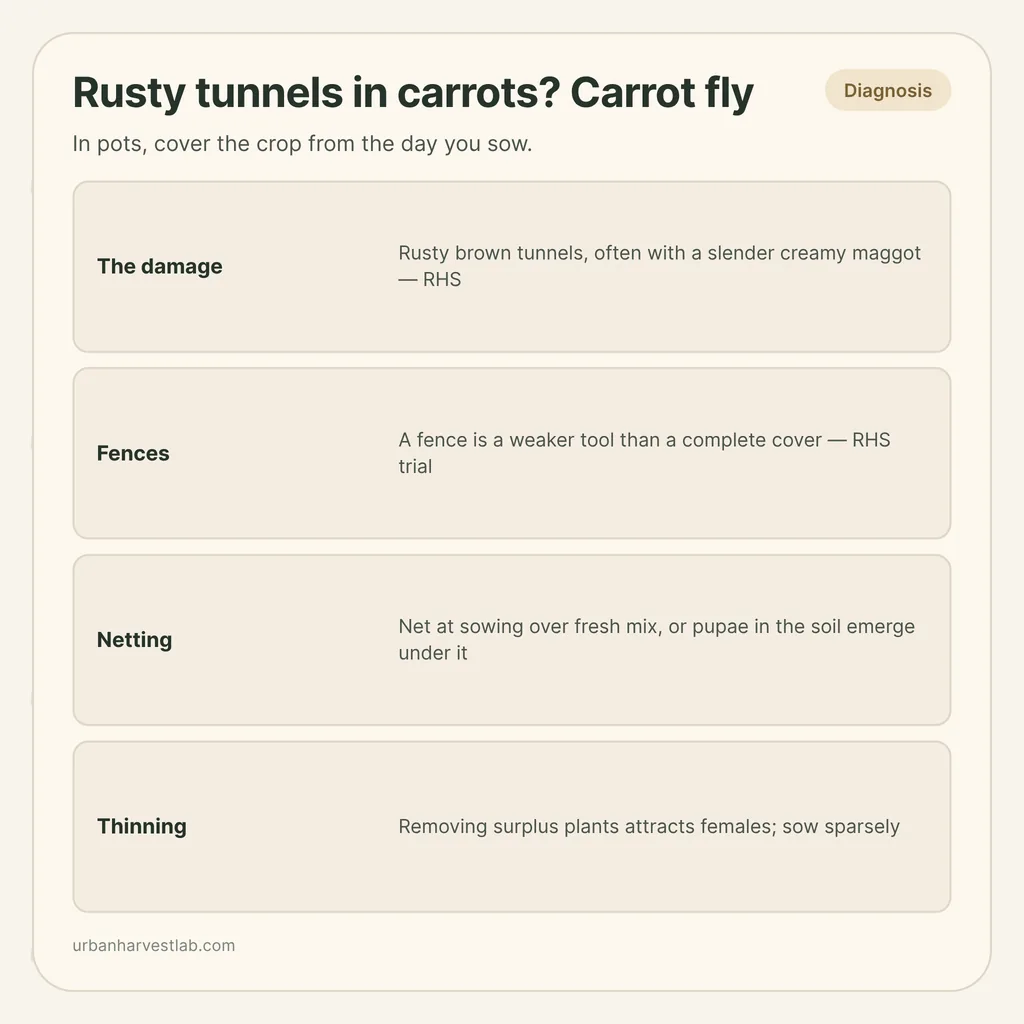
Carrot fly in containers: rusty tunnels, why pot height is not a fix, and netting
Carrot fly maggots tunnel into the root and leave rusty scars. A complete cover over the pot, sown or harvested outside the egg-laying windows, is what the research supports.
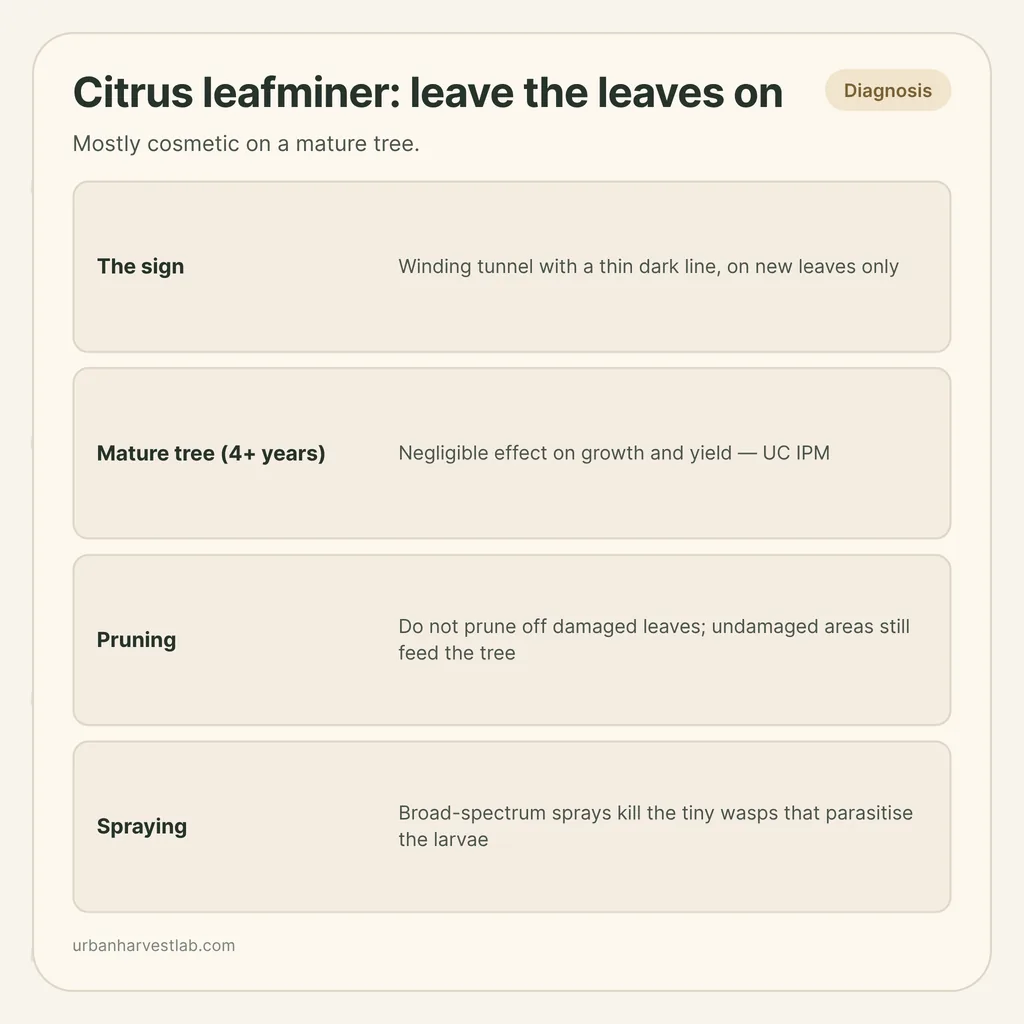
Citrus leafminer: curled new leaves, winding tunnels and why not to prune
Rolled, distorted new growth with a squiggly tunnel inside is citrus leafminer. On mature trees it looks worse than it is, and the usual reflexes, pruning and spraying, tend to make it worse.