Troubleshoot the system before you change the inputs.
Symptoms
- New leaves on citrus are rolled at the edge and look distorted
- A winding, shallow tunnel runs through a young leaf, with a thin dark line down the middle
- Only the soft, recently opened flush is affected; hardened older leaves look normal
- Damage appears in waves, soon after the tree puts out a burst of new growth
Possible causes
- Citrus leafminer (Phyllocnistis citrella): larvae mining new leaves, then rolling the edge to pupate
- Citrus peelminer: a similar moth, but its larvae leave no frass trail and attack fruit and stems rather than new leaves
- Nutrient shortage: yellowing with flat, unmined leaves points elsewhere
Quick fixes
- Leave the damaged leaves on the tree; the undamaged areas still make food
- Prune live branches no more than once a year, so flushes come in uniform, short cycles
- Hold back nitrogen fertiliser in summer and fall, when leafminer numbers are high
- Remove water sprouts and rootstock suckers, which keep producing soft growth the moths favour
- Avoid broad-spectrum sprays so parasitic wasps survive
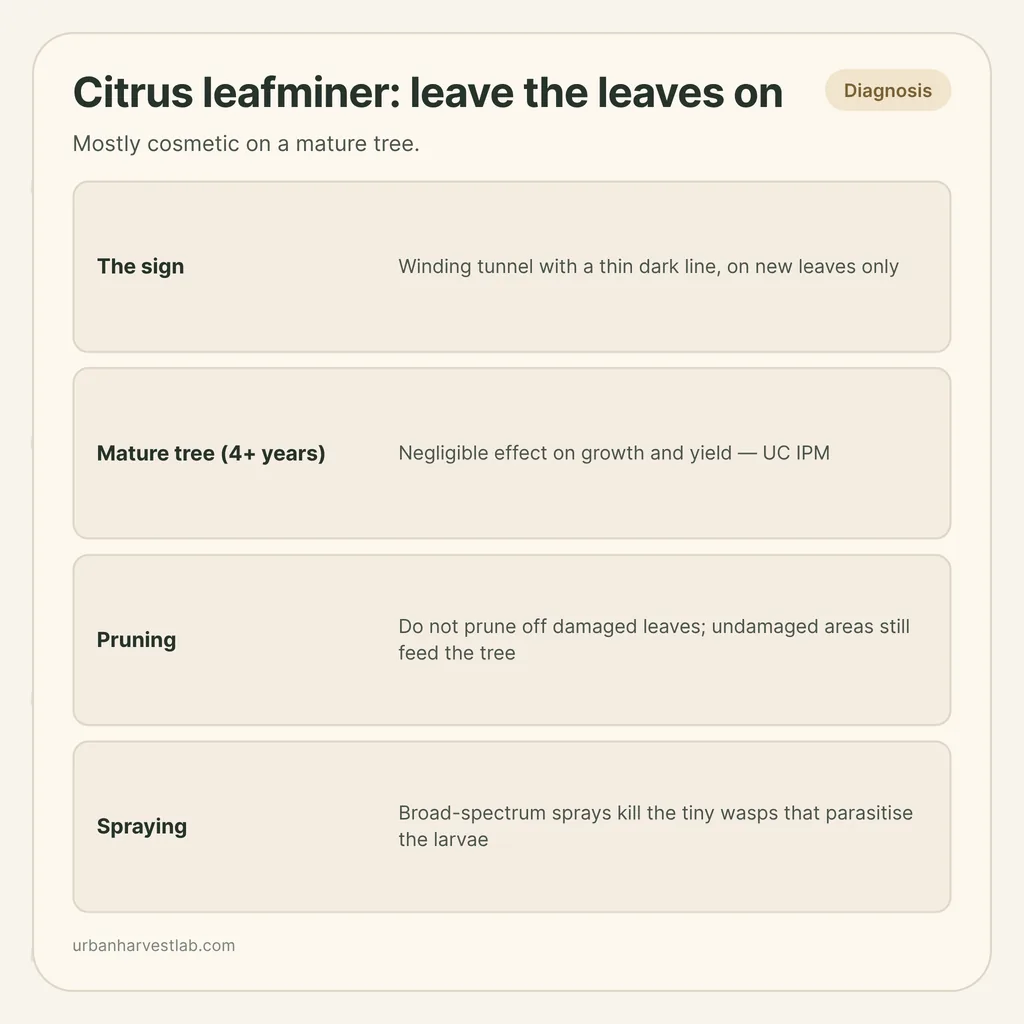
Rolled, twisted new leaves with a winding tunnel inside are citrus leafminer, and on a mature tree the damage is mostly cosmetic. Leave the leaves on, skip the pruning shears and go easy on sprays. The reflexes most people have, cutting off the ugly growth and spraying whatever is on the shelf, are the two that work against you.
If the leaves are yellow rather than mined or curled, that is a different problem: see why citrus leaves turn yellow indoors. For the tree itself, growing dwarf citrus in pots covers the basics.
How to tell it is citrus leafminer
The pest is a tiny moth, but it is rarely seen. UC IPM describes the adult as less than 1/4 inch long, resting under leaves by day. What you see is the larva’s work.
Look at the soft, newly opened leaves. The larva feeds in a shallow, meandering tunnel just under the leaf surface, and as it grows it leaves a thin dark line of droppings along the middle of that tunnel. UC IPM uses that dark line as the identifying feature. When the larva is done feeding, it moves to the leaf edge, rolls the edge around itself and pupates inside. That rolled, distorted leaf is the symptom most people notice first.
Two checks help confirm it:
- Only new growth is hit. UC IPM says the larva survives only in the tender, young, shiny flush. Leaves that have hardened off are not susceptible unless populations are extremely high.
- The tunnel has a frass line. The citrus peelminer, a similar moth, leaves no frass trail and attacks fruit and stems rather than new leaves, according to UC IPM.
Leafminer tunnels on citrus are the same kind of damage as the tunnels in basil and greens, but the insects, timing and responses differ. For vegetables and herbs, see leaf miners on basil and greens.
Why it comes in waves
Females lay single eggs on the underside of leaves, and UC IPM says newly emerged leaflets, particularly along the midvein, are the preferred spot. The UC IPM home-garden note gives egg hatch at about 1 week; the UC agricultural guidelines say 4 to 5 days. Larvae molt four times over a 2 to 3 week period in the home-garden note (1 to 3 weeks in the agricultural guidelines), and the pupal stage lasts 1 to 3 weeks. The whole cycle takes 3 to 7 weeks in the home-garden note and 2 to 7 weeks in the agricultural guidelines, depending on temperature.
UC IPM says the insect develops best at 70 to 85 °F with relative humidity above 60%. In California it is active from mid-summer through fall and early winter. The practical point is that a pulse of new growth on your tree is what sets off an outbreak. No new flush means nothing for the moths to use.
How much it matters
This depends mostly on the age of the tree.
| Tree | What UC IPM says |
|---|---|
| Mature, over 4 years old | Tolerates damage on new leaves with negligible effect on growth and fruit yield |
| Young, under 4 years old | Growth can be reduced, since there is little mature foliage and more flush; even heavy infestations are unlikely to kill it |
A small tree you bought recently falls in the second group, so it deserves a closer look than a large established one. Coastal lemons are the exception UC singles out among mature trees: they flush repeatedly, and the agricultural guidelines note that damaged leaves are weaker and more open to wind damage and other pests. In Florida, UC IPM notes that the mines create openings for citrus bacterial canker to enter; it adds that this disease is not found in California.
What to do
Leave the leaves alone. UC IPM says not to prune off damaged leaves, since the undamaged areas keep producing food for the tree.
Prune less. The moths are attracted to new flush, so UC IPM advises pruning live branches no more than once a year, which keeps flushing cycles uniform and short. Once leaves harden, they can no longer be mined.
Time the fertiliser. UC IPM advises against nitrogen fertiliser when leafminer numbers are high and flush would be badly damaged, such as summer and fall. Leaf colour is a separate question; the yellow-leaves page above covers feeding.
Take out water sprouts. Where leafminer is a problem, UC IPM recommends removing the vigorous water sprouts that grow on branches and above the graft union, because they produce fresh leaves for a long time and attract egg-laying. Suckers from below the graft union should be removed in any case, UC says.
Protect the wasps. UC IPM names tiny, nonstinging wasps, including Cirrospilus and Pnigalio species, that lay eggs in the mine so the wasp larva eats the leafminer larva. It says you do not need to buy or release them, and advises against broad-spectrum sprays. Frequent use of malathion, carbaryl or pyrethroids can also allow whiteflies and scale to build up.
When spraying is on the table
UC IPM says many insecticides sold for home use do not control citrus leafminer well, because they have trouble reaching larvae inside the mines. Mature trees rarely if ever need treatment. Very young or high-value trees are where treatment may be justified.
For those, UC IPM says products containing azadirachtin or spinosad show some efficacy against larvae and are safe for natural enemies, but their residues do not last, and they may need reapplying every 7 to 14 days. It also describes a systemic soil product, imidacloprid, with a bee warning around bloom. Read the label of whatever you buy for the allowed crop and interval, since this fruit goes in your kitchen; choosing a pest treatment for edible plants covers how to weigh that.
Pheromone traps catch only males and UC IPM says they are for detecting moths and timing, not for control.
Sources
More on citrus and leaf miners
Other foliage problems on potted citrus, and how leaf miners differ on herbs.
Common questions
What are the winding lines on my lemon tree leaves?
On new citrus growth they are usually the tunnels of citrus leafminer larvae. UC IPM describes a meandering mine just under the leaf surface with a thin dark line of frass inside it, and a leaf edge rolled over where the larva pupates.
Will citrus leafminer kill my tree?
UC IPM says even young trees with heavy leafminer populations are unlikely to die, and that mature trees over 4 years old tolerate leaf damage with negligible effect on growth and fruit yield. Young trees may grow more slowly.
Should I cut off the damaged leaves?
UC IPM advises against it, because the undamaged areas of those leaves keep producing food for the tree. It also advises pruning live branches no more than once a year, since moths are attracted to the new flush that pruning triggers.
Do I need to spray?
UC IPM says infestations on mature trees rarely if ever need insecticide, and that natural enemies, tiny wasps that parasitise the larvae, do much of the work. Broad-spectrum sprays kill those wasps. Very young trees are the case where treatment may be justified.
Related guides

Citrus leaves turning yellow indoors: iron, nitrogen, water or winter light
Where the yellow starts and whether the veins stay green separate nitrogen, iron, magnesium and wet roots on a potted lemon, lime or orange.
Leaf miners on basil and greens: reading the tunnels
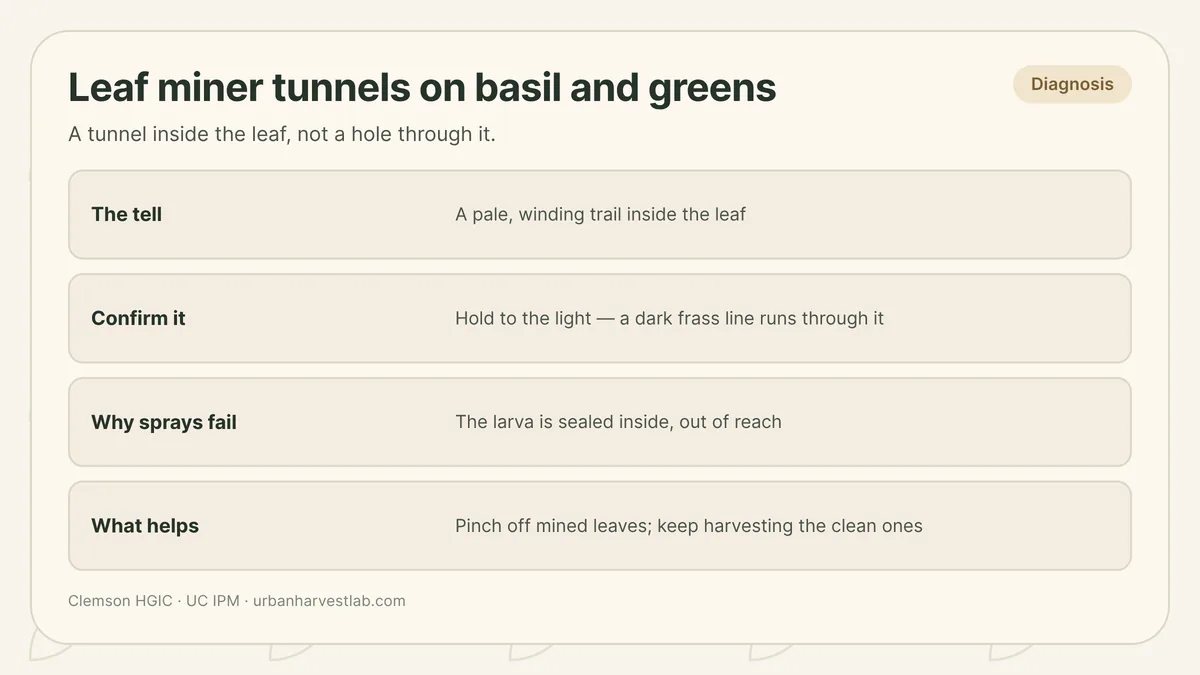
Leaf miner damage on basil and leafy greens shows up as a pale, winding tunnel inside the leaf tissue itself, and most sprays cannot reach the larva causing it.

Choosing a pest treatment for plants you are going to eat
Once you know which pest you have, the next question is what you can treat it with without compromising the food. The answer is a ladder of methods, and the label on any product you buy sets the legal limits of the top rung.