Troubleshoot the system before you change the inputs.
Symptoms
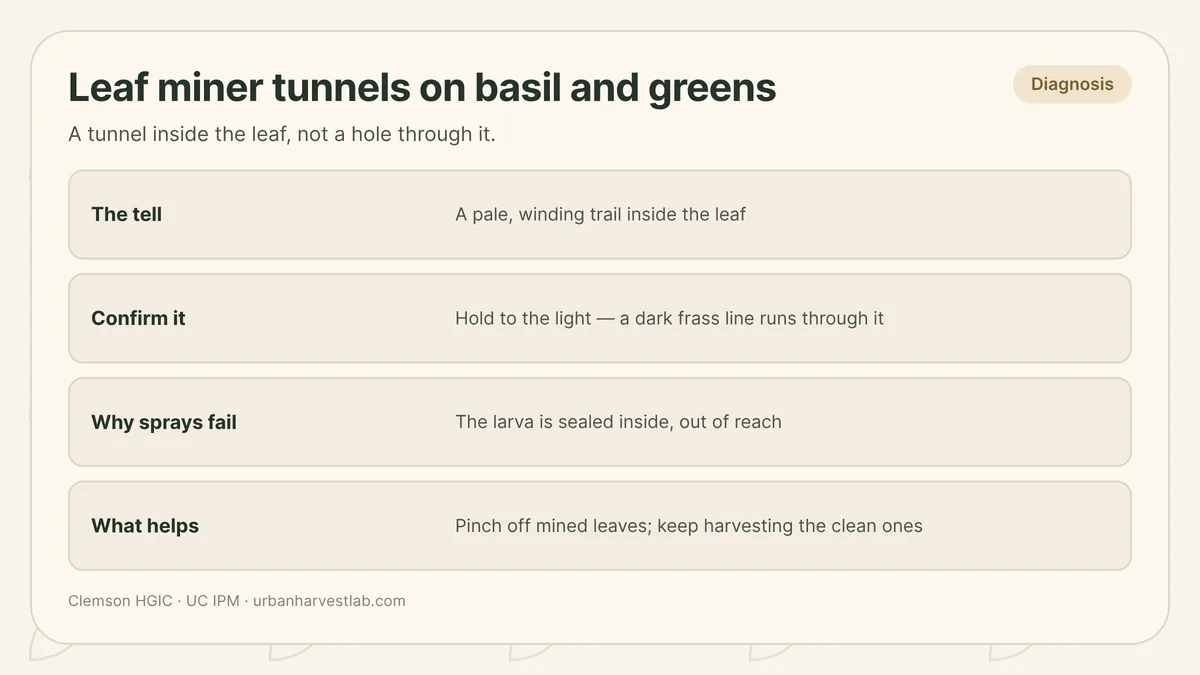
- A pale, winding trail or irregular blotch visible inside the leaf, with both leaf surfaces still unbroken.
- A thin dark line running through the trail when the leaf is held up to light; this is the larva's frass.
- New mines keep appearing on younger leaves even after older ones are removed.
Possible causes
- A leafminer larva is feeding between the upper and lower leaf surfaces, out of reach of a surface spray.
- A previous generation has already pupated and adults are laying eggs on new growth nearby.
- Nearby host plants, including other basil or greens in the same bed or shelf, are seeding new mines.
Quick fixes
- Pinch off and discard the worst-mined leaves rather than spraying the whole plant.
- Keep harvesting clean, unmined leaves normally; the plant does not need to be pulled for cosmetic damage alone.
- Check any product label for the specific edible crop before treating, since most sprays cannot reach the larva anyway.
If the damage on your basil or leafy greens is a winding, pale tunnel running inside the leaf rather than a hole punched through it, you are looking at a leaf miner, and the larva causing it is sealed between the two leaf surfaces where almost nothing you spray on the outside will reach it. If you want the broader troubleshooting sequence for potted herbs before narrowing in on a single pest, start with common potted herb problems.
Confirm the tunnel, not just the discoloration
Hold the leaf up to a window or a lamp. A leaf miner mine reads as a pale, winding trail or an irregular blotch, and Clemson HGIC’s description is the clearest one for a home garden: the larva “feeds inside the leaf, leaving winding discolored trails or irregular blotches” that are “unsightly but rarely serious.” Both leaf surfaces stay intact over the mine; nothing has bitten through from outside.
Look closely at the trail itself for a thin dark line threading through the middle of it. UC IPM’s research on citrus leafminer, a different species but the same tunneling biology, describes exactly this: “a thin dark line, inside the meandering serpentine mine just under the surface.” That line is frass, the larva’s droppings, packed along the path it has already eaten. Basil and leafy greens host their own leafminer species rather than citrus leafminer itself, but the mining behavior, the frass trail, and the larval stage staying inside the leaf tissue are the shared pattern across leafminer species.
The discriminator: tunnel, not hole
This is the single fact that separates a leaf miner from almost everything else chewing on a basil plant or a tray of greens. A hole means a pest bit through the leaf from one side to the other and left an opening. A leaf miner does not do that while it is feeding; the mine stays sealed under one or both leaf surfaces for the entire larval stage. If you can see daylight through the damaged spot, you are not looking at a mine; holes in herb leaves covers the chewing pests that leave one instead.
That also rules out the usual soft-bodied suspects. Aphids curl and distort new growth rather than tunneling through mature leaf tissue, and their colonies are visible on the surface; the diagnosis and control loop for that pattern is in aphids on indoor herbs. Spider mites leave fine, separate pale stippling across the leaf surface, not a single continuous trail, and UC IPM’s 10x hand lens on the underside usually finds the mites themselves; see spider mites on indoor herbs for that check. Neither produces a mine you can trace with your finger under the leaf surface, and if what you are seeing matches neither pattern, the herb pest identification chart sorts other feeding signs to the pest behind them.
Why the tunnel keeps growing wider
The trail widens as the larva grows, because it is eating its way through the soft tissue between the leaf’s outer layers and getting bigger as it goes. New mines on younger leaves after you have already dealt with older ones is not a sign that treatment failed; it usually means the current generation is still laying eggs or a new one has already hatched. UC IPM’s citrus leafminer figure for a full generation, egg to adult, is three to seven weeks under favorable conditions. That window is a reasonable planning horizon for basil and leafy greens too: expect fresh mines to keep appearing for weeks after the first one, not days.
Why most sprays do not reach the larva
The mine is also the reason a spray so often looks like it did nothing. UC IPM states it plainly for citrus leafminer, and the mechanism applies to any leafminer sealed inside a leaf: “Many insecticides registered for residential use do not effectively control citrus leafminer, because they have difficulty reaching the larvae inside the mines.” The larva is physically shielded by the leaf’s own tissue on both sides.
Reaching for a stronger, broader product usually makes things worse rather than better. UC IPM specifically advises against it: “Frequent use of broad-spectrum insecticides such as malathion, carbaryl, and pyrethroids are not recommended as they will kill beneficial insects.”
If you are growing basil or greens to eat, any product still has to be labeled for that specific edible crop before you use it. The EPA states that pesticide labels are legally enforceable and that every one carries the statement that using a product inconsistent with its labeling is a violation of federal law. The National Pesticide Information Center puts the practical version of the same rule directly: if your crop is not listed on the label, you cannot apply that product to it. Given how poorly most sprays reach a leafminer larva in the first place, checking the label before buying anything is worth doing before you decide whether to spray at all.
What actually helps
Pinch off and discard leaves that are heavily mined. This does not clear an infestation on its own, but it removes the larvae already inside those leaves, and it is something a spray cannot reliably do. Bag the discarded leaves rather than dropping them loose beside other plants.
Keep harvesting the leaves that are clean. Established basil and most leafy greens produce plenty of unaffected leaf area even while a few mines are present, and UC IPM and Clemson HGIC both frame leafminer damage on garden plants as largely cosmetic rather than a threat to the plant’s survival. A young seedling or a leafy green grown specifically for a dense, uniform canopy has less spare leaf area to give up, so the same level of mining matters more there than on a mature, bushy basil plant.
Watch for new mines on the newest growth rather than judging the plant by damage that is already done. A tunnel does not heal or disappear once it exists; the leaf carrying it stays marked for the rest of its life. Progress looks like new leaves emerging clean, not old ones looking better.
Keep it from spreading to the next tray
New plants and any greens that spent time outdoors are the most likely way a leafminer arrives in the first place; Clemson HGIC frames this as the general pattern for houseplant pests, most of which “come into the home on newly purchased plants or on those that have been outside for the summer.” Inspect new basil and greens before setting them next to an established collection, and keep a new arrival apart until repeated checks of its newest leaves come back clean.
Space plants so leaves are not touching if you are growing more than one tray of greens, and check the newest growth on the whole shelf every few days rather than only the plant that first showed a mine. Adults laying eggs on one basil plant can just as easily lay them on the pot next to it.
Common mistakes
- Treating any surface hole as a leaf miner without checking whether the tunnel is actually sealed under the leaf surface.
- Reaching for a broad-spectrum spray because a targeted one “isn’t working,” which kills the beneficial insects along with everything else.
- Pulling an established plant over cosmetic mining that has not reduced its harvestable leaf area.
- Skipping the label because the product is marketed as natural; edible-crop rules apply to it the same as to any registered pesticide.
- Judging control by whether old mines have faded, instead of whether new leaves are emerging clean.
Sources
Rule out the other usual suspects
Tunnels are one specific damage pattern. These guides cover the pests and problems that get confused with it.
Common questions
What does leaf miner damage look like on basil?
A winding, pale or discolored trail inside the leaf, sometimes widening into an irregular blotch, with the leaf surfaces on both sides still intact. Clemson HGIC describes the pattern as winding discolored trails or irregular blotches that are unsightly but rarely serious.
Is a leaf miner tunnel the same as a hole in the leaf?
No. A tunnel stays sealed under the leaf surface, which is what a hand lens or backlighting shows. A hole means something chewed all the way through from outside, which points to a different pest entirely.
Will neem oil or insecticidal soap stop leaf miners?
Rarely, once the larva is inside the leaf. UC IPM notes that many residential insecticides do not effectively control leafminers because they cannot reach a larva sealed inside its mine, and any product used still has to be labeled for the edible crop you are treating.
Do leaf miners kill basil or leafy greens?
Established plants usually keep growing and produce plenty of clean leaf; UC IPM and Clemson HGIC both describe leafminer damage on garden plants as largely cosmetic. A young seedling or a leafy green grown for its whole canopy has less spare leaf area to lose.
Related guides
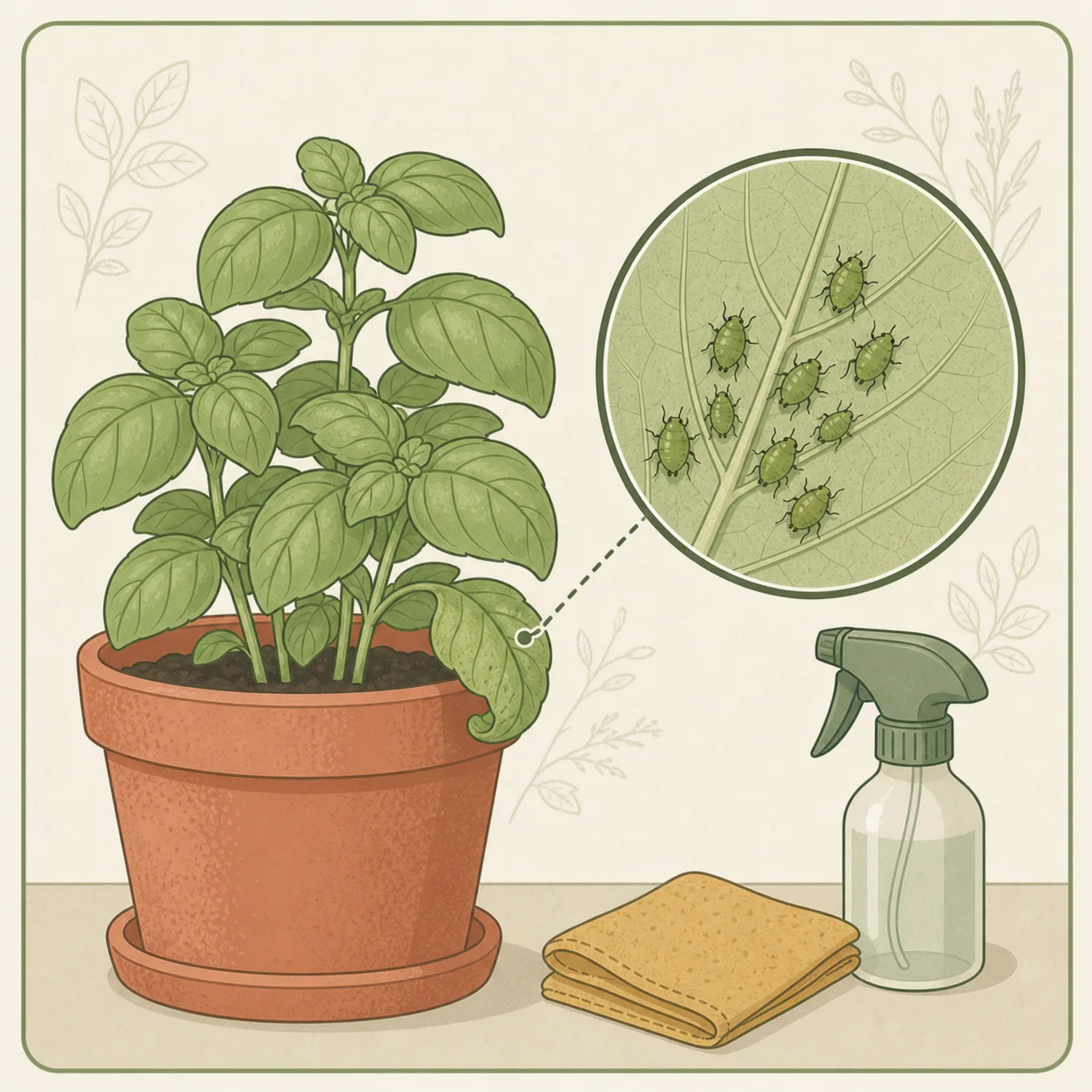
Aphids on indoor herbs: identify, isolate, and control them
Aphids are manageable when you find the colony, isolate the plant, remove most insects physically, and repeat inspections through the next generation.
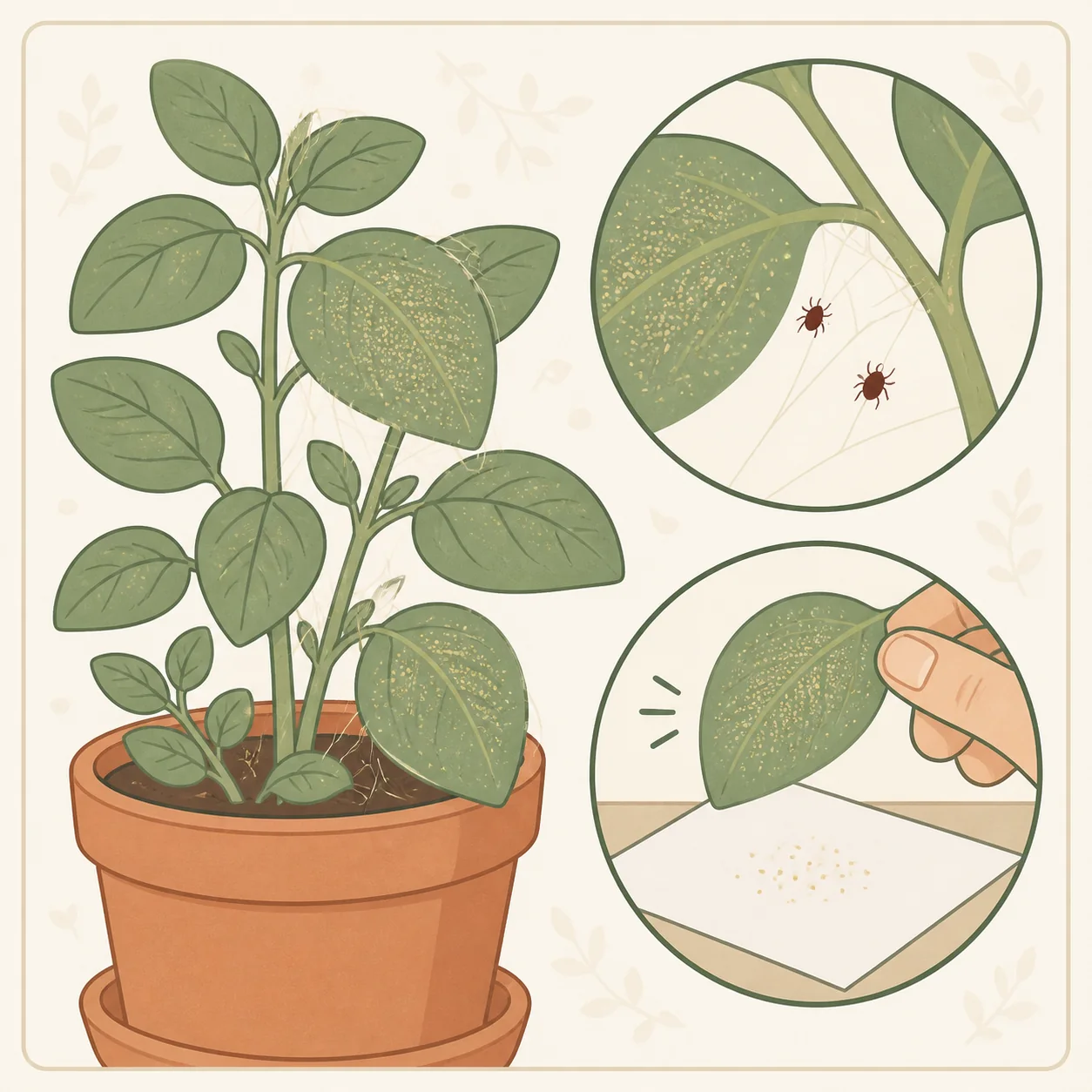
Spider mites on indoor herbs: signs, paper test, and control
Spider mites are easiest to control before webbing is obvious. Look for fine pale stippling and confirm moving specks over white paper.
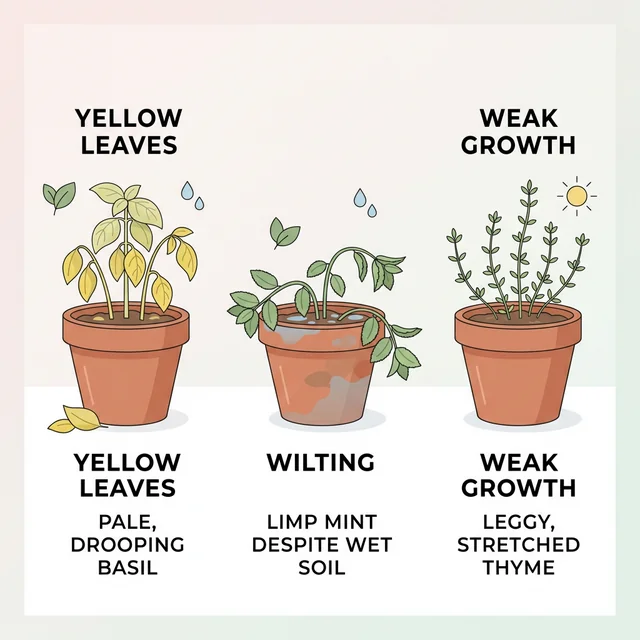
Common potted herb problems: yellow leaves, wilting, and weak growth
Common potted herb problems usually show up as yellow leaves, wilting, or weak growth, but the useful diagnosis starts with light, drainage, and root stress.