
Troubleshoot the system before you change the inputs.
Symptoms
- Old leaves turn evenly pale green to yellow and new leaves are small and thin.
- Newest leaves are yellow while the veins stay green.
- Leaves yellow and drop while the mix stays wet for days.
- Leaves yellow after the tree was moved indoors for the winter.
Possible causes
- Nitrogen has been used up or washed out of the pot.
- Mix pH is too high, or iron is low, so new leaves cannot get enough iron.
- The mix stays saturated and the roots stop working.
- Winter light is far weaker than what the tree had outdoors, and cold roots are working poorly.
- Salt from frequent shallow watering and feeding has built up in the pot.
- Whiteflies or spider mites are feeding on the leaves.
Quick fixes
- Check moisture 2 inches down and empty the saucer before changing anything else.
- Move the tree to the brightest window, or add a grow light, and shift it gradually.
- Test the mix pH, then correct pH or use a chelated iron product for green-veined new leaves.
- Feed with a citrus fertilizer only in the growing season.
- Turn a leaf over and check for insects or webbing.
Yellow citrus leaves: what the pattern points to
| What you see | Where it starts | Most likely cause |
|---|---|---|
| Even pale green to yellow, no pattern, small thin new leaves | Oldest leaves first | Nitrogen |
| Yellow between the veins, veins stay green | Newest leaves | Iron, often tied to mix pH |
| Pale mottling or blotches between green veins, small narrow leaves | New growth | Zinc or manganese |
| Yellow from the edges inward, green inverted V at the base | Mature leaves | Magnesium |
| Yellow leaves that may drop, mix stays wet | Throughout | Waterlogged roots |
Yellow leaves on an indoor citrus usually trace back to one of four things: wet roots, too little nitrogen, too little iron, or weak winter light. Check which leaves yellow first and whether the veins stay green, then check the pot, before you add any fertilizer. The leaf pattern separates the nutrient causes. The pot and the window separate everything else.
If the plant is not citrus, start with the yellow leaves cause finder.
Wet roots look like hunger on citrus
UC Master Gardeners say overwatering “is one of most common causes of yellow leaves”: when soil stays continually wet, “the roots cannot function so nutrients cannot reach the leaves.” That means a tree with wet roots can show deficiency-like yellowing even when the mix holds plenty of nutrients. University of Florida’s citrus guide makes a related point about iron, noting that an early expression of flooding damage to roots can be iron deficiency symptoms.
Do this first:
- Push a finger 2 inches into the mix. University of Maryland Extension says that if it feels dry, it is time to water, and that you should water until it drains, then remove excess water from the saucer so the plant does not sit in standing water.
- Check that the pot has a drainage hole. Maryland advises a general-purpose, cactus and succulent, or citrus mix that drains well.
- If the mix is still wet days later, hold off.
Underwatering also yellows leaves. UC Master Gardeners describe leaves that turn yellow or dull green, curl upward and become leathery and dry. The overwatered vs underwatered guide covers how to tell the two apart. Roots that are brown or black, with an outer layer that rubs off easily, are rotting; UC Master Gardeners say healthy roots are light tan.
Read the pattern
University of Florida stresses that “yellow leaves are not necessarily an indication of N deficiency”. UC Master Gardeners add that citrus often has more than one deficiency at once, with overlapping patterns. Use the table above as a first pass, then read the detail.
Nitrogen: even yellow, oldest leaves first
University of Florida describes nitrogen deficiency as “light green to yellow foliage over the entire tree in the absence of any distinctive leaf patterns”, appearing first on older leaves and moving toward younger ones. New leaves are small and thin. UC Master Gardeners call it the most common nutritional cause of yellow citrus leaves, with irregular yellow blotches on mature leaves.
Potted trees are exposed to this one. University of Maryland Extension says container-grown citrus needs fertilizer, particularly nitrogen, and University of Florida lists over-irrigation in a porous mix and waterlogged soil among the causes of nitrogen loss. Florida also notes that cooler fall and winter weather can reduce nitrogen uptake, so a winter tree can look hungry without being short of food.
Iron: green veins on the newest leaves
University of Florida says iron deficiency shows “first on new foliage”, with veins slightly darker green than the tissue between them. In severe cases the areas between the veins fade towards ivory and emerging leaves are smaller. UC Master Gardeners describe the same look as leaves that are yellow with green veins.
The cause is often the mix rather than a lack of iron in it. Florida says iron deficiency usually indicates calcareous, alkaline conditions. Maryland’s table lists the same sign as soil not acidic enough or insufficient iron, and suggests a sulfur-containing acidifier, a chelated iron formulation, or both, applied as directed for potted plants. Check the mix with a pH test first; the container soil pH guide shows how and where the numbers stop applying to a pot.
Zinc, manganese and magnesium
Zinc and manganese look similar to iron: pale or mottled tissue between green veins on new growth, per UC Master Gardeners. University of Florida says that because their availability is pH related, iron, zinc and manganese symptoms often occur together and can mask each other. UC Master Gardeners add that zinc and manganese deficiencies often mask iron.
Magnesium has its own tell. University of Florida describes a yellow blotch near the leaf base that enlarges until the only green left is an inverted V on the midrib. UC Master Gardeners describe yellowing from the edges inward with the same green V at the base.
Why winter indoors makes it worse
Indoor citrus needs far more light than most houseplants. University of Maryland Extension recommends at least 6 hours of direct sunlight, preferably 8 to 12 hours, with a south-facing window the strongest winter position and a fluorescent or LED grow light when ambient light is not enough. It also advises moving the plant between outdoors and indoors gradually. Maryland lists leaf drop as typical when citrus comes indoors after a season outside, as it adjusts to different light and humidity; the leaf drop after moving indoors guide covers that adjustment.
Cold matters too. UC Master Gardeners describe winter chlorosis, where cold temperatures cause root dysfunction and yellow leaves, and say it is transient and resolves as the weather warms. University of Maryland Extension gives a daytime temperature of 65 to 75 °F and a nighttime temperature of 55 to 65 °F.
Do not respond to winter yellowing by feeding. Maryland says to fertilize only when the plant is actively growing, spring to late summer, and “You do not need to fertilize in the winter.” Its general guide is a nitrogen-heavy product in a 2-1-1 or 3-1-1 N-P-K ratio, or one labeled as citrus fertilizer, at least three times in the growing season.
Salt and insects
Frequent shallow watering and heavy feeding can build up salts. UC Master Gardeners list yellow or brown-tipped leaves as salt burn and recommend slow, deep watering to push salts down and away from roots. In a pot, that means watering until it drains rather than sipping.
Look under the leaves too. Maryland ties yellow leaves with tiny insects flying up when the plant is touched to whiteflies, and yellow or white stippling with webbing to spider mites. See spider mites on indoor herbs for the paper test, which works on any houseplant.
Sources
Narrow down the cause
Water, mix pH and general yellow-leaf diagnosis for potted plants.
Common questions
Why are my citrus tree leaves turning yellow indoors?
The usual suspects are wet roots, a nitrogen shortage, an iron shortage and weak light. UC Master Gardeners call overwatering one of the most common causes of yellow citrus leaves, and name nitrogen, iron, zinc and manganese as the most common deficiencies. Look at which leaves yellow and whether the veins stay green before treating.
Is yellow citrus with green veins iron deficiency?
Often, yes. University of Florida describes iron deficiency as appearing first on new foliage with veins staying greener, and University of Maryland Extension lists yellowing with green veins as soil not acidic enough or low iron. Zinc and manganese produce similar patterns and can mask iron, so a mix pH check is worth doing first.
Should I fertilize a citrus with yellow leaves in winter?
Usually not. University of Maryland Extension says you do not need to fertilize citrus in winter and to fertilize only while it is actively growing, spring to late summer. Winter yellowing is more often light, cold or wet roots than hunger.
How often should I water an indoor citrus?
University of Maryland Extension says to press a finger 2 inches into the mix and water when it feels dry, then drain the saucer so the plant does not sit in standing water.
Related guides
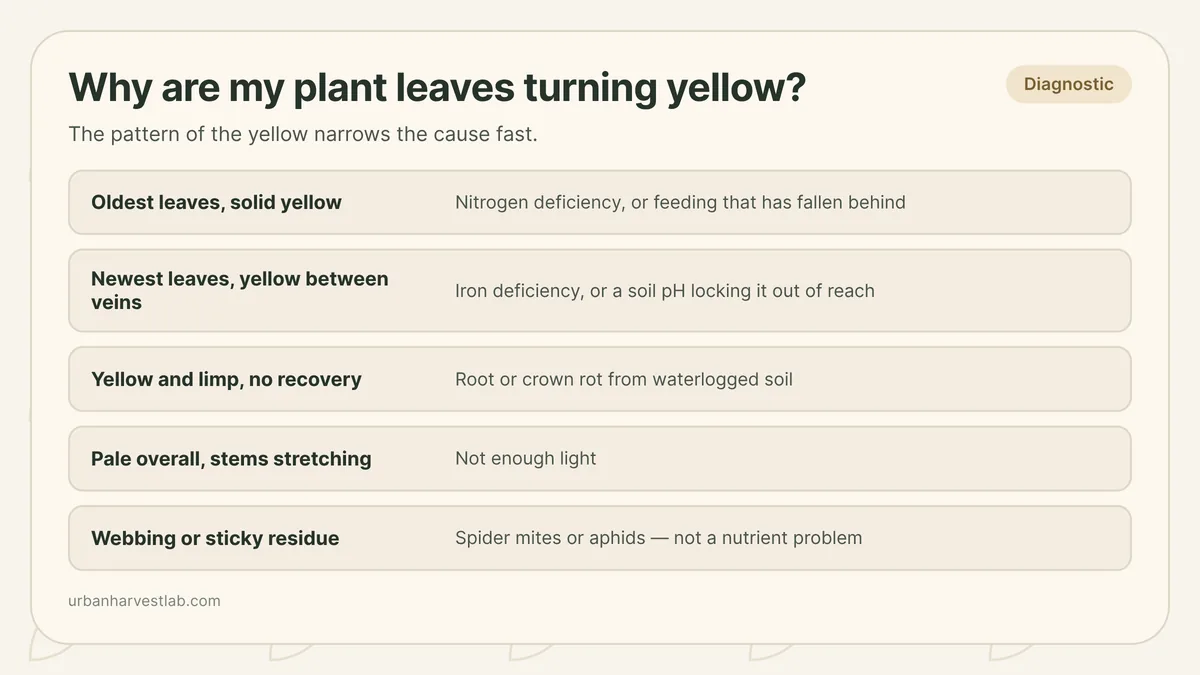
Why are my plant leaves turning yellow? Find the likely cause
Yellow leaves have a short list of real causes, and the pattern of the yellowing narrows it fast, once you know what to look for.

Plants dropping leaves after moving indoors: light, dry air, and what to do
A plant that sheds leaves in the weeks after moving inside is mostly adjusting to much weaker light. Dry winter air, drafts and carried-over watering habits add to it.
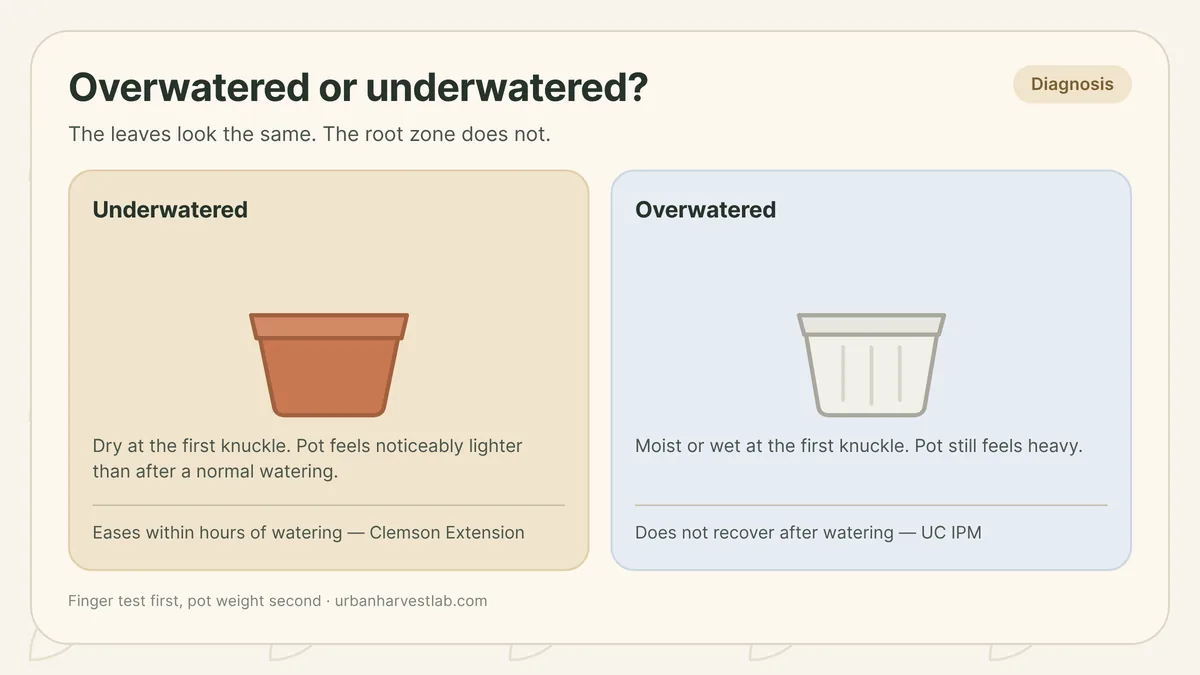
Overwatered vs underwatered: how to tell which one you have
Reading the root zone directly, with a finger test, pot weight, and how the plant responds to being watered, settles what the leaves alone cannot.