
Indoor dwarf citrus: the numbers by source
| Question | Figure | Source |
|---|---|---|
| Direct light | At least 6 hours; 8-12 hours preferred | University of Maryland Extension |
| Day and night temperature | 65-75 °F day, 55-65 °F night | University of Maryland Extension |
| Overall growing range | 55-85 °F, with a 5-10 degree day-night swing to promote flowering | University of Wisconsin Extension |
| Humidity | About 50% relative humidity | University of Maryland Extension |
| Pot size | 10-12 inches can last several years | University of Wisconsin Extension |
| Repotting | Every 3 years (Maryland); every 1-2 years (Wisconsin) | Maryland, Wisconsin |
| Fertilizer ratio | 2-1-1 or 3-1-1 N-P-K, spring to late summer | University of Maryland Extension |
| Blossom to ripe fruit | 6-9 months for lemons and limes; about a year for oranges | University of Wisconsin Extension |
A dwarf lemon grows indoors if it gets at least 6 hours of direct light a day, sits in a pot that drains freely, and is pollinated by hand while it is inside. University of Maryland Extension prefers 8 to 12 hours of direct sun, and says a south-facing window gives the strongest winter light. Fruit takes patience, but the tree itself is a decent houseplant.
Start with the right plant. University of Maryland Extension notes that dwarf citrus is grafted onto cold-hardy rootstock and can be kept as a 3 to 6 foot houseplant, in types that range from lemons and limes to mandarins and kumquats. University of Wisconsin Extension warns that citrus grown from seed is unlikely to produce the same fruit as its parent, so buy a named grafted variety. It also notes that thornless cultivars of lemon and lime exist but may be less flavorful and less productive.
Light is the first limit
Citrus wants more light than almost any houseplant. University of Maryland Extension asks for at least 6 hours of direct sunlight, or preferably 8 to 12 hours, every day. University of Wisconsin Extension adds that the foliage can adapt to the lower light of a home, but that plants are very unlikely to flower and fruit in low light.
In winter, a south-facing window is the strongest spot (Maryland), and a fluorescent or LED grow light is necessary if the window does not deliver enough. Wisconsin puts the threshold in the same place: supplemental light is needed for fruit if the tree gets less than 6 hours of direct light a day. To decide between a window and a lamp, see grow lights vs sunlight.
Citrus does not go dormant the way many plants do, says Wisconsin, so it needs light all winter even though growth slows.
Water and the pot
Citrus likes consistent moisture, and the pot decides whether that works. University of Maryland Extension recommends a lightweight container with a drainage hole. Indoors, check the mix once or twice a week by pressing a finger 2 inches down. If it feels dry, water thoroughly until it drains from the bottom, then empty the saucer so the plant is not standing in water. Let the surface dry between waterings, because fungus gnats can become a problem if it stays wet (see fungus gnats in herb pots).
The tree tells you when you have it wrong. Maryland says leaf drop indicates overwatering, and flower drop indicates the mix is too dry. The overwatered vs underwatered guide separates the two when the signs are less clear. University of Wisconsin Extension prefers infrequent, deep watering to frequent, shallow watering, and says to reduce watering in winter when the plant is not actively growing.
For the mix, Maryland suggests a general-purpose, cactus and succulent, or citrus potting mix with good drainage. Wisconsin says to amend a standard potting mix with up to one-third perlite or pumice by volume, and to avoid mixes formulated for moisture retention.
Pot size and repotting
Wisconsin advises starting small and moving up, because an oversized pot can stay too wet after watering and make root rot more likely. A 10 to 12 inch pot can hold a citrus for several years, and a deep pot balances a top-heavy tree better than a shallow one. Wisconsin says to repot every year or two, while Maryland says every three years into fresh mix. If you would rather keep the tree at a size you can carry, University of Maryland Extension describes root pruning: tip out the root ball, slice it vertically in several places, remove the outer 1 to 2 inches of roots, and repot in fresh mix. A drainage hole guide helps if the pot you own is decorative and sealed.
Temperature, humidity and feeding
Citrus comes from warm, humid places and dislikes the dry air of heated rooms. University of Maryland Extension suggests a humidifier aiming for about 50% relative humidity, and a daytime temperature of 65 to 75 °F with nights of 55 to 65 °F. Wisconsin gives a wider range of 55 to 85 °F and says to avoid abrupt shifts. Both sources tie flowering to a cooler night: Maryland says cooler temperatures initiate flower development, and Wisconsin says a 5 to 10 degree difference between day and night promotes it. Most citrus is damaged below 32 °F, Maryland warns, so a pot left outdoors too late needs rescuing.
Container citrus needs feeding, particularly with nitrogen. Maryland recommends a fertilizer with an N-P-K ratio of 2-1-1 or 3-1-1, or a product labeled for citrus, applied while the plant is actively growing, roughly spring to late summer and at least three times in that season. It says to stop by early fall and that you do not need to fertilize in winter. If the leaves yellow anyway, the pattern points to the cause; the citrus yellow leaves guide covers it.
Summer outdoors, winter indoors
Both sources like a summer outside. University of Wisconsin Extension says to move the tree out once temperatures are consistently above 50 °F, and to bring it in before night temperatures drop into the 40s. Maryland says to move it out after frost danger has passed and back in before the first frost.
The change in light is the risk. Wisconsin warns that leaves sunburn if moved too quickly from a house to full sun, and Maryland describes a two-week transition, starting in partial shade and moving gradually into more light. Coming back indoors is the same in reverse, and leaf loss in the first weeks is common; see leaf drop after moving plants indoors.
Flowers, pollination and fruit
Citrus flowers are fragrant and white. Most dwarf citrus is self-fertile, so one tree is enough (University of Maryland Extension), and University of Wisconsin Extension agrees it will set fruit on a single plant indoors. What is missing inside is the insects. Maryland says that flowers produced while the plant is indoors have to be hand pollinated: pick up pollen from one flower with a small dry paintbrush and brush it onto the others. The same move works for other crops, as in hand-pollinating tomatoes and peppers.
Then wait. Maryland says a young plant may not bear fruit for a few years, and Wisconsin says most lemons and limes ripen six to nine months after flowering, oranges in about a year. Meyer lemons ripen mainly in fall and winter but may fruit through the year (Maryland).
Do not panic when fruit falls. University of Maryland Extension says potted plants typically set more fruit than they can support, and as much as 75% of it may drop. It adds that a sudden change in temperature can also trigger drop.
If there are no flowers or fruit, Maryland lists three causes: the plant is too young, the light is too weak, or the flowers were not pollinated. Light is the one you can fix fastest.
Pests
Maryland lists scale insects, mites, mealybugs, whiteflies and aphids as the usual indoor citrus pests, and says proper light, water and feeding strengthen the plant against them. Wisconsin names brown soft scale and two-spotted spider mite as the most common in the Midwest, and says control usually needs several applications. A sticky film on leaves, or fine stippling and webbing, means check the undersides. Spider mites on indoor herbs shows the paper test, which works on a lemon leaf too. Read and follow the label on any product you use.
Sources
Keep a citrus healthy indoors
Light, yellow leaves and leaf drop for a potted lemon, lime or orange.
Common questions
Can you grow a lemon tree indoors?
Yes. University of Maryland Extension says dwarf citrus grafted onto cold-hardy rootstock can be kept as a 3 to 6 foot houseplant, and University of Wisconsin Extension says it sets fruit on a single plant indoors. The conditions that matter are 6 or more hours of direct light, a pot that drains, and hand pollination while the tree is inside.
How much light does an indoor lemon tree need?
University of Maryland Extension says at least 6 hours of direct sunlight, preferably 8 to 12 hours a day. In winter that means a south-facing window, and a fluorescent or LED grow light if the window is not enough. University of Wisconsin Extension says plants are very unlikely to flower and fruit in low light.
How often should you water an indoor lemon tree?
University of Maryland Extension says to check the mix once or twice a week by pushing a finger 2 inches down, and to water when it feels dry. Water until it runs out of the bottom, then empty the saucer. University of Wisconsin Extension says to reduce watering in winter when the plant is not actively growing.
How long does an indoor lemon take to fruit?
University of Maryland Extension says a young plant may not bear fruit for a few years, and University of Wisconsin Extension says most lemons and limes ripen in six to nine months after the flower, and oranges in about a year. A tree that sets fruit may drop many of them first, up to 75 percent according to Maryland, which is normal.
Related guides

Citrus leaves turning yellow indoors: iron, nitrogen, water or winter light
Where the yellow starts and whether the veins stay green separate nitrogen, iron, magnesium and wet roots on a potted lemon, lime or orange.
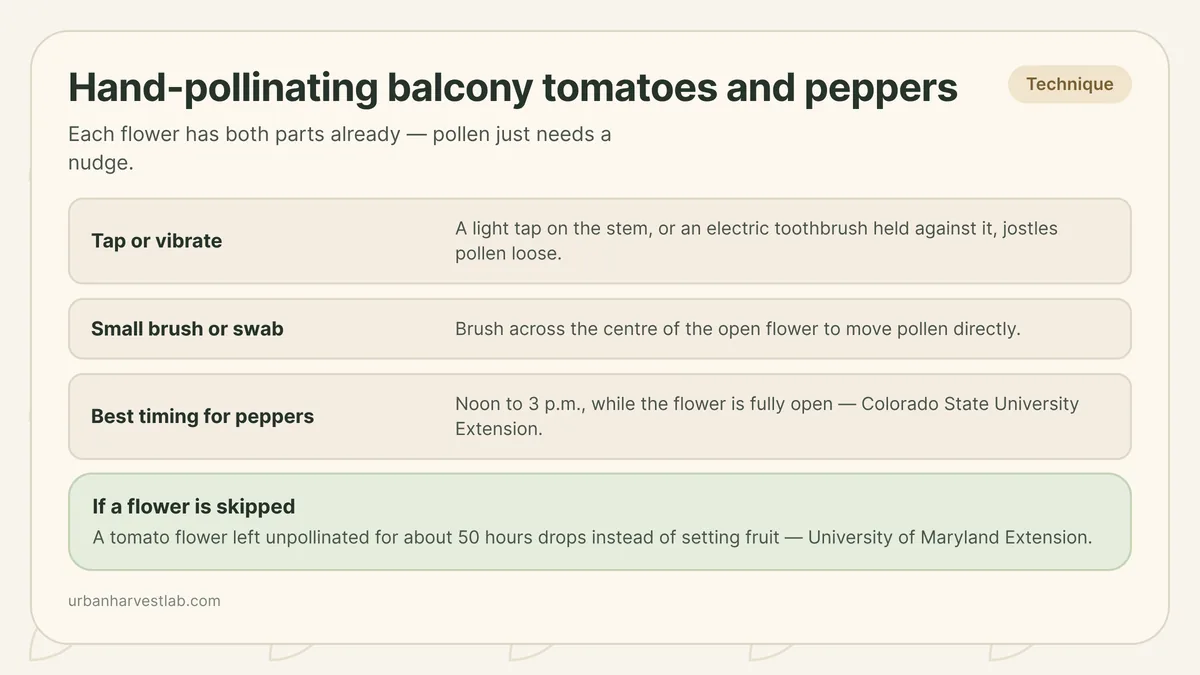
How to hand-pollinate tomatoes and peppers on a balcony
A tomato or pepper flower already carries both male and female parts, but nothing on a balcony reliably moves the pollen between them. This is the tap, brush, or vibrate technique that stands in for a bee.

Plants dropping leaves after moving indoors: light, dry air, and what to do
A plant that sheds leaves in the weeks after moving inside is mostly adjusting to much weaker light. Dry winter air, drafts and carried-over watering habits add to it.