Troubleshoot the system before you change the inputs.
Symptoms
- A one- to three-inch cucumber behind a fading flower turns yellow, shrivels, and drops.
- The tip of the baby fruit goes soft or rotten at the blossom end.
- The vine is green and flowering, but few fruit reach picking size.
Possible causes
- The female flower was not pollinated, which WSU Extension says leads to small fruit that usually yellow and drop.
- A seedless variety carrying a heavy fruit load; a 2015 Horticulture Journal study found fruit load matters more than hormones in such plants.
- Drought, heat or too much water, which Ohio State Extension says can make cucumber flowers wilt and die or female flowers abort.
- Insecticide sprayed on open flowers, which Penn State Extension says can harm pollinating insects.
Quick fixes
- On a standard variety, hand-pollinate open female flowers in the morning.
- Pick cucumbers every 2-3 days, which Clemson and Illinois Extension say keeps the vines producing.
- Water evenly and mulch the pot surface.
- Do not spray open flowers.
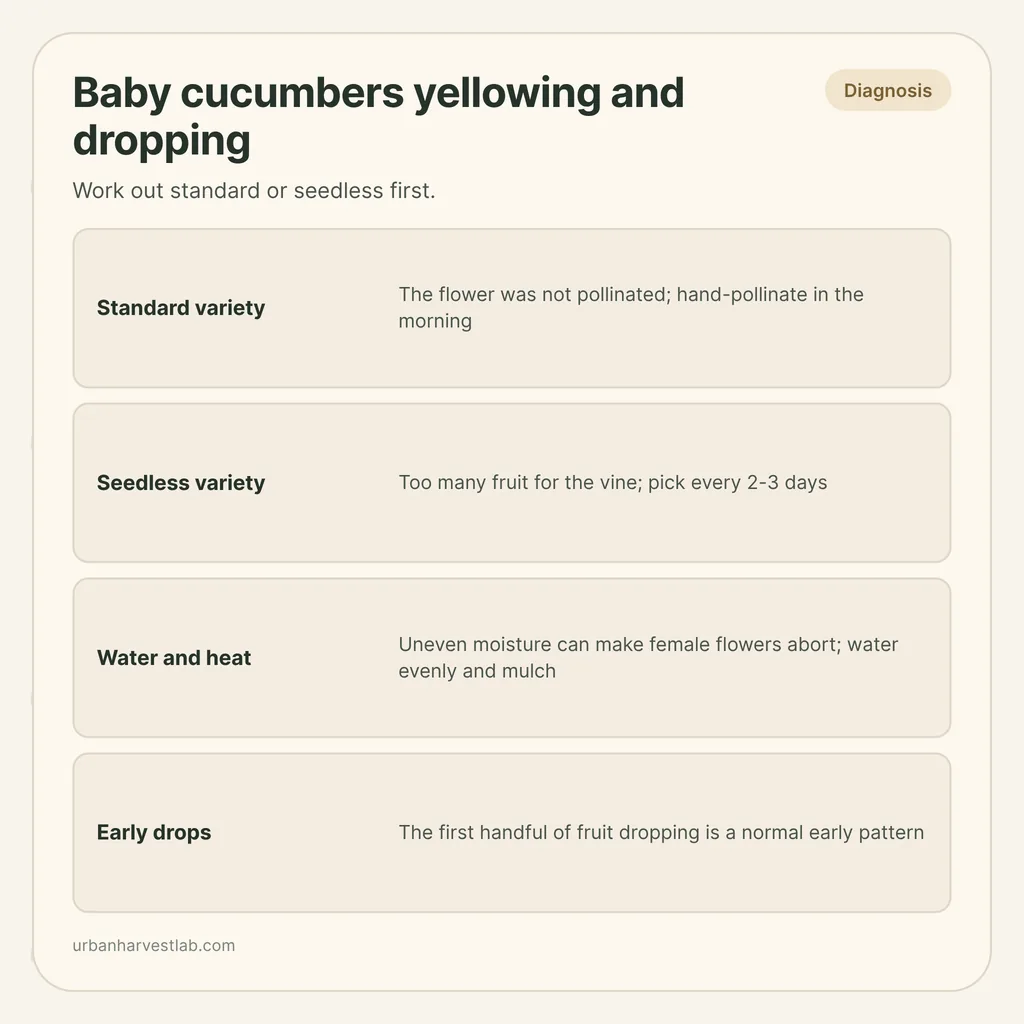
A baby cucumber that yellows and drops is a fruit the plant has given up on. On a standard variety the usual reason is that the flower did not get pollinated; on a seedless variety, look at how many fruit the vine is carrying and how evenly it is watered. Work out which kind of cucumber you have first, because the two diagnoses split there.
Step one: standard or seedless?
Check the seed packet or plant tag. Penn State Extension says seedless cucumbers are parthenocarpic and do not require pollination for production. Clemson Extension names Diva, Excelsior and Sugar Crunch as parthenocarpic cultivars that make seedless fruit without bees. Varieties not labelled seedless or parthenocarpic need pollen carried from a male flower to a female one.
If you grow a seedless type, skip ahead to the fruit-load section. Pollination is not the problem there.
Standard varieties: the flower was not pollinated
Look behind the petals of the flower the fruit grew from. A female flower carries a tiny cucumber at its base, and that is the fruit that is failing. WSU Extension says fruits may begin to develop without pollination but must be pollinated to continue normal growth. The unpollinated fruit remain small and may show a rot beginning at the blossom end, and these fruits usually turn yellow and drop fairly quickly. That matches the classic picture exactly: a thumb-sized cucumber that shrivels from the tip and falls with a touch.
Early fruit are the most likely to fail. WSU notes that female flowers typically appear before male ones on the vine, so the earliest female flowers are not usually pollinated, and Clemson Extension says the first 10 to 20 flowers on a plant are male and will not produce fruit. A few early drops are part of the normal start, and the order flowers open in is explained in cucumbers with only male flowers.
The window is short. Clemson Extension says flowers open for one day only and shrivel by the afternoon, and Ohio State Extension puts the open time at about 4 hours. On a high balcony or a shaded patio, few bees may arrive in that time. Rain, cold and heat all reduce what gets through: WSU says low temperatures may prevent flower development and pollination, and Penn State Extension says insecticides applied to flowers or weeds in bloom can adversely affect pollinating insects, especially honey bees.
Hand-pollinate in the morning
Clemson Extension’s method: pick a male flower, remove the petals, and leave the pollen-covered anthers. Rub the pollen from the anthers onto the stigma of the female flower. Do it in the morning, since the flowers close by afternoon. WSU says a single male flower can pollinate several female flowers, so a small container planting needs only a few. Ohio State Extension also suggests a small paint brush where pollinators are lacking.
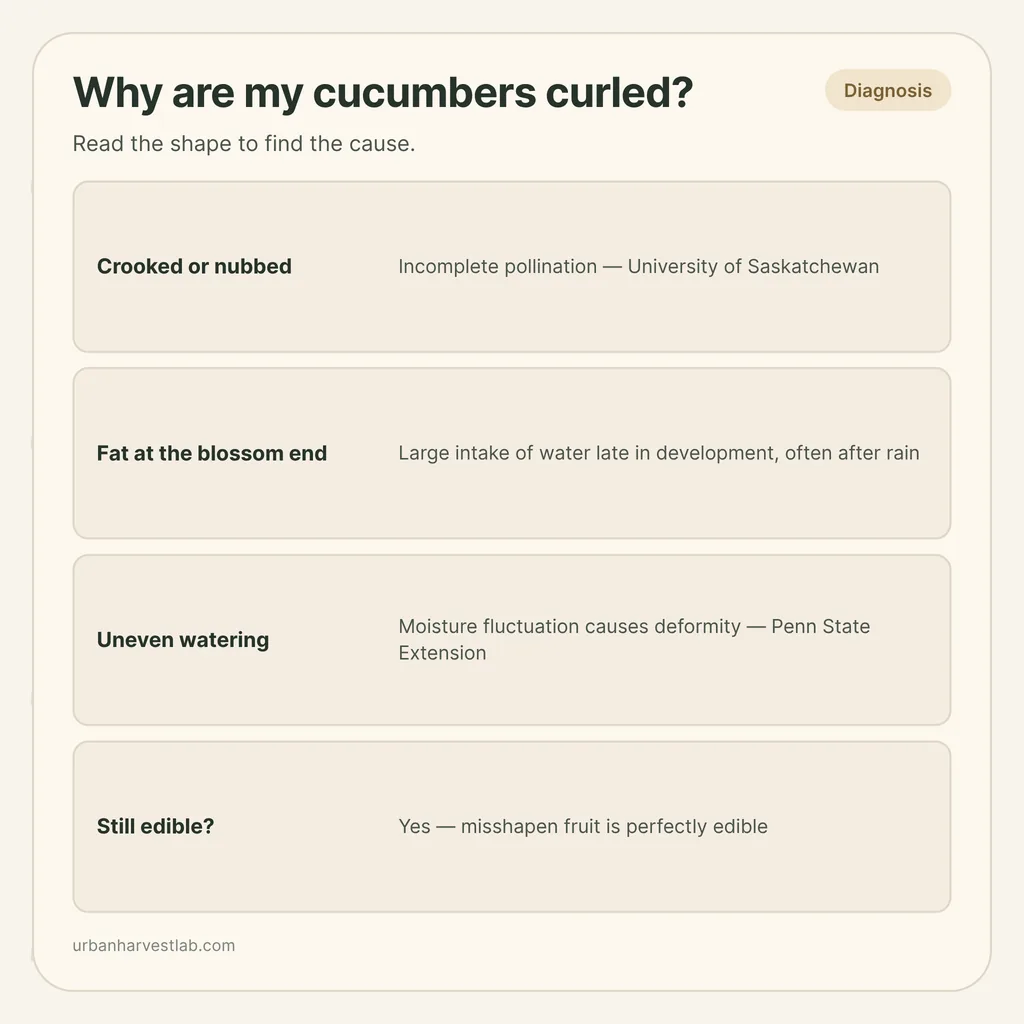
WSU says incomplete pollination can also give misshapen fruit (curved, bell-shaped or nubbins) instead of a drop; see why cucumbers come out curled, pointed or fat at one end.
Seedless varieties: too many fruit for the vine
The study below found that seedless plants carrying many fruit abort some of them; no source here tests this on standard types. Direct extension guidance is thin, but peer-reviewed work on seedless cucumber is clear. A 2015 study in the Horticulture Journal (Hikosaka and Sugiyama) notes that parthenocarpic cucumbers with many female flowers and heavy fruit load often show fruit abortion and reduced fruit yield. When the researchers left only one fruit on a plant, no fruit abortion occurred, and they concluded that fruit load may have a greater influence on fruit abortion than plant growth regulators do. The study tested a seedless variety, so it explains seedless types best; it gives no count of how many fruit one pot can carry.
Picking is the practical step, though no source shows it stops drops. Clemson Extension says that by keeping the fruit picked, the vines will continue to produce, and Illinois Extension says to harvest every 2-3 days once fruit has reached the size you want. Clemson also advises harvesting before the skins begin to yellow and the seeds harden, so a cucumber left to swell and yellow on the vine is past its best.
Water and heat swings
Cucumbers dislike uneven moisture, and pots swing fastest. Penn State Extension says cucumbers require a constant supply of moisture during the growing season, and that moisture fluctuation, especially soil water depletion, will cause growth deformity. Ohio State Extension adds that drought stress can cause female flowers to abort, and that heat, drought and too much water can cause flowers to wilt and die so that pollinators cannot transfer pollen. The same page says high nitrogen can delay female flowers.
Check the pot by lifting it or pushing a finger into the mix, and water before it dries through. Clemson Extension says mulching helps provide uniform moisture; a straw or coco mulch search on Amazon shows what is sold. Penn State gives 65 to 95°F as the best average range and says temperatures above 95°F or below 50°F slow growth and maturity of the crop, so a pot on a hot south-facing wall may need afternoon shade. Yellowing leaves rather than fruit point elsewhere; see cucumber leaves turning yellow in pots.
Which cause fits
| What you see | Likely cause | What to do |
|---|---|---|
| Standard variety, fruit yellows from the tip and drops soon after the flower fades | No pollination | Hand-pollinate in the morning; do not spray open flowers |
| Seedless variety, several fruit swelling, newest ones yellow and drop | Heavy fruit load | Pick every 2-3 days (keeps vines producing; not shown to stop drops) |
| Fruit drop plus wilting flowers after dry spells or heat | Water or heat stress | Even watering, mulch, afternoon shade |
| Soft, rotting blossom end on the baby fruit | Unpollinated fruit | See above; WSU describes this rot on unpollinated fruit |
| Only the first handful of fruit drop, then it settles | Normal early pattern | Wait; see the male-flower page |
Rot on the blossom end of baby squash has its own story, covered in zucchini rotting on the end.
Sources
- WSU Hortsense: Cucumber, Pumpkin, Squash: Pollination failure (archived copy)
- Clemson Cooperative Extension: Cucumber
- Penn State Extension: Cucumber production
- Penn State Extension: Cucumber pollination
- Ohio State University BYGL: Pollination of cucurbits
- University of Illinois Extension: Cucumbers
- Hikosaka and Sugiyama (2015), Horticulture Journal 84(4): fruit load and fruit abortion in parthenocarpic cucumber
More on cucumber flowers and fruit
Flower sex, misshapen fruit and yellow leaves, each on its own page.
Common questions
Why do baby cucumbers turn yellow and fall off?
Most often because the flower was not pollinated. WSU Extension says unpollinated fruit remain small, may rot from the blossom end, and usually turn yellow and drop fairly quickly. On a seedless variety, a heavy fruit load or uneven watering is the likelier cause.
Do seedless cucumbers need pollination?
No. Penn State Extension says seedless cucumbers are parthenocarpic and do not require pollination for production. If a seedless type drops baby fruit, pollination is not the reason.
How do I hand-pollinate cucumbers?
Clemson Extension says to pick a male flower, remove the petals, and rub the pollen-covered anthers onto the stigma of the female flower, in the morning, because flowers open for one day only and shrivel by afternoon.
Will picking cucumbers stop the small ones dropping?
No source here shows that picking stops drops. Clemson Extension says that by keeping the fruit picked the vines continue to produce, and Illinois Extension advises harvesting every 2-3 days once fruit reaches the size you want. A Japanese study on seedless cucumbers linked fewer fruit on the plant to less fruit abortion, but it did not test picking.
Related guides

Cucumber only male flowers: normal start or a problem?
Male-only blooms at the start are the usual cucumber pattern. Learn how to spot the first female flower, what delays it, and when to step in.
Why are my cucumbers curled, pointed or fat at one end?
A crooked or pointed cucumber usually means some of the ovules inside were not pollinated; a fat blossom end points to water. Here is how to read the shape in a pot.

Cucumber leaves turning yellow in pots: which cause fits
Where the yellow starts and what it looks like tells you whether a potted cucumber is hungry, waterlogged, mildewed or infested.