
Troubleshoot the system before you change the inputs.
Symptoms
- The cucumber vine is growing well and covered in yellow flowers, but none has a tiny cucumber behind the petals.
- The flowers that open drop off and no fruit follows.
- The plant had a few female flowers earlier, and now only male flowers appear during hot weather.
Possible causes
- The normal early pattern, where male flowers open first and in larger numbers and female flowers follow shortly later.
- Hot weather, which Ohio State Extension says leads to male flowers only while female flowers are delayed.
- Drought stress, which Ohio State Extension says can make female flowers abort.
- Excess nitrogen, which Ohio State Extension says can delay female flower production.
- A female flower that opened but went unpollinated because few bees visit a high balcony.
Quick fixes
- Wait a week or so from the first bloom and check each new flower for a swollen base.
- Shade the pot in the hottest part of the day, water so the mix stays evenly moist, and hold off on nitrogen feeding.
- Use a small paintbrush to move pollen from a male flower to a female flower if no bees visit.
Cucumber plant with male flowers only: what you are probably seeing
| What you see | Likely meaning | What to do |
|---|---|---|
| Young plant, first blooms all male, no fruit anywhere | Normal start; female flowers follow | Wait a week or so (Ohio State Extension) and keep watering evenly |
| Female flowers were there, now only male in a heat wave | Heat delaying female flowers | Shade the pot in the hottest hours; keep the mix moist |
| Lush, dark vine after heavy feeding, male flowers only | High nitrogen can delay female flowers (Ohio State Extension) | Stop nitrogen feeding and water evenly |
| Tiny fruit forms, then shrivels and yellows | Female flower not pollinated, or drought stress | Move pollen with a brush; water steadily |
| Bought an all-female or seedless variety, still few female flowers | Weather or stress rather than genetics | Check heat, water and light before anything else |
Male flowers first is the normal cucumber pattern. Penn State Extension says male flowers appear on the main stem earlier and in much larger numbers than female flowers, and Illinois Extension says the female flowers follow shortly later. Worry only if the plant keeps blooming for weeks with no female flower at all, and then look at heat, water and the variety. If the female flowers do open but no fruit follows, the fix is pollination, covered in how to hand-pollinate tomatoes and peppers on a balcony.
How to tell a female flower from a male one
Turn the bloom and look behind the petals. Illinois Extension describes female flowers as having a small immature fruit at the base of the flower, and male flowers as having none. A female flower looks like a miniature cucumber wearing a yellow flower. A male flower sits on a plain, thin stalk.
Female flowers are fewer and easy to miss under the leaves. Check along the main stem and at the leaf joints before you decide there are none. Male flowers drop on their own, and Ohio State Extension says each blossom stays open for only about 4 hours, so an open flower is easy to miss if you check only once a day.
What is normal, and how long to wait
The early run of male flowers is the plant’s standard start, not a fault. Ohio State Extension says the male flowers bloom first and fall off, then a week or so later both male and female flowers bloom. If the plant is growing, healthy and still producing new male flowers, give it a week or so and look again at each new bloom.
If it is a young plant in a cool spell, the delay can simply be the plant getting established. The cool side has its own limits: Penn State Extension says temperatures above 95°F or below 50°F slow the growth and maturity of the crop.
When heat or stress is the cause
Hot weather is one documented reason for a vine that stays male. Ohio State Extension says that if it is too hot only male flowers will be produced and female flowers will be delayed. The same page says drought stress can cause female flowers to abort. It also says heat, drought and too much water can make flowers wilt and die.
Ohio State Extension adds that high nitrogen levels can also delay female flower production, so hold off on feeding. Penn State Extension says cucumbers “require a constant supply of moisture during the growing season”, which a small pot makes harder to deliver. What helps:
- Shade the pot during the hottest hours, and keep it in full sun the rest of the day.
- Water evenly. If you are unsure whether the mix is too wet or too dry, the overwatered versus underwatered guide separates the two.
- Give the roots enough volume. A cramped pot dries out quickly, and the sizes extension sources recommend are in how big a pot cucumbers need.
Wait out the heat rather than adding fertilizer or a spray. Keep the moisture even and, per Ohio State, add no extra nitrogen.
Your variety changes what to expect
Not every cucumber starts with all-male blooms. Penn State Extension says many modern hybrids are gynoecious: they produce only female flowers and are sold as all-female varieties. Penn State also says seedless cucumbers are parthenocarpic and do not require pollination to produce fruit. Illinois Extension describes the same type as producing fruit without pollination.
Check the seed packet or plant tag. If it says all-female, gynoecious, seedless or parthenocarpic, a vine with few female flowers points to weather or stress rather than to the plant’s nature. If it is a standard variety, male flowers first is exactly what the packet would predict.
When the female flowers are there but no cucumbers form
A standard variety needs pollen carried from a male flower to a female one. Illinois Extension says bees or other insects do this, and Penn State Extension calls insect pollinators including honey bees, squash bees and bumble bees essential for pollination and fruit set. On a high balcony or a rooftop there may simply be too few of them.
Ohio State Extension says cucurbits can be hand-pollinated with a small paint brush where pollinators are lacking. The routine is the same one used for squash: pick a fresh male flower, or touch its centre, to the centre of a female flower in the morning. Ohio State Extension says blossoms stay open only about 4 hours and that squash bees and bumble bees forage in the morning while the flowers are open, so morning is when to pollinate. The squash section of the balcony pollination guide applies here, because tapping a bloom does nothing when the flowers are separate. Do not hand-pollinate a seedless variety: there is nothing to gain, and Penn State Extension notes that these types do not need it.
A baby cucumber that yellows and shrivels from the tip points to the same pollination gap. The squash version of that problem is covered in zucchini rotting on the end. If fruit forms but tastes harsh, see why cucumbers turn bitter. Yellowing leaves are a separate diagnosis, in cucumber leaves turning yellow.
Sources
Related cucumber and fruit-set pages
Pollination technique, pot size and the other common cucumber problems each have a page of their own.
Common questions
Why does my cucumber plant only have male flowers?
Because that is how most cucumber plants start. Penn State Extension says male flowers appear on the main stem earlier and in much larger numbers than female flowers, and Illinois Extension says female flowers follow shortly later. Ohio State Extension says the male flowers bloom first and fall off, then a week or so later both male and female flowers bloom, so check again after a week or so before assuming anything is wrong.
How do I tell a female cucumber flower from a male one?
Look behind the petals. Illinois Extension says female flowers have a small immature fruit at the base of the flower and male flowers do not. Male flowers sit on a plain thin stalk.
Can heat stop a cucumber plant from making female flowers?
It can delay them. Ohio State Extension says that if it is too hot only male flowers will be produced and female flowers will be delayed, and that drought stress can cause female flowers to abort. Penn State Extension says cucumbers need a constant supply of moisture, so water evenly; Ohio State Extension also notes that high nitrogen can delay female flowers, so hold off on feeding.
Do I need to hand-pollinate cucumbers?
Only if the variety needs pollination and bees are not visiting. Penn State Extension says standard varieties need insect pollinators, while parthenocarpic (seedless) types do not need pollination. Ohio State Extension suggests a small paintbrush where pollinators are lacking.
Related guides

Why are my cucumbers bitter? Stress, genes, and when to bin them
Bitterness comes from cucurbitacin moving into the fruit when the vine is stressed. Learn how to rescue mild cases, keep pot cucumbers sweet, and tell when bitter fruit is not worth eating.

Zucchini rotting on the end? Pollination failure vs blossom end rot
Zucchini rotting from the blossom end has three possible causes, and the fruit itself tells you which. Here is how to read it and what to change in a container.
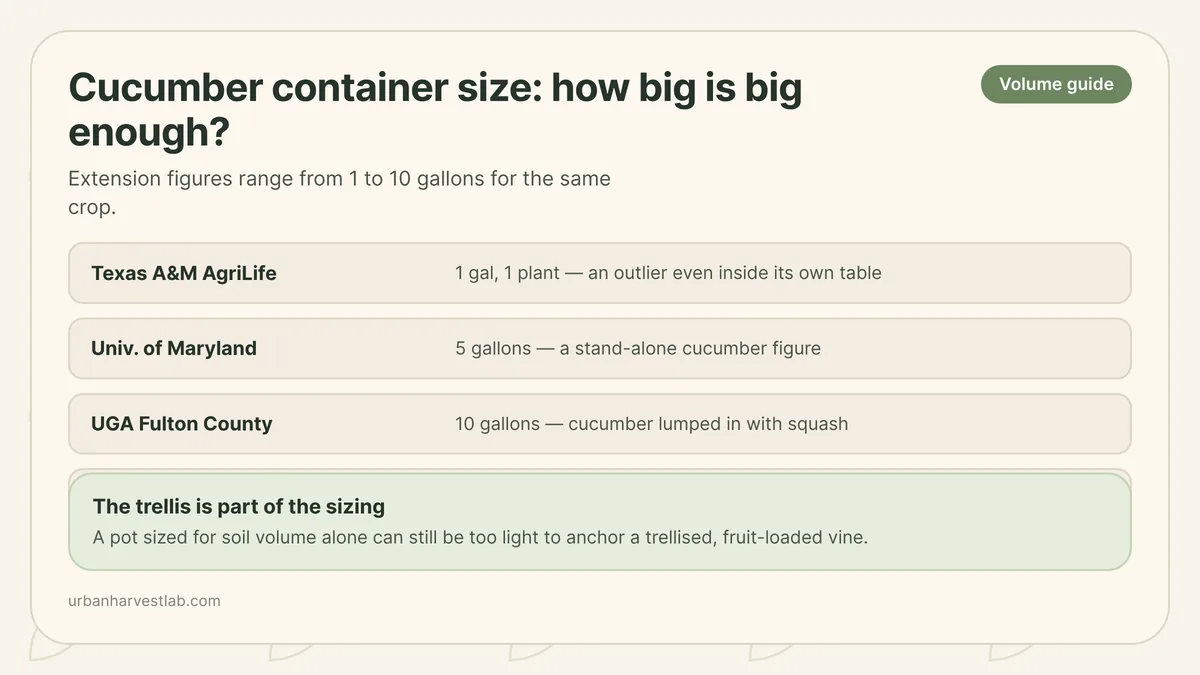
Container size for cucumbers: how big a pot do they really need
Cucumbers are vines with a fruit load to support, and extension sources disagree sharply on how much container that takes. The safer number is bigger than the smallest one you will find.