
Troubleshoot the system before you change the inputs.
Symptoms
- Fruit a few centimetres long turns yellow, shrivels and rots from the tip where the dead flower sits.
- A sunken, water-soaked patch on the blossom end of a fruit that had been swelling normally.
- A soft, mouldy rot spreading from a withered flower in warm, humid weather.
Possible causes
- The female flower was not pollinated, often because of rain, cold, or no pollinators reaching a balcony.
- Blossom end rot, linked to a calcium shortage in the fruit and to swings in soil moisture.
- A flower-infecting fungus taking hold on dead blossoms in warm, damp conditions.
Quick fixes
- Pick off every rotting fruit and withered flower now.
- Hand-pollinate each open female flower in the morning with a male flower or a soft brush.
- Water the mix on a steady schedule, mulch it, and water at the base rather than over the flowers.
Iowa State Extension says rot on small zucchini fruit is either poor pollination or blossom end rot, and the fruit tells you which. A fruit that shrivels whole, flower still attached, was not pollinated; a sunken, water-soaked patch confined to the blossom end is blossom end rot. A mouldy rot that spreads from a dead flower in warm, humid weather is a third cause, a fungus.
Do not start by adding calcium or spraying. Look at the fruit first, because the three causes need different fixes (sizing the pot matters for all three). In a pot, watering swings and the lack of pollinators both hit harder than in a garden bed.
Read the fruit before you treat anything
| What you see | Most likely cause | Why |
|---|---|---|
| Fruit yellowing and shrivelling as a whole, withered flower still attached | Pollination failure | Iowa State: the fruit begins to grow and then suddenly shrivels up and dies |
| Sunken, water-soaked spot confined to the blossom end, which can enlarge and turn brown to black and mouldy | Blossom end rot | Missouri Botanical Garden: distinguished from other rots by its confinement to the blossom end |
| Soft, fuzzy or mouldy rot spreading from a dead flower, after warm and damp days | Fungal rot | A fungus colonises failed blossoms and young fruit |
Size will not settle it, because Iowa State says rot on small fruit can be either cause. Missouri Botanical Garden itself notes that blossom end rot may be confused with rot from female flowers that failed to set fruit, so look at where the rot sits and whether the whole fruit is shrivelling.
Pollination failure: fruit that shrivels whole
Zucchini carries separate male and female flowers. The female has a small swelling, a miniature fruit, directly behind the petals; the male sits on a plain thin stalk. Pollen has to travel from a male flower to a female one. Iowa State Extension describes what follows when it does not: if the female flowers are not pollinated properly, the fruit begins to grow and then suddenly shrivels up and dies. The plant has not caught a disease. It has abandoned a fruit it cannot finish.
Iowa State also links rain to this, noting that bees and other pollinators are less active in rainy weather and that rainy weather could be responsible for poor pollination and rotting of the small fruits. On a high balcony the same thing happens without any rain, simply because few bees visit.
The fix is to move the pollen yourself. University of Maryland Extension notes that squash flowers open early and stay open for less than a full day, so work in the morning. Pick a freshly opened male flower, pull back the petals, and touch its pollen-covered centre to the centre of each open female flower. A soft brush also works. The full routine, with the tell-tale features of each flower, is in how to hand-pollinate on a balcony. If your cucumbers are the ones producing flowers that do not turn into fruit, that is a different pattern, covered in cucumbers that only make male flowers.
Flowers that open and close without fruiting may simply be male; University of Maryland Extension makes that point, since male and female flowers appear separately. The male-first pattern is covered in cucumbers that only make male flowers.
Blossom end rot: a calcium and water problem
Missouri Botanical Garden describes blossom end rot on cucurbits as beginning as a water-soaked, sunken spot on the blossom end, and says it can be told from other rots by being confined to that end. Both Missouri Botanical Garden and Iowa State attribute it to a lack of calcium in the developing fruit.
That does not mean the soil is short of calcium. Iowa State says that in most cases there is no need to apply calcium to the soil, and points instead to water: uneven moisture supplies and excessive nitrogen inhibit calcium uptake. Missouri Botanical Garden, by contrast, lists calcium nitrate in the soil or a calcium chloride spray among its controls. For cucurbits in containers it recommends a fertilizer that contains micronutrients including calcium, and notes that many tomato fertilizers meet that description. Against that, Iowa State sees no need to apply calcium to the soil in most cases. The two agree on the part you can act on today, which is keeping soil moisture uniform. Missouri Botanical Garden adds mulching the plants.
Epsom salt is a popular remedy that goes the wrong way. North Dakota State University Extension says it supplies magnesium and no calcium, and that it does not stop blossom end rot but leads to more of it. The full myth is covered in Epsom salt for plants.
In a pot the mix dries fast and a big squash leaf canopy drinks a lot, so the plant swings between dry and soaked unless you set a routine. Water when the top of the mix starts to dry, soak until water runs from the drainage holes, and cover the surface with mulch. The watering rhythm for vegetables in containers is in how often to water container vegetables, and mulch details are in mulching container plants. The same disorder on tomatoes, where the sources and symptoms differ in detail, is covered in blossom end rot on container tomatoes.
A pot that is too small makes every one of these swings worse, because it holds too little water to buffer a hot afternoon. Zucchini wants far more root room than the seedling suggests, as set out in what size pot zucchini needs.
Fungal rot on dead flowers
Dead flowers that stay stuck to young fruit are food for fungi. A University of Maryland Extension answer on rotting squash blossoms named Choanephora, a common fungus that can kill blossoms or young fruits when the weather is warm and humid, as the likely cause in the case it was shown. It was working from a photo and did not confirm the diagnosis, so treat that as a pattern to watch for rather than a certainty.
The advice is practical either way. Maryland says to remove failed blossoms promptly so they do not harbor fungi that can spread to other buds, and to make sure the flowers do not get wet when you water. Water the soil, not the plant, and give the pot enough space for air to move around the leaves. Maryland adds that no fungicide is useful against it during the growing season; clear crop debris at the end of the season so spores do not overwinter.
A week of checks on the pot
- Pick every rotting or shrivelled fruit and every withered flower, including those hanging on healthy-looking fruit.
- Hand-pollinate every open female flower each morning until the plant is setting fruit on its own.
- Put the pot on a steady watering schedule and mulch the surface.
- Hold off on nitrogen-heavy feeding, which Iowa State links to poorer calcium uptake.
- Watch the next three or four fruit. If the rot comes back as a sunken spot at the blossom end, concentrate on the water.
Sources
- Iowa State University Extension and Outreach, “Why are my zucchini fruit rotting before harvest?”
- Missouri Botanical Garden, “Blossom end rot of cucurbits”
- University of Maryland Extension, Home and Garden Information Center, via Ask Extension
- North Dakota State University Extension, “The Epsom Salt Myth”
Keep a pot of zucchini fruiting
Pollination technique, pot size and steady watering cover most of what goes wrong with container squash.
Common questions
Why is my zucchini rotting at the end?
Iowa State Extension names two causes: poor pollination or blossom end rot. Iowa State says unpollinated fruit begins to grow and then suddenly shrivels up and dies, while Missouri Botanical Garden says blossom end rot is a water-soaked, sunken spot confined to the blossom end.
Can I still eat zucchini that is rotting at the end?
The sources cited here cover causes and control, not whether affected fruit is safe to eat. A fruit with a rotted or mouldy tip should be picked and discarded, which also stops it holding moisture against the plant.
Does Epsom salt or calcium fix zucchini blossom end rot?
Epsom salt does not. North Dakota State University Extension says it does not stop blossom end rot and leads to more of it. Extension sources disagree on adding calcium: Iowa State says soil calcium is usually not needed, while Missouri Botanical Garden lists calcium nitrate or a calcium chloride spray, and for pots advises a fertilizer containing calcium. Even moisture is the point they share.
Will hand-pollination stop the rot?
It stops the pollination-failure kind. It does nothing for blossom end rot, which affects fruit that was pollinated, or for a fungal rot on dead flowers.
Related guides

Blossom end rot on tomatoes in pots: why it happens and what fixes it
Potted tomatoes swing between soggy and bone dry faster than garden ones, and that swing is what starves the fruit of calcium. Steady watering fixes most cases.

Cucumber only male flowers: normal start or a problem?
Male-only blooms at the start are the usual cucumber pattern. Learn how to spot the first female flower, what delays it, and when to step in.
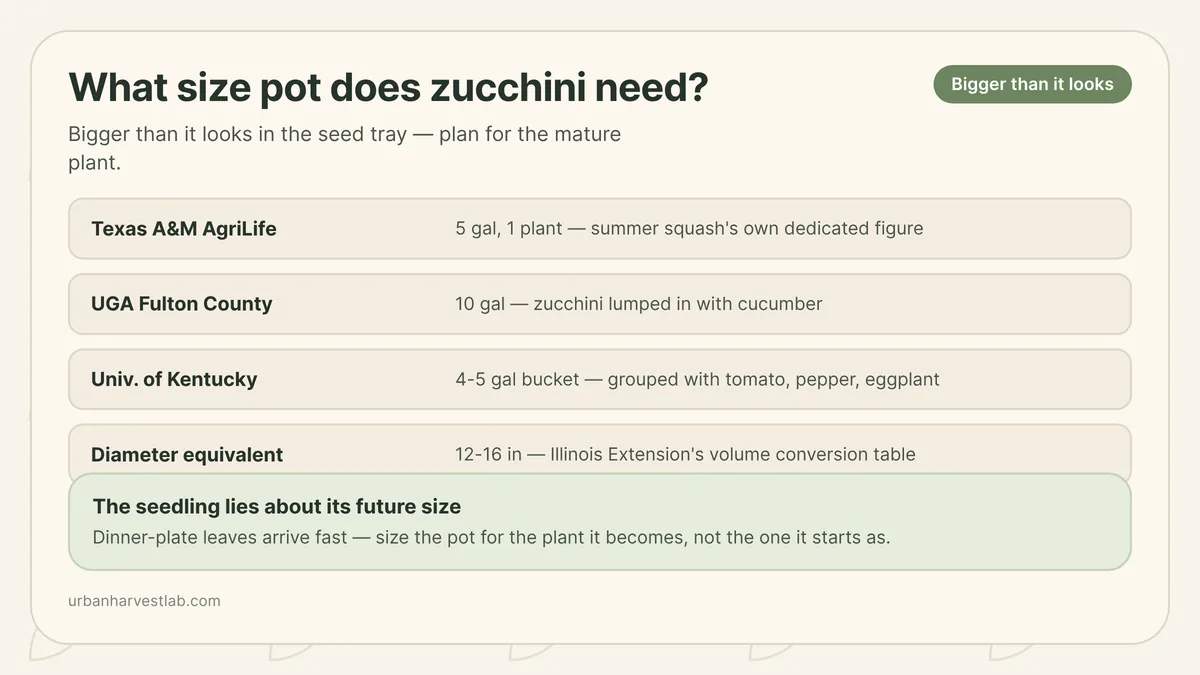
What size pot does zucchini need? Bigger than it looks in a seed tray
A zucchini seedling looks modest for weeks, then fills a pot almost overnight. The container has to be sized for the plant it becomes, not the one it starts as.