Troubleshoot the system before you change the inputs.
Symptoms
- A cucumber that is full on one end and narrows to a thin point or knob on the other.
- A fruit that bends or curls into a crescent instead of growing straight.
- A fruit that is fat or bulbous at the blossom end, often after a rainy spell.
Possible causes
- Incomplete pollination: pollen did not reach every ovule, so parts of the fruit did not develop.
- A big intake of water late in fruit development, especially after rain, swelling the blossom end.
- Moisture swings, especially the mix drying out, which Penn State links to growth deformity.
Quick fixes
- Hand-pollinate in the morning with a small paint brush while the flowers are open.
- Keep the mix evenly moist rather than letting it dry and then soaking it.
- Pick the oddly shaped fruit, check the taste, and eat it if it is not bitter.
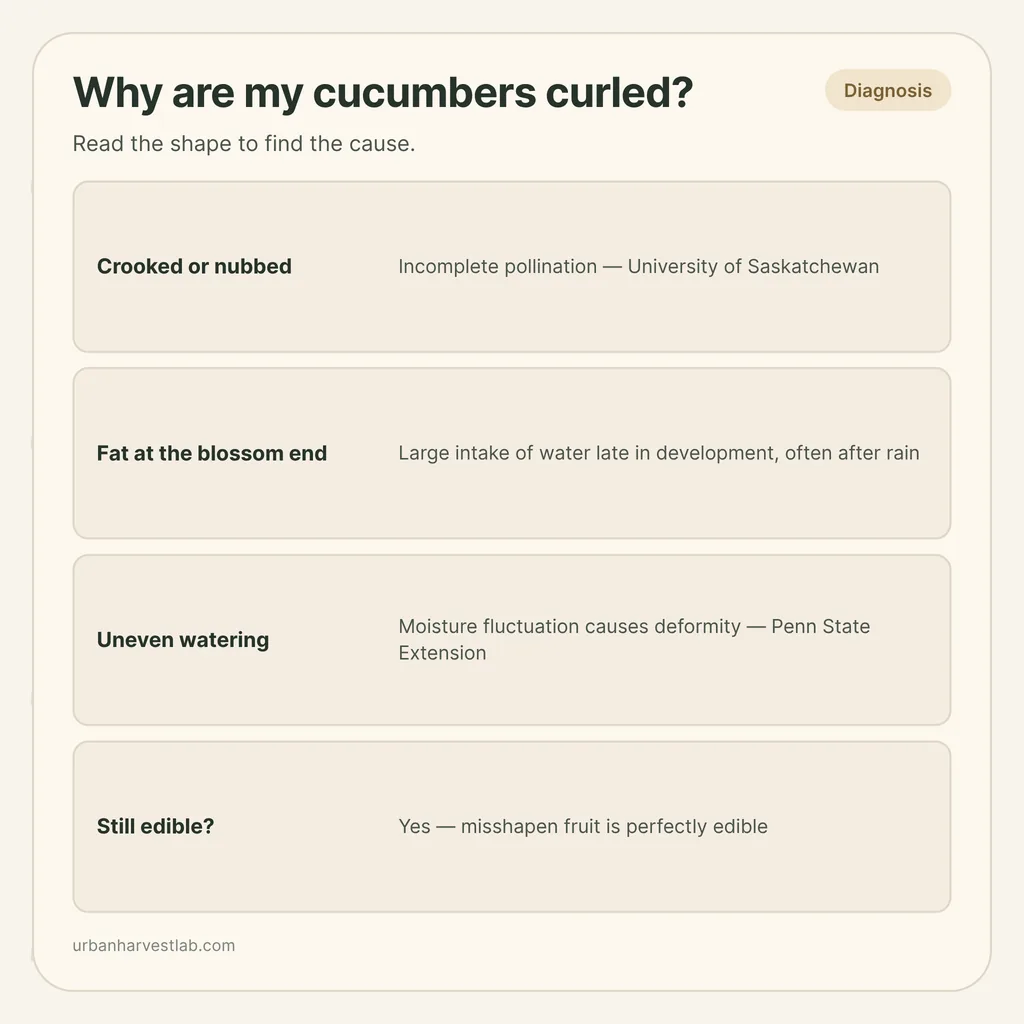
University of Saskatchewan says crooked or nubbed cucumbers are usually caused by incomplete pollination: pollen did not reach every ovule, so part of the fruit did not fill out. A fruit that is fat at the blossom end is a different problem, tied to a large intake of water. Either way, the fruit is perfectly edible according to the same source.
Look at the shape first, because it points to the cause. If the plant is not setting fruit at all, see cucumbers that only make male flowers. If the fruit tastes harsh, that is a bitterness problem, not a shape problem.
Read the shape
| What you see | Most likely cause | Source |
|---|---|---|
| Full on one end, pointed or knobbed on the other; crooked | Incomplete pollination | University of Saskatchewan |
| Thick or bulbous at the blossom end | Large intake of water late in development, often after rain | University of Saskatchewan |
| Deformed fruit on a plant that dries out between waterings | Moisture fluctuation | Penn State Extension |
| Small fruit that shrivels and drops | Pollination failure, abortion of the fruit | Penn State Extension |
Crooked or nubbed: incomplete pollination
A cucumber is a fruit with many seeds, and each seed starts as an ovule inside the swollen base of the female flower. University of Saskatchewan explains that pollen sometimes does not reach each of the tiny ovules and they are not fertilised. The sections with unfertilised ovules fail to develop as much fleshy enclosure, which gives a bent, pinched or nubbed fruit.
Penn State Extension lists deformed fruit, lower seed count, lighter fruit and reduced fruit production as effects of insufficient pollination, and says fruit abortion is another sign. Illinois Extension makes the same link: misshapen fruits occur due to poor pollination.
On a balcony the usual reason is too few visitors. Penn State Extension calls honey bees, squash bees, bumble bees and other wild bees essential for pollination and fruit set. Ohio State Extension adds that each blossom stays open for about 4 hours, and that a flower not pollinated in that window will not produce a fruit or will be misshapen.
What to do:
- Hand-pollinate in the morning. Ohio State says plants can be hand pollinated with a small paint brush if pollinators are lacking. The female flower is the one with a small fruit behind the petals; the routine for moving pollen is in hand-pollinating on a balcony.
- Check your variety first. Penn State Extension says seedless cucumbers are parthenocarpic and do not require pollination, so hand-pollinating them does nothing, and their odd shapes need another explanation.
- Mind sprays near flowers. Penn State Extension notes that insecticides applied to flowers or weeds in bloom can adversely affect pollinating insects. If you have an actual pest, the pest treatment guide compares the options.
Fat at the blossom end: water
University of Saskatchewan says fruits that are thick or bulbous at the blossom end are not usually a pollination problem. It names a large intake of water later in the fruit’s development, especially common after a period of rain. If your pot sat dry for days and then got a heavy soaking or a downpour, this is the likely read.
Uneven watering in a pot
Penn State Extension says cucumbers require a constant supply of moisture and that moisture fluctuation, especially soil water depletion, will cause growth deformity. A pot is where that fluctuation happens fastest, because a small volume of mix dries quickly. Ohio State Extension also says drought stress can cause female flowers to abort, and that heat, drought and too much water can make flowers wilt and die so pollinators cannot transfer pollen.
The fix is a steady routine, not more water at once. How often to water container vegetables covers checking the mix, and pot size for cucumbers covers how much root volume holds moisture between waterings. If you cannot tell whether the mix is too wet or too dry, overwatered versus underwatered separates them.
If you see insects on the vine
If you find insects on the plant, the whitefly guide and the aphid guide cover identifying them.
Should you eat it?
University of Saskatchewan says misshapen fruit is perfectly edible and suggests salads or bread and butter pickles when a straight pickling shape is not needed. Taste a small piece. If it is bitter, follow the bitter cucumbers page rather than assuming shape and bitterness are linked.
Sources
Straighter cucumbers in pots
Pollination, steady water and pot size are the levers the extension sources point to.
Common questions
Why are my cucumbers curled?
University of Saskatchewan says crooked or nubbed cucumbers are usually caused by incomplete pollination. Pollen did not reach every ovule inside the flower base, and the sections with unfertilised ovules fail to develop as much flesh. Illinois Extension also says misshapen fruits occur due to poor pollination.
Are misshapen cucumbers safe to eat?
University of Saskatchewan says misshapen fruit is perfectly edible and suggests slicing it for salads or cutting it up for bread and butter pickles. Bitterness is a separate problem, covered in the bitter cucumbers page.
Why is my cucumber fat at one end?
University of Saskatchewan says fruit that is thick or bulbous at the blossom end is not usually a pollination problem. It is caused by a large intake of water later in the fruit's development and is especially common after a period of rain.
Do I need to hand-pollinate seedless cucumbers?
No. Penn State Extension says seedless cucumbers are parthenocarpic and do not require pollination for production, so a misshapen seedless fruit points to water or something else rather than missing pollen.
Related guides

Why are my cucumbers bitter? Stress, genes, and when to bin them
Bitterness comes from cucurbitacin moving into the fruit when the vine is stressed. Learn how to rescue mild cases, keep pot cucumbers sweet, and tell when bitter fruit is not worth eating.

Cucumber only male flowers: normal start or a problem?
Male-only blooms at the start are the usual cucumber pattern. Learn how to spot the first female flower, what delays it, and when to step in.

Cucumber leaves turning yellow in pots: which cause fits
Where the yellow starts and what it looks like tells you whether a potted cucumber is hungry, waterlogged, mildewed or infested.