
Troubleshoot the system before you change the inputs.
Symptoms
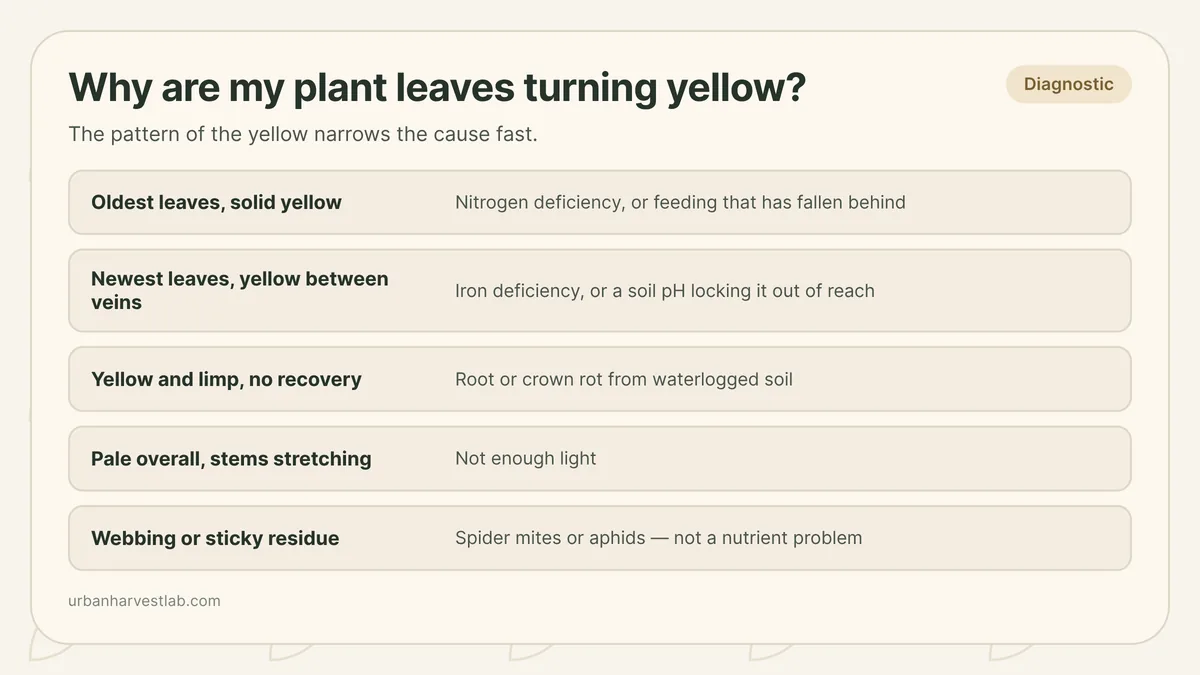
- The oldest leaves turn an even pale yellow while the vine grows slowly.
- Lower leaves yellow while the potting mix stays wet for days.
- Yellow, angular spots appear on the upper surface of older leaves, with gray fuzz on the underside.
- Leaves show fine yellow or white speckling, or a yellow-green mottling with distortion.
Possible causes
- Nitrogen has run out of the pot or been flushed through the drainage hole.
- The mix stays saturated, so roots lose oxygen and cannot feed the plant.
- Downy mildew is spreading in warm, wet, humid weather.
- Spider mites, squash bugs or a virus carried by insects.
Quick fixes
- Push a finger into the mix and check the drainage hole and saucer before changing anything else.
- Turn over a yellow leaf and look for gray fuzz, then check for stippling or webbing.
- If the pattern is even yellowing of old leaves in a well-draining pot, resume a feeding routine at the label rate.
- Remove badly affected leaves, space plants for airflow, and pull out plants with virus mottling.
Yellow cucumber leaves: what the pattern points to
| What you see | Where it starts | Most likely cause |
|---|---|---|
| Even pale yellow, slow growth | Oldest, lowest leaves | Nitrogen shortage |
| Yellow lower leaves, mix stays wet, growth stalled | Lower leaves, then upward | Waterlogged roots |
| Yellow angular spots, gray fuzz underneath | Older leaves, upper surface | Downy mildew |
| White powdery coating | Older leaves, both surfaces | Powdery mildew |
| Fine yellow or white stippling | Leaf surface | Spider mites |
| Yellow and green mottling, distorted leaves | Anywhere on the plant | Mosaic virus |
Yellow leaves on a potted cucumber come from a handful of causes, and the pattern separates them: even yellowing of the oldest leaves is usually nitrogen, yellowing in a soggy pot is a root problem, yellow angular spots with gray fuzz underneath are downy mildew, fine yellow specks are mites, and yellow-green mottling is a virus. Work out which leaves are yellow and what the yellow looks like before you feed or spray.
For a decision tree that covers every plant, start with the yellow leaves cause finder.
Start with the pattern
| What you see | Where it starts | Most likely cause |
|---|---|---|
| Even pale yellow, slow growth | Oldest, lowest leaves | Nitrogen |
| Yellow lower leaves, mix stays wet | Lower leaves, moving up | Waterlogged roots |
| Yellow angular spots, gray fuzz underneath | Older leaves, upper surface | Downy mildew |
| White powdery coating | Older leaves, both surfaces | Powdery mildew |
| Fine yellow or white stippling | Leaf surface | Spider mites |
| Yellow-green mottling, distorted leaves | Anywhere | Mosaic virus |
Check the pot before you feed
Check the mix before you decide the plant is underfed. Missouri Botanical Garden lists “stunted slow growth with yellowing leaves” among the symptoms of overwatering, and explains why: roots in waterlogged soil “may die because they cannot absorb the oxygen needed to function normally.” Dying roots stop supplying water and nutrients, so the leaves yellow whatever is in the pot. UC IPM, writing about established woody plants, makes the same point: when they show nitrogen-deficiency symptoms the cause is often unhealthy roots, including poor drainage and too much irrigation, and adding nitrogen will not remedy those causes.
A cucumber vine in a pot is a thirsty plant, which tempts people to water on a timetable. Instead:
- Push a finger into the mix to the first knuckle. Wet at that depth days after watering is the warning sign.
- Lift the pot. One that stays heavy has not dried.
- Check the drainage holes and the saucer. Standing water keeps the bottom of the mix saturated.
- Look at the other side of the problem too, since UC IPM lists “too little or too much irrigation” among the causes of nitrogen uptake trouble.
The difference between too much and too little water is laid out in overwatered vs underwatered, and a watering rhythm for vegetables is in how often to water container vegetables. A pot that is too small for the vine swings between dry and flooded, so check yours against the cucumber container size figures.
Hungry vine: the yellow climbs from the base
UC IPM says, “Slow growth and uniform yellowing of older leaves are usually the first symptoms of nitrogen (N) deficiency,” and lists plants “in containers or planter boxes” among those that may need nitrogen. University of Maryland Extension shows a nitrogen-deficient cucumber with yellow leaves. On a long cucumber vine the lowest leaves are the oldest and sit furthest from the growing tip, so they are the first to give up nitrogen when supply runs short, while the tip stays greener.
Leaf age matters here. Yellowing confined to one or two of the very oldest leaves, with vigorous new growth above, is a different picture from a vine where the yellow keeps climbing. If it climbs, resume a routine from the fertilizer schedule for container vegetables, which gives the feeding rhythm for fruiting crops, and follow the label rate. UC IPM warns that “applying excess nitrogen can damage plants and pollute the environment,” and University of Maryland Extension lists “brown leaf edges, tan blotches” as the sign of fertilizer or pesticide burn, which is not the same as yellowing.
If new leaves go yellow while the veins stay green, the problem is not nitrogen. UC IPM places iron and manganese deficiency on new foliage and notes that deficiency symptoms often result from adverse conditions such as pH problems or unhealthy roots. Illinois Extension’s chlorosis page instead says manganese and zinc deficiencies “develop on the inner or the older leaves first and then progress outward,” so the two services disagree about where manganese shows first. If older-leaf yellowing in a pot that drains well does not respond to feeding, check pH; see container soil pH.
Downy mildew: yellow angular spots
University of Maryland Extension describes it as “yellow, angular spots on upper leaf surface, with gray fuzzy spots on the undersides,” starting on older leaves. North Carolina State Extension explains the shape: the fungus “has a difficult time crossing the many veins that criss-cross the leaf,” so the spots are boxed in by the veins. Turn a leaf over. Gray to purplish fuzz under a yellow spot confirms it.
Speed is the reason to act. University of Maryland Extension says downy mildew “can quickly kill leaves and entire plants during warm, wet weather,” and North Carolina State Extension says it can defoliate and kill the plant. Remove badly spotted leaves, give the vine room and sun for airflow so leaves dry faster, and water at the base of the plant. University of Maryland Extension advises choosing disease-resistant varieties for diseases that return each year. Any fungicide on a food crop needs a label that lists cucumbers, so read the label before you buy.
Powdery mildew is white, not yellow
Do not confuse the two. University of Maryland Extension contrasts downy mildew’s angular lesions with powdery mildew’s “noticeable white, moldy growth,” which on cucumber appears on upper and lower surfaces and starts on older leaves. It adds that powdery mildew “is not encouraged by wet foliage.” Leaves under heavy powdery mildew can still yellow and die, but the white coating is the tell. Control is covered in powdery mildew on container herbs, and the same principles apply to a cucumber vine.
Mites, squash bugs and virus
Fine yellow or white dots across the leaf are stippling. University of Maryland Extension says spider mites “suck the green pigment (chlorophyll) out of the leaves, resulting in yellowing” and are common in extended hot, dry weather; squash bugs cause “small yellow-green or white spots.” Check the underside of a leaf with a hand lens. The method and control for mites are in spider mites on indoor herbs.
Yellow or green mottling, with leaves that pucker, curl or distort, is a different story. University of Maryland Extension says viruses “are transmitted by insects and can survive in perennial weeds,” and advises: “Pull out and dispose of infected plants. Control weeds, aphids, and cucumber beetles.” Aphids are one of the carriers University of Maryland Extension names, and aphids on indoor herbs shows how to find and stop them.
What to do first
- Check the mix and the drainage. If it is wet, fix that before anything else.
- Flip a yellow leaf over. Fuzz means downy mildew, dots mean mites.
- If the pattern is even yellowing of old leaves in a pot that drains and dries normally, feed at the label rate.
- If the leaves are mottled and distorted, remove the plant.
Bitter fruit and yellow leaves can show up on the same stressed vine; fruit flavour is covered in bitter cucumbers.
Sources
- University of Maryland Extension, Key to common problems of cucumbers
- University of Maryland Extension, Downy mildew on vegetables
- University of Maryland Extension, Powdery mildew on vegetables
- University of Maryland Extension, Nutrient deficiency of vegetable plants
- North Carolina State Extension, Watch leaves for cucumber downy mildew
- Illinois Extension, Chlorosis
- UC IPM, Nitrogen deficiency
- UC IPM, Common nutrient deficiency symptoms
- Missouri Botanical Garden, Overwatering
Narrow down the cause
Water, feeding and mildew account for most yellow cucumber leaves in pots.
Common questions
Why are the bottom leaves of my potted cucumber turning yellow?
Three causes lead the list. Even pale yellowing of the oldest leaves with slow growth is nitrogen shortage, per UC IPM. Yellow angular spots on older leaves with gray fuzz underneath are downy mildew, per University of Maryland Extension. Yellowing with a constantly wet mix is a root problem, because Missouri Botanical Garden says roots in waterlogged soil cannot absorb the oxygen they need.
How do I tell downy mildew from powdery mildew on cucumber?
Downy mildew makes yellow, angular spots on the upper leaf surface with gray fuzzy growth underneath. Powdery mildew is a white powdery coating that University of Maryland Extension says can sit on the upper and lower surfaces. Yellow with fuzz underneath is downy; white dust is powdery.
Should I fertilize a cucumber with yellow leaves?
Only if the pattern fits nitrogen: even yellowing of the oldest leaves, slow growth, and a mix that drains and dries normally. UC IPM warns that excess nitrogen can damage plants, and, writing about established woody plants, says that when nitrogen-deficiency symptoms appear the cause is often unhealthy roots, including poor drainage and too much irrigation, and that adding nitrogen will not remedy those causes.
Can I save a cucumber with mosaic virus?
No. University of Maryland Extension gives no cure; it advises pulling out and disposing of infected plants, and controlling weeds, aphids and cucumber beetles, because insects transmit the virus.
Related guides

Why are my cucumbers bitter? Stress, genes, and when to bin them
Bitterness comes from cucurbitacin moving into the fruit when the vine is stressed. Learn how to rescue mild cases, keep pot cucumbers sweet, and tell when bitter fruit is not worth eating.
Why are my plant leaves turning yellow? Find the likely cause
Yellow leaves have a short list of real causes, and the pattern of the yellowing narrows it fast, once you know what to look for.
Powdery mildew on container herbs: diagnosis and control
A white mark is not automatically mildew. Confirm whether patches recur and spread on living tissue before changing the entire care routine.