Troubleshoot the system before you change the inputs.
Symptoms
- Powdery or dusty white coating on leaf surfaces that spreads to new leaves over several days
- Silvery, stippled, or bronzed patches with tiny dark specks scattered across the damaged tissue
- Flat, papery white or bleached patches that stay the same size and shape once they appear
Possible causes
- Powdery mildew spores germinating on leaf surfaces, which does not require standing water to start
- Thrips rasping and feeding on leaf tissue, leaving stippling and dried excrement rather than a true spot
- A sharp increase in direct light on tissue that was not acclimated to it
Quick fixes
- Check the mark under a hand lens for insects, frass, or webbing before assuming disease
- Mark one patch and recheck it in two to three days: expanding means mildew, unchanged means sunscald
- Move a plant with fresh sunscald out of the harshest direct light rather than treating it as an infection
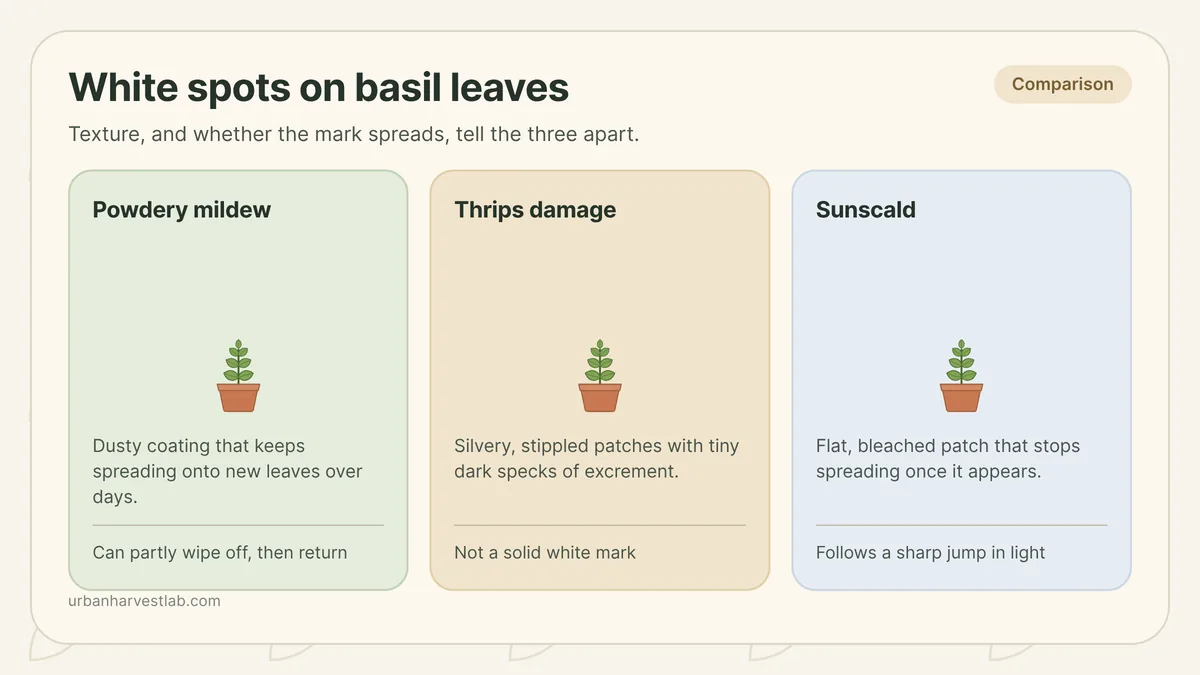
White marks on basil, compared
| Clue | Powdery mildew | Thrips damage | Sunscald |
|---|---|---|---|
| Texture | Dusty, powdery coating | Silvery, stippled, sometimes bronzed | Flat, dry, papery |
| Edge | Irregular, spreads outward over days | Speckled, follows feeding path | Sharp, matches the area that was exposed |
| Extra sign | Coating partly wipes off, then returns | Tiny dark specks of dried excrement | No insects, no residue, follows a change in light exposure |
| Changes over 2-3 days | Expands onto new leaves | New stippling on new growth if still active | Stays the same size and shape |
White spots on basil usually mean one of three things: powdery mildew, thrips damage, or sunscald. Powdery mildew is a dusty coating that spreads over several days. Thrips leave silvery, stippled patches with tiny dark specks, not a true solid white mark. Sunscald is a flat, bleached patch that appears once and does not grow. Checking texture, edge shape, and whether the mark changes over the next few days tells you which one you have.
If your basil is yellowing rather than showing white marks, that is a different problem with a different cause; see why basil leaves turn yellow indoors or, if the yellowing follows the leaf veins with grey fuzz underneath, basil downy mildew. For general potted-herb decline without a clear mark on the leaf, start with the potted herb problem guide instead.
Start with a hand lens, not a guess
Move the plant into bright light and look at both sides of the affected leaves. A hand lens changes what you can rule in or out here, because the three causes look similar from across a room and different up close.
Look for three things in order: an insect or webbing, a dusty coating versus a flat bleached patch, and whether the mark sits on new growth or old growth. Powdery mildew and thrips can both appear on the same plant at the same time, so confirm each mark rather than assuming one explanation covers everything you see.
Powdery mildew: a dusty coating that spreads
UC IPM describes powdery mildew as a fungal disease that “can germinate and infect without water on the plant’s surface,” which is the detail that surprises most growers who assume every white coating on a plant means it got wet and stayed wet. The counter-intuitive corollary is worth knowing too: “water on plant surfaces for extended periods inhibits spore germination and kills the spores,” and overhead sprinkling can actually wash spores off and reduce spread. So a dusty patch on a basil leaf that has not been rinsed at all is not evidence against mildew.
Conditions that favor it, per UC IPM: “moderate temperatures of 60° to 80°F and shady conditions,” with growth suppressed above roughly 95°F. Crowded basil in a dim corner of a kitchen or a shaded balcony rail is exactly the setup this describes.
Mark one patch with a photograph and recheck it in two or three days. Mildew keeps expanding onto new leaves; a one-time residue mark does not. UC IPM’s own caveat applies here too: “there are many species of powdery mildew fungi, and each species infects a range of different plants,” so a mildew patch on a nearby ornamental is not automatically a threat to the basil beside it, though it is not automatically safe either.
For the full diagnosis-and-control sequence, including how to separate mildew from mineral deposits and spray residue, and how to choose a treatment that is actually labeled for an edible herb, see powdery mildew on container herbs. That page also covers spacing, airflow, and light corrections that reduce recurrence.
Thrips: silvery stippling that gets called a “white spot”
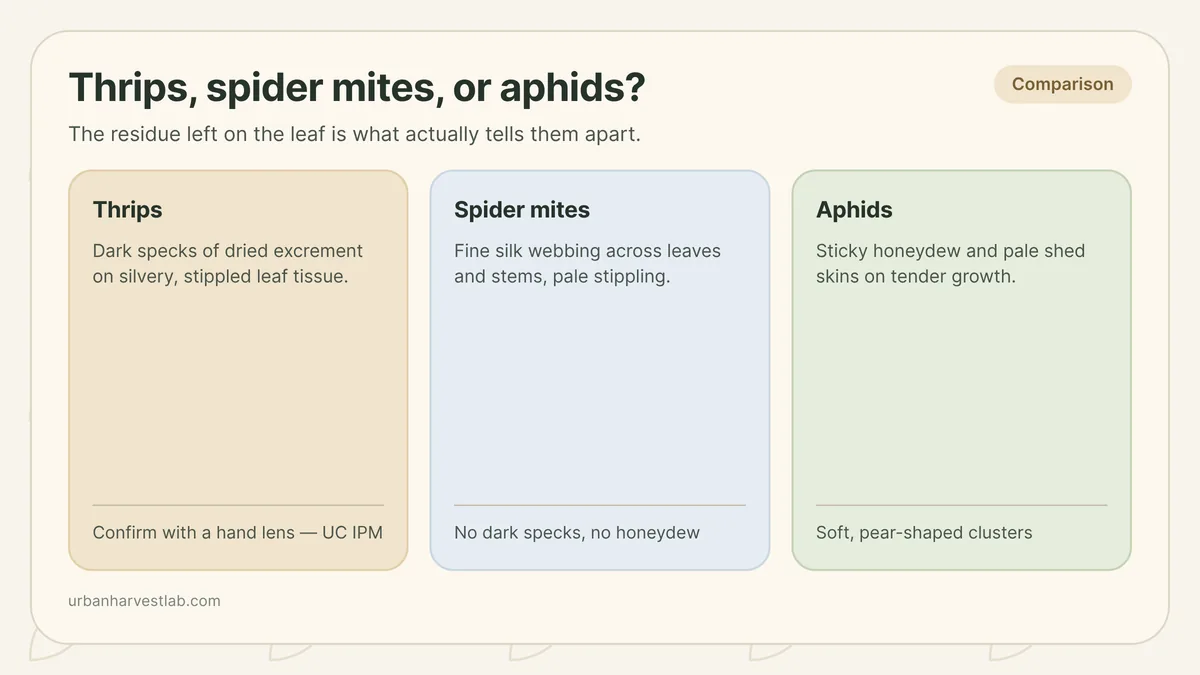
Thrips damage is often described as a white spot by growers, but it is not a solid white mark at all. UC IPM’s description is “less than 1/20 inch long,” translucent white to dark brown adults with long, narrow, fringed wings, and damage that looks like “scabby, silvery to dark brown discoloration.” Clemson’s houseplant summary calls the same damage a “silvery/speckled leaf appearance.”
The detail that actually separates thrips from mildew or sunscald is frass: UC IPM identifies “dark specks of excrement” scattered across the damaged tissue. Neither mildew nor sunscald leaves that mark. If you see fine, silvery stippling with tiny dark flecks inside it, and no dusty coating and no sharp bleached outline, that is thrips rather than either of the other two.
Distorted or curled new growth alongside the stippling is another thrips signal UC IPM notes. Old stippling does not fade once thrips are controlled, so judge whether treatment worked by watching new leaves rather than the ones already marked.
For confirming the insect, isolating the plant, and choosing a treatment, see thrips on herbs. That page also covers the spider mite and aphid look-alikes, which show webbing or honeydew instead of frass.
Sunscald: a bleached patch that stops where it started
The extension sources cited here describe powdery mildew and thrips damage in detail but publish no description of basil sunscald, so it is identified by what is absent rather than by a sourced description: a flat, dry, papery white or bleached patch that appears once and then holds still, with no dusty coating that spreads, no dark frass specks, no insects or webbing, and no change in the mark over two or three days.
This kind of patch typically follows a sharp jump in light exposure — a plant moved from a shaded spot straight into a south-facing window, or a grow light set too close or too bright, landing on tissue that was not acclimated to that much light.
Because the tissue is dead where it is bleached, the mark itself does not heal. What you can do is remove the immediate cause: move the plant out of the harshest direct light, water at the base rather than overhead in strong sun, and let the plant produce new growth without a repeat exposure. New leaves that come in clean, with no new patches forming, confirm the cause is corrected.
Basil grows best with strong light, so the fix is not simply “less light” everywhere. Clemson says basil grows reasonably well in part-sun, which it defines as “six hours of sun per day,” and Penn State Extension recommends “at least six to eight hours” a day for strong growth. The distinction is between steady bright light, which basil wants, and a sudden intense burst on tissue that was not acclimated to it, or a wet leaf under that burst, which is what actually scalds.
What white spots on basil are not
Basil downy mildew is a different disease with a different look, and it does not belong on this list of white-spot causes. Clemson describes its first symptom as “slight yellowing of the foliage, with a spread that is limited by the major leaf veins” on the top of the leaf, confirmed by “sporulation” on the underside that is “purplish-gray,” which Penn State Extension describes as “a gray downy growth on the undersides.” That is yellow on top and grey fuzz underneath, bounded by veins, not white and dusty or white and flat. If your basil shows vein-bounded yellowing with fuzz on the underside, go to basil downy mildew rather than treating it as one of the three causes above.
A dried spray residue or a hard-water mineral deposit can also leave a pale film that gets mistaken for mildew. Both tend to sit uniformly across the leaf and match the timing of a watering or spraying event rather than spreading over the following days, and the powdery mildew page covers telling the two apart in more detail.
Oedema is a different mark again, and one with a real texture to it rather than a flat surface change. Clemson describes “rough corky swellings” forming “on the petioles and lower leaf surfaces,” brought on by excessive soil moisture combined with poor lighting and low temperatures, and Missouri Botanical Garden lists “water-soaked spots and blisters (oedema)” among the symptoms of overwatering. Raised, corky bumps on the leaf underside and petioles, rather than a flat mark on the upper surface, point to oedema and a watering or light correction rather than to any of the three causes above.
Common mistakes
- Treating a dry, unchanging bleached patch with a fungicide meant for mildew.
- Assuming every silvery mark is sunscald without checking for the dark specks that identify thrips.
- Wiping a patch once, seeing it disappear, and concluding it was not disease at all, when mildew can partly wipe off and still return.
- Fertilizing a scalded plant to “help it recover,” when the leaf tissue is already dead and the fix is light and water management, not feeding.
- Confusing basil downy mildew’s yellow, vein-bounded patches with any of the three white-spot causes above.
Sources
- UC IPM Pest Notes 7493, “Powdery Mildew on Ornamentals”
- UC IPM Pest Notes 7429, “Thrips”
- Clemson HGIC, “Common Houseplant Insects & Related Pests”
- Clemson HGIC, “Basil”
- Penn State Extension, “Basil, A Summer Favorite”
- Clemson HGIC, “Houseplant Diseases & Disorders”
- Missouri Botanical Garden, “Overwatering”
Confirm the cause before you treat it
White marks on basil come from disease, insects, and light exposure, and each one needs a different response.
Common questions
What causes white spots on basil leaves?
The three most common causes are powdery mildew, thrips damage, and sunscald. Powdery mildew looks dusty and spreads over days. Thrips leave stippled, silvery patches with tiny dark specks rather than a solid white mark. Sunscald is a flat, bleached patch that stops spreading once it appears, usually following a sharp increase in light exposure.
Does a white powdery patch on basil mean powdery mildew?
Usually, but not automatically. Dried spray residue and hard-water mineral deposits can leave a similar surface film. Powdery mildew keeps expanding onto new growth over several days; residue and mineral deposits generally do not.
Does a white spot mean my basil has downy mildew?
No. Basil downy mildew does not produce white spots. It shows as yellow patches bounded by the leaf veins on the upper surface, with grey-purple fuzz on the underside directly beneath the yellowing.
Can I still eat basil with white spots?
Discard leaves that are visibly coated, distorted, or degraded. Wash the remaining harvest well, and if you applied any product, follow that label's harvest interval for the specific crop before cutting more leaves.
Related guides
Thrips on herbs: identify the damage and stop it
Thrips leave silvery, stippled leaves and dark specks of excrement rather than webbing or honeydew, and confirming the insect matters more than guessing from the damage alone.
Why are basil leaves turning yellow indoors?
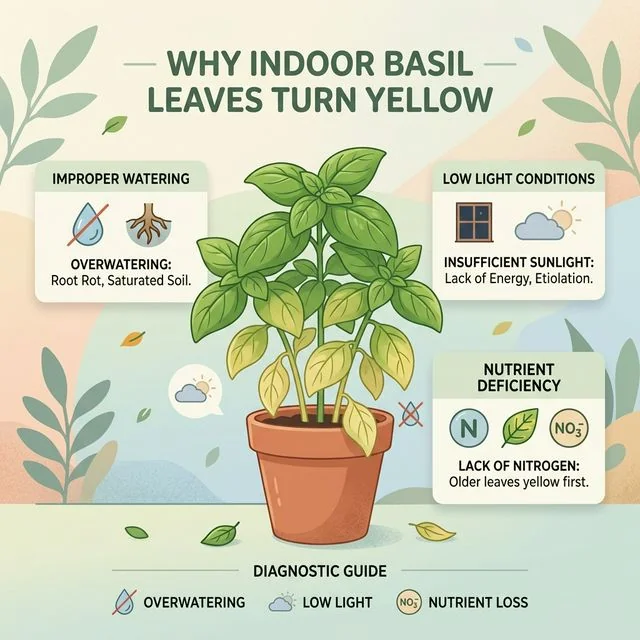
Yellow basil rarely has a single universal cause. The pattern of yellowing, the growing medium, and the recent care routine usually tell the story.
Powdery mildew on container herbs: diagnosis and control
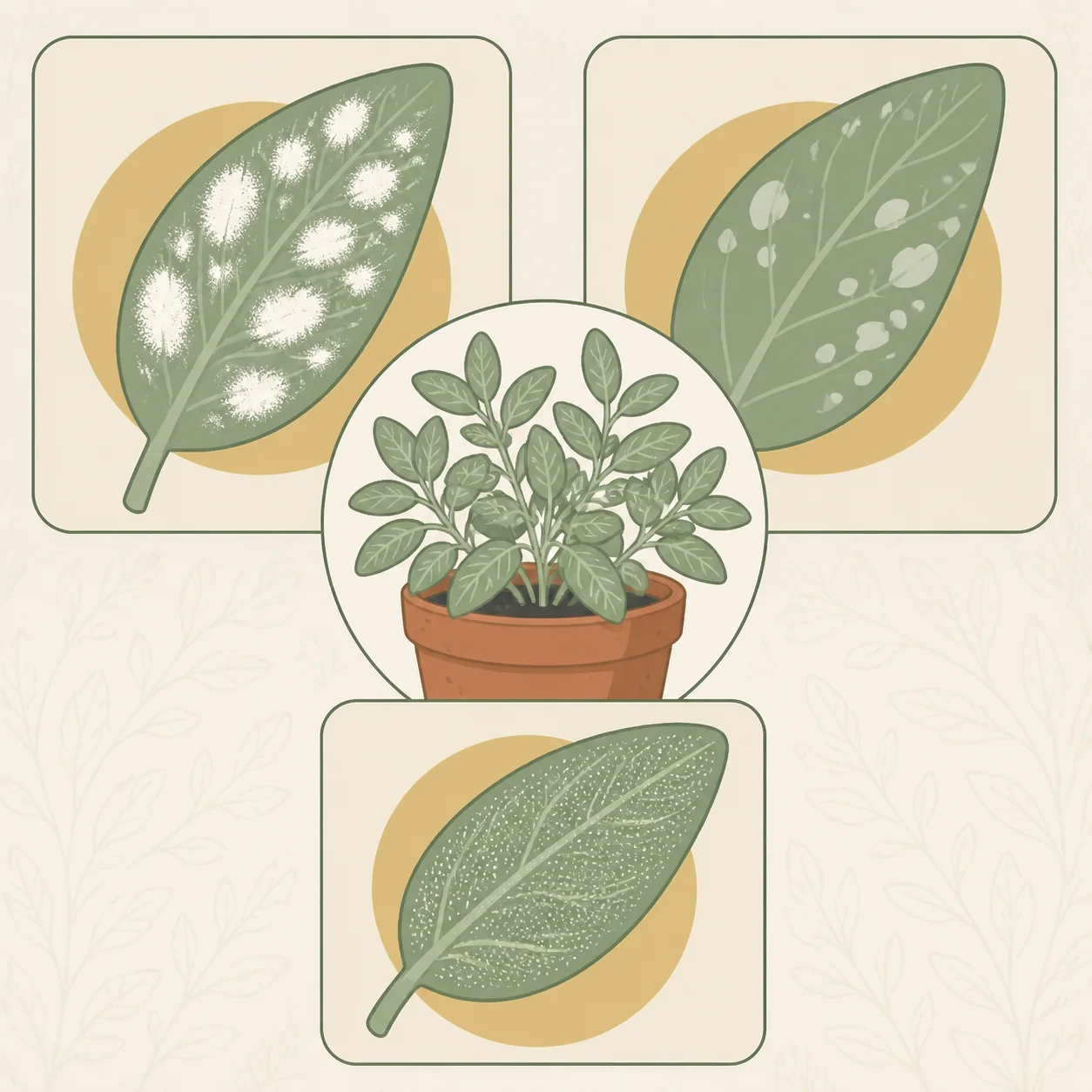
A white mark is not automatically mildew. Confirm whether patches recur and spread on living tissue before changing the entire care routine.