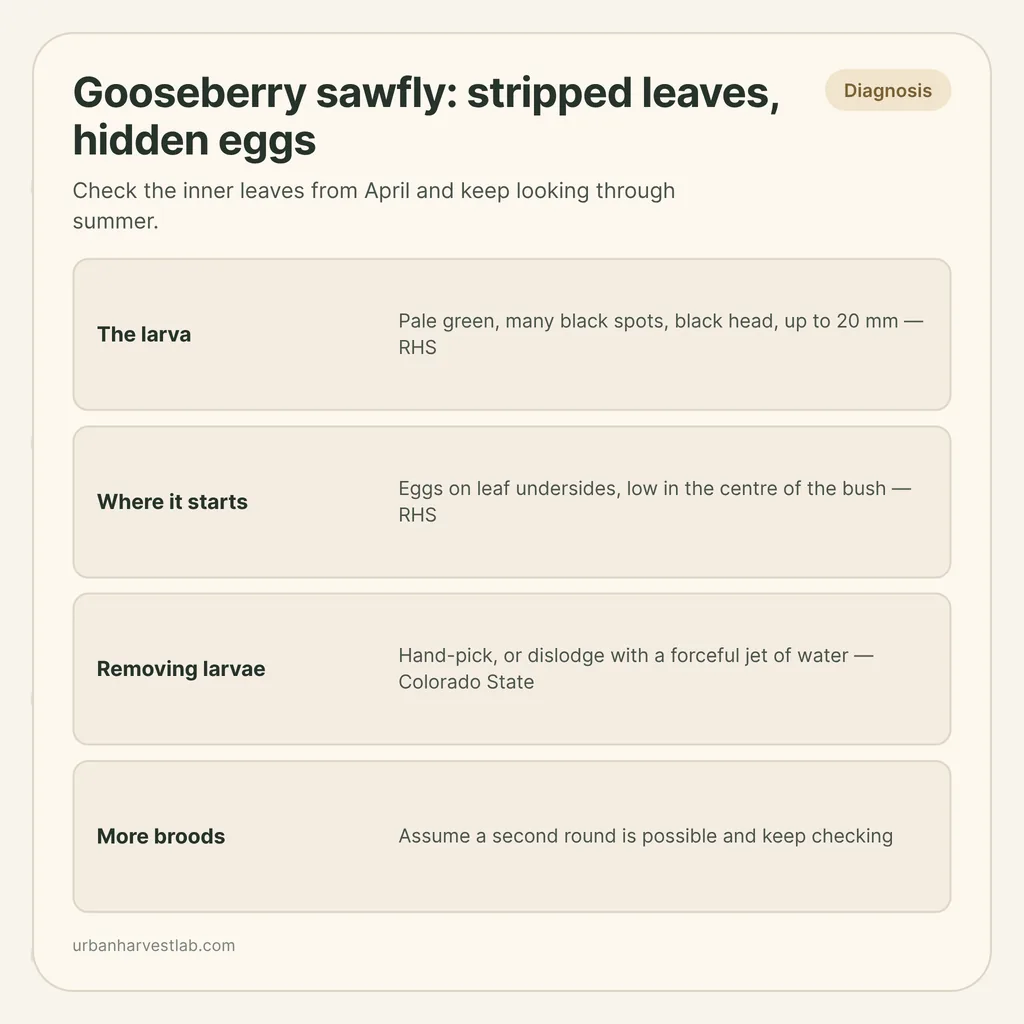
Troubleshoot the system before you change the inputs.
Symptoms
- Small holes in leaves at the centre of the bush, low down, in spring
- Pale green larvae with black dots and a black or pale green head feeding along leaf edges
- Leaves eaten down to the main veins, starting inside the bush and working outward
- Short rows of narrow white eggs along the midrib on the underside of leaves
Possible causes
- Common gooseberry sawfly, pale spotted gooseberry sawfly or small gooseberry sawfly larvae (the RHS lists these three)
- Imported currantworm, the name Colorado State and Washington State use for the common species
- Moth caterpillars such as the currant spanworm, which walk with a looping motion
Quick fixes
- Part the bush and check inner, shaded leaves every few days from April
- Pick off larvae by hand, or shake the branches over a container and dispose of what falls
- Keep checking through summer, because later broods follow the first
Green larvae with black spots that strip a gooseberry or currant bush from the inside out are sawfly larvae. Check the inner leaves from April, pick the larvae off by hand, and keep looking through summer because more than one brood is possible.
Sawflies are not moths. The RHS places them in the Hymenoptera, the group with bees, ants and wasps, and describes the larvae as caterpillar-like. They are the usual culprit when a bush that looked fine last week is suddenly lace. If you are still choosing a bush or a pot, start with growing currants and gooseberries in pots.
Confirm it is a sawfly
The RHS describes the common gooseberry sawfly larva as up to 20 mm long, pale green, with many black spots and a black head. The pale spotted species has a pale green head and is a little smaller. Washington State University gives about half an inch for a mature larva of the imported currantworm, the name it uses for the common species, and notes the larvae are whitish at first and turn green with black spots and heads as they mature.
Where the damage starts is as useful as what the larva looks like. The RHS explains that females lay eggs on the underside of leaves, low down in the centre of the bush, so the larvae go unnoticed until they have eaten their way upwards and outwards. Colorado State University describes short rows of elongate white eggs along the leaf midrib, usually on shaded leaves inside the plant. The eggs hatch in one to two weeks. The young larvae first cut small shothole wounds in the interior of the leaf, then move to the leaf edge as they grow.
Not every green larva on these bushes is a sawfly. The RHS notes that some moth larvae also eat gooseberry and currant foliage. Colorado State names the currant spanworm, a spotted inchworm with a distinctive looping walk. A looping walker is not a sawfly. For caterpillars on other crops, see caterpillars on tomato plants, and for a broader identification aid, the herb pest identification chart.
How much damage to expect
The RHS says plants will usually survive complete defoliation, but yield may be reduced, and defoliated plants are weakened and may produce a poor crop the following year. Colorado State adds that heavy early defoliation can expose berries to sunscald and leave plants more open to other pests such as the currant borer. A stripped bush is a setback for the crop, not usually the end of the plant.
Start checking in April
Washington State advises monitoring plants in April for small holes in the centre of leaves from larval feeding. The RHS likewise says to check regularly from April. In practice that means parting the branches and looking at the underside of inner leaves, not glancing at the outside of the bush, because the outside is the last place to show damage. A potted bush makes this easy: tilt or turn the pot so you can reach the middle.
Removing larvae
The RHS lists removal by hand where practical, and Washington State lists non-chemical options as the first choice and says to hand-pick and kill larvae when noticed. Colorado State adds two more ways to dislodge them: a forceful jet of water, after which many larvae often fail to regain the plant, or shaking the plants over a container so you can collect and dispose of what falls. The RHS also recommends encouraging natural enemies such as birds, wasps and ground beetles.
Washington State says floating row cover may be useful. Its page does not say how or when to fit it, so treat it as an option to read up on locally rather than a tested routine.
When more than one brood arrives
How many broods you get depends on the species and where you live. The RHS says the common gooseberry sawfly can have three generations a year, with larvae active in late April to June, July, and August to September. The pale spotted species has one generation, with larvae in May and June. The small gooseberry sawfly can have up to four generations from late April. Colorado State describes a single generation per year for the imported currantworm there, and Washington State says a second generation may occur around June or July.
The sensible reading: assume a second round is possible and keep checking inner leaves after you clear the first. The larvae that finish feeding go into the soil, where the RHS says they spin silk cocoons and pupate. Colorado State says the insect overwinters in a cocoon in the soil around previously infested plants. That is why the next spring’s check matters, even after a bad year.
Sprays and other products
The RHS points out that complete defoliation rarely kills the plant, and recommends tolerating sawflies where possible. Washington State says not to apply a pesticide unless there is evidence of larvae or damage. For examples, its page lists products with spinosad or potassium salts of fatty acids as active ingredients, as legal in Washington, and notes that the list may not be complete. Colorado State says chemical control options are limited on currants and gooseberries and that some pyrethrin formulations allow use on the crop. Registrations differ by state and country and change, and these are fruit you will eat, so read the current label for your location and follow it. Choosing a treatment for edible plants covers how to weigh the options.
Sources
Berry bushes and pests in pots
Growing currants and gooseberries in containers, other caterpillars, and how to choose a treatment for edible plants.
Common questions
How fast can gooseberry sawfly strip a bush?
The RHS describes the foliage as rapidly devoured, and Colorado State University reports that the whole larval period may be over in a couple of weeks, with leaves eaten down to the larger veins in outbreaks. No source consulted gives a number of days for a whole bush, so check inner leaves often in spring.
Will sawflies kill my gooseberry?
The RHS says plants will usually survive complete defoliation, but that yield may be reduced and the bush may crop poorly the following year. Colorado State adds that early heavy defoliation can expose berries to sunscald.
How many broods of gooseberry sawfly are there a year?
It depends on the species and the region. The RHS gives up to three generations for the common gooseberry sawfly, one for the pale spotted species and up to four for the small gooseberry sawfly. Colorado State describes a single generation per year for the imported currantworm there, and Washington State says a second generation may occur around June or July.
Are sawfly larvae the same as caterpillars?
No. The RHS places sawflies in the Hymenoptera with bees, ants and wasps, and calls their larvae caterpillar-like. Some moth caterpillars also eat gooseberry and currant leaves, so look at how the larva moves and where it feeds before choosing a response.
Related guides

Caterpillars eating tomato leaves: find them and stop them
Hornworms are green, up to 3 inches long, and nearly invisible among the leaves. The droppings give them away, and hand removal is the first and often only fix a balcony needs.
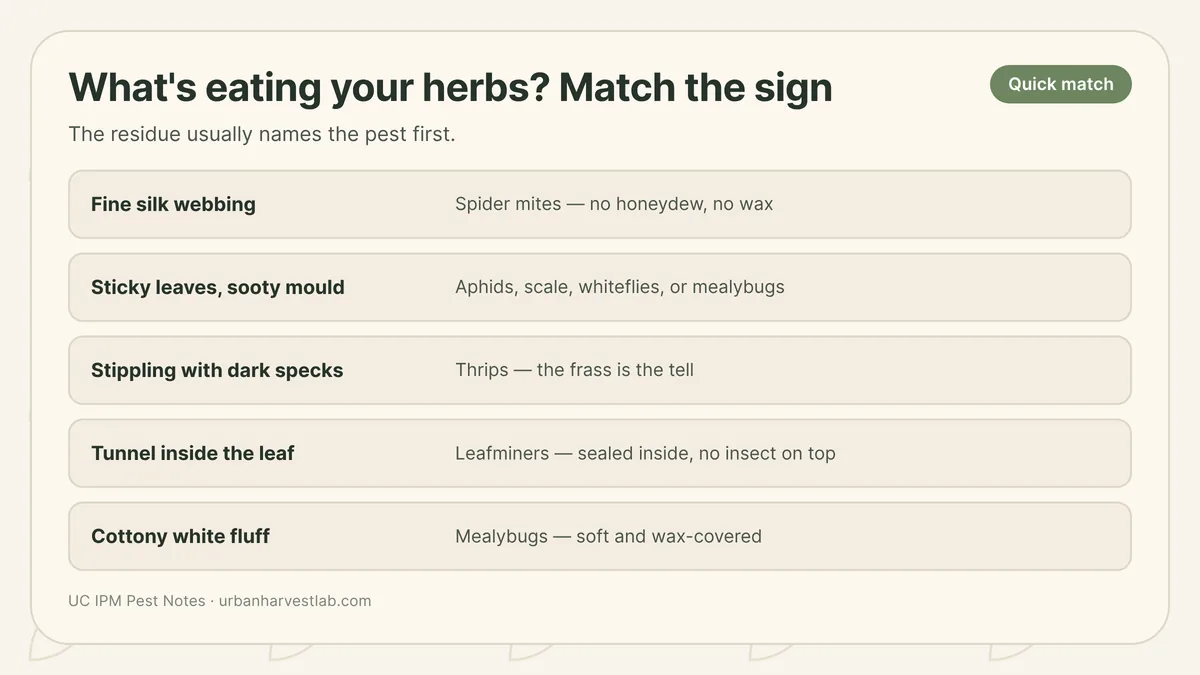
What's eating your herbs? Match the signs to the pest
Every common herb pest leaves its own tell before you ever spot the insect itself. Pick out what you are actually seeing, then go straight to the page that treats it.
Choosing a pest treatment for plants you are going to eat
Once you know which pest you have, the next question is what you can treat it with without compromising the food. The answer is a ladder of methods, and the label on any product you buy sets the legal limits of the top rung.