
Troubleshoot the system before you change the inputs.
Symptoms
- Whole branches stripped of leaves, often from the top down, with bare stems or midribs left behind.
- Large dark pellets on leaves, soil or the pot rim under the damage.
- Ragged notches starting at leaf edges, and sometimes gouged patches on green fruit.
Possible causes
- Hornworms: large green caterpillars that blend into the foliage and do most of their feeding in the last growth stage.
- Smaller caterpillars chewing irregular holes, sometimes folding a leaf with silk.
- Fruit-feeding caterpillars that are much smaller than hornworms.
Quick fixes
- Search stems and leaf undersides in early morning or evening, following the droppings upward.
- Pick caterpillars off daily and drop them in soapy water.
- Leave hornworms carrying white cocoons, since the wasps will go on to parasitise others.
- Use Bt kurstaki only on small caterpillars and only if the product label lists tomatoes.
Two hornworms you will meet on tomato
| Feature | Tomato hornworm | Tobacco hornworm |
|---|---|---|
| White markings | V-shaped | Diagonal stripes with dark spots |
| Tail horn | Dark blue (Virginia Tech), black (Utah State) | Red (Virginia Tech), orange-red (Utah State) |
| Management | Same for both: handpick, Bt kurstaki while small | Same for both: handpick, Bt kurstaki while small |
Large dark pellets on the leaves and a tomato stripped from the top down point to a hornworm, a green caterpillar that Virginia Tech Extension says reaches 3 inches and blends into the foliage. Pick it off by hand. For a few pots on a balcony, that is usually all the control you need.
If the damage looks more like scattered holes in herbs or greens, the holes in herb leaves guide separates caterpillars from slugs and earwigs. If you are not sure it is a caterpillar at all, the pest identification chart matches signs to pests.
How hornworm damage looks
Virginia Tech Extension describes tomato plants “defoliated, seemingly overnight,” most commonly in late summer. The speed is real, but the cause is slow. Early feeding often goes unnoticed while the plant is growing, and the full-grown caterpillar does most of the feeding. Penn State Extension puts about 90% of all feeding damage in the final of five growth stages.
Look for these signs:
- Feeding starts at the leaf edge and notches inward, Virginia Tech says.
- Penn State describes upper portions of the plant stripped with the midrib left behind.
- Utah State University Extension says hornworms start on the upper leaves and move down. When leaves run short or numbers are high, they also eat fruit, blossoms and stems.
- Penn State notes that late-stage larvae leave large feeding areas on fruit.
Losing foliage is not only a cosmetic problem. Utah State warns that it can reduce fruit production and increase the risk of sunscalded fruit.
Follow the droppings
Hornworms are hard to see. Virginia Tech points out that their green colour and pale markings help them blend into the foliage. The droppings are easier. Penn State says the frass “resembles rabbit droppings” and turns up on leaves, on the ground or on mulch. Utah State describes dark green-black pellets that are plentiful even with a few larvae present.
So start with the pellets. Find the freshest ones, look straight above them, and follow the damaged stem upward.
Timing helps. Utah State says larvae tend to hide during the day, so scout in early morning or evening. Shaking part of the plant over paper or cardboard can dislodge a caterpillar you cannot spot.
Which caterpillar is it?
Virginia Tech Extension describes hatchlings of about 5 mm (1/4 inch) and full-grown caterpillars reaching 80 mm (3 inches). Two species occur on tomatoes, and they are easy to confuse.
Virginia Tech Extension says the tobacco hornworm has diagonal white stripes and a red horn, while the tomato hornworm has V-shaped white markings and a dark blue horn. Utah State describes the same split with a black versus orange-red tail spine. The colour of the horn varies in how it is described, so use the markings. For control it does not matter which one you have.
Utah State also lists the tomato fruitworm as a look-alike on the same crops, but “significantly smaller.” If the culprit is a small caterpillar chewing ragged holes, UC IPM notes that caterpillars “chew irregular holes in foliage or blossoms” and some fold leaves with silk to hide inside. Cutworms “hide in the soil during the day, emerging to feed at night,” so a night-time check with a torch finds them.
Hornworms also feed on other nightshades. Virginia Tech lists eggplant, potato and green pepper, so check those pots too.
Removing them
Virginia Tech’s advice is to handpick and destroy caterpillars daily. Utah State suggests dropping them in soapy water. Penn State agrees hand removal can be effective in small areas. On a balcony, that describes you.
UNH Extension calls physical removal the best practice and says finding young larvae is key to avoiding crop damage. Check the undersides of leaves, especially on new growth, where Penn State saw the lime-green, shiny eggs.
Leave the ones with white cocoons
If a hornworm has white cocoons on its back, a parasitic wasp has already attacked it. Virginia Tech says to leave parasitised hornworms in the garden, because the wasps emerge and seek out other hornworms. Utah State says the process ultimately kills the hornworm.
Bt for small caterpillars
Bt kurstaki is a bacterial insecticide. Virginia Tech says it is effective against young hornworms and, being specific to caterpillars, is considered more environmentally friendly than an insecticide treatment. UNH Extension adds the limit: products containing Bt labeled for caterpillars are effective “but only when they are young.”
That makes Bt a way to deal with a batch of tiny caterpillars, not a rescue for a plant with 3-inch hornworms. Utah State states that pesticides are typically not necessary in small gardens.
The label has the last word. The National Pesticide Information Center says: “If your fruit or vegetable is not listed on the label, that means you cannot apply the product to it.” It also defines the pre-harvest interval as the wait between application and harvest, which the label states. Read choosing a pest treatment for plants you are going to eat before buying anything.
Colorado State University Extension adds that caterpillars are “generally immune to soap sprays,” so soap that cleared aphids last month will not touch them.
Keeping them from coming back
The moth lays single eggs on the leaves, and the caterpillar drops to the soil when it is done. Virginia Tech notes that hornworms pupate in the soil. Utah State puts them 4-6 inches down. In a pot, that means the potting mix. If you reuse a pot, turn the mix over when you refresh it and check for the dark, reddish-brown pupae Virginia Tech describes.
Utah State puts peak numbers in mid-summer and advises monitoring from early July there; Virginia Tech sees the worst defoliation in late summer. Check for fresh pellets every couple of days through those months.
Common mistakes
- Looking for the caterpillar at midday, when it is hiding.
- Spraying soap on caterpillars.
- Using Bt on large hornworms.
- Removing a hornworm that already carries white cocoons.
- Treating without checking that the product label lists tomatoes.
Sources
- Virginia Tech Extension: Hornworms in Home Gardens
- Penn State Extension: Keep an Eye Out for Hornworms
- Utah State University Extension: Tomato and Tobacco Hornworms
- UNH Extension: Time to Scout Your Tomatoes for Hornworms
- UC IPM: Foliage-Feeding Caterpillars
- National Pesticide Information Center: Preharvest Interval
- Colorado State University Extension: Insect Control, Soaps and Detergents
Sort out other chewing damage
Not every hole is a hornworm. These guides cover other chewers and how to choose a treatment for plants you will eat.
Common questions
What is eating my tomato leaves overnight?
Most often a hornworm. Virginia Tech Extension describes tomato plants defoliated seemingly overnight, usually in late summer, because the full-grown caterpillar does most of the feeding. Look for large dark droppings on the leaves or soil under the damage, then search the stems in early morning or evening.
How do I get rid of tomato hornworms on potted plants?
Pick them off by hand every day and drop them in soapy water, which is what Utah State University Extension suggests for gardeners with a few plants. If they are small and numerous, a Bt kurstaki product labeled for tomatoes works on young caterpillars. Leave any hornworm with white cocoons on its back.
Is Bt safe to spray on tomatoes I will eat?
Virginia Tech Extension describes Bt kurstaki as specific to caterpillars. Whether you may use a particular product on tomatoes, and how long to wait before harvest, is set by that product label. NPIC notes that if a crop is not listed on the label, you cannot apply the product to it.
How do I tell a hornworm from other caterpillars?
Hornworms are bright green, up to about 3 inches long, with a horn at the tail end. Tomato hornworms have V-shaped white markings; tobacco hornworms have diagonal stripes. Smaller caterpillars that chew a few holes are usually something else and need the same look-and-pick approach.
Related guides

Tomato plant wilting even though you water it: heat, roots, or disease
Midday droop that clears by evening is usually heat. Wilt that stays after watering points to rotting roots or a vascular disease, and a cut stem tells you which.
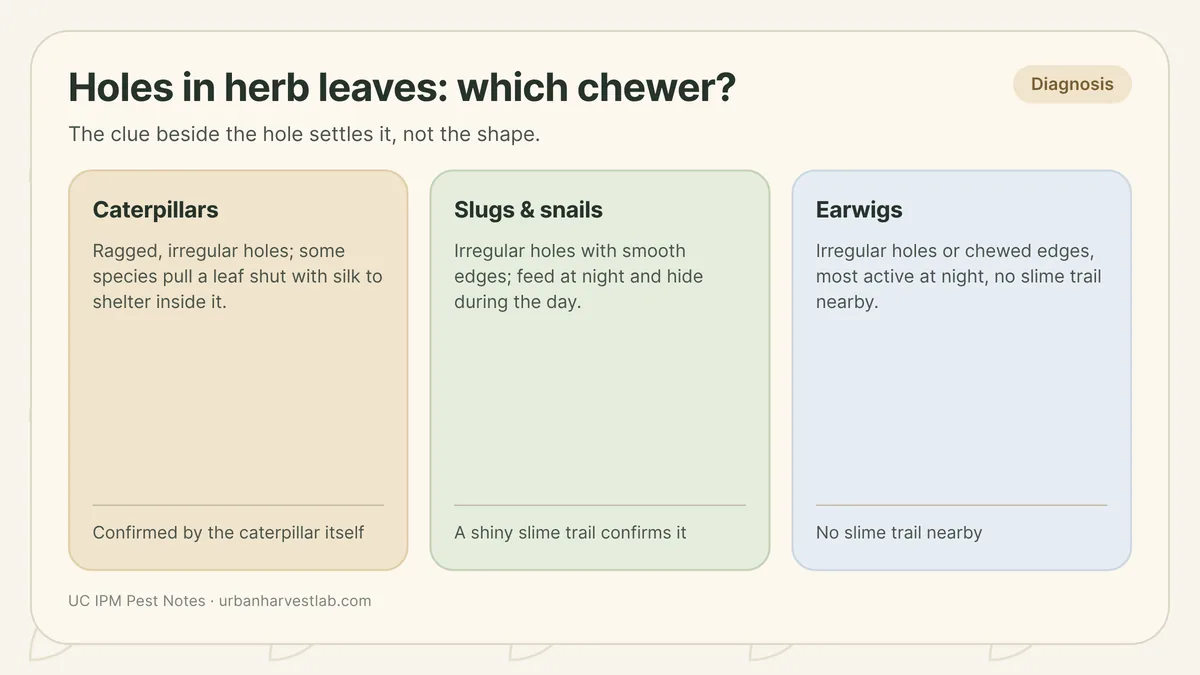
Holes in basil leaves: what's actually chewing them
Three insects punch actual holes through a herb leaf: caterpillars, slugs and snails, and earwigs. Each leaves its own clue, and the clue matters more than the shape of the hole.
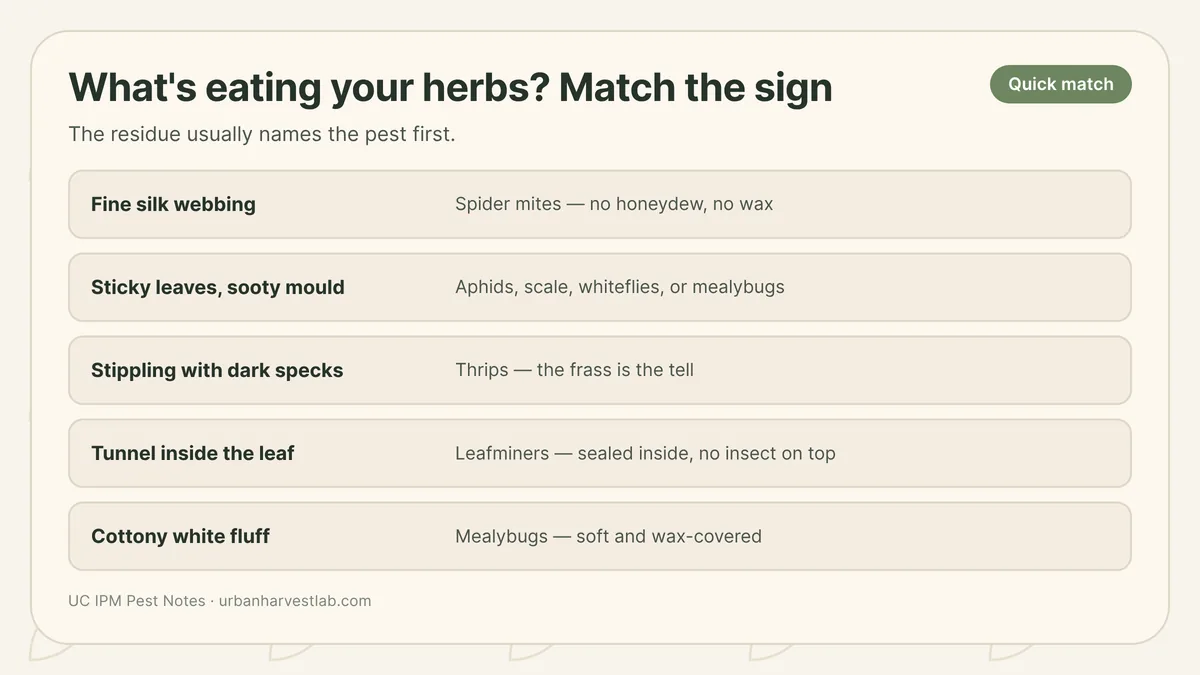
What's eating your herbs? Match the signs to the pest
Every common herb pest leaves its own tell before you ever spot the insect itself. Pick out what you are actually seeing, then go straight to the page that treats it.