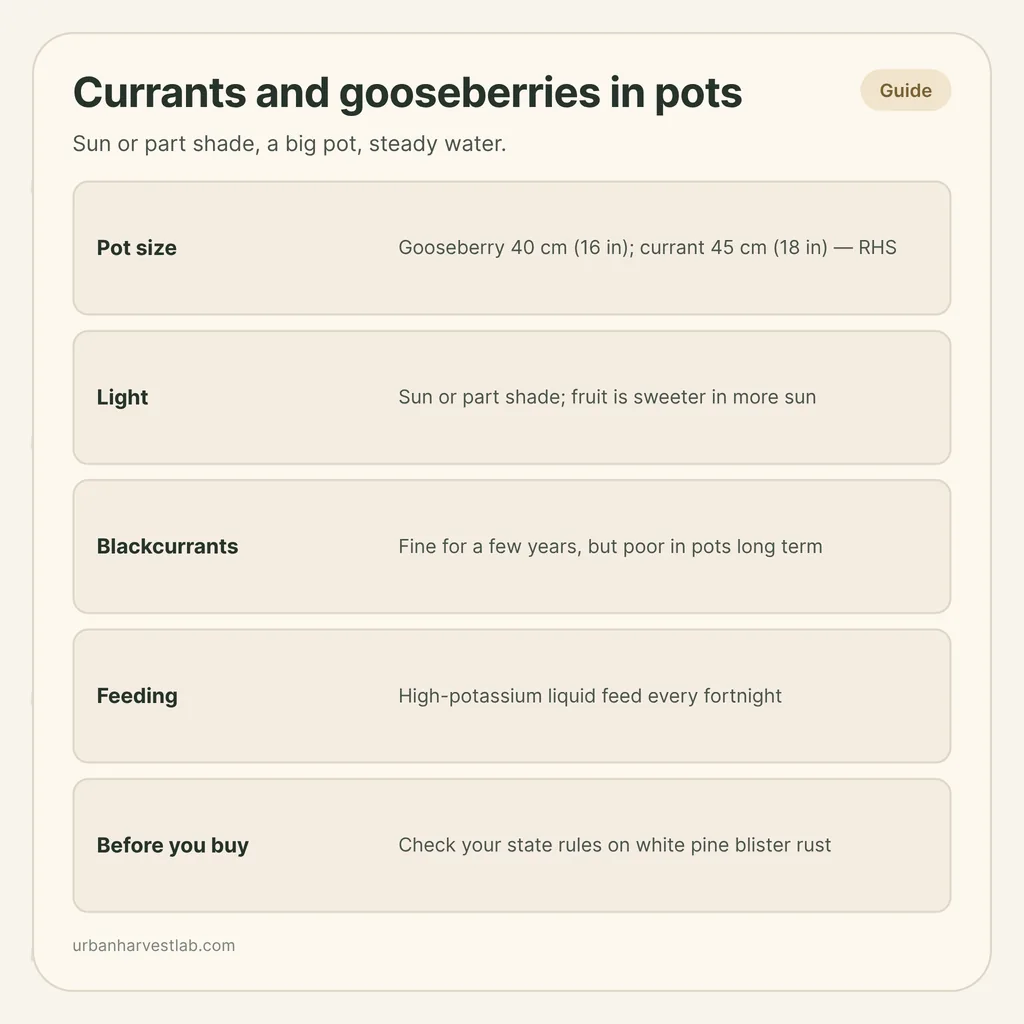
Currants and gooseberries in pots, by type
| Plant | Pot size (RHS) | Light (RHS) | Container verdict (RHS) |
|---|---|---|---|
| Gooseberry | At least 40 cm (16 in) wide and deep | Sun or light shade; sweeter in sun | Easy to look after in containers |
| Redcurrant and whitecurrant | At least 45 cm (18 in) wide | Full sun preferred; grows well in partial shade | Can be grown in containers |
| Blackcurrant | Large container | Fruits best in full sun; does well in light shade | Fine for a few years; poor in pots long term |
Gooseberries and redcurrants grow well in a large pot of soil-based compost, in sun or part shade, and need steady water, a regular feed and annual pruning. Blackcurrants are the weak link: the RHS says they are fine in a pot for a few years but do not do well there long term. Check the white pine blister rust rules for your state before you buy, because some states restrict these plants.
These are among the more forgiving fruits for a balcony that does not get all-day sun. The RHS calls gooseberries “happy in sun or light shade” in the ground or in containers, and says redcurrants grow well in partial shade such as against a north-facing wall. If you are weighing fruit for a dim spot, the vegetables in shade-balcony-vegetables are the other half of that plan. A full pot is heavy, so run the numbers in balcony-weight-limit first.
Which one suits a pot
The RHS treats the three differently, and the gap matters more than the colour of the fruit.
Gooseberries are the easiest. The RHS says they are easy to look after in containers. Most varieties have prickly stems, though a few are almost thornless, which the RHS notes makes pruning and picking easier.
Redcurrants and whitecurrants come next. The RHS says they can be grown in containers, and it also describes them as pruned into cordons, single-stemmed forms that take little room.
Blackcurrants are bigger and more vigorous. The RHS says they generally do not perform well in pots long term, and that once they fruit poorly you should plant them into the ground. If a pot is your only option, it points to compact varieties and a few good years.
Light: part shade works, with a trade-off
The RHS says gooseberries crop best and give sweeter fruit in a sunny position but tolerate some shade. For redcurrants, partial shade is fine, “although the fruit will ripen slightly later and be less sweet”. Blackcurrants fruit best in full sun and still do well in light shade, in the RHS’s words.
Hot summers push the other way. Ohio State University says Ribes plants prefer a cool and partially shaded site, full sun in cooler regions and partial shade in hotter ones. Its trial plants in full sun had leaf spots, and it says shade cloth can reduce sun exposure. On a baking south-facing balcony, give the pot afternoon relief; heatwave-protect-container-plants covers the tactics.
Wind is a separate problem. The RHS says to choose a sheltered site for gooseberries, because the stems are brittle and can snap in wind when laden with fruit. Move the pot behind a screen; see windproof-balcony-garden.
Pot, compost and planting time
For a gooseberry, the RHS says choose a pot at least 40 cm (16 in) wide and deep with plenty of drainage holes. For a currant, at least 45 cm (18 in) wide. Both go in good-quality soil-based compost, which the RHS says lasts 3 to 4 years in a shrub pot.
Unlike blueberries, these do not need acidic compost, so the mix in blueberries-in-containers is the wrong one here.
The RHS says potted redcurrants can be planted any time of year but settle best in the dormant season, November to March in its climate. Ohio State University, writing for a colder climate, says actively growing container plants should go in during spring.
Water, feeding and repotting
A pot dries out far faster than ground. The RHS says container gooseberries and currants need a steady supply of moisture through the growing season, and that gooseberries need it most while flowering and swelling fruit. It also warns that waterlogged compost can cause roots to rot, so check the drainage holes as the plant fills its pot.
For feeding, the RHS suggests an organic high-potassium liquid fertiliser every fortnight through the growing season for pots. It adds that too much nitrogen encourages sappy growth, which is prone to mildew.
Every few years, the RHS says, repot into a larger container. Once the pot is as big as you can move, repot into the same one, replacing loose compost and lightly trimming the roots. In the years between, scrape off the top layer of compost and replace it with fresh.
Pruning in a pot
The RHS says prune gooseberries twice a year, in summer and winter. It prunes redcurrant bushes in late winter or early spring into an open goblet of up to ten well-spaced branches, and cordons in late winter or early spring and again in summer. For a blackcurrant four years or older, it cuts out up to a third of the oldest stems to the base each winter.
Opening the centre has a second purpose. Ohio State University says removing some central canes improves air movement and light penetration, and calls annual pruning necessary to keep the plants healthy and productive.
Pollination, mildew and birds
Ohio State University says most currants, gooseberries and jostaberries are self-fruitful, so one plant will set fruit on its own, though some black currants are not. The RHS says redcurrant flowers are insect-pollinated, so if you cover plants against frost at flowering, take the cover off in the daytime. A balcony with flowers nearby helps; see attract-pollinators-balcony.
The RHS calls powdery mildew the most serious disease of gooseberries. Open pruning and restrained nitrogen are the two levers it names.
Birds are the other problem. The RHS recommends netting as soon as redcurrants start to change colour, and says to cut whole strigs (fruit trusses) rather than single currants. For gooseberries it suggests two pickings a month or two apart: pick every other green fruit in June for cooking, which leaves the rest to grow larger, then pick the remainder ripe in July and August.
Check the white pine blister rust rule first
Currants and gooseberries (the genus Ribes) are the alternate host for white pine blister rust, a fungus that kills white pines. Ohio State University Extension says planting them where white pines are present can lead to serious losses of white pines, and that black currant is the most susceptible Ribes.
That is why some states regulate them, and the rules differ:
- North Carolina’s Department of Agriculture says currant and gooseberry plants “cannot be legally imported into, or grown in, North Carolina”.
- Maine’s rule prohibits “the planting or possession of European black currant, Ribes nigrum or its varieties anywhere” in the state, and bans the sale, transport, planting or possession of any Ribes in a long list of counties.
- Ohio rescinded its rule in 2021, and Ohio State says currants and gooseberries had no restrictions there as of January 2025.
Rules change, and these three states are examples, not a list. Ask your state department of agriculture or state forestry agency before you order a plant.
If you want a different berry for a pot, raspberries-in-containers and blackberries-in-containers cover cane fruit, and overwinter-perennial-edibles-containers covers keeping a shrub alive through freezing weather.
Sources
- Royal Horticultural Society, How to grow gooseberries
- Royal Horticultural Society, How to grow redcurrants
- Royal Horticultural Society, How to grow blackcurrants
- Ohio State University CFAES, Growing currants, gooseberries, and jostaberries in Ohio
- Ohio State University Extension, White pine blister rust on currants and gooseberries (HYG-3205)
- North Carolina Department of Agriculture and Consumer Services, White pine blister rust
- Maine Forest Service, White pine blister rust quarantine on currant and gooseberry bushes
Fruit for a small balcony
Other berries and shade-tolerant crops that work in containers.
Common questions
Can you grow currants in containers?
Yes, with a caveat by type. The RHS says redcurrants and whitecurrants can be grown in large containers and are happy in sun or partial shade, in a pot at least 45 cm (18 in) wide with soil-based compost. For blackcurrants it says they do not perform well in pots long term because of their size and vigour, but should be fine for a few years, especially compact varieties.
Do currants and gooseberries need full sun?
No. The RHS says gooseberries crop best and give sweeter fruit in a sunny position but tolerate some shade, and that redcurrants grow well in partial shade, although the fruit ripens slightly later and is less sweet. Ohio State University suggests a partially shaded site in hot areas and full sun in cooler regions.
Do I need two plants to get fruit?
Usually not. Ohio State University says most currants, gooseberries and jostaberries are self-fruitful, so one variety sets fruit on its own, although some black currants are not. The RHS notes that redcurrant flowers are insect-pollinated, so pollinators need to reach the flowers.
Is it legal to grow currants and gooseberries where I live?
It depends on the state. North Carolina says currants and gooseberries cannot be legally imported into, or grown in, the state. Maine prohibits European black currant statewide and bans all Ribes in many counties. Ohio rescinded its rule in 2021. Check your state department of agriculture or forestry agency before buying.
Related guides
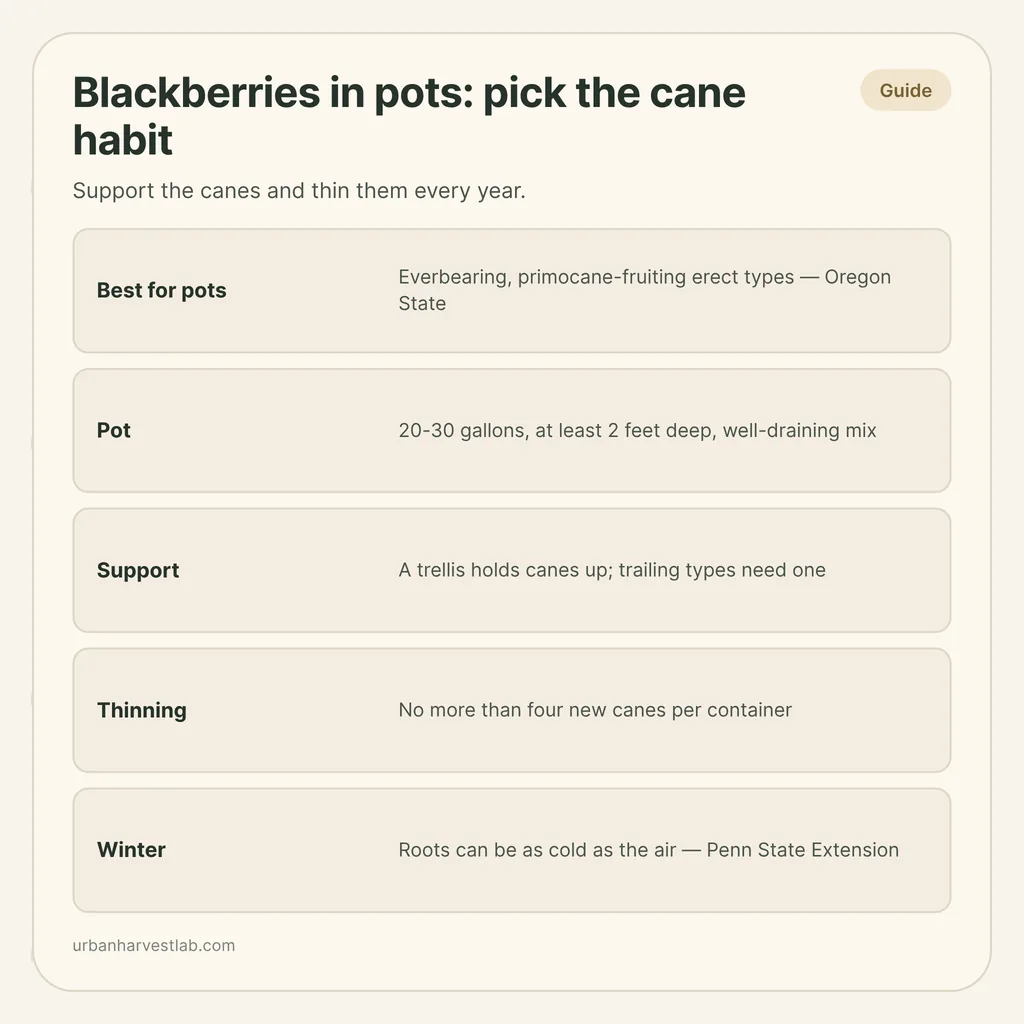
How to grow blackberries in pots: cane habit, support and pruning
Whether a container blackberry behaves comes down to the cane habit you buy, what holds the canes up and which canes you cut. Here is each choice, with the pot sizes and cane counts the extension services give.

How to grow raspberries in pots: type, support and cane pruning
A container raspberry lives or dies on three choices: which type you buy, what holds the canes up, and which canes you cut. Here is each one, with the pot sizes and cane counts the extension services give.
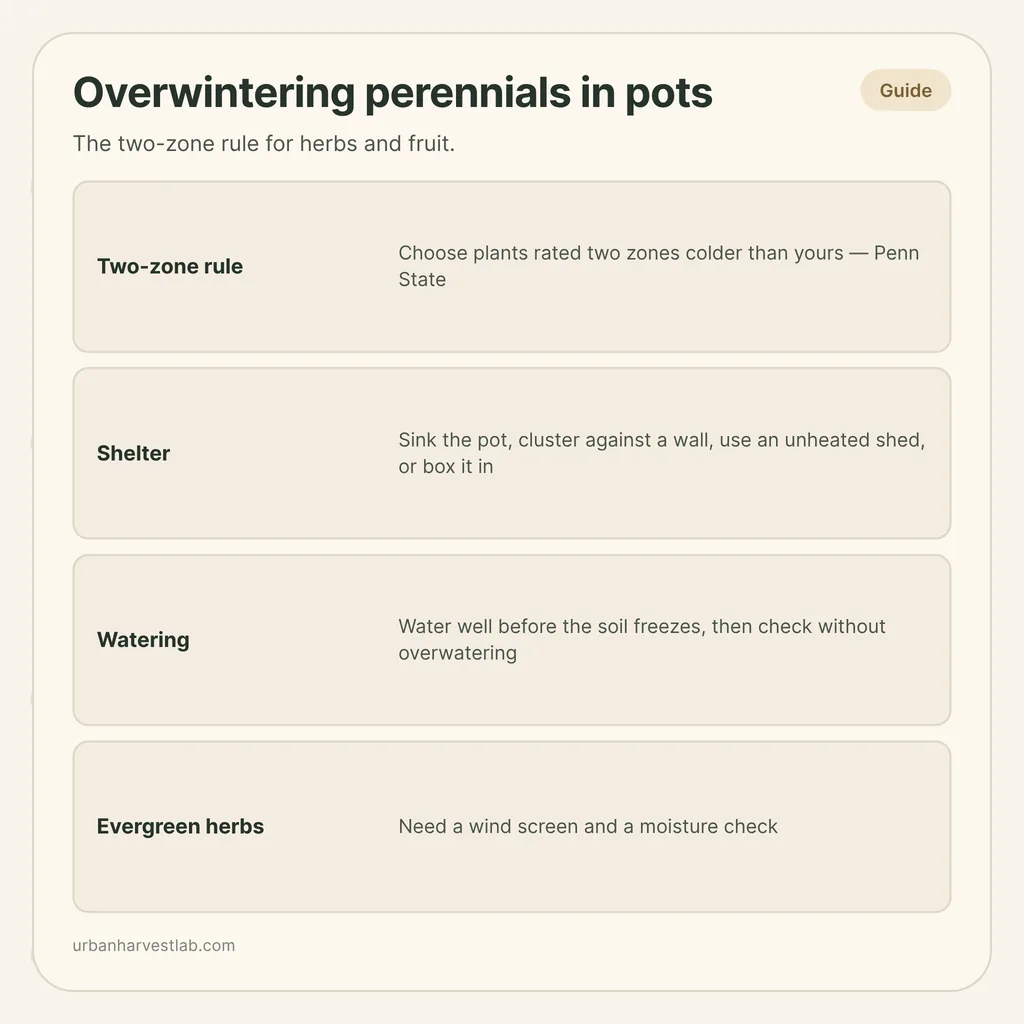
Overwintering perennials in pots: the two-zone rule for herbs and fruit
The hardiness zone on a plant tag assumes the roots are in the ground. In a pot they are not, so the rule, the shelter and the winter watering all change.