Troubleshoot the system before you change the inputs.
Symptoms
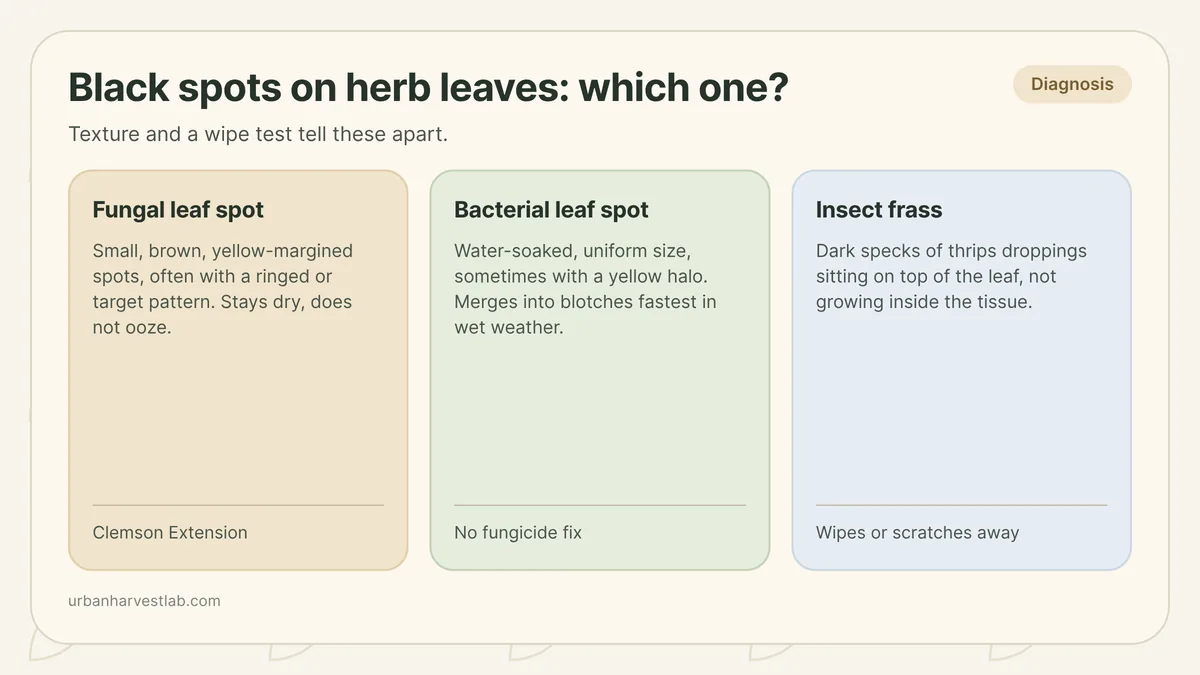
- Small dark or brown spots scattered across leaves, sometimes with a yellow ring or margin.
- Spots that look water-soaked or greasy, sometimes merging into larger patches in wet weather.
- Fine black specks on the leaf surface that were not there a few days ago.
Possible causes
- A fungal leaf spot disease.
- A bacterial leaf spot disease, which spreads fastest in warm, wet conditions.
- Insect frass, most often from thrips, sitting on top of the leaf rather than inside it.
Quick fixes
- Wipe or scratch a spot gently: frass rubs away, disease does not.
- Remove and bag the worst-affected leaves rather than composting them in the same bed.
- Improve airflow and stop wetting the foliage overhead before reaching for any product.
Tell fungal leaf spot, bacterial leaf spot, and insect frass apart
| Sign | Fungal leaf spot | Bacterial leaf spot | Insect frass |
|---|---|---|---|
| Appearance | Small, brown, yellow-margined, often ringed | Water-soaked, uniform size, sometimes with a yellow halo, sometimes oozing | Dark specks scattered on the surface |
| In wet weather | Stays as separate spots | Enlarges and merges into blotches | Unchanged; not weather-driven |
| Wipe or scratch test | Stays put | Stays put | Rubs or flakes away |
| Treatable with a labeled fungicide | Sometimes, if the label lists your herb | No | No |
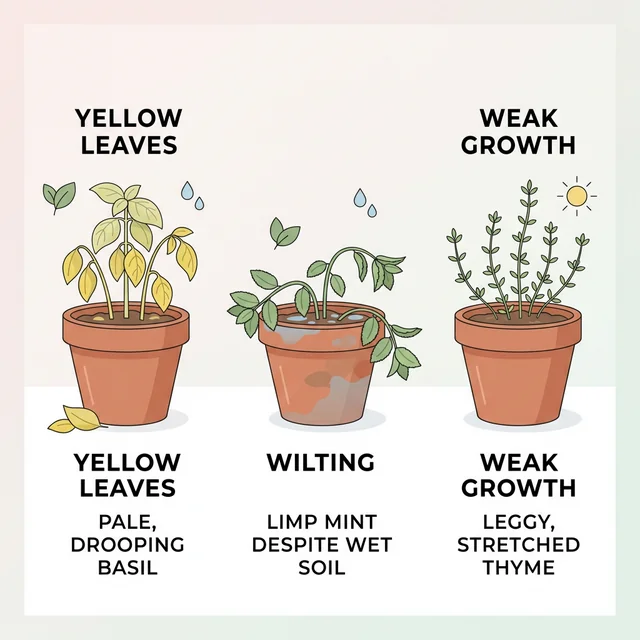
Black spots on herb leaves usually come from one of three unrelated causes: a fungal leaf spot disease, a bacterial leaf spot disease, or insect frass sitting on the surface of the leaf. Only two of those are infections. The third is not a disease at all, and telling them apart matters, because a fungicide does nothing for a bacterial infection and nothing at all for a speck of insect droppings. If yellowing, wilting, or general decline is mixed in with the spots, work through the common potted herb problems guide first before focusing on the marks themselves.
The fastest first move is texture, not color. Rub one spot gently with a thumb, or scratch at it lightly with a fingernail. If it smears, flakes, or lifts away cleanly, you are looking at something sitting on top of the leaf rather than something growing inside it.
Fungal leaf spot: small, brown, and often ringed
Fungal leaf spot shows up as “small, brown spots with yellowish margins on the leaves,” and the spots “may have a concentric ring or target pattern,” according to Clemson Cooperative Extension’s Home and Garden Information Center. That ringed, target-like look is the single most useful clue: a bullseye pattern inside an otherwise dry, brown spot points to a fungus, not bacteria, and it will not wipe off.
Removing affected leaves and improving airflow around the plant is the standard first response. That mirrors the cultural practice extension sources give for other fungal problems on herbs: the RHS recommends better ventilation and no overcrowding for gray mold, and Penn State Extension recommends skipping overhead watering to keep basil’s downy mildew from spreading. Neither recommendation is specific to plain leaf spot, but the mechanism, wet leaf surfaces plus still air, is the same one worth interrupting.
Bacterial leaf spot: water-soaked, and it moves fast in wet weather
Bacterial leaf spot looks different up close. Clemson describes it as “water-soaked spots, sometimes with a yellow halo, usually uniform in size, and sometimes with a sticky ooze.” In wet weather those spots “enlarge and run together”; in drier conditions they instead “dry out and turn reddish-brown, giving a speckled appearance.”
Two things separate this from the fungal picture. First, the spots look wet or greasy rather than dry, at least while conditions are humid. Second, they merge into irregular blotches instead of staying as separate ringed circles. A sticky residue on or near the spot, when present, is the clearest single tell of the two, since fungal leaf spot does not ooze.
Water-soaked tissue is not always infection, though. Missouri Botanical Garden lists “water-soaked spots and blisters” on stems and leaves among overwatering symptoms, a condition called oedema, which Clemson describes as rough corky swellings on petioles and lower leaf surfaces brought on by excessive soil moisture and poor light. The discriminator is texture and location: oedema is raised and corky to the touch and sits on petioles and lower leaf surfaces, with no yellow halo and no ooze, while bacterial leaf spot is flat, often halo-edged, and merges into blotches in wet weather. Overwatered vs underwatered covers oedema and the other overwatering signs in full.
The distinction matters because no fungicide treats a bacterial infection. If the spots match the water-soaked, merging description, removing affected leaves, spacing plants out, and keeping water off the foliage is the response a fungicide labeled for leaf spot will not replace.
It might not be disease at all: insect frass
Before treating either disease, rule out the simplest explanation: an insect has been feeding nearby and left droppings behind. UC IPM’s pest notes on thrips name “dark specks of excrement” on plant surfaces as the actual discriminator entomologists use to separate thrips damage from spider mites, which leave no such marks at all.
Frass sits on top of the leaf. Unlike a true leaf spot, it did not grow out of the tissue underneath, so a gentle wipe or scratch removes it and leaves the leaf surface clean. If the marks come away and the leaf underneath looks normal, disease is not the problem.
Frass rarely shows up alone. UC IPM also lists “distorted, curled, galled, or dead shoot tips and leaves” and a “scabby, silvery to dark brown discoloration” around thrips feeding, so new growth that looks stunted or streaked alongside the specks points at thrips rather than at a leaf-spot pathogen. The full identification and control sequence for that pest is in thrips on herbs: identify the damage and stop it.
A sticky black coating is a different look again
One more black mark is worth ruling out separately: a shiny, sticky black coating over the whole leaf surface rather than distinct spots. That is usually sooty mold, a fungus that grows on the honeydew left behind by aphids and other sap-feeding insects. UC IPM notes that this honeydew “often turns black with the growth of a sooty mold fungus.” The black coating is growing on that honeydew rather than in the leaf tissue itself, so it comes away with the sticky residue rather than staying put the way a leaf spot does — the same test that separates surface residue from a true leaf-tissue mark. The fix is controlling the insect producing the honeydew rather than treating the mold itself; see aphids on indoor herbs if sticky leaves are the bigger complaint than the black coating.
What actually helps once you know which one it is
For either disease, the same first steps apply: remove the worst-affected leaves and bag them rather than composting them in the same bed, space plants so leaves are not touching, and water the soil rather than the foliage. Extension sources do not give a specific fungicide product or interval for plain leaf spot on herbs, so any product decision goes through the label rather than a general recommendation.
That is not a minor caveat on an edible crop. The EPA states that every pesticide label carries the statement “it is a violation of Federal law to use this product in a manner inconsistent with its labeling.” The National Pesticide Information Center puts the practical consequence plainly: “if your fruit or vegetable is not listed on the label, that means you cannot apply the product to it.” A product sold for ornamentals is not automatically legal on basil or parsley you intend to eat, whatever the active ingredient. Check the label before buying, not after.
For frass, there is nothing to spray on the mark itself; treat the insect instead — the identification and control sequence is on thrips on herbs.
When the marks are not black spots at all
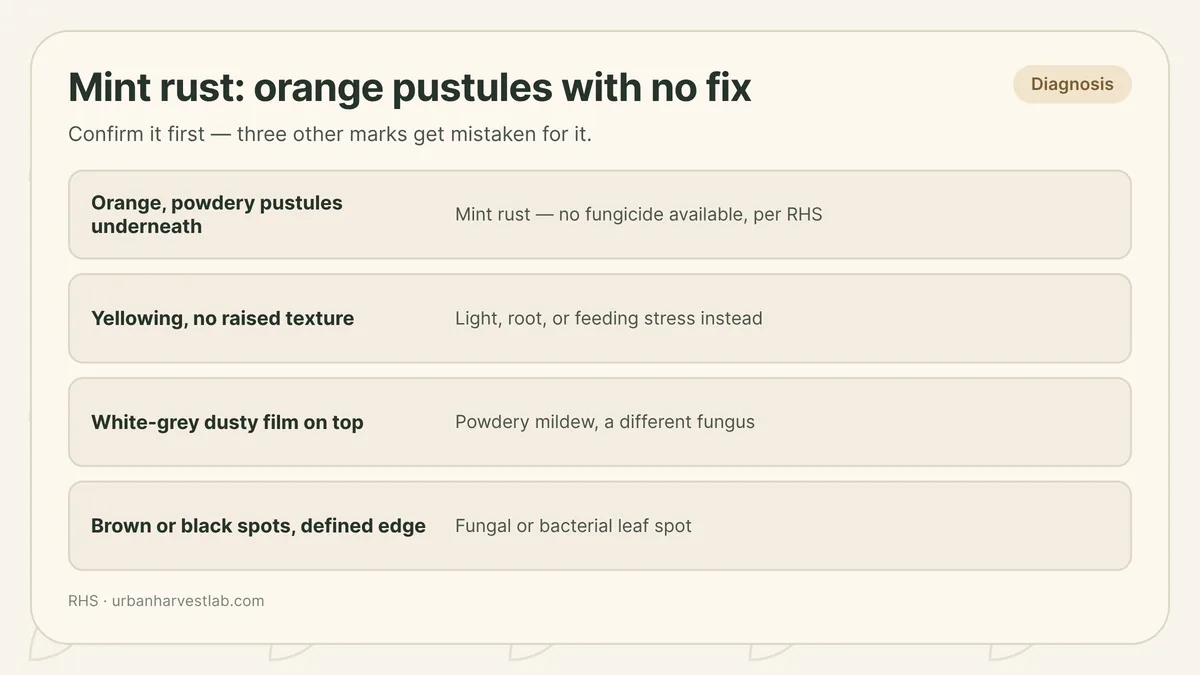
Two other herb problems get reported as “black spots” and are neither of the above. Mint rust looks orange, not black: it produces raised orange pustules, most often on the underside of the leaf, and the RHS states that no fungicide is available for gardeners to use against it on mint or other culinary herbs. If a mint plant is showing orange rather than black or brown, see mint rust rather than treating it as a leaf-spot problem.
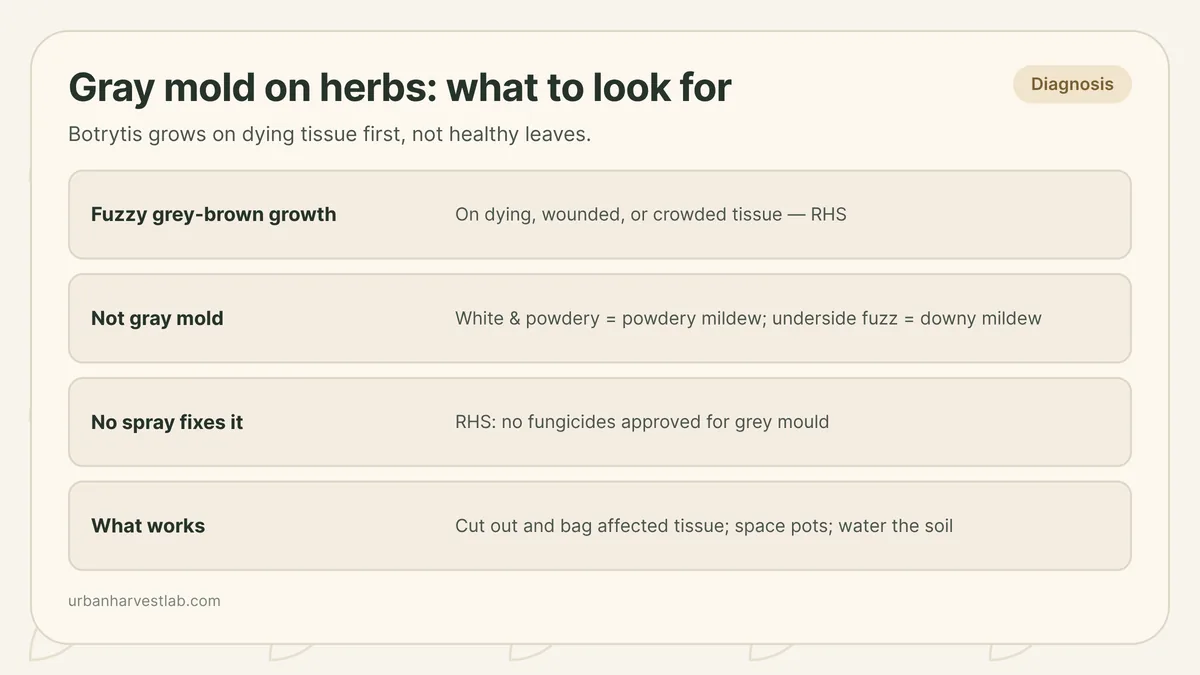
Gray mold, or Botrytis, can also carry small black flecks, called sclerotia, and the RHS describes it as fuzzy grey-brown mould growing on decaying buds, leaves, flowers or fruit, usually entering through a wound or stressed tissue, though it will infect healthy plants as well under humid conditions. The fuzz is the giveaway; a leaf spot has none. Full identification and control for that one is at gray mold on herbs.
A third look-alike is dry rather than wet or fuzzy. Clemson’s houseplant disease sheet describes powdery mildew as producing “white, powdery growth or dry, brown, papery leaf spots,” so a dry, papery brown patch with no yellow margin and no ooze can be mildew rather than a true leaf spot. Powdery mildew on container herbs covers that presentation directly.
Common mistakes
- Spraying a fungicide before checking whether the spots wipe off as frass.
- Treating a water-soaked, merging bacterial infection with a fungicide, which will not touch it.
- Buying a product labeled only for ornamentals and using it on an edible herb anyway.
- Composting badly affected leaves instead of bagging them, which can spread spores to the next bed.
- Assuming every dark mark on mint is disease rather than checking for rust’s orange color first.
FAQ
What causes black spots on herb leaves?
Most black or dark spots trace back to one of three things: a fungal leaf spot disease, a bacterial leaf spot disease, or insect droppings sitting on the leaf surface. The pattern, texture, and whether the mark rubs off tell you which.
How do I tell fungal leaf spot from bacterial leaf spot on herbs?
Fungal spots are usually small, brown, and edged with a yellow margin, sometimes with a ringed or target pattern. Bacterial spots look water-soaked, are more uniform in size, can ooze, and merge into larger blotches fastest in wet weather.
Can insect droppings look like black spots on herbs?
Yes. Thrips leave dark specks of excrement on the leaf surface, and those specks get mistaken for disease. Wipe or scratch gently: frass sits on top of the leaf and comes off, while true leaf spot is inside the tissue and stays put.
Will a fungicide clear up black spots on my herbs?
Only if the cause is fungal, and only if the product label lists your herb. A fungicide will not treat a bacterial infection, and it does nothing at all for insect frass.
Sources
- Clemson Cooperative Extension HGIC, “Houseplant Diseases & Disorders”
- UC IPM Pest Notes 7429, “Thrips”
- UC IPM Pest Notes 7405, “Spider Mites”
- UC IPM Pest Notes 7404, “Aphids”
- RHS, “Grey Mould: Causes, Symptoms & Control”
- RHS, “Mint Rust: Causes & Treatment”
- US EPA, “Introduction to Pesticide Labels”
- National Pesticide Information Center, “Preharvest Interval”
Rule out the other dark marks first
Gray mold and mint rust can leave dark marks too; these guides cover the pest and disease specifics for each.
Common questions
What causes black spots on herb leaves?
Most black or dark spots trace back to one of three things: a fungal leaf spot disease, a bacterial leaf spot disease, or insect droppings sitting on the leaf surface. The pattern, texture, and whether the mark rubs off tell you which.
How do I tell fungal leaf spot from bacterial leaf spot on herbs?
Fungal spots are usually small, brown, and edged with a yellow margin, sometimes with a ringed or target pattern. Bacterial spots look water-soaked, are more uniform in size, can ooze, and merge into larger blotches fastest in wet weather.
Can insect droppings look like black spots on herbs?
Yes. Thrips leave dark specks of excrement on the leaf surface, and those specks get mistaken for disease. Wipe or scratch gently: frass sits on top of the leaf and comes off, while true leaf spot is inside the tissue and stays put.
Will a fungicide clear up black spots on my herbs?
Only if the cause is fungal, and only if the product label lists your herb. A fungicide will not treat a bacterial infection, and it does nothing at all for insect frass.
Related guides
Gray mold on herbs: what botrytis looks like and how to stop it spreading
Gray mold grows on dying or wounded tissue first, not healthy leaves. Remove the source, open up the canopy, and stop watering overhead.
Mint rust: orange leaf pustules with no real cure
Mint rust cannot be treated away once it is on the leaf. The realistic job is removing infected growth, improving airflow, and knowing when to start over.
Common potted herb problems: yellow leaves, wilting, and weak growth
Common potted herb problems usually show up as yellow leaves, wilting, or weak growth, but the useful diagnosis starts with light, drainage, and root stress.