Troubleshoot the system before you change the inputs.
Symptoms
- A stiff, round stalk pushes up from the centre of the leaves, with a swelling bud at the tip.
- The bulb stays small and the neck stays thick.
- It happens in the first season, often after a cold spell in spring.
Possible causes
- Plants with about five leaves or more sat through a cool stretch, which is what starts the flower stalk.
- The sets were large, or the transplants thick, when planted.
- Sets or transplants went out too early in spring.
Quick fixes
- Pull bolted plants and use them fresh; do not put them in storage.
- Next season, sort sets and plant only the small ones for bulbs.
- Hold planting until the cold has passed for your area.
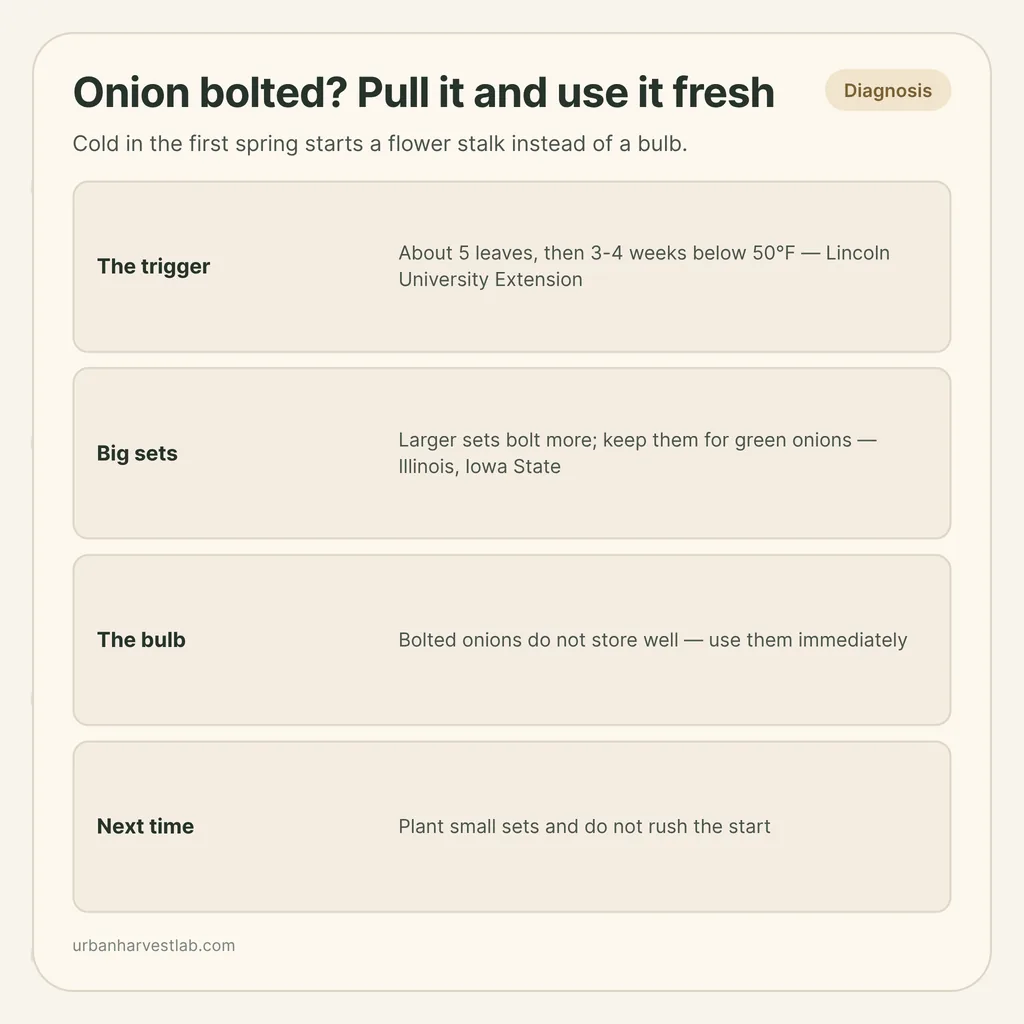
An onion that sends up a stiff flower stalk in its first year has been triggered by cold, and the bulb will not finish. Pull it and eat it fresh. What you can still control is the next planting: small sets, thin transplants and a start date after the cold has passed.
If you are still deciding what to plant, growing bulb onions in containers covers day length, pots and curing. For a plant that has already flowered, read on.
What bolting is
Onions are biennials. Lincoln University Cooperative Extension describes the natural pattern: they grow into bulbs before the hot summer, go dormant, then sprout and flower the next spring. Flowering needs a stretch of cold first, called vernalization. A plant that gets that cold in its first spring behaves as if a winter has already gone by, and starts a flower stalk instead of fattening a bulb.
Two details from the same Lincoln University source:
- Onions need about five leaves before they can register the cold. Seedstalk formation may begin before the bulb matures if plants are held below 50°F for 3-4 weeks, and lower temperatures above freezing count for more.
- Bolting in onions is not induced by day length, as is sometimes believed. Bulb formation does need long days, but day length is not what sends the flower stalk.
Clemson Cooperative Extension puts the outcome plainly: a prolonged cold period after good growth gives small bulbs with large necks, which are hard to cure and generally unusable.
Match what you see to the cause
| What happened | Why it matters | Source |
|---|---|---|
| Cool weeks after the plants had leaves | The cold effect builds up over time, so a late cold snap on a leafy plant is the classic trigger | Lincoln University Cooperative Extension |
| Sets were large when planted | Larger plants at the time of cold bolt at a higher rate | Clemson Cooperative Extension |
| Planted very early | Early-planted sets and transplants often bolt | Utah State University Extension |
| Sets were kept near freezing before you bought them | Cold storage can vernalize sets before they reach you | Lincoln University Cooperative Extension |
Set size is the part you can pick
Extension services split sets into two piles, and each draws the line in a slightly different place.
- University of Illinois Extension: sets larger than a dime are best used for green onions; sets smaller than a dime produce the best bulbs and usually do not bolt.
- Iowa State University Extension: the line is a nickel. The larger sets often bolt and do not produce good-sized bulbs.
- Utah State University Extension: larger sets or transplants, over 5/8 inch in diameter, have a greater tendency to bolt.
- Clemson Cooperative Extension: choose sets of an inch or less, and transplants about 6 inches high and about half the thickness of a lead pencil.
The cut-offs differ, but the direction does not: pick the small end of the bag for bulbs and plant the big ones close together for scallions.
What to do with the onion that has bolted
Lincoln University Cooperative Extension says that removing seedstalks may help with bulb formation but the effect is limited, and that if sets bolt shortly after planting, bulbs are next to impossible. Its advice is to pull them and use them as green onions, the sooner the better. University of Illinois Extension agrees on the use: remove plants that have formed flower stalks and use them immediately, since they do not make good bulbs for dry storage.
So treat a bolted onion as a fresh ingredient, not a crop for the shelf. If you want to keep onions going into winter, set aside the ones that did not flower, cure them and store them by the steps in storing onions, garlic and potatoes.
Avoiding a repeat
- Sort the sets. Plant the small ones for bulbs, as above.
- Do not rush the start. Utah State says sets and transplants often bolt if planted too early, and that later plantings are less likely to produce seed stalks. Clemson says planting too early can increase seed stem production. Use your local dates in first and last frost dates for a balcony to see how much cold is still likely.
- Skip heavy fall feeding. Clemson advises avoiding high fertilizer rates applied in the fall.
- Watch the cold forecast once leaves are up. A pot can be moved to shelter, but the cold effect is cumulative, so a plant that has already had weeks of it will not be rescued.
Garlic has its own flower stalk, the scape, and its own reasons for small heads. Small garlic bulbs explains that separately.
Sources
- Why Onions Bolt, Failing to Bulb? (Lincoln University Cooperative Extension, MU Integrated Pest Management)
- Onion (University of Illinois Extension)
- What is the proper way to plant onion sets? (Iowa State University Extension)
- Onion, Leek, Shallot and Garlic (Clemson Cooperative Extension)
- How to Grow Onions in Your Garden (Utah State University Extension)
Onions and the spring calendar
Growing the crop, the neighbouring allium problem and timing the planting.
Common questions
Why are my onions bolting?
Cold followed by growth is the usual trigger. Lincoln University Cooperative Extension says seedstalk formation may start before the bulb matures if plants are exposed to temperatures below 50°F for 3-4 weeks, and that onions need about five leaves to register the cold. Clemson adds that the larger the plants are when the cold arrives, the higher the rate of bolting.
Can I stop an onion that has started to bolt?
Not reliably. Lincoln University Cooperative Extension says the cold effect is cumulative and that once the chilling units are met, bolting is not avoidable. Removing the stalk may help bulb formation a little, but it says the effect is limited.
Can I store a bolted onion?
Extension advice is to use it instead. Illinois Extension says to remove plants that have formed flower stalks and use them immediately, because they do not produce good bulbs for dry storage. Clemson describes the result as small bulbs with large necks that are hard to cure.
Which onion sets are least likely to bolt?
The small ones. Illinois Extension says sets smaller than a dime usually do not bolt, Iowa State draws the line at a nickel, Utah State points to sets over 5/8 inch as more likely to bolt, and Clemson says to choose sets of an inch or less.
Related guides
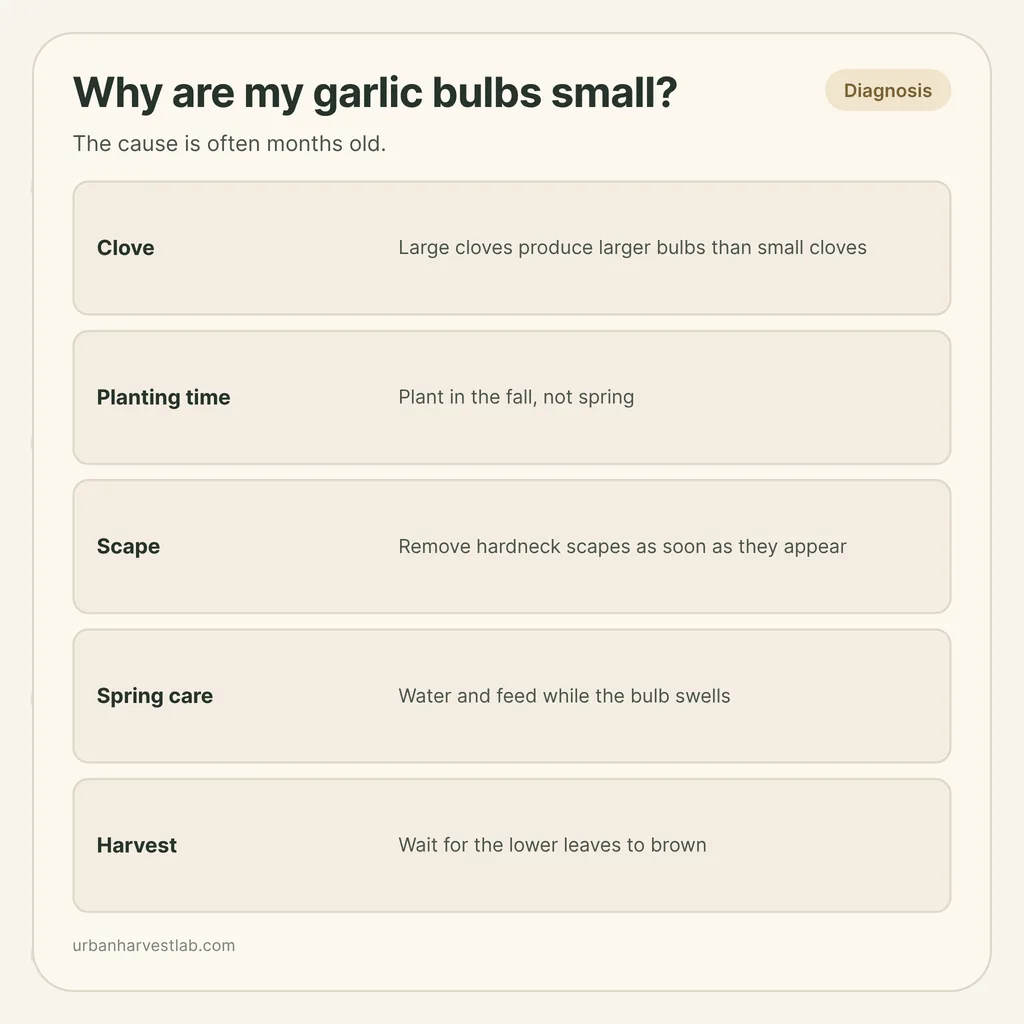
Why are my garlic bulbs small? Clove, timing, scape, and harvest
Garlic sizes up in a short spring window, and most of what limits it was decided months earlier: which clove you planted, and when. Here is how to work out which cause fits your pot.
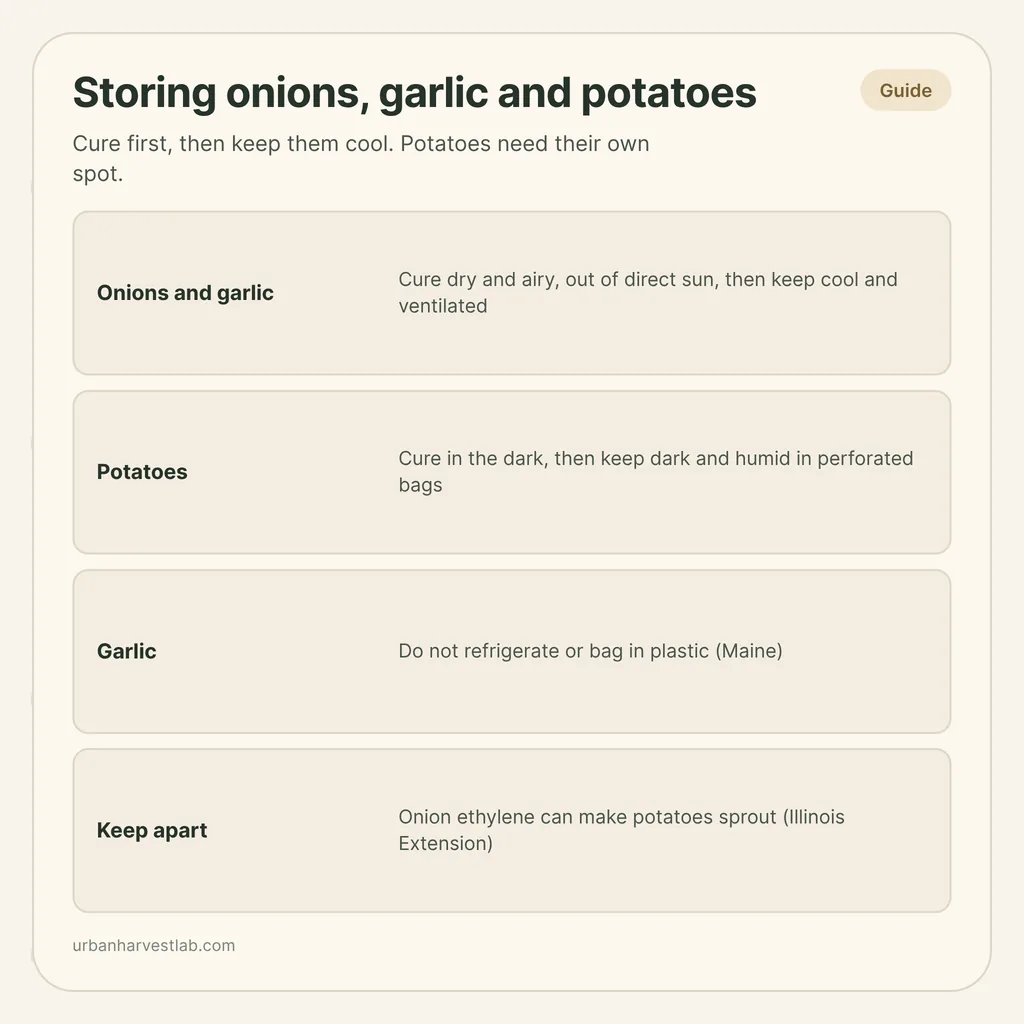
Storing onions, garlic and potatoes at home after harvest
Onions and garlic keep dry and airy, potatoes keep dark and humid, and onions near potatoes is a bad pairing. Curing times, temperatures and a small-space layout from extension sources.
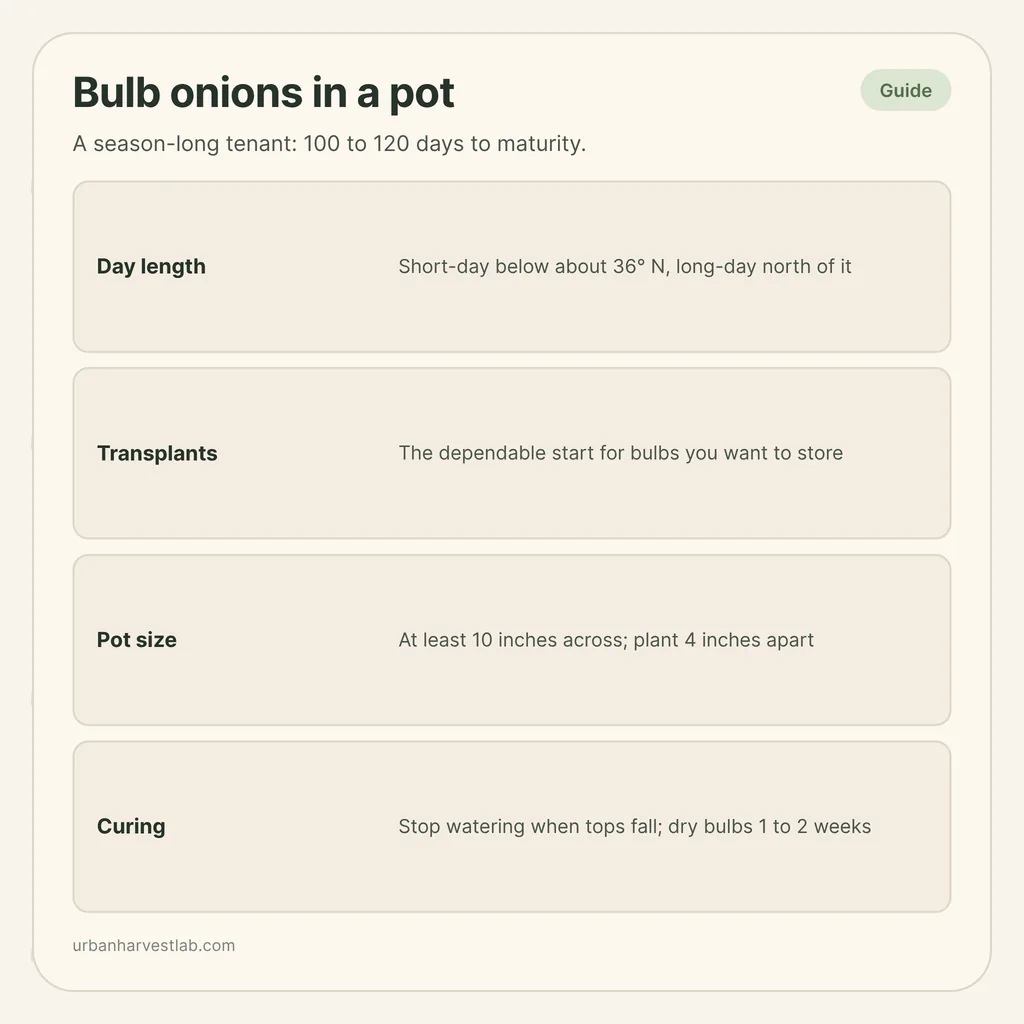
How to grow bulb onions in containers: day length, sets and curing
A bulb onion decides when to swell based on day length, not on how big your pot is. Pick the right type, plant transplants, and the container work is simple.