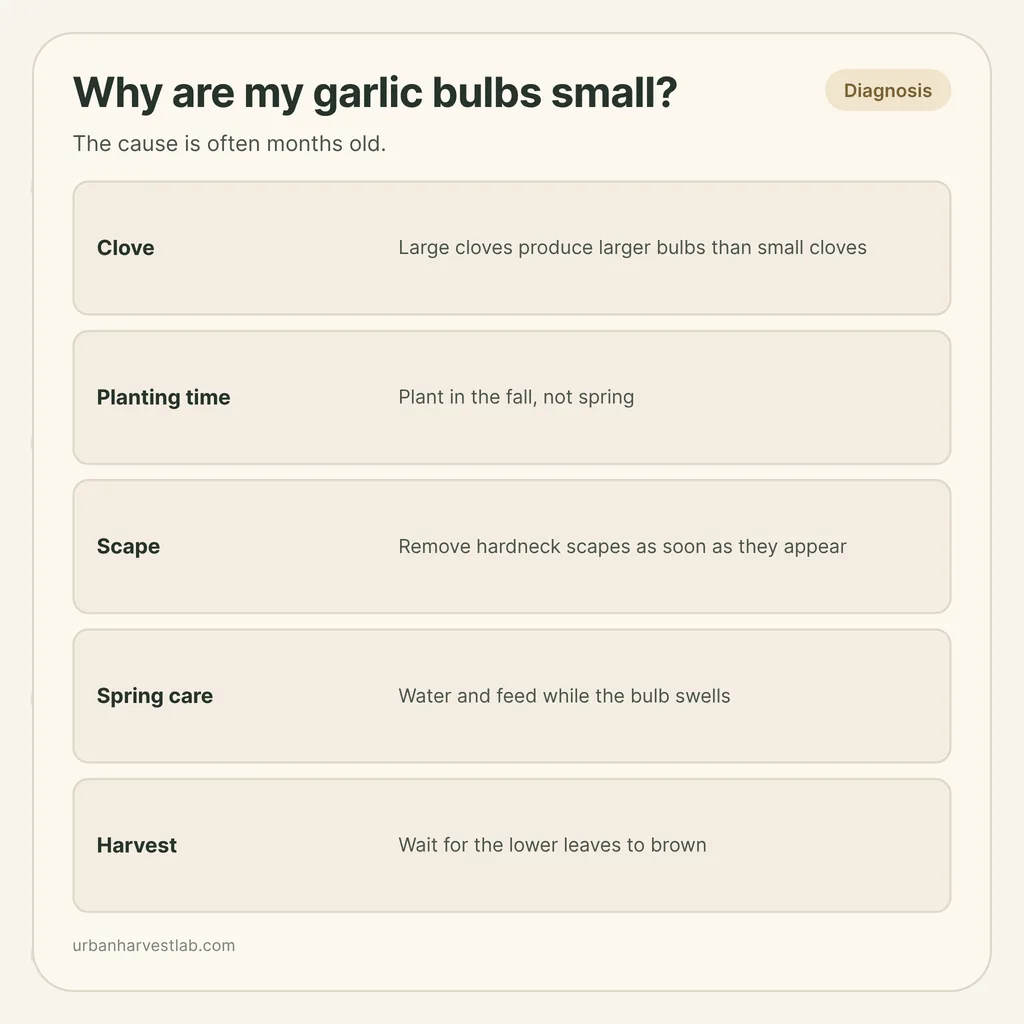
Troubleshoot the system before you change the inputs.
Symptoms
- Bulbs are well under the size you expected, with small cloves or few of them.
- The wrapper around the bulb is thin and the head is not plump.
- Plants stayed short and pale through spring, or the pot dried out between waterings.
Possible causes
- The seed cloves were small, or the variety makes many small cloves.
- The garlic went in during spring or late fall, so it missed the cold period and grew too little leaf.
- A hardneck scape was left on, or the plants were crowded, weedy, thirsty or underfed while the bulb was swelling.
- The bulbs were dug before they had finished filling out.
Quick fixes
- Plant only the biggest cloves from the biggest bulbs next fall, and put them in the pot on time.
- Remove hardneck scapes as soon as they emerge.
- Water and feed through spring growth, then taper off as the lower leaves yellow.
- Test one plant before you dig the lot, and wait for the lower leaves to brown.
Small garlic bulbs: what you see, likely cause, first check
| What you see | Likely cause | First check |
|---|---|---|
| Small bulbs and small cloves from the start | Small seed cloves, or a softneck variety that makes many small cloves | Compare the cloves you planted with the cloves you harvested, and note the variety |
| Planted in spring, or in late fall with little top growth before winter | Missed cold period and too little leaf to feed the bulb | Count the weeks between planting and the first hard frost |
| Hardneck plant with a curled stalk left standing | Energy going to the scape instead of the bulb | Look for a scape on the plants you harvested |
| Pale, thin leaves in spring, or a pot that dried out repeatedly | Underfed or water-stressed while the bulb was swelling | Think back over April to June: feeding, and how often the pot went dry |
| Thin, papery wrapper and a bulb that is not plump | Harvested early | Compare your dig date with how many lower leaves had browned |
| Swollen, misshapen or soft heads | Nematode or bulb rot, not a size problem | Cut a bulb open and look inside |
Small garlic bulbs usually trace back to a decision made months earlier: a small seed clove, a late or spring planting, or a scape left on the plant. Spring thirst, hunger, crowding and an early harvest do the rest. Work down the list in the order below, because the earliest causes are the quickest to rule in or out. The full fall-to-summer routine for a pot, including depth and spacing, is in growing garlic in containers.
Start with the clove you planted
Bulb size starts at the clove. University of Maryland Extension says that large cloves produce larger bulbs than small cloves, and Cornell Cooperative Extension puts it as “the larger the clove, the bigger the bulb you will get the following summer.” Utah State University Extension tells growers to plant the largest unpeeled cloves, and NC State Extension and Ohio State University Extension say the same.
So if you split a bulb and planted every clove, including the small ones from the middle, you planted a small crop. The inner cloves are the ones to eat.
Two other planting-day causes are worth a look:
- Orientation. Ohio State says a clove planted upside down or sideways gives small or misshapen cloves. Flat basal plate down, pointed tip up.
- Where the garlic came from. University of Maryland Extension advises against planting grocery-store garlic because it may be a symptomless disease carrier. Seed garlic from a supplier also lets you pick a variety suited to your climate.
Variety matters for size too. The UC Master Gardener Program of Contra Costa County notes that softneck garlic has more cloves, but the cloves are smaller, while hardneck typically has fewer, larger ones. A softneck head with many modest cloves is not necessarily a failed crop.
Check when it went in
University of Maryland Extension explains that cloves must be exposed to 32 to 50°F for two months before bulb enlargement, which long days then trigger. It adds that spring-planted garlic cannot produce enough foliage to support large bulb development. Utah State reports poor bulb growth and low yields from spring planting, and Ohio State says fall-planted garlic is more mature and forms a larger bulb than spring plantings, which give smaller heads.
Fall planting also gives roots time to grow. Cornell Cooperative Extension says garlic roots develop in the fall and winter, so that by early spring they can support the rapid leaf growth needed to form large bulbs. Utah State’s version: large tops are required to produce large bulbs.
That is also why planting too late in fall can cost size. Cornell suggests planting as early as 6 to 8 weeks before the first expected fall frost, and Ohio State wants the first leaves above ground before freezing temperatures. If you planted into a cold pot in December, count the weeks. Your own first-frost date, and how a balcony shifts it, is in first and last frost dates for a balcony.
Cold is the other half. The UC Master Gardener Program of Contra Costa County gives hardneck garlic 4 to 6 weeks below 40 to 45°F to develop a strong bulb and says softneck is less demanding. A pot kept in a warm hallway or a mild, sheltered spot all winter may not deliver that. Where winters are mild, a softneck variety is the safer fit, and the same program says a February planting there gives small bulbs.
If you did plant late, the best you can do is plant as soon as the soil can be worked, as Utah State advises, and accept a smaller result.
Look for a scape
Hardneck garlic sends up a curled flower stalk in late spring. Ohio State is blunt: the scape must be removed to gain better bulb size. University of Maryland Extension says pinching it back increases bulb size, Cornell says flower shoots left on may decrease it, and NC State cuts the scapes as they emerge so the plant does not put energy into flowers.
Cut it as soon as it appears, and cook it. If the plants you dug still had a stalk standing, this is a likely contributor.
Think back over spring
Spring is when the bulb swells, and several things can pinch it.
Water. Utah State says drought stress during growth decreases yield and reduces bulb size, and that rooting depth in garlic is shallow, so water needs are critical. Ohio State puts the target at about 1 inch of water per week through June in a garden bed. A pot has less soil to buffer a dry spell, so check it by feel rather than by the calendar. The overwatering side is real too: Ohio State links poorly drained soil to disease in wet years, and overwatered versus underwatered plants shows how to tell the two apart.
Feeding. Cornell calls garlic a heavy feeder that needs adequate nitrogen. Ohio State says that if plants look yellow, small-leaved or not vigorous, a further fertilizer application before bulbing could help. Feeding has a limit: NC State warns that too much nitrogen may overstimulate leaf growth at the expense of root and bulb formation. Feed early in spring while the leaves are growing, then stop.
Crowding. Utah State says high-density plantings reduce bulb size unless adequate water and nutrients are supplied. A pot packed with cloves is a high-density planting with a fixed amount of soil. The spacing figures from each source are in the growing guide.
Weeds. Ohio State says garlic competes poorly with weeds, and Utah State says weed control matters most during the first 2 months of growth, when plants are growing slowly. In a pot, that means pulling volunteers, including grass seedlings and any bulbils that dropped from last year’s scapes, as soon as you see them.
Consider that you dug it too early
Wait for the tops. NC State warns that if you harvest too soon you will not get fully mature bulbs. Cornell says that if pulled too early, the bulb wrapping will be thin and will disintegrate. University of Maryland Extension lifts a test plant when about half of the foliage has turned brown, at which point the bulbs should be full-sized and well-wrapped.
A thin wrapper and a head that is not plump point to this cause. Next year, dig one plant first, and give the rest a few more days if it is not finished. The signals for the harvest window, and what to do with the crop after, are in the growing guide, and when container vegetables are ripe compares them with other crops.
When it is not a size problem
A head that is swollen, misshapen or soft is a different diagnosis. Ohio State describes bloat nematode, microscopic worms that feed inside the heads and cause swollen or misshapen heads and cloves, and bulb rots in wet years or poorly drained soil. Cut one open, and buy planting stock from a trusted source.
What to do before next fall
Save your largest bulbs and plant their largest cloves, as Utah State and NC State both advise. Plant in the fall window rather than the spring. Give the pot a cold winter. Cut scapes. Water and feed through spring, then stop. Dig a test plant before the rest. That sequence addresses every cause above, and for a pot that has to hold a crop for most of a year, it is worth a look at the container depth guide before you choose the container.
Sources
- University of Maryland Extension: Growing Garlic in a Home Garden
- Utah State University Extension: How to Grow Garlic in Your Garden
- Ohio State University Extension (CFAES): Growing Garlic in the Garden
- Cornell Cooperative Extension, Schoharie & Otsego Counties: Guide for Growing Garlic
- NC State Extension, Henderson County Center: It’s Time for Garlic!
- University of California Master Gardener Program of Contra Costa County: Garlic, Love It or Leave It
Get the garlic cycle right
Most small-bulb cases trace back to planting time and the yearly cycle. These cover both.
Common questions
Why are my garlic bulbs small?
The usual causes are a small seed clove, planting in spring or too late in fall, a hardneck scape left on the plant, dry or underfed soil while the bulb swells, crowding or weeds, and harvesting before the bulb has filled out. University of Maryland Extension notes that large cloves produce larger bulbs and that spring plantings produce smaller bulbs. Check what you planted and when before you change anything else.
Can I fix small garlic bulbs once they have formed?
No. A harvested bulb will not grow larger. What you can do is save the biggest bulbs and plant their biggest cloves in fall, which Utah State University Extension and Cornell Cooperative Extension both point to as the route to bigger bulbs the following year.
Should I cut the scape off my garlic?
Yes, on hardneck types. Ohio State University Extension says the scape must be removed to gain better bulb size, and NC State Extension cuts scapes as they emerge so the plant does not put energy into flowers. Softneck garlic does not produce one.
Does spring-planted garlic make a full bulb?
It usually makes a smaller one. University of Maryland Extension, Utah State University Extension and Ohio State University Extension all report smaller bulbs or heads from spring plantings. Planting as soon as the soil can be worked, as Utah State advises, is the best version of a late start.
Related guides
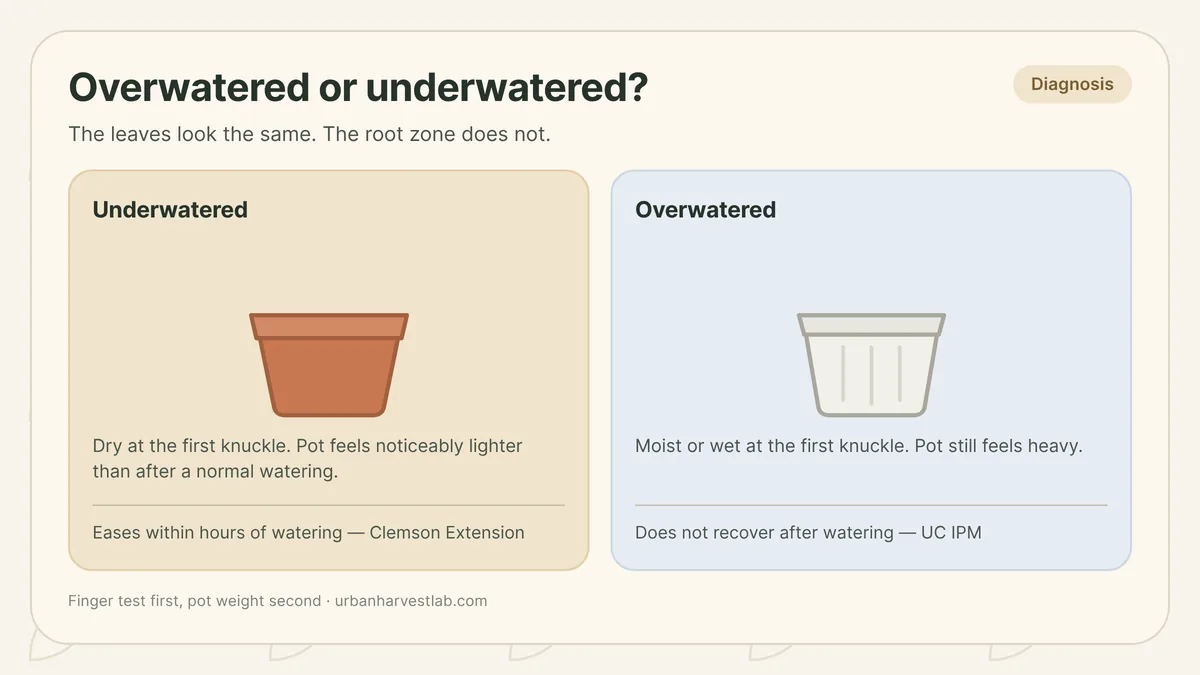
Overwatered vs underwatered: how to tell which one you have
Reading the root zone directly, with a finger test, pot weight, and how the plant responds to being watered, settles what the leaves alone cannot.
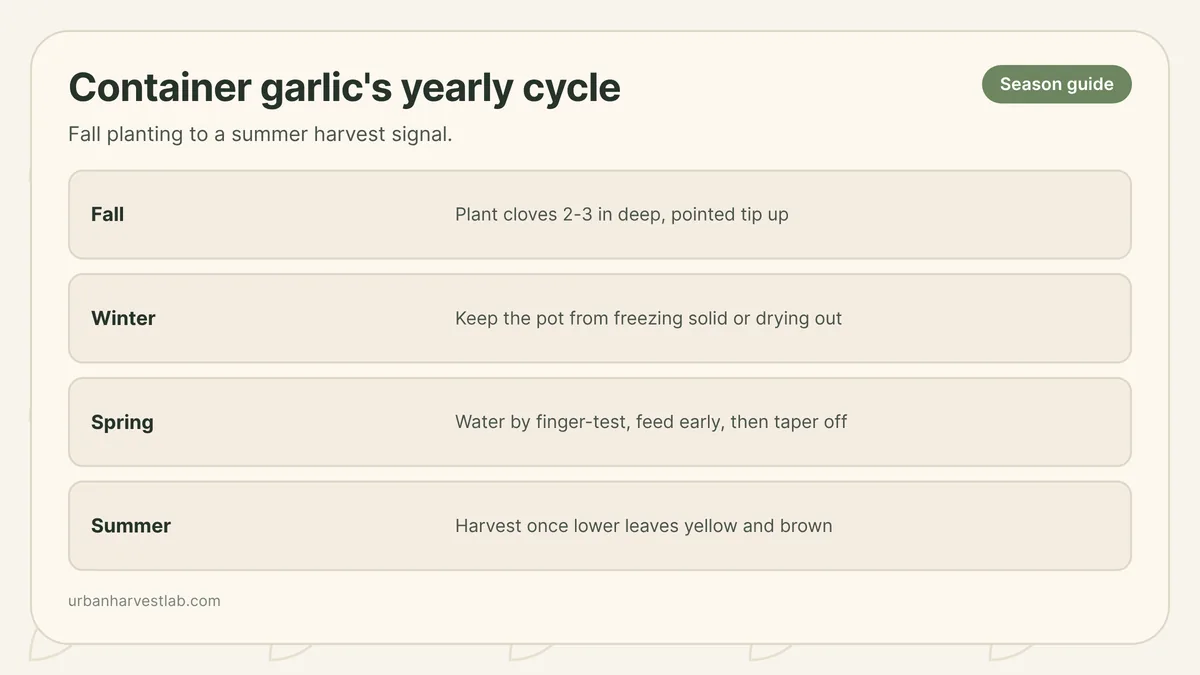
Growing garlic in containers: fall planting to summer harvest
Container garlic runs the same yearly cycle as garlic in the ground, but a pot freezes and dries out faster than garden soil. Here is the full process, season by season.
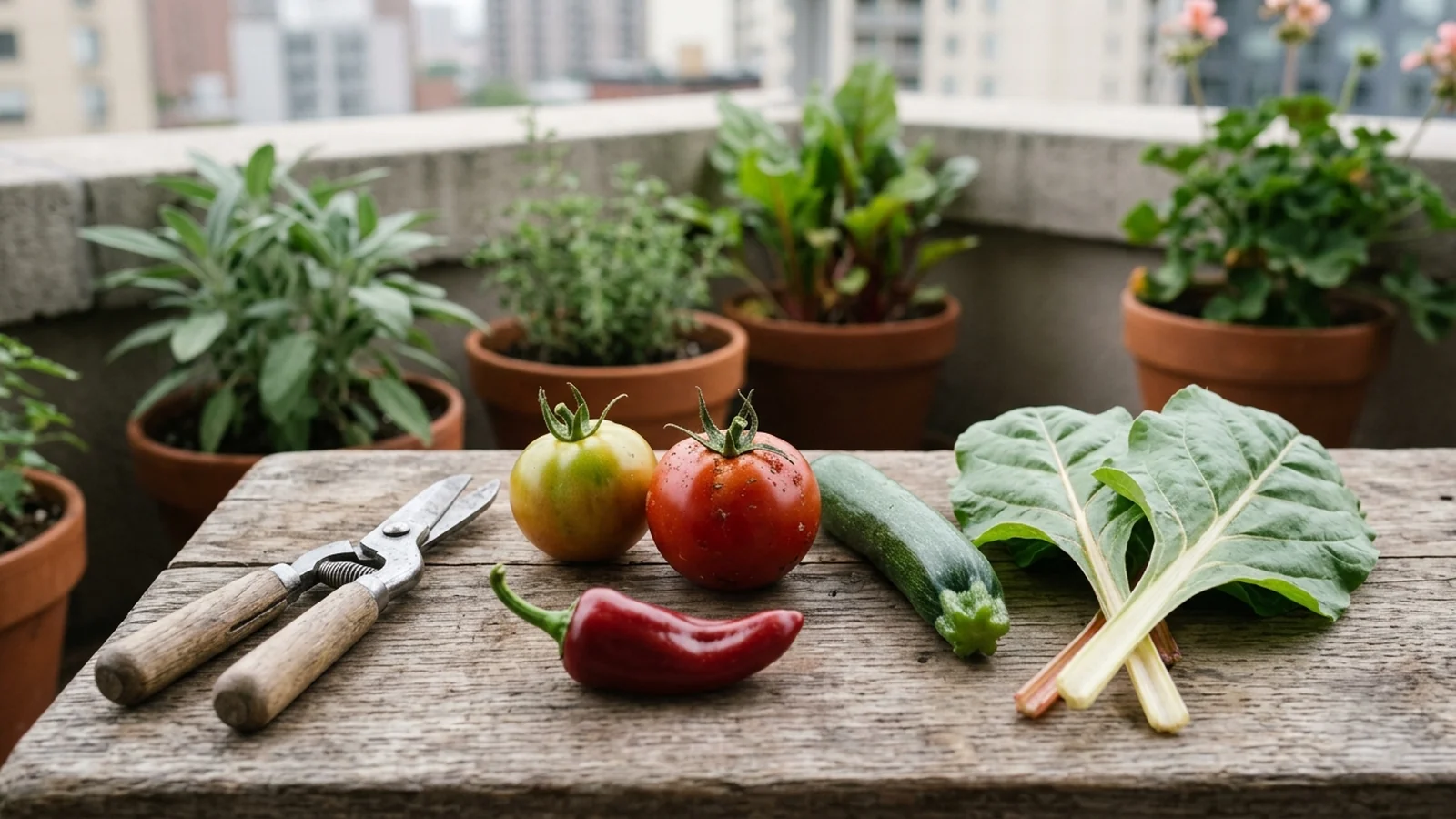
When container vegetables are ripe, crop by crop
A tomato tells you it's ready with color and give. A zucchini tells you with size and how easily it lets go. The signal is different for every crop, and waiting costs more when the plant only has a pot's worth of reserve behind it.