Day length that triggers bulbing, by source (hours of daylight)
| Source | Short-day | Intermediate-day | Long-day |
|---|---|---|---|
| University of Maryland Extension | 10 to 12 | 12 to 15 | 14 to 16 |
| Nebraska Extension | 11 to 12 | 12 to 14 | 14 or more |
| University of Tennessee Extension | 10 to 13 | 13 to 14 | 14 or more |
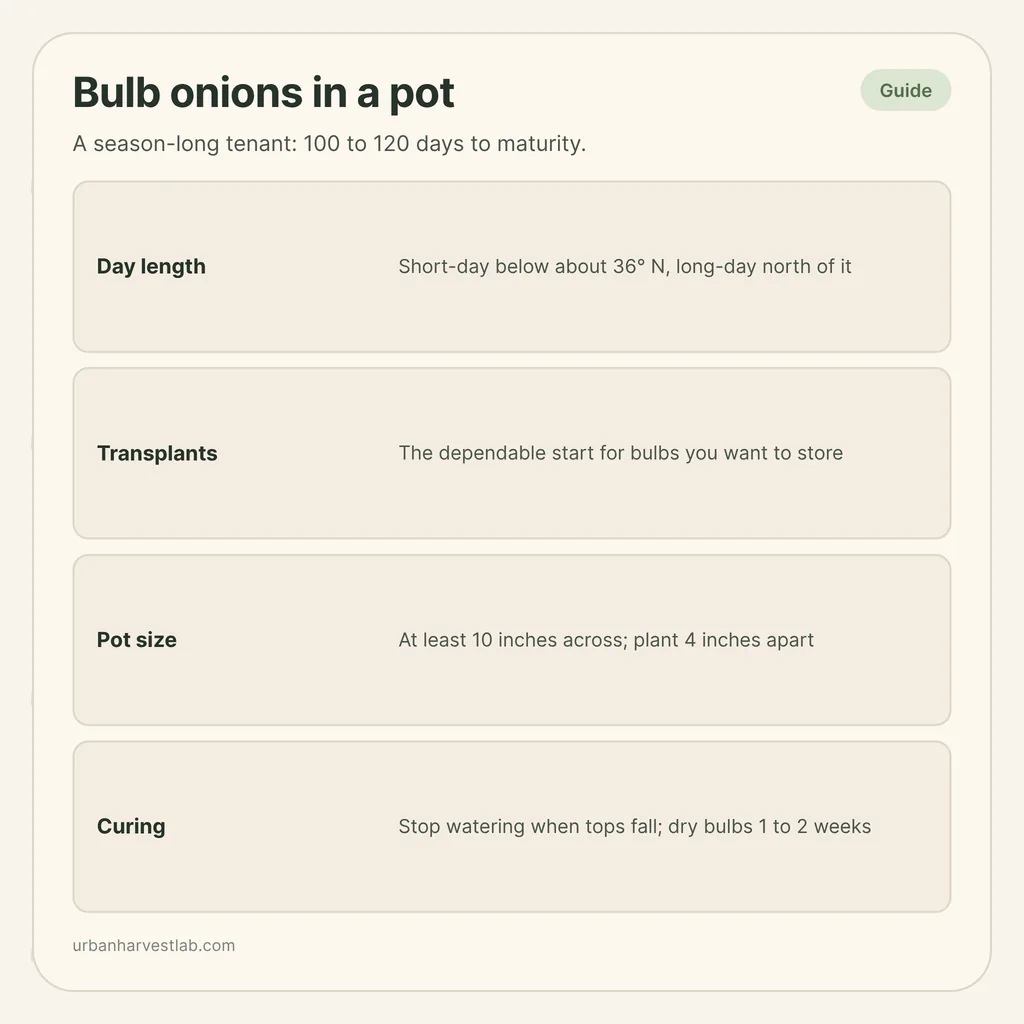
Grow bulb onions in a pot by choosing the day-length type that suits your latitude, planting transplants about an inch deep and 4 inches apart in a container at least 10 inches across, keeping the mix evenly moist, and drying the bulbs once the tops fall over. Utah State Extension puts maturity at 100 to 120 days, so this is a season-long tenant, not a quick filler.
Here the crop is the dry onion you cure and store, plus shallots. For leaves to snip, the pot, spacing and calendar are different: see growing green onions in a container or regrowing store-bought scallions. Leeks do not form a bulb and have their own routine in growing leeks in containers.
Match the day-length type to where you live
Onions decide when to stop making leaves and start swelling a bulb by counting hours of daylight. Catalogs label varieties short-day, intermediate-day or long-day, and that label matters more than the variety name. The sources agree on the idea but not on the exact hours, which is why the table above gives each one separately.
Maryland’s extension service puts short-day onions below about 36° N latitude and long-day onions north of it. Nebraska explains what goes wrong when you ignore that: short-day onions grown in northern gardens start bulbing too soon, giving disappointingly small bulbs, because they have not had time to grow leaves. Each leaf becomes one layer of the bulb, so a plant that starts swelling early has fewer layers to fill.
The mistake runs the other way too. University of Tennessee Extension warns that long-day types may not produce bulbs well under shorter summer days in more southern locations. Tennessee sits in between, and its specialist suggests intermediate-day onions for dry bulbs there. Maryland Extension reaches the same conclusion for its own mid-latitude: the most reliable varieties there are intermediate-day ones.
So the rule of thumb is this. Find your latitude, then buy the type your local garden center or a regional seed catalog sells for it. Tennessee adds a trade-off: long-day onions are typically the harder storage types, while intermediate and short-day onions are milder and are used fresh because they do not store as well.
Pot growing does not change any of this. The day length reaching your balcony is the same as the one reaching a garden bed. For help knowing your planting window, see first and last frost dates for a balcony.
Transplants, sets or seed
Transplants are the dependable start for bulbs you want to store. Nebraska Extension calls seed or transplants the better option for large storage onions, because sets have already had a season of growth and are primed to flower. Its warning is blunt: plants grown from sets often begin blooming in mid-summer and stubbornly refuse to stop, after which the bulb barely grows. Sets are still a good way to get green onions.
Utah State adds a size rule: larger sets or transplants, over 5/8 inch in diameter, have a greater tendency to bolt. Pick the thinner ones. Starting your own from seed takes time. Utah State says transplants need about 8 weeks of growth before they go out, so mail-order or garden-center bundles save a lot of effort.
Nebraska plants transplants out as soon as the soil is workable and daytime temperatures reach 50°F, and notes that transplants tolerate light frost. Utah State cautions that onion sets and transplants often bolt if planted too early, so wait for those 50°F days rather than racing them. Maryland’s extension service flags the opposite risk: soil warmer than 75°F can make onions bolt if bulbing has not started yet. A pot that heats up before bulbing begins is a place to watch for it.
Pot, mix and spacing
University of Illinois Extension lists onions in the group that needs a container at least 10 inches across, and a 16-inch pot in the same table holds 10 gallons of mix. University of Kentucky Extension says 6 to 8 inches of depth is adequate for onions. Width is the useful dimension, since onion roots are shallow and each bulb needs its own patch of surface.
Nebraska Extension sets transplants 1 to 1.5 inches deep and says slightly deeper planting makes more globe-shaped bulbs, while a basal plate near the surface gives flat discs. Tennessee’s range for transplants and sets is 1.5 to 2.5 inches. Nebraska spaces plants 4 inches apart and Tennessee says 4 to 6 inches. In a 10-inch pot that is a handful of plants, not a crowd.
Utah State says onions grow best in full sun. If you seed thickly or plant tight, thin to spacing early and eat the thinnings as green onions. Utah State also warns that high-density plantings shrink bulb size unless water and nutrients keep up, and in a pot both run out fast. Feeding rhythm for pots is covered in a fertilizer schedule for container vegetables.
Water evenly, and do not hill
Utah State says water needs are critical because the rooting depth of onions is shallow, and that stress reduces yield and bulb size. A pot dries out faster than a bed, so check it often; how often to water container vegetables explains how to judge it by weight and finger rather than by calendar.
Swings matter as much as dryness. Nebraska says moisture stress can cause double or split bulbs, and Tennessee lists splitting as a physiological problem eased by even watering, moderate fertilizing and steady temperature. Do not pile mix up around the necks as you would for leeks: Nebraska says hilling up soil on onions can encourage stem rot.
Shallots
Shallots are the same species, grown the same way. University of Tennessee Extension describes a small clump of bulbs coming from a single set, with a mild flavor, and gives the same spacing and depth as onions. Tennessee harvests them like dry onions, when the necks become limber and bend over, and lists Matador and Conserver at 90 to 100 days with good storage potential. Because one set makes a clump, give each its own share of the pot’s width.
Bolting, and bulbs that stay small
Small bulbs and flower stalks usually trace back to one of a few causes. The first is the wrong day-length type, covered above. The second is planting late: Utah State says onions form bulbs under long days and hot weather, and those planted too late in spring mostly grow leaves. The third is bolting: Utah State says sets and transplants often bolt if planted too early or if they are over 5/8 inch, and Maryland Extension adds soil above 75°F before bulbing starts.
Harvest, dry and store
Stop watering once the tops start to fall over: Utah State warns that excess water at maturity delays curing and causes storage problems. Tennessee says dry bulb onions and shallots are harvested when the necks become limber and bend or break over. Do not leave bulbs sitting in a wet pot, because Tennessee notes that exposed bulbs can sunscald after the leaves dry down.
Lift the bulbs and dry them for one to two weeks, as Utah State advises, until the skins are papery and the roots dry. Choose a spot with air movement and low humidity (Tennessee). Then cut the leaves about 1 to 2 inches above the bulb and keep them cold and dry, around 32 to 40°F according to Utah State. Check the stored bulbs regularly and use any that soften or sprout first.
Garlic is the next job for an empty pot: it goes in during fall, as covered in growing garlic in containers.
Sources
- Onions and day length, University of Maryland Extension (Maryland Grows)
- Onions: long day, short day or neutral?, Nebraska Extension
- Onions, leeks and shallots for the Tennessee vegetable garden (D 127), University of Tennessee Institute of Agriculture
- How to grow onions in your garden, Utah State University Extension
- How to grow fruits, vegetables and herbs in container gardens, University of Illinois Extension
- Vegetables grown in containers improves accessibility, University of Kentucky Cooperative Extension
More from the onion family
Green onions, leeks and garlic each need a different pot and a different calendar from a bulb onion.
Common questions
Can you grow onions in containers?
Yes. University of Illinois Extension lists onions among the crops that need a container at least 10 inches across, and University of Kentucky Extension counts 6 to 8 inches of depth as adequate. Utah State says a bulb onion needs 100 to 120 days to mature, so plan for a long stay in the pot.
Should I grow onions from sets, seed or transplants?
For bulbs you want to store, transplants. Nebraska Extension says plants grown from sets often begin blooming in mid-summer and then increase little in size, which makes sets better for green onions. Utah State notes that larger sets or transplants over 5/8 inch in diameter bolt more readily.
Why did my onions grow leaves but no bulb?
Usually day length, planting date or heat. Utah State says onions form bulbs under long days and hot weather, and that those planted too late in spring mostly grow leaves. Tennessee notes that long-day types may not bulb well under shorter summer days in the south.
When are container onions ready to pick?
When the tops fall over. University of Tennessee describes the necks becoming limber and bending or breaking over. Utah State then has you lift the bulbs and dry them for 1 to 2 weeks, until the skins are papery and the roots dry.
Related guides
How often to water container vegetables: volume and crop stage set the interval
A pepper in a 2-gallon pot in May and the same pepper in the same pot in August are two different watering problems. Once you can see why, the question stops being how often and becomes how much mix you gave the plant, and what it is carrying right now.
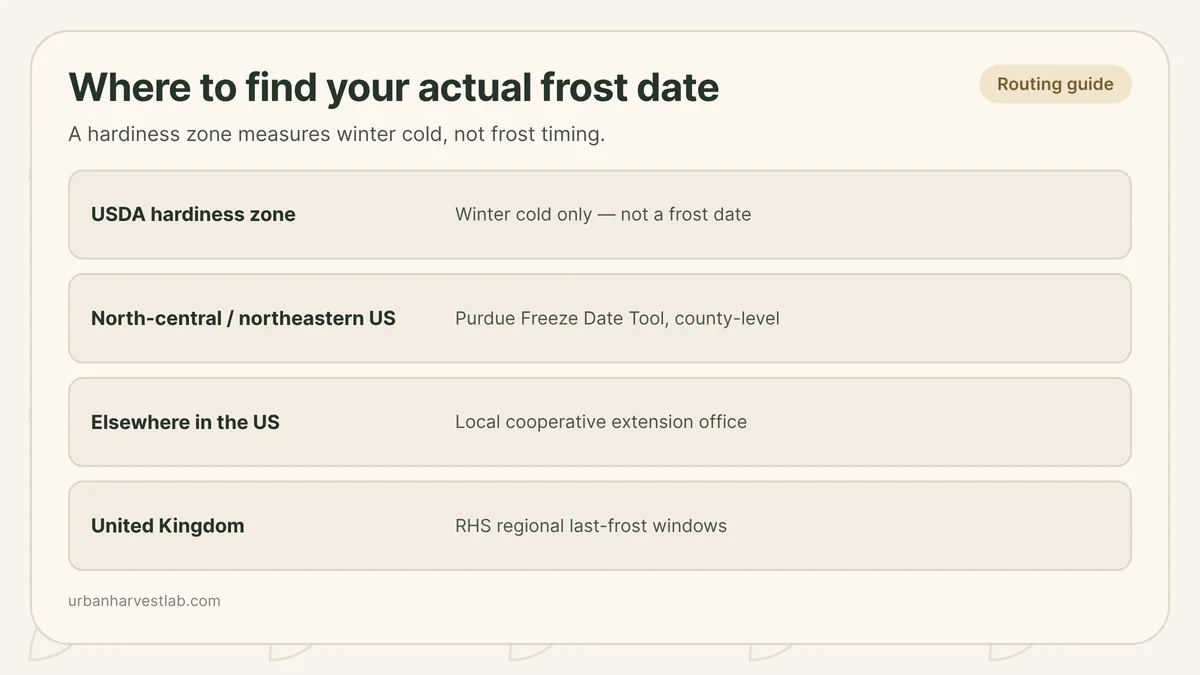
First and last frost dates for a balcony: start with your zone
Your hardiness zone tells you how cold winter gets, not when frost starts or ends. Look up the zone's temperature band, then use the tools built to answer the date question directly.

How to grow leeks in containers: planting deep, hilling and a long harvest
A leek is a slow, shallow-rooted crop that earns its white stem from soil piled around it. In a pot that means planting deep, leaving headroom, and keeping the mix evenly moist for months.