Curing and storage for each crop, by extension source
| Crop | Cure first | Then keep it | Avoid |
|---|---|---|---|
| Onions | 2-3 weeks (Utah State) or 3-4 weeks (Maine), well-ventilated and out of the sun | Cool, dry and ventilated: 40-60°F (UC Master Food Preservers) or 32-40°F and 65-70% humidity (Maine) | Refrigerating (UC); storing beside potatoes |
| Garlic | 3-4 weeks in a single layer, warm and dry with good air movement (Maine) | Dark, about 60°F and about 50% humidity (Maine), in mesh bags or braided | Refrigerating or plastic bags (Maine) |
| Potatoes | 7-10 days in the dark with high humidity (Oregon State), or about a week in shade (Maine) | Dark and humid: 40-46°F (Oregon State), 38°F (Maine), in perforated bags or ventilated containers | Light, temperatures below 38°F, storing beside onions |
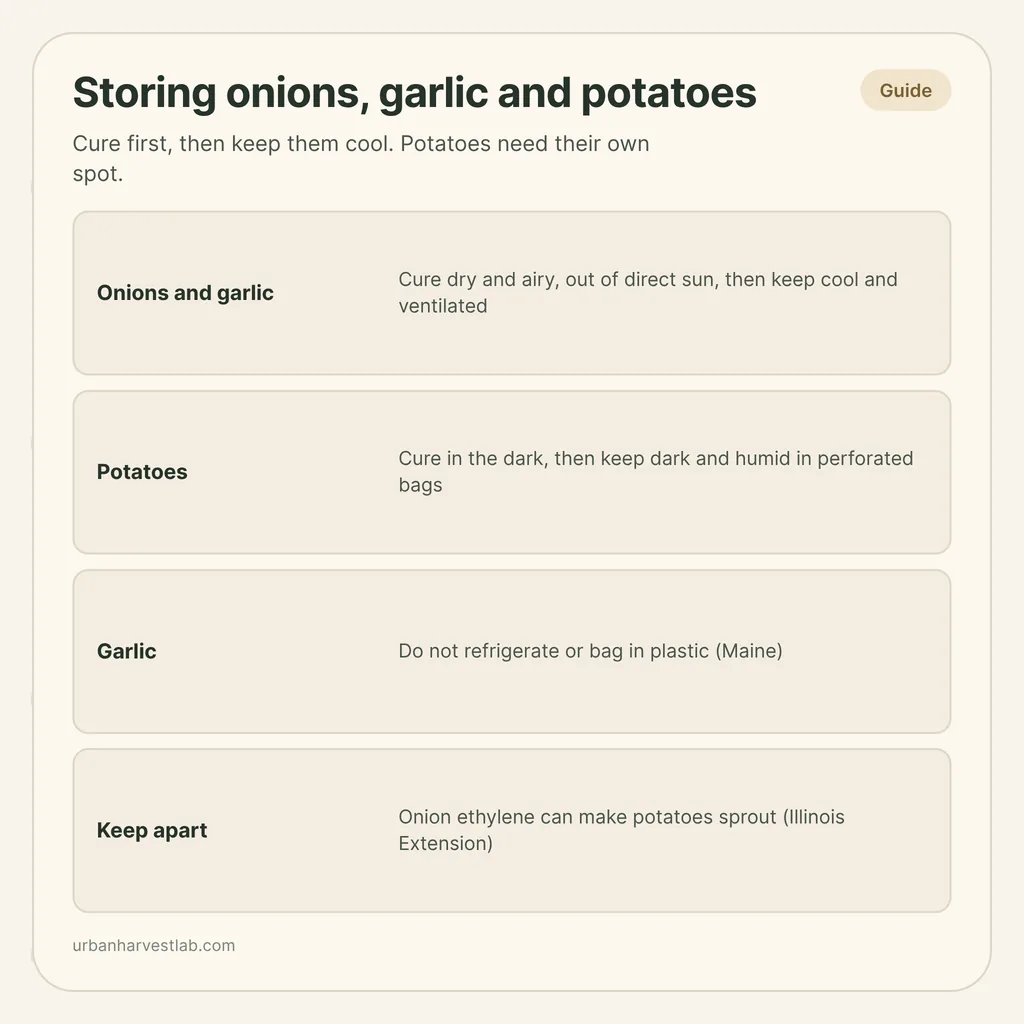
Cure onions and garlic dry and airy for a few weeks, then keep them cool, dry and in moving air. Cure potatoes briefly in the dark, then keep them cool, dark and humid, and give them their own spot away from the onions. The three crops are close kin on the harvest table and opposites in storage, which is why one pantry shelf rarely suits them all. Growing and lifting each crop is covered in bulb onions in containers, garlic in containers and potatoes in grow bags. What follows starts once the crop is out of the pot.
Cure first, store second
Curing means drying the outer skins and the neck so the bulb is sealed against rot. Utah State Extension says onions are ready for long-term storage when the outer skin rustles when disturbed and the necks are dry. University of Maine Extension describes the same endpoint: the neck just above the bulb is dry and tight and the outer scales are dry and papery.
The time it takes varies by source. Utah State gives 2 to 3 weeks for both onions and garlic in a well-ventilated area out of direct sun. Maine Extension gives 3 to 4 weeks for onions in shallow boxes or mesh bags, and three to four weeks for garlic spread in a single layer in a warm, dry place with good air movement. Maine’s advice on heat is useful in an apartment: do not cure garlic somewhere very hot such as an attic or closed greenhouse, or in direct sunlight. A shaded balcony corner or a spare room with a window cracked open fits the description better than a sunny sill. The Utah State 2 to 3 weeks here comes from its harvest-and-storage page; garlic in containers cites a Utah State figure of 1 to 2 weeks for garlic from another source page. Judge by the necks and skins rather than the calendar.
Potatoes cure on a much shorter clock. Oregon State Extension says to cure cleaned tubers in a dark, well-ventilated space with moderate temperatures and high humidity for 7 to 10 days. Maine Extension gives about a week in a shaded, well-ventilated place and warns that tubers turn green with even small amounts of light. Utah State cures at 45-60°F for about 2 weeks. Whatever the exact number of days, the point is the same: potatoes cure in the dark. The reasons greening matters are in why potatoes turn green.
Onions: cool, dry and ventilated
Once cured, Maine Extension says onions belong in a well-ventilated container such as a basket or mesh bag, or hung where air can move around them, in a space that is cool and relatively dry: 32-40°F and 65-70% relative humidity. It also suggests bringing them down to storage temperature gradually.
Other sources set the bar warmer. Master Food Preservers of the University of California (Inyo-Mono) give an ideal of 40-60°F and say not to refrigerate onions. Utah State says onions store best just above freezing, and also lists a dry, cool (45-60°F) basement room as suitable for them. If you have no garage or cellar, the warmer end of the range is the realistic one: a cool, dark, airy cupboard or a box on a closet floor.
The UC advice on layout works in a small home. Keep the onions in no more than two layers in a cool, dark, well-ventilated area, or braid the tops, or hang them in a mesh bag. Mesh produce bags are cheap to buy and let air reach every bulb. Check the stock regularly and take out any onion that is sprouting or rotting at once. UC also says to use the soft, smaller and thick-necked onions first, and that pungent onions store longer than sweet ones, so eat the sweet varieties early.
Garlic: dark, mild and dry
Maine Extension’s storage target for garlic is a dark place at about 60°F with relative humidity of about 50 percent. That is close to ordinary room temperature, so garlic is the easiest of the three in an apartment. Other extension sources differ: garlic in containers gives the University of Maryland’s 32-38°F and about 65% humidity for cured bulbs, against Maine’s 60°F and 50% here. Cooler, moister conditions promote sprouting and shorten storage, and Maine says not to refrigerate garlic or keep it in a plastic bag. Utah State suggests mesh bags or braiding the tops together. If you are not braiding, Maine cuts the tops to leave about an inch and a half of stem above the bulb.
Garlic stored in oil is a different matter and a food safety one. Penn State Extension says oil flavored with fresh herbs or garlic can be a source of botulism, because garlic is a low-acid food that can carry spores and the oil creates an oxygen-free environment. Its safe options are narrow: it describes refrigerating fresh-herb oil and using it within 2 to 4 days, or a tested acidification method developed at the University of Idaho. Keep garlic dry, in the open air, and do not improvise a jar of garlic in oil on the shelf.
Potatoes: dark, cool and humid
Where onions and garlic want dry air, potatoes want humid. Oregon State Extension notes that tubers are about 80 percent water, so high humidity prevents shriveling, and it suggests perforated plastic bags or well-ventilated containers to hold that humidity. Maine Extension’s ideal is 38°F with 95 percent humidity, and says a cool, damp basement usually does fairly well. Oregon State gives 40-46°F and lists a refrigerator set to that range, an insulated garage or a cool basement as suitable. Utah State gives 40°F in the dark in boxes or crates. Those figures sit alongside the ranges already given in the green potato guide: the sources agree on cool and dark and differ by a few degrees. They differ on the fridge too: Iowa State advises against it, while Oregon State allows it at 40-46°F.
Two limits matter most. Oregon State says to avoid temperatures below 38°F, which can cause sugar buildup and sweetening, and above 46°F it expects storage life to fall to two to three months, with some risk of sprouting and shriveling. In an apartment the choice is usually between a cool closet and the fridge. If you use the fridge, a refrigerator thermometer tells you whether it sits in the 40-46°F window.
Sorting helps. Oregon State says to discard injured or diseased tubers before long-term storage and to use potatoes with cuts or bad spots within the first month. It adds that thin-skinned types such as red potatoes store for less time than thick-skinned russets, and that with proper storage mature, late-season potatoes can stay in good condition for seven to eight months.
Keep onions and potatoes apart
Illinois Extension says plainly that onions and potatoes do not play well together: ethylene gas released by onions can cause potatoes to sprout. A sprouted potato is still safe to eat if you remove the sprouts first, according to that source, but a soft, shriveled one goes in the bin. Master Food Preservers of the University of California (Inyo-Mono) give a second reason, that potatoes and certain fruit can pick up the onion flavor. Their humidity needs differ too, as the sections above show.
In practice that means two containers, ideally in separate spots: a dry, airy one for onions and garlic, and a dark, closed-in one for potatoes. Onions and garlic both want dry, ventilated air, so they can sit in the same area. Hang the mesh bag or set the box well away from the potato crate.
Sources
- Utah State University Extension: Harvest and Storage of Vegetables and Fruits
- University of Maine Cooperative Extension: Growing Garlic in Maine (Bulletin 2063)
- University of Maine Cooperative Extension: A Donor’s Guide to Vegetable Harvest (Bulletin 4303)
- University of Maine Cooperative Extension: Potato Facts, Growing Potatoes in the Home Garden (Bulletin 2077)
- University of Maine Cooperative Extension: Maine Home Garden News, September 2014
- Oregon State University Extension: Best practices for harvesting and storing homegrown potatoes
- University of California Backyard Gardener: Harvesting and Storing Onions from the Garden
- University of Illinois Extension: Learn how to preserve your produce like a pro
- Penn State Extension: How to Safely Make Infused Oils
Growing and keeping the crops
From the pot to the pantry for onions, garlic and potatoes.
Common questions
How do you store onions, garlic and potatoes?
Cure onions and garlic first: Maine Extension gives three to four weeks for garlic and Utah State two to three weeks for both onions and garlic. Then keep them cool, dry and ventilated, in mesh bags or open boxes. Potatoes are cured for 7 to 10 days in the dark (Oregon State), then kept dark and humid in perforated bags or ventilated containers, at roughly 38 to 46 degrees Fahrenheit depending on the source. Keep the potatoes away from the onions.
Can you store onions and potatoes together?
It is better not to. Illinois Extension says ethylene gas released by onions can cause potatoes to sprout, and the University of California Master Food Preservers say potatoes and some fruit may pick up the onion flavor. Onions and potatoes also want different humidity, dry for onions and high for potatoes.
Should homegrown garlic go in the refrigerator?
University of Maine Extension says not to refrigerate garlic or keep it in a plastic bag, and that cooler, moister conditions promote sprouting. It recommends a dark place at about 60 degrees Fahrenheit and about 50 percent relative humidity.
Can potatoes go in the refrigerator?
Oregon State Extension lists a refrigerator set to 40 to 46 degrees Fahrenheit as a suitable place, in perforated bags or ventilated containers, and says to avoid temperatures below 38 degrees because they can cause sugar buildup and sweetening. A standard fridge may run colder than that range, so check it with a thermometer.
Related guides
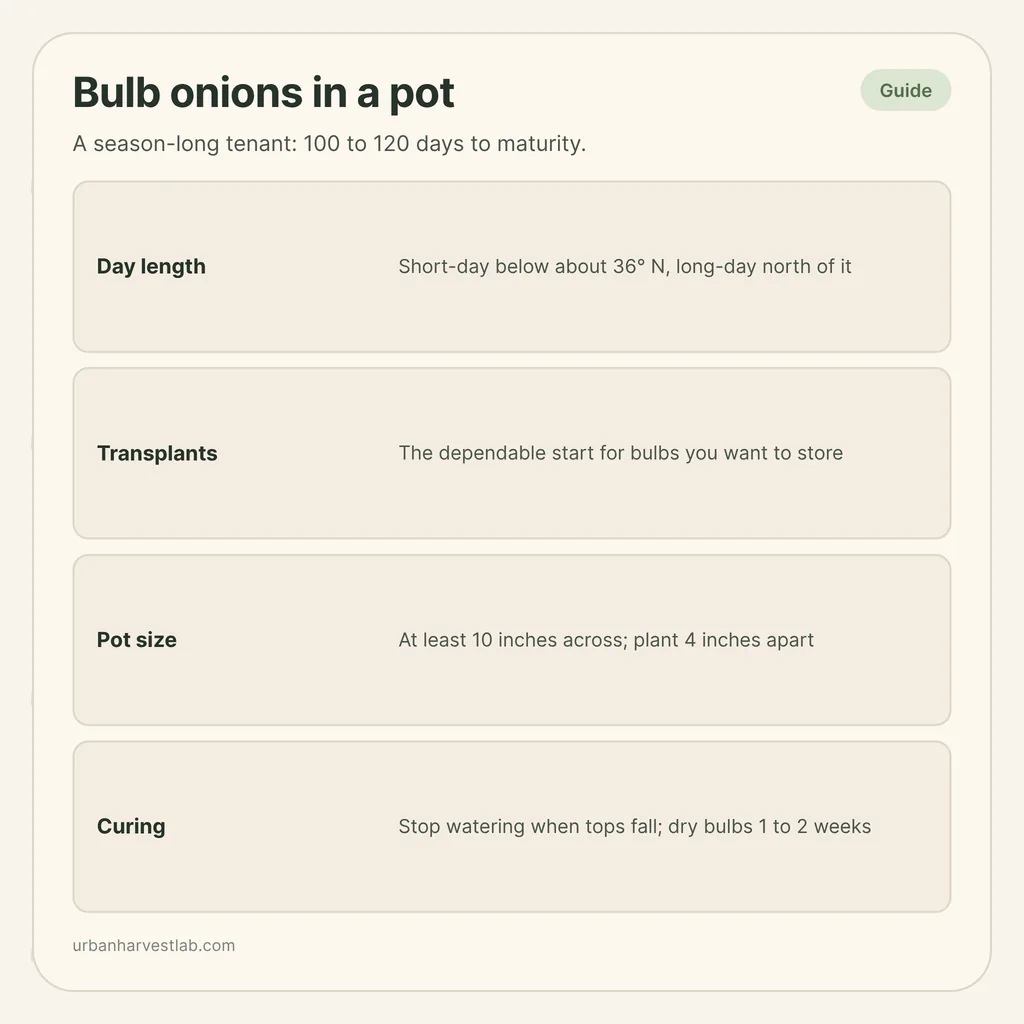
How to grow bulb onions in containers: day length, sets and curing
A bulb onion decides when to swell based on day length, not on how big your pot is. Pick the right type, plant transplants, and the container work is simple.
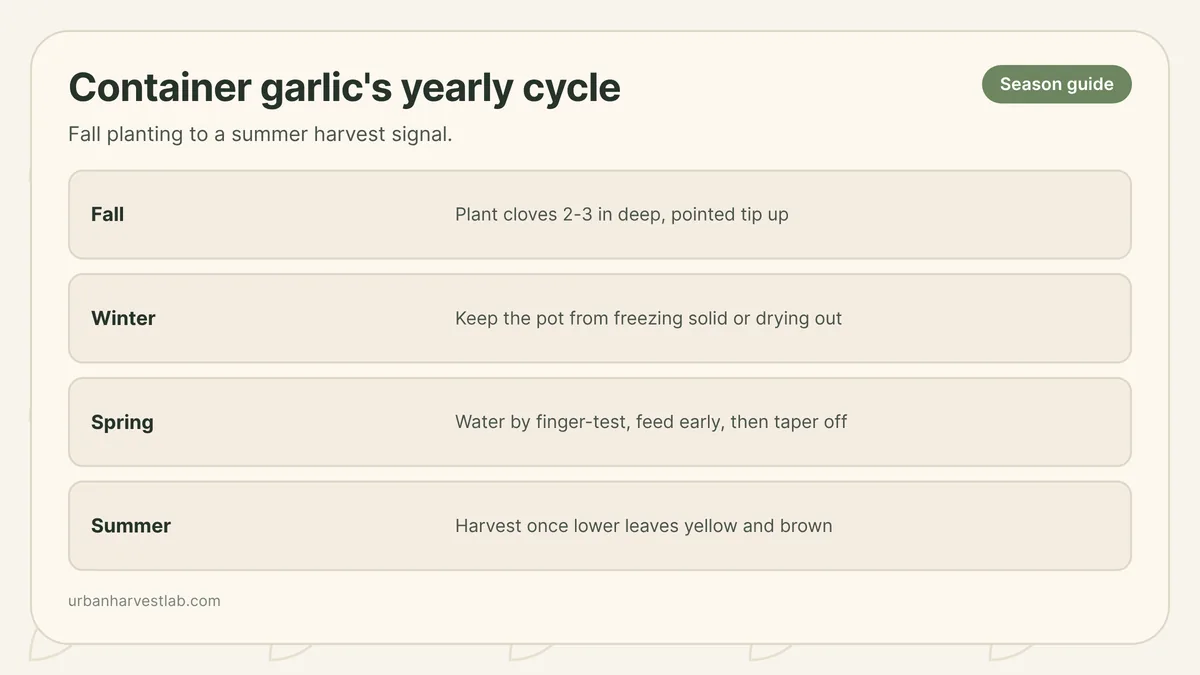
Growing garlic in containers: fall planting to summer harvest
Container garlic runs the same yearly cycle as garlic in the ground, but a pot freezes and dries out faster than garden soil. Here is the full process, season by season.
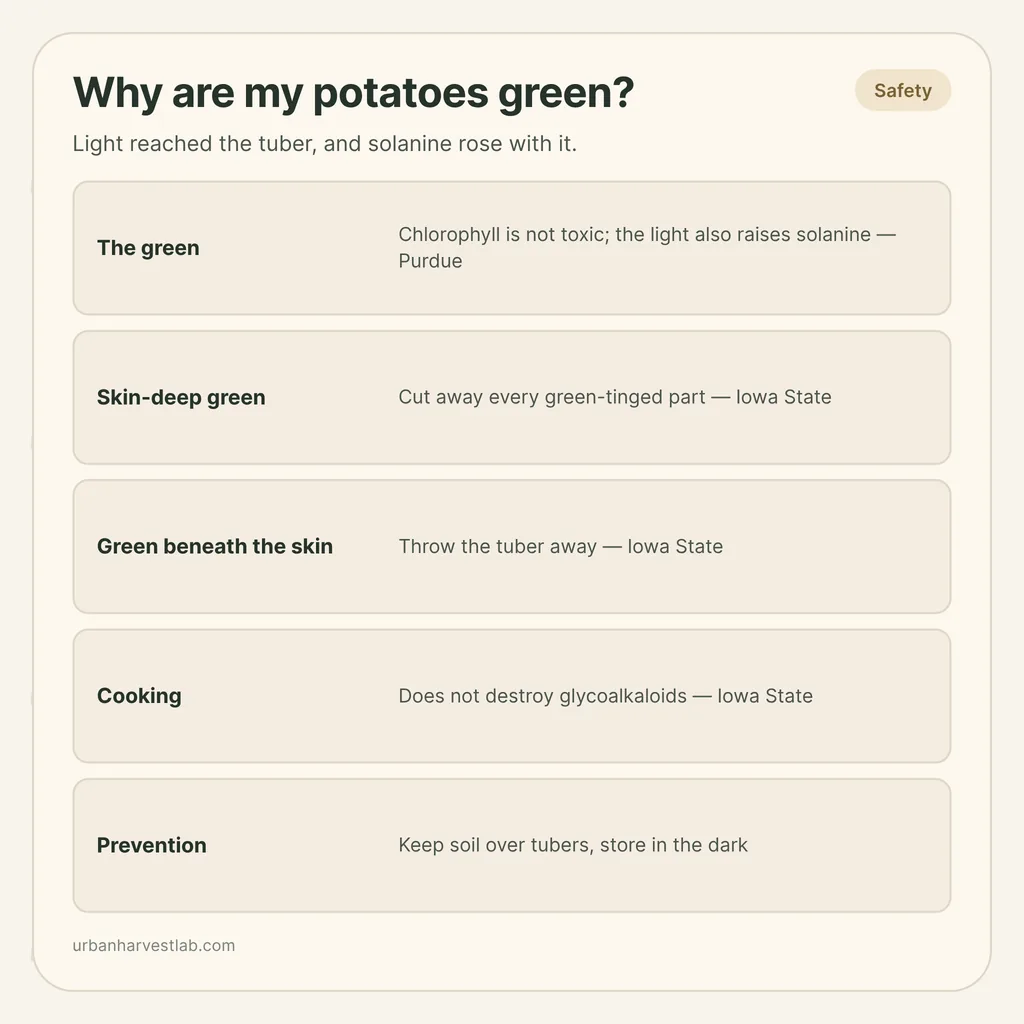
Why are my potatoes green? Light, solanine and what to do with them
Green on a potato is chlorophyll from light exposure, and solanine rises alongside it. Here is how to judge a green tuber, what to cut or throw out, and how to stop it next time.