Troubleshoot the system before you change the inputs.
Symptoms
- Dill, parsley or fennel stripped of leaves, sometimes down to bare stalks.
- Plump green caterpillars with black bands and yellow dots, or small black spiny ones with a white patch, on stems, leaves or flower heads.
- Small pale yellow round eggs on new growth.
Possible causes
- Black swallowtail larvae, which feed on dill, parsley, fennel, carrot and other carrot-family plants.
- Several caterpillars on a small pot, which can outrun the leaf the plant makes.
Quick fixes
- Hand-pick the caterpillars and move them to a related host such as extra dill, fennel or Queen Anne's lace.
- Accept some damage, or keep a separate pot of dill or parsley for them and harvest from another.
- Do not spray: Bt kills butterfly caterpillars along with pests.
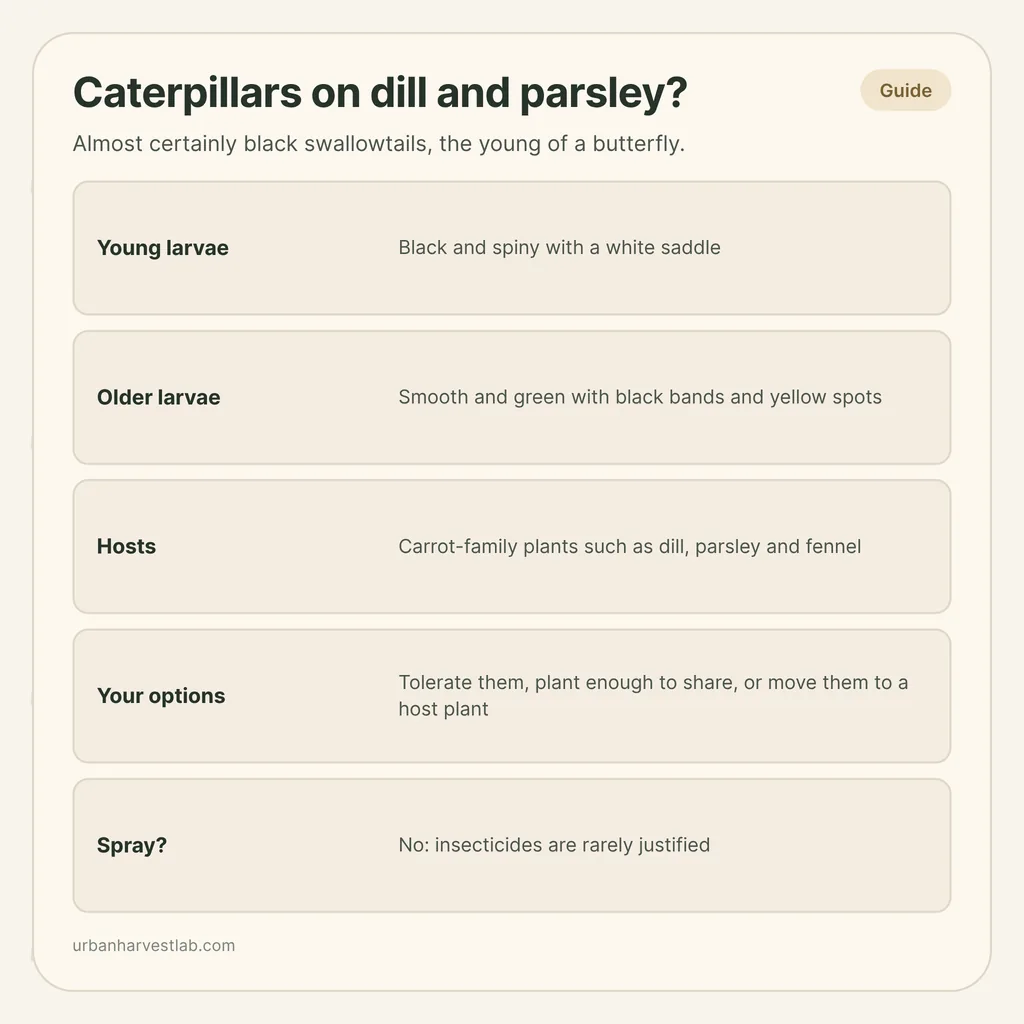
Striped green caterpillars on dill, parsley or fennel are almost certainly black swallowtail larvae, the young of a butterfly, and the usual fix is to share the plant or move them rather than kill them. They feed on carrot-family plants (Wisconsin also notes common rue), so they will not touch your basil or tomatoes. On a single small pot, though, a handful can strip a plant fast.
If the caterpillars are on a tomato, the caterpillars on tomato plants guide covers hornworms, and the kale caterpillar guide covers cabbageworms. A dill or parsley pot with holes but no caterpillar in sight belongs to the herb pest identification chart.
Recognising a black swallowtail caterpillar
The look changes as the caterpillar grows, which is why people think they have two different pests.
- Young larvae. The University of Wisconsin-Madison says the early instars are black and spiny with a white saddle, resembling bird droppings. NC State Extension describes the younger larvae as black and orange, and not nearly as pretty as the older ones.
- Older larvae. After a moult they become smooth and green with black bands and yellow spots. Wisconsin gives a final length of 1 1/2 to 2 inches.
- The horn. Touch one and it rears up and pushes out a forked, bright yellow-orange organ behind the head, the osmeterium, which Wisconsin says all swallowtail larvae use to repel predators.
- Eggs. Wisconsin says females lay pale yellow, spherical eggs singly, usually on new foliage. They darken as the caterpillar develops, and hatch in 3 to 9 days.
University of Minnesota Extension notes that the caterpillars prefer the flowers and seeds of dill and its relatives, and that in Minnesota they are present from July to September. Check the flower heads, not just the leaves.
Wisconsin lists cultivated dill, parsley, fennel, celery, caraway and carrot as the common backyard hosts.
How much damage to expect
Less than it looks like, in most gardens. Minnesota Extension says their feeding is rarely sufficient to seriously injure plants, and Wisconsin says they are usually not numerous enough to present a real problem. The exception is a small pot. Wisconsin also notes that a number of them can consume entire plants, and NC State describes the exact picture many readers land here with: a pot of dill stripped down to a bare stalk.
The University of Wisconsin-Madison puts the larval stage at 10 to 30 days, depending on temperature and host plant, so each brood is a burst of damage.
Your options
- Tolerate it. NC State’s first suggestion. Pick the leaves you need now, and let the rest feed the caterpillars.
- Plant enough to share. Penn State Extension’s York County Master Gardeners advise planting enough dill and parsley to share with the caterpillars. Dill does not transplant easily because of its long taproot, so sow a second pot where it will stay rather than moving a seedling. The dill pot size guide covers the depth it needs.
- Move them. Wisconsin says handpicking would eliminate the problem in most situations and that removed larvae can be relocated to host plants outside the garden. NC State suggests Queen Anne’s lace, wild parsnip or another related plant. They need a carrot-family host (or rue) to finish growing, so a non-host plant will not keep one alive. A spare pot of fennel or dill that you do not plan to harvest works the same way.
Pick them up with a leaf or a gloved finger and set them on the new plant. Expect them to wander. Wisconsin says a mature caterpillar leaves the host to find a place to pupate, on a plant stem, tree trunk, foundation wall or other spot, and turns into a naked chrysalis, not a cocoon. A brown or green lump hanging from a railing or wall near your pots is probably one, so leave it alone.
Should you spray?
No. Wisconsin Extension says insecticides are rarely justified for this caterpillar. If you do consider Bt, the National Pesticide Information Center states that Bt kurstaki and aizawai control the caterpillars of moths and butterflies. That includes the swallowtail you may have been hoping to see in the end. If you spray anything on herbs you plan to eat, the product label decides which crops are allowed, as the guide to choosing a pest treatment for edible plants explains. Given the choice, hand removal is simpler.
Common mistakes
- Treating the small black spiny caterpillars as a different, nastier pest. They are the same insect as the green ones.
- Moving a caterpillar to a plant it cannot eat.
- Squashing a chrysalis found on a wall because it does not look like a caterpillar.
- Spraying a dill or parsley pot for chewing pests when the chewer is the swallowtail you could have moved instead.
Sources
- University of Wisconsin-Madison Extension Horticulture, Black swallowtail, Papilio polyxenes
- NC State Extension, Black swallowtail caterpillars munching on herbs
- University of Minnesota Extension, Black swallowtail
- Penn State Extension, York County Master Gardeners, Help the butterflies with milkweed, parsley, and dill
- National Pesticide Information Center, Bacillus thuringiensis general fact sheet
Sort out other chewing pests
Not every caterpillar on a herb is a swallowtail. These guides cover look-alike damage and the other caterpillars worth knowing.
Common questions
What are the striped caterpillars on my dill and parsley?
Black swallowtail caterpillars. The University of Wisconsin-Madison describes them as green with black bands and yellow spots, growing to 1 1/2 to 2 inches long. Younger ones are black and spiny with a white saddle.
Will black swallowtail caterpillars kill my dill or parsley?
University of Minnesota Extension says their feeding is rarely enough to seriously injure plants. Wisconsin Extension adds that a lot of them can consume entire plants, which is why a single small pot can be stripped bare.
Can I move the caterpillars to another plant?
Yes. NC State Extension suggests moving them to Queen Anne's lace, wild parsnip or another related plant, and Wisconsin Extension says removed larvae can be relocated to host plants outside the garden. They need a carrot-family plant such as dill, fennel or parsley (Wisconsin says they sometimes use rue as well), so a rose or a tomato will not do.
Is it safe to spray the caterpillars with Bt?
It will work, but not selectively. The National Pesticide Information Center says Bt kurstaki and aizawai control the caterpillars of moths and butterflies, so a swallowtail larva that eats a sprayed leaf is affected. Wisconsin Extension calls insecticides rarely justified for this caterpillar.
Related guides

Caterpillars eating tomato leaves: find them and stop them
Hornworms are green, up to 3 inches long, and nearly invisible among the leaves. The droppings give them away, and hand removal is the first and often only fix a balcony needs.
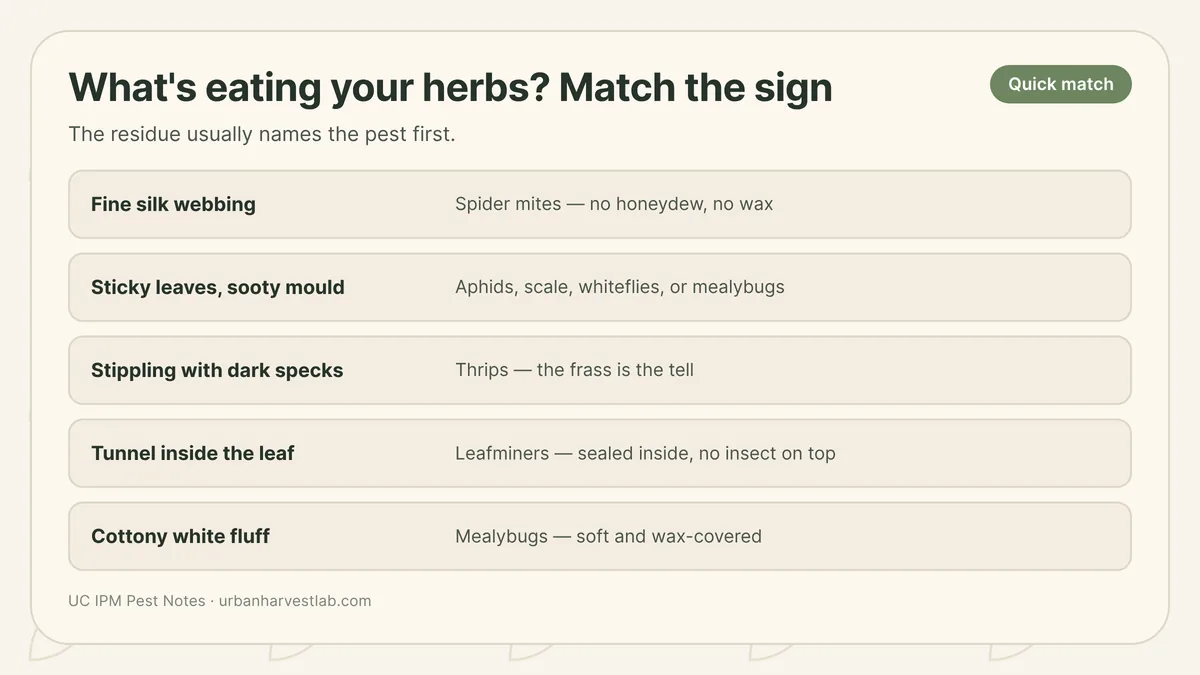
What's eating your herbs? Match the signs to the pest
Every common herb pest leaves its own tell before you ever spot the insect itself. Pick out what you are actually seeing, then go straight to the page that treats it.
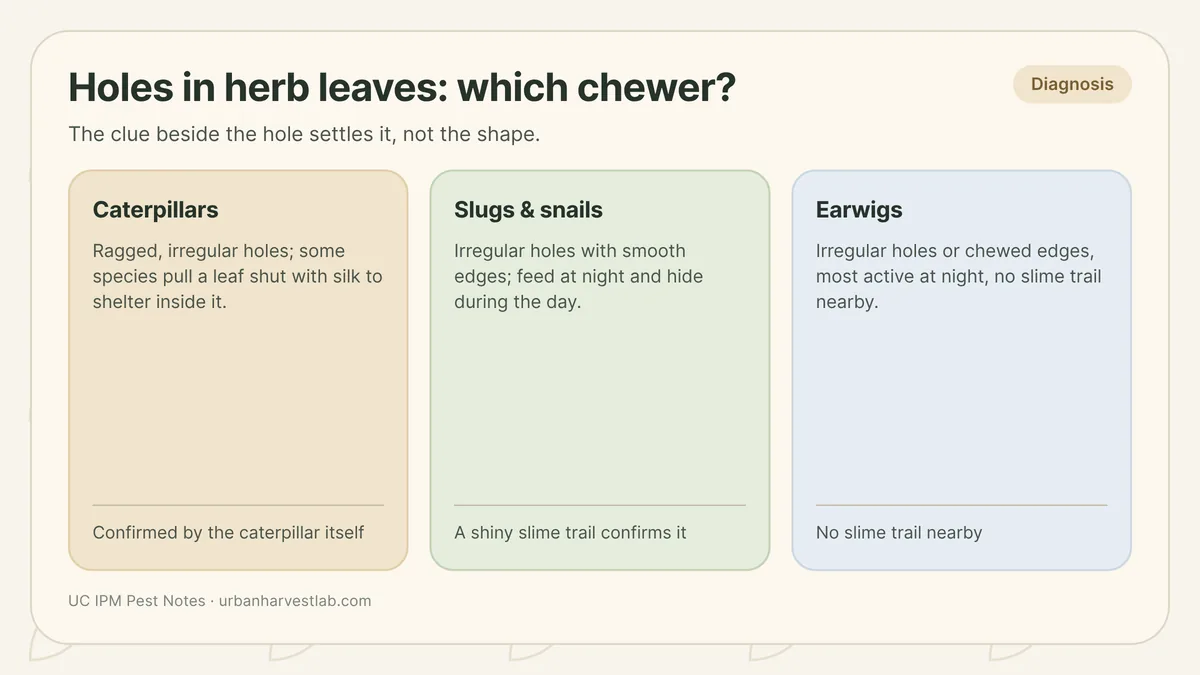
Holes in basil leaves: what's actually chewing them
Three insects punch actual holes through a herb leaf: caterpillars, slugs and snails, and earwigs. Each leaves its own clue, and the clue matters more than the shape of the hole.