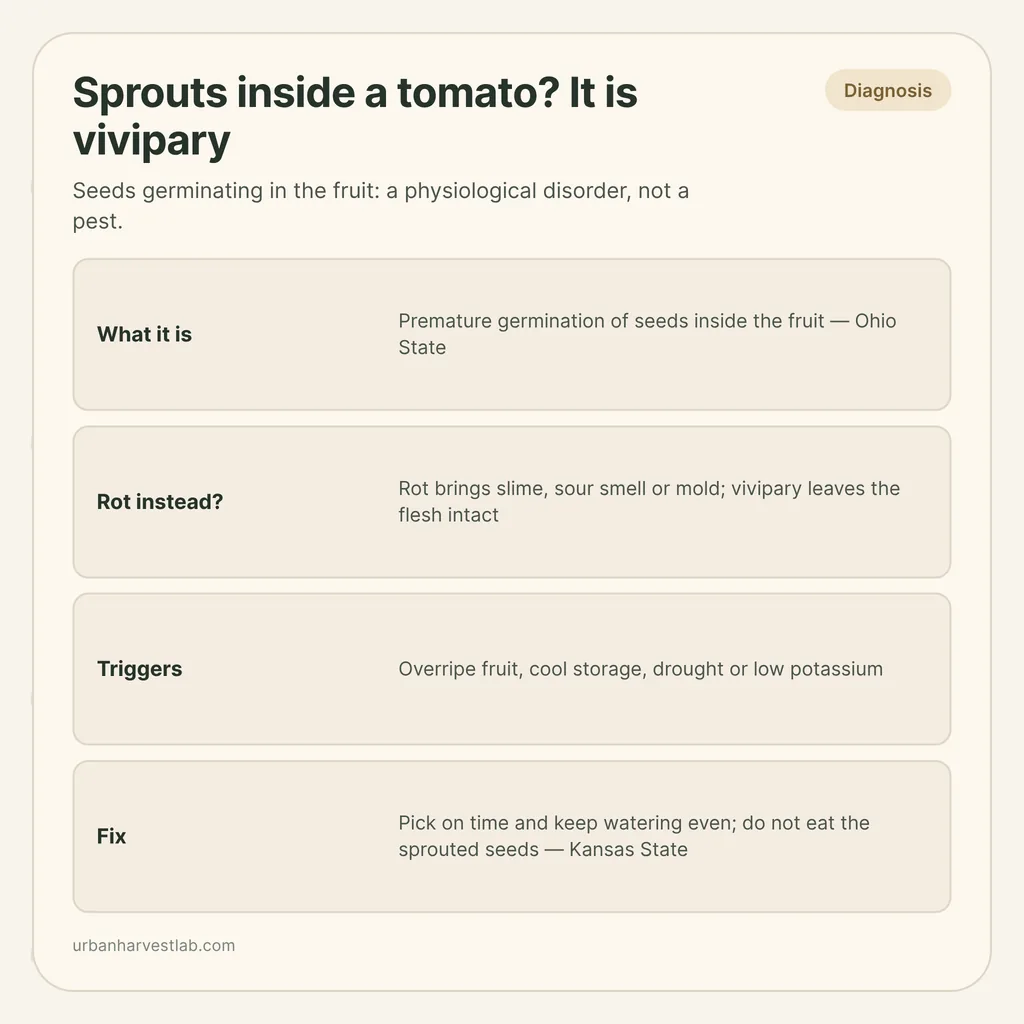
Troubleshoot the system before you change the inputs.
Symptoms
- White threads or tiny green shoots growing from the seeds when the tomato is cut open.
- In a few fruit, shoots push out through the skin of an uncut tomato.
- The flesh around the seeds is otherwise intact, with no sour smell, slime or fuzzy mold.
Possible causes
- Fruit left on the plant or counter too long, so the dormancy hormone in the seeds falls away.
- Cool storage, including the refrigerator, which Georgia and Ohio State link to the problem.
- Plant stress such as drought or erratic watering, or low potassium, which Washington State suspects.
Quick fixes
- Cut the fruit open and look for rot first. If it is sound, cut out the seeds and sprouts and eat the flesh.
- Pick before fruit hangs past maturity; Ohio State suggests the breaker to turning stage for plants that keep repeating it.
- Keep ripe fruit at room temperature and eat it soon.
- Water evenly through the season; a pot that swings from bone dry to soaked adds stress.
White threads or green shoots inside a cut tomato are seeds that have germinated in the fruit, a quirk called vivipary. Extension sources describe the fruit as edible if it is otherwise sound, and they tie the problem mainly to overripe fruit, cool storage and plant stress.
Ohio State University’s greenhouse team defines vivipary as the premature germination of tomato seeds inside the fruit. It is a physiological disorder and “is not caused by greenhouse pests or pathogens.” Nothing is attacking your plant. The seeds simply stopped waiting, and harvest timing is the usual lever (see when container vegetables are ripe).
Tell vivipary from rot
Cut the tomato fully open before you decide anything. Vivipary shows as roots or shoots emerging from seeds in a cavity whose flesh is otherwise intact. Ohio State separates it from internal decay, which brings tissue breakdown, discoloration, off odors or fungal growth.
Washington State’s vegetable extension group shows a variation: a fruit with a dark patch just under the skin that, when cut, had germinating seeds inside. If the fruit is slimy, smells sour or has fuzzy mold, that is decay on top of whatever else is going on, and it goes in the bin.
In some fruit the shoots do not stay inside. UConn Extension notes that if an affected tomato sits uncut in warm conditions, the new sprout eventually pokes through the skin of the by-then decomposing fruit.
Why the seeds wake up
Seeds inside a tomato stay dormant because of a hormone. Ohio State says tomato seeds remain dormant through hormonal regulation, including abscisic acid, and that when dormancy weakens the moist, carbohydrate-rich fruit can support rapid germination, particularly in very ripe fruit. UConn puts it simply: the hormone controlling dormancy is exhausted or runs out.
Several things push it that way.
Fruit that stays too long. Ohio State finds vivipary most commonly associated with fruit that remains on the vine beyond the optimal harvest stage. Extension in Georgia also lists overripe and very vine-ripe tomatoes. A tomato forgotten on a warm counter behaves the same way; UConn’s example was a fruit that had sat in a warm kitchen for a while.
Cold. Georgia’s extension service says tomatoes stored in the refrigerator are affected, since cool temperatures and low light are thought to inhibit the hormone. Ohio State names cool storage below 55 °F (13 °C), and standard refrigeration at 33 to 40 °F, as associated with vivipary in overmature fruit.
Plant stress. Washington State suspects stress such as drought, water stress or potassium deficiency within the fruit. Ohio State lists high temperature, inconsistent irrigation and rapid shifts in root-zone electrical conductivity. Uneven watering is easy to fall into in a pot, so steady moisture is worth the effort. Ohio State’s team also says to avoid excessive nitrogen and confirm potassium is not limiting; Georgia lists potassium deficiency and nitrogen over-feeding as conditions thought to influence it.
Variety. Georgia’s extension service notes some tomato types are more prone than others, and Ohio State says repeat cases in one cultivar are worth raising with your extension educator. If the same variety does it year after year, try another.
| What you see | Most likely trigger | What to change |
|---|---|---|
| Sprouts in a fruit that hung on the plant for a long time | Past the right harvest stage | Pick sooner |
| Sprouts after the fruit sat in the fridge | Cool storage | Keep ripe fruit at room temperature and eat it soon |
| Sprouts in fruit from a pot that dries out hard | Water stress | Even watering |
| Sprouts every year on one variety | Variety | Switch variety |
Is it safe to eat?
The extension sources agree that the flesh is edible, with one caution about the seeds. UConn says affected tomatoes are “entirely edible.” Washington State says the fruit is still edible. Georgia says they may not be appealing or tasty but are safe to eat. Ohio State says vivipary is not a food safety issue, though it points out the fruit is often overmature and softer.
Kansas State’s Butler County horticulture agent adds the one warning: do not eat the germinating seeds themselves, because they can cause stomach issues. So cut out the seed cavity and eat the rest, provided there is no rot.
Can you plant the sprouts?
Yes, if you want to. UConn Extension says the new plants can be potted up and grow into a large tomato plant that produces tomatoes. It will not be a clone of the parent, since the seed came from a flower pollinated by another tomato flower and carries new parent genes. If you actually want a plant like the original, the seed-saving routine in how to save seeds from container vegetables is a better route.
Stopping it next time
Ohio State’s advice, written for commercial growers but easy to apply to a few pots, is about harvest discipline: tighten the harvest interval and do not let fruit hang past maturity, especially in warm, high-light weeks when ripening speeds up. If it keeps happening, picking slightly earlier, at the breaker to turning stage, and ripening the fruit indoors reduces the share that become overmature on the plant.
Use the cues in the ripeness guide for tomatoes to judge the stage. Keep the pot evenly watered, which also helps with tomato cracking. If your fruit also shows uneven color, yellow shoulders and blotchy ripening shares the potassium thread. And if the inside is empty rather than sprouting, see hollow tomatoes.
Sources
- Ohio State University, e-GRO Alert: Vivipary in Greenhouse Tomatoes
- UConn Extension: Seeds sprouting inside a tomato
- Washington State University, Pacific Northwest Vegetable Extension Group: Tomato vivipary
- University of Georgia Extension (Cherokee County) via Ask Extension: vivipary in tomatoes
- Kansas State University, Butler County: Vivipary
More tomato fruit problems and seed saving
Harvest timing, other fruit disorders in pots, and what to do with the seed.
Common questions
Why are the seeds sprouting inside my tomato?
Tomato seeds are normally held dormant by the plant hormone abscisic acid. Ohio State University says vivipary is most often associated with overmature fruit, cool storage and plant stress. UConn Extension adds that a warm, moist fruit is a good place for a seed to grow once that restraint is gone.
Is it safe to eat a tomato with sprouted seeds?
UConn Extension calls such tomatoes entirely edible, Washington State says the fruit is still edible, and Ohio State says vivipary is not a food safety issue. Kansas State advises against eating the germinating seeds, which it says can cause stomach issues. Throw the fruit out if it is also rotten, slimy or smells off.
Can you plant the seeds that sprouted inside a tomato?
UConn Extension says the sprouts can be potted up and grow into a tomato plant that fruits. Because each seed came from a pollinated flower, the plant will not be a clone of the parent.
How do I stop it happening again?
Ohio State advises tightening the harvest interval so fruit does not hang past maturity, avoiding unnecessary cold storage, and checking that potassium is not limiting. Georgia Extension notes some varieties are more prone to it than others.
Related guides
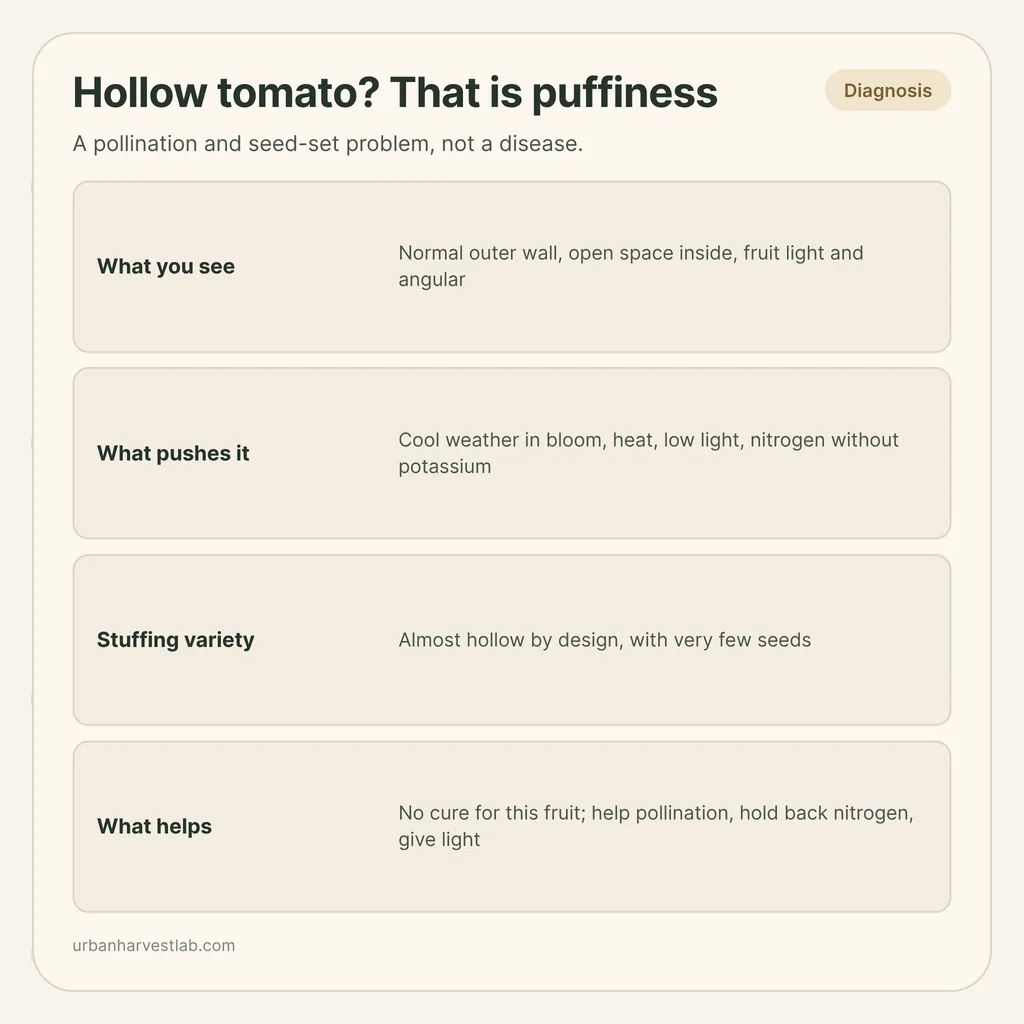
Tomatoes hollow inside? That is puffiness, and it starts at pollination
Hollow, light, angular tomatoes with empty seed cavities are a pollination and seed-set problem, not a disease. Here is how to confirm it and what to change.

Why are my tomatoes cracking? Radial vs concentric splits
Cracked tomatoes are almost always a water-swing problem. Learn which split you have, whether the fruit is safe to eat, and how to stop it in pots.

How to save seeds from container vegetables: tomatoes, beans and peppers
Tomatoes, peppers, beans and peas are the easiest vegetables to save seed from, as long as the variety is not an F1 hybrid. Here is how to do each one from a pot.