Troubleshoot the system before you change the inputs.
Symptoms
- The fruit looks normal or slightly angular outside, but is light for its size.
- Cut open, the wall is normal and one or more seed cavities are empty or lack the usual gel.
- It shows up mostly on the first fruit of the season.
Possible causes
- Poor pollination during cool, wet, very hot or low-light weather around flowering and fruit set.
- High nitrogen with low potassium, or generally high fertility.
- A variety that is prone to it.
Quick fixes
- Help pollination by tapping or vibrating the open flowers.
- Do not add more nitrogen; keep feeding balanced.
- Move the pot to the sunniest spot you have.
- Pick a variety less prone to puffiness next season.
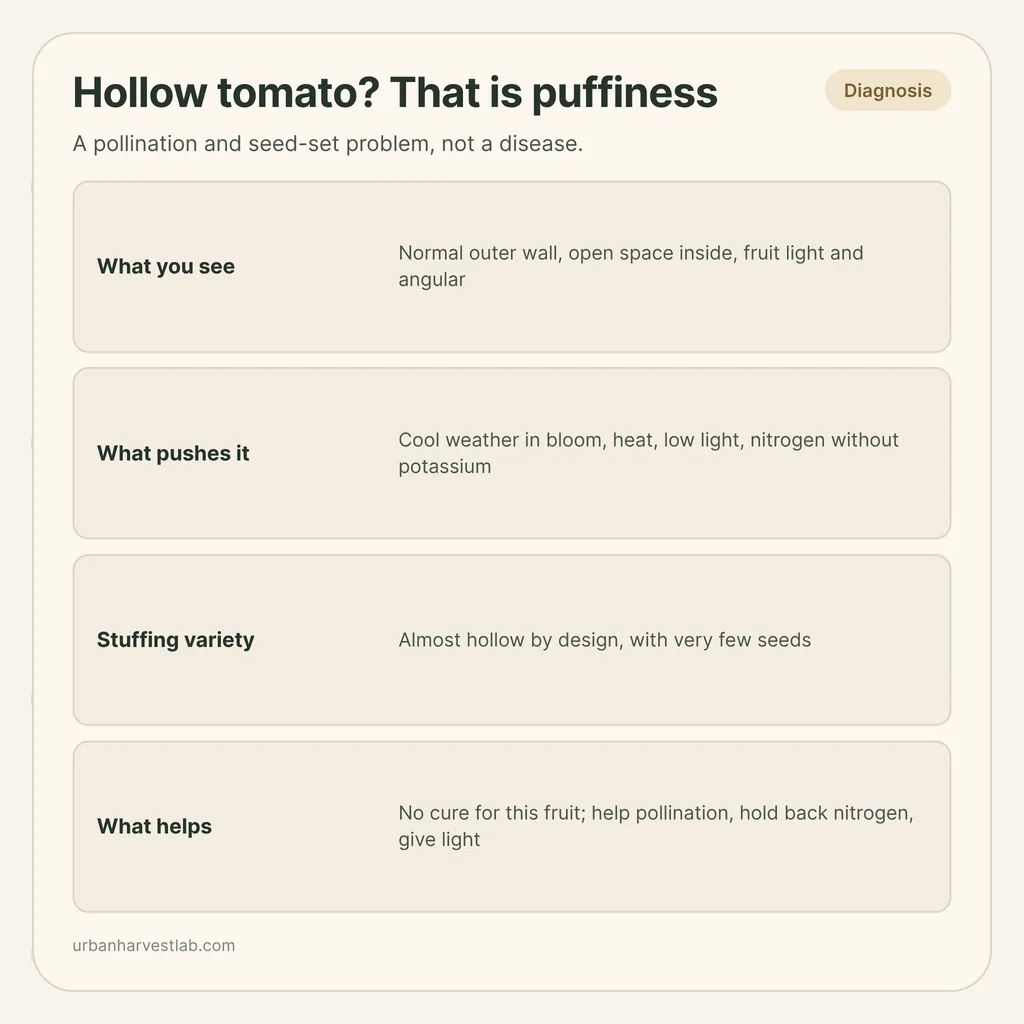
A tomato that looks fine outside but is hollow inside, with empty seed cavities and little gel, has puffiness. It is a pollination and seed-set problem, not a disease, and the fruit was set up that way around flowering and fruit set. You cannot refill a cavity, so the useful work is confirming the diagnosis and helping the flowers that are still coming.
Cut one open: what puffiness looks like
Iowa State University Extension describes the disorder as fruit where the outer wall is normal but the tomato is hollow inside, with one of the seed cavities usually empty. The University of Kentucky adds the outside clue: the fruit looks flattened on one or more sides. University of Wisconsin Extension describes fruit that appear somewhat bloated and angular, with cavities that may lack the normal gel and a fruit that is less dense.
Cut one open. A sound tomato is packed with seeds in gel. A puffy one has open space between the wall and what is inside. An Ohio State paper defines it as open cavities between the outer walls and the contents that would normally be filled with gel, seeds or placental tissue, and notes that puffy fruit tend to be soft, ribbed, spongy and gel-free.
Wisconsin’s description of a less dense fruit gives you a quick check: a fruit that feels light and angular next to its neighbours is worth cutting open.
What goes wrong inside
The Ohio State authors write that any factor that impairs pollination, fertilization or seed set promotes puffiness, and that it arises from either an overgrowth of the outer wall or poor development of the tissue inside the cavities. Either way the problem is set early, during flowering and fruit set, long before the fruit ripens, which is why changing your feeding today will not rescue the fruit already hanging there.
What pushes a tomato toward puffiness
Iowa State Extension lists extreme high or low temperatures, excessive nitrogen fertilization and heavy rains, which may interfere with normal pollination. The sources add a few more:
- Cool weather during bloom. University of Wisconsin Extension says puffiness is often due to cool temperatures during bloom that reduce insect activity and pollination. A cold, damp spring on a balcony fits.
- Heat and cold both count. Iowa State names extreme temperatures at either end, and the Ohio State paper lists high and low temperatures. For the temperatures at which flowers stop setting, see tomato flowers falling off.
- Low light. The University of Kentucky links puffiness to winter and early spring conditions that combine low light levels, high fertility and poor pollen viability.
- Nitrogen without potassium. University of Wisconsin Extension says high nitrogen and low potassium can also lead to puffiness. If feeding has also left the plant leafy and slow to flower, see tomato plant not flowering.
- Heavy rain. Iowa State lists it, and the Ohio State paper includes excessive rain among the associated conditions.
- Genetics. Wisconsin says some cultivars are more susceptible than others, and the Ohio State authors report a genetic component.
Cornell’s diagnostic key also lists puffiness among symptoms of potato leafroll virus, associated with systemic infection. If the whole plant looks sick as well as the fruit, think virus; if the plant is healthy and only the early fruit is hollow, think weather and pollination.
Puffiness or a variety that is meant to be hollow?
Stuffing tomatoes are bred to be roomy. Reimer Seeds describes Burgess Stuffing as looking like hollow bell peppers with very few seeds, and Charlie Chaplin as almost hollow when mature and resembling a bell pepper. These are seed-seller descriptions, so check what your own packet says.
| Sign | Puffiness | Stuffing variety |
|---|---|---|
| Shape | Bloated, angular or flattened on one or more sides | Bell-pepper shape |
| Inside | Open space between wall and contents, little or no gel | Almost hollow, very few seeds |
| Which fruit | Most frequent on early fruit | Described as the variety’s normal fruit |
| Variety | Any type, some more prone than others | Sold as a stuffer |
If your plant is a normal slicer or cherry and only some fruit are hollow, it is puffiness.
Hollow, or just scarred or cracked?
Puffiness is an inside problem on a fruit that is otherwise normal. If the damage is on the outside, a different page applies.
- Lumpy, puckered fruit with scarred bottoms is catfacing, another cold-flower problem.
- Rings or splits in the skin are covered in why tomatoes crack.
- Yellow shoulders or blotchy colour on a solid fruit are covered in blotchy ripening.
No cure for this fruit; what helps the next truss
Do not expect a rescue. Iowa State Extension says there are no effective controls and that puffiness should decline later in the summer.
For the flowers still to come:
- Help the pollination. On a balcony there may be little wind or insect traffic. The technique is in hand-pollinating tomatoes and peppers.
- Hold back on nitrogen. Iowa State and Wisconsin both name excess nitrogen, and the University of Kentucky says proper nutrient management is critical. Skip high-nitrogen feed; keep feeding balanced rather than stopping altogether.
- Give it light. Kentucky calls maximizing light penetration critical. In a pot, that means the sunniest spot you have.
- Pick varieties that are not prone. Kentucky and Wisconsin both point to variety choice. If early fruit keeps coming out hollow, try a different type next year.
Sources
- Iowa State University Extension: Managing Tomato Diseases, Disorders, and Pests
- University of Wisconsin-Madison Extension: Tomato disorder: Physiological fruit problems (A3798)
- University of Kentucky: Puffiness, Scouting Guides for Problems of Vegetables
- Ohio State University (Dariva et al., 2024): Fruit puffiness in a processing tomato population
- Cornell Vegetable Program: Tomato diagnostic key, entire fruit
- Reimer Seeds: Stuffer tomato varieties
Better fruit set on pot tomatoes
Pollination, flower drop and other fruit problems that share the same causes.
Common questions
Why are my tomatoes hollow inside?
The usual reason is puffiness: the flower was pollinated or fertilized incompletely, so the seeds and the gel around them did not fill the cavities. University of Wisconsin Extension names incomplete pollination, fertilization or seed development, often after cool temperatures during bloom. Iowa State Extension adds extreme heat or cold, excess nitrogen and heavy rain.
Can I fix a hollow tomato?
No. The cavities are set early, around flowering and fruit set. Iowa State Extension says there are no effective controls and that puffiness should decline later in the summer. What you can change is the next flowers: help pollination, balance feeding and give the plant more light.
Is a hollow tomato the same as a stuffing tomato?
Not necessarily. Reimer Seeds describes stuffing types such as Burgess Stuffing as looking like hollow bell peppers with very few seeds. Those are hollow by design. Puffiness shows up in varieties not sold that way, and the fruit often looks angular or flattened on one or more sides.
Does too much fertilizer cause hollow tomatoes?
It can contribute. Iowa State Extension lists excessive nitrogen fertilization, and University of Wisconsin Extension says high nitrogen and low potassium can lead to puffiness. Kentucky links it to high fertility with low light. Adding more feed is not a fix.
Related guides
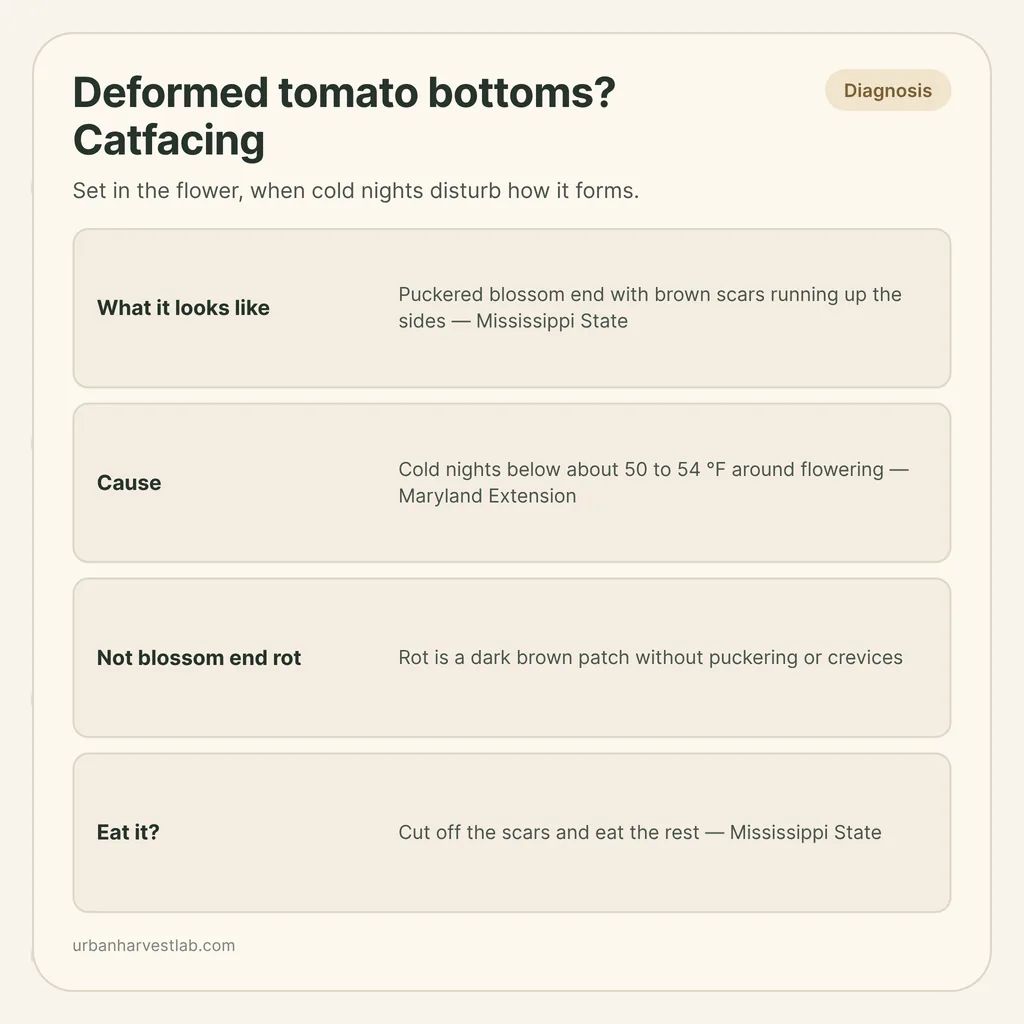
Deformed tomatoes with scarred bottoms? That is catfacing
Puckered, scarred, lumpy tomatoes on the first trusses are usually catfacing, a flower-stage problem tied to cold nights. Here is how to confirm it and what to change.

Why are my tomatoes cracking? Radial vs concentric splits
Cracked tomatoes are almost always a water-swing problem. Learn which split you have, whether the fruit is safe to eat, and how to stop it in pots.
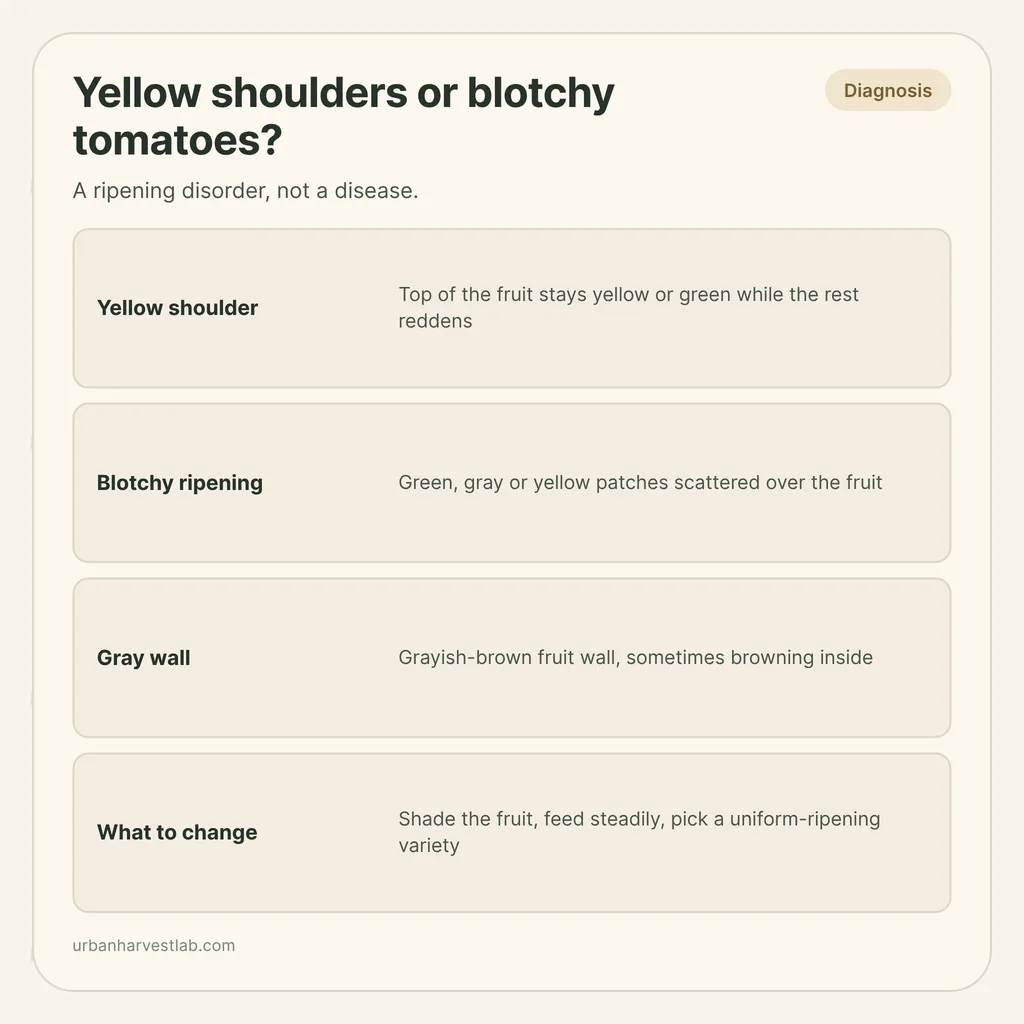
Tomatoes with yellow shoulders or blotchy color? Heat, potassium and variety
A tomato that reddens everywhere except the top, or ripens in gray and yellow blotches, has a ripening disorder. Heat, low potassium in the plant and the variety all play a part, and the fruit that is already marked will not recover.