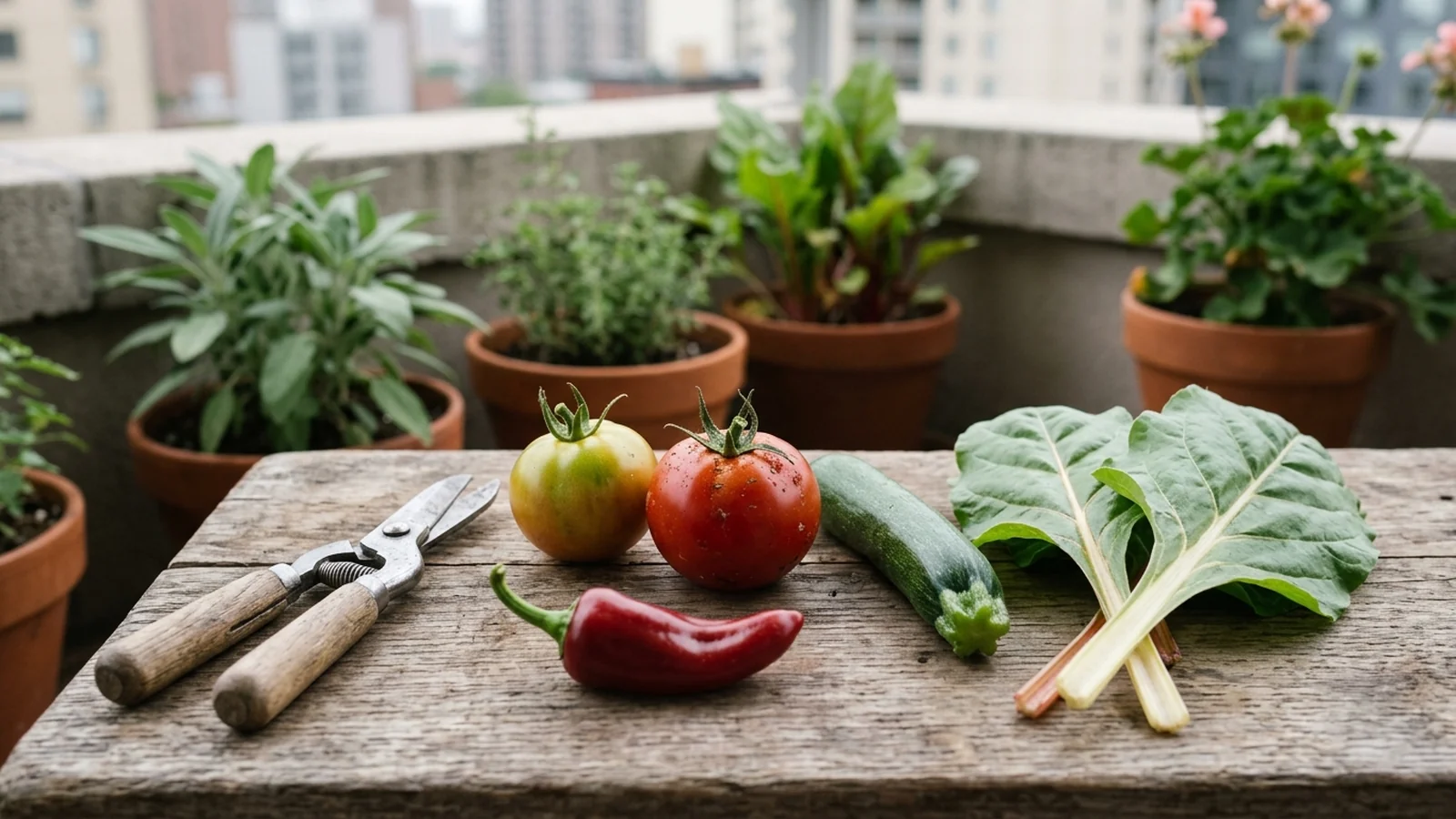
A container vegetable tells you it is ready through color, give, and size, not through the day count printed on the seed packet. A tomato’s skin colors from the blossom end outward and turns slightly soft under a gentle squeeze. A zucchini stays glossy-skinned and detaches easily at a fraction of the length it will reach if nobody picks it. A carrot pushes an orange shoulder up through the soil surface. Learn that signal once, per crop, and a seed packet’s “70 days” — Iowa State University Extension’s own rough figure for a transplanted tomato — stops being something to count toward and becomes background information instead.
Picking a herb is a different kind of decision. Cutting basil or chives is a pruning call — get the timing wrong and the plant regrows from where the scissors went in, which how to harvest basil, mint, parsley, and chives so they keep growing and a harvest calendar by life cycle both work through. A tomato or a zucchini is a ripeness call instead, and it does not run backward the way a pruning cut does. How forgiving that call is still depends on the crop: Penn State Extension notes a tomato keeps coloring once it is off the vine, so picking a shade early at the breaker stage costs little, while Iowa State University Extension treats a strawberry as already finished developing the moment it is picked, whatever shade of red it happened to be. What both crops share is that the container sets the stakes — how the plant has been watered and fed the rest of the season, covered separately in how often to water container vegetables — and general pruning of the plant itself, apart from picking its fruit, is its own task, covered in pruning container vegetables.
What ripe looks like, crop by crop
| Crop | Signal it’s ready | If you leave it | Common mistake |
|---|---|---|---|
| Tomato | Skin colors from the blossom end outward; by Penn State Extension’s “light red” stage the fruit is a bit soft to the touch | Color deepens past ripe with little flavor to gain, and a fruit left too long is more likely to split after rain or draw pests | Waiting for full supermarket red, when Penn State’s breaker stage is already a valid pick point |
| Pepper | Green types are firm and full-sized at 3 to 4 inches, per Illinois Extension; colored types are left on the plant until they turn red, yellow, orange, or brown | Nothing is lost by letting a colored pepper finish ripening — that is the point — but Illinois Extension notes a plant carrying no fruit puts its energy into leaves and stems instead | Pulling the fruit off instead of cutting it, which Illinois Extension says damages the plant more |
| Zucchini (summer squash) | Skin stays glossy and the fruit detaches easily well under its maximum length; Iowa State University Extension has growers checking every 2 to 3 days once fruit reach about 2 inches across | Colorado State University Extension is direct about this one: “keep fruit picked for continued production” | Letting one fruit balloon under the leaves; it turns tough and seedy and slows the plant’s next round |
| Cucumber | Skin stays dark green and firm, about 6 to 8 inches for slicing types, picked every 2 to 3 days per Iowa State University Extension | Clemson Cooperative Extension: “by keeping the fruit picked, the vines will continue to produce” — an unpicked cucumber yellows, turns bitter, and slows the vine behind it | Missing a picking day and finding an oversized, seedy fruit hidden under the canopy |
| Eggplant | Skin stays glossy at about 6 to 8 inches long, per Illinois Extension | Once the skin turns dull or brown, Illinois Extension calls the fruit too mature for the table — the flesh goes spongy, seedy, and can turn bitter | Mistaking the dulling skin for deeper ripeness, when it actually signals the fruit is past its point |
| Lettuce (leaf) | Outer leaves reach about 4 to 6 inches, per Iowa State University Extension | Hot weather turns the leaves bitter, and Colorado State University Extension adds that lettuce grown dry or crowded does the same | Cutting the whole plant at the first harvest instead of the outer leaves only, which ends the regrowth |
| Chard | Outer leaves reach about 12 inches, roughly four to six weeks after planting, per the University of Georgia Extension | New leaf growth tapers off once the plant bolts and sends up a flower stalk | Cutting from the center growing point instead of the oldest outer leaves |
| Carrot | An orange shoulder pushes up through the soil surface, at roughly 3/4 inch across, per Iowa State University Extension | Illinois Extension: an overgrown root develops a tough, woody core and loses flavor, and can crack | Judging readiness by how full the leafy top looks instead of checking the shoulder itself |
| Strawberry | Fruit is uniformly red from tip to cap, per Iowa State University Extension | The berry will not sweeten further once picked, whether that happens a shade early or a few days late — it is done developing on the plant | Pulling the berry free instead of pinching the stem above the cap, which wounds the fruit and shortens its shelf life |
Why the days on the seed packet are a range, not a due date
Iowa State University Extension’s vegetable harvest tables give two kinds of timing figures, and neither is a fixed date. The first counts from transplant: roughly 70 to 90 days for tomatoes, 50 to 60 for zucchini, 55 to 65 for slicing cucumber. The second counts from flowering, which narrows the window but still spans days rather than pinning one: zucchini reaches picking size just 3 to 4 days after its flower opens, slicing cucumber takes 15 to 18 days, and eggplant takes 25 to 40. That last range is wide enough on its own to make a single day count close to useless for eggplant specifically — heat, light, and how root-bound the container has gotten all move the number in both directions, and a pot moves it further than a garden bed does. A seasonal calendar is a reasonable planning tool for when to start seed or roughly when to expect the first harvest; it is not a substitute for checking the fruit itself once that window opens.
Cut it, don’t pull it
Every crop above that fruits on a vine or a woody stem gets the same instruction, and three separate extension sources give it independently. Illinois Extension notes that pulling rather than cutting a pepper does more damage to the plant, and recommends a knife or pruning shears for eggplant, cutting with the cap and some stem attached rather than twisting the fruit free. Clemson Cooperative Extension gives the identical instruction for cucumber — cut the stem with a sharp knife or pruners for a clean break, rather than tearing the vine. Strawberries are the exception worth naming, because it is the fruit that is fragile rather than the stem: Iowa State University Extension’s guidance is to pinch the stem about a quarter inch above the cap and not pull, since pulling wounds the berry and shortens how long it keeps. A clean, sharp blade matters here for the same reason it matters anywhere else on the plant — a ragged cut is an entry point, whatever it is cutting.
Why a container plant feels a late harvest sooner than a garden bed does
This is where the pot changes the math. Colorado State University Extension frames container vegetables as a category with less margin than the same crops in the ground: with the limited root spread in a container, the gardener has to supply water and fertilizer frequently and regularly, and a minor lapse in care can noticeably reduce produce quality in a way an in-ground bed, with more soil and a bigger root system to draw on, absorbs more easily. The same logic runs through individual crops. CSU’s own instruction for zucchini in containers is direct — keep fruit picked for continued production — and Clemson makes the equivalent point for cucumber, where keeping the fruit picked is what keeps the vine producing. Neither source is writing about pots specifically when it says this, but the effect lands harder in one: a garden-grown squash plant has a larger root system underwriting its next flush of fruit, while a container plant is working from whatever that pot holds, and a few pieces of ripe fruit sitting unpicked are a bigger share of that plant’s total reserve than the same fruit would be in the ground.
Not every crop in the table follows that pattern. A carrot is not carrying fruit toward a next flush; it is a single root, and the container question for it is depth and steady moisture rather than pick-to-produce-more — the same is true of leaf lettuce, whose container sizing is a volume question more than a harvest-timing one. Potatoes sit further out still: a potato harvest is not a ripeness call on visible fruit at all, but a decision keyed to the foliage dying back, which growing potatoes in grow bags covers on its own terms. Zucchini’s own container figures live at the zucchini container guide, and strawberries’ at the strawberry container guide; both are worth reading before the first fruit sets, since the sizing decision made there is what limits how much reserve the plant has once picking starts. A dwarf tomato in a small pot runs into the same ceiling faster than a full-sized vine in a large container would.
Common mistakes
- Waiting for a supermarket-red tomato before picking anything. Penn State Extension’s breaker stage — the first visible color at the blossom end — is already a legitimate pick point, and the fruit keeps coloring afterward.
- Judging a carrot by its leafy top instead of the root itself. Illinois Extension’s signal is the shoulder diameter at the soil line, not how tall or full the foliage looks.
- Letting one zucchini or cucumber hide under the leaves for a week. By the time it turns up, it is oversized and tough, and per Colorado State University Extension and Clemson Cooperative Extension, it has already slowed the fruit behind it.
- Pulling instead of cutting. A twisted-off pepper or a yanked strawberry damages tissue a clean cut would not, on the plant or the fruit itself.
- Treating “days to harvest” as a due date rather than a cue to start checking. The range on the packet, and the wider range Iowa State University Extension publishes for time after flowering, both say the same thing: start looking, don’t circle a date.
Sources
- Penn State Extension: Is This Tomato Ready to Harvest?
- Illinois Extension: Peppers
- Illinois Extension: Eggplant
- Illinois Extension: Carrots
- Iowa State University Extension: Vegetable Harvest Guide
- Iowa State University Extension: When Should Strawberries Be Harvested?
- Clemson Cooperative Extension HGIC: Cucumber
- Colorado State University Extension, CMG GardenNotes #724: Vegetable Gardening in Containers
- University of Georgia Extension Circular 1039: Home Garden Swiss Chard
Once the harvest is timed, the container is what limits it
These guides cover the container sizing and pruning decisions that set how much reserve a plant has for the next flush of fruit.
Common questions
How do I know when a container tomato is ripe?
Color is the signal, not size. Penn State Extension describes the ripening color starting at the blossom end and spreading across the skin, and the fruit turns a bit soft to the touch as that color develops. A tomato is a legitimate pick at the breaker stage, when color first appears, because Penn State notes it keeps ripening once it is off the vine.
What happens if I leave a zucchini on the plant too long?
It turns tough, seedy, and oversized, and Colorado State University Extension is specific about the wider cost: keeping the fruit picked is what keeps the plant producing more. An unpicked zucchini does not just waste that one fruit -- it slows the ones behind it.
Should I cut or pull ripe vegetables off the plant?
Cut. Illinois Extension recommends cutting rather than pulling peppers and eggplant, and Clemson Cooperative Extension gives the same instruction for cucumber, all citing less damage to the plant. Strawberries are the exception, where the fruit itself is fragile rather than the stem: Iowa State University Extension recommends pinching the stem above the cap rather than pulling the berry free.
Is a carrot ripe the same way a tomato is ripe?
Not quite. A carrot does not change color or soften the way a fruit does -- Iowa State University Extension's signal is the orange shoulder pushing up through the soil surface, at roughly three-quarters of an inch across. Left too long, Illinois Extension notes the root develops a tough, woody core instead of turning any less ripe.
Related guides
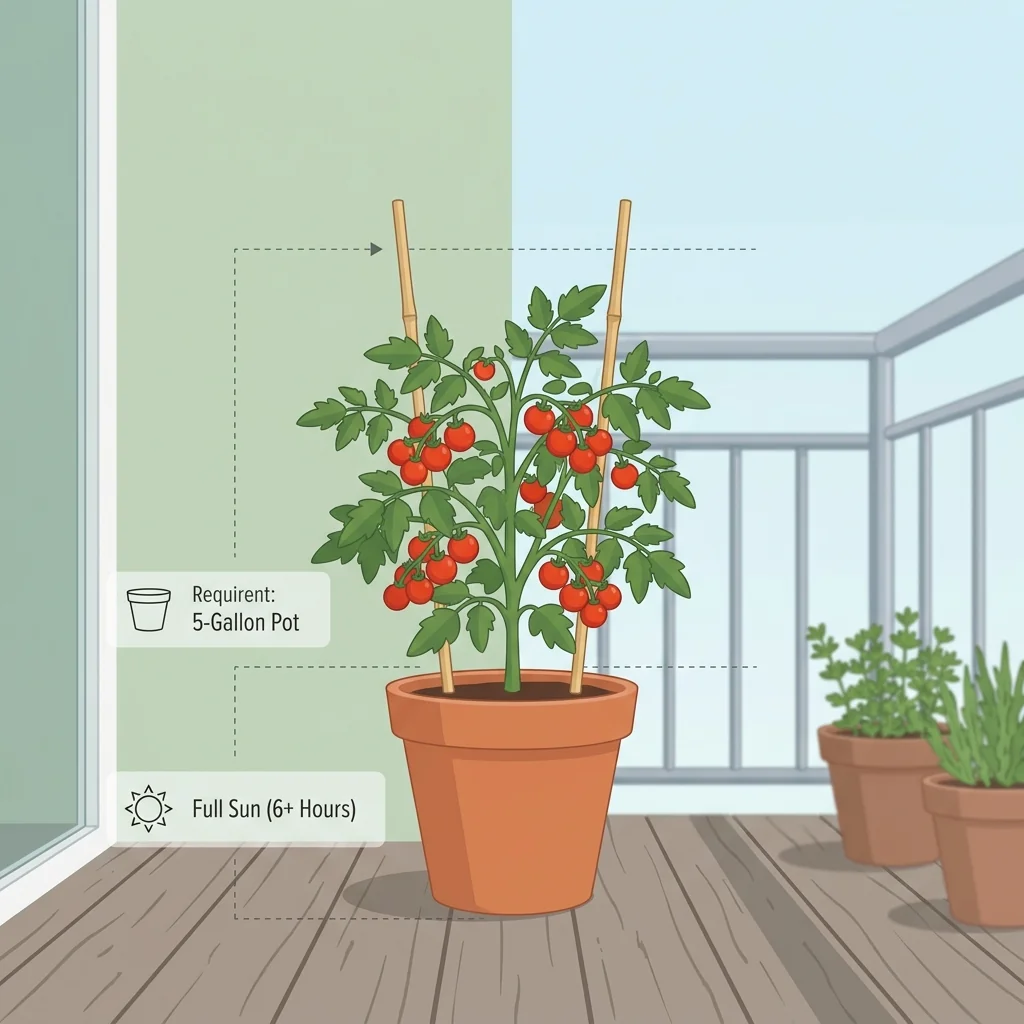
How to grow dwarf tomatoes in pots on a small balcony
Traditional tomato plants grow into massive, untameable 8-foot jungle vines that require giant cages and take over your entire balcony. But with modern 'micro-dwarf' or patio tomato varieties, you can grow heavy yields of sweet cherry tomatoes on a plant that stays under 2 feet tall. Here is the dwarf tomato container blueprint.
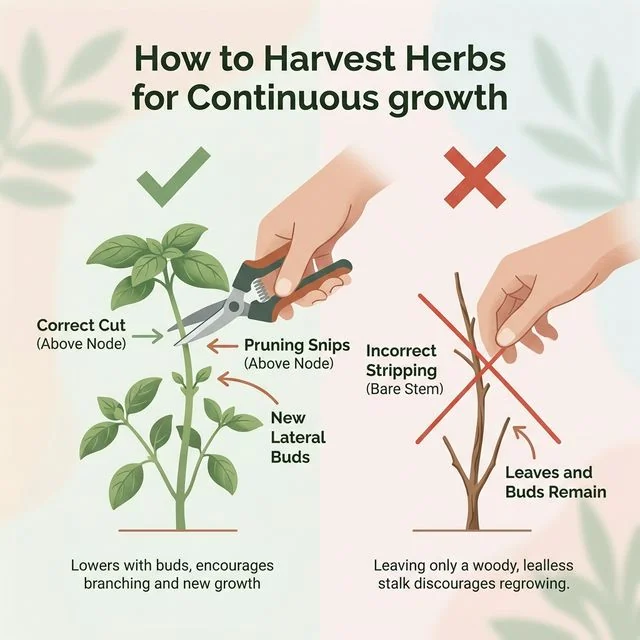
How to harvest basil, mint, parsley, and chives so they keep growing
The fastest way to destroy an indoor herb plant is to harvest it incorrectly. If you just pull random leaves off the stem, the plant will eventually go bald and die. Here is the exact botanical method to harvest your herbs so they yield endlessly.
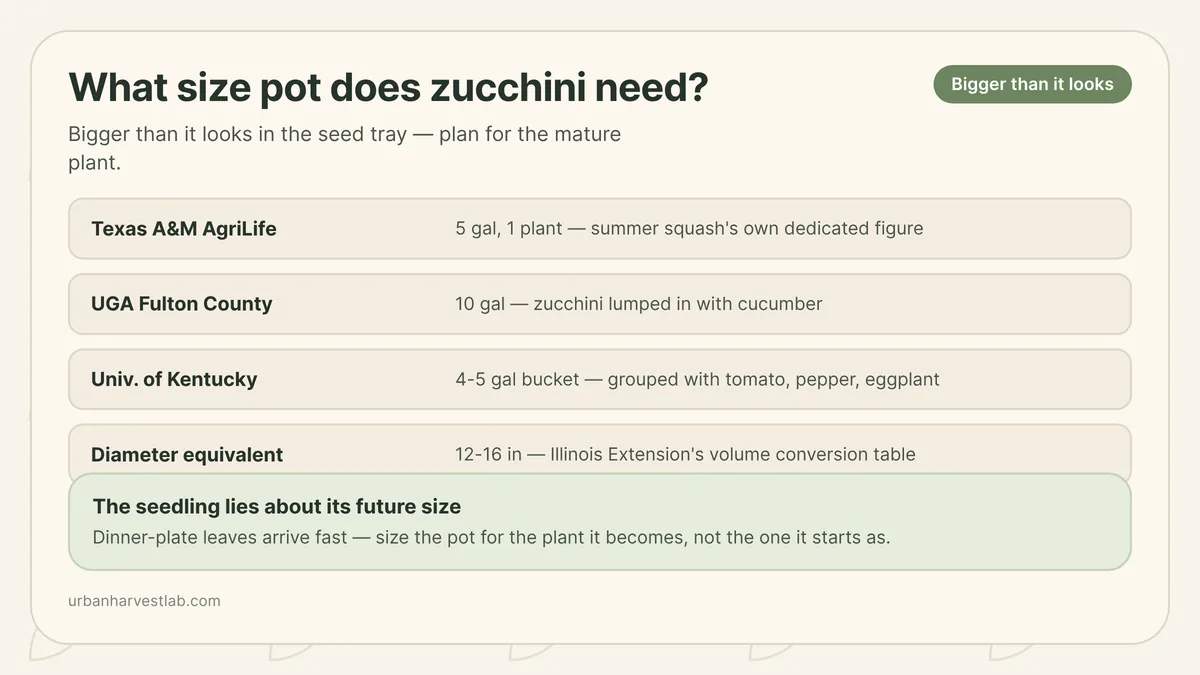
What size pot does zucchini need? Bigger than it looks in a seed tray
A zucchini seedling looks modest for weeks, then fills a pot almost overnight. The container has to be sized for the plant it becomes, not the one it starts as.