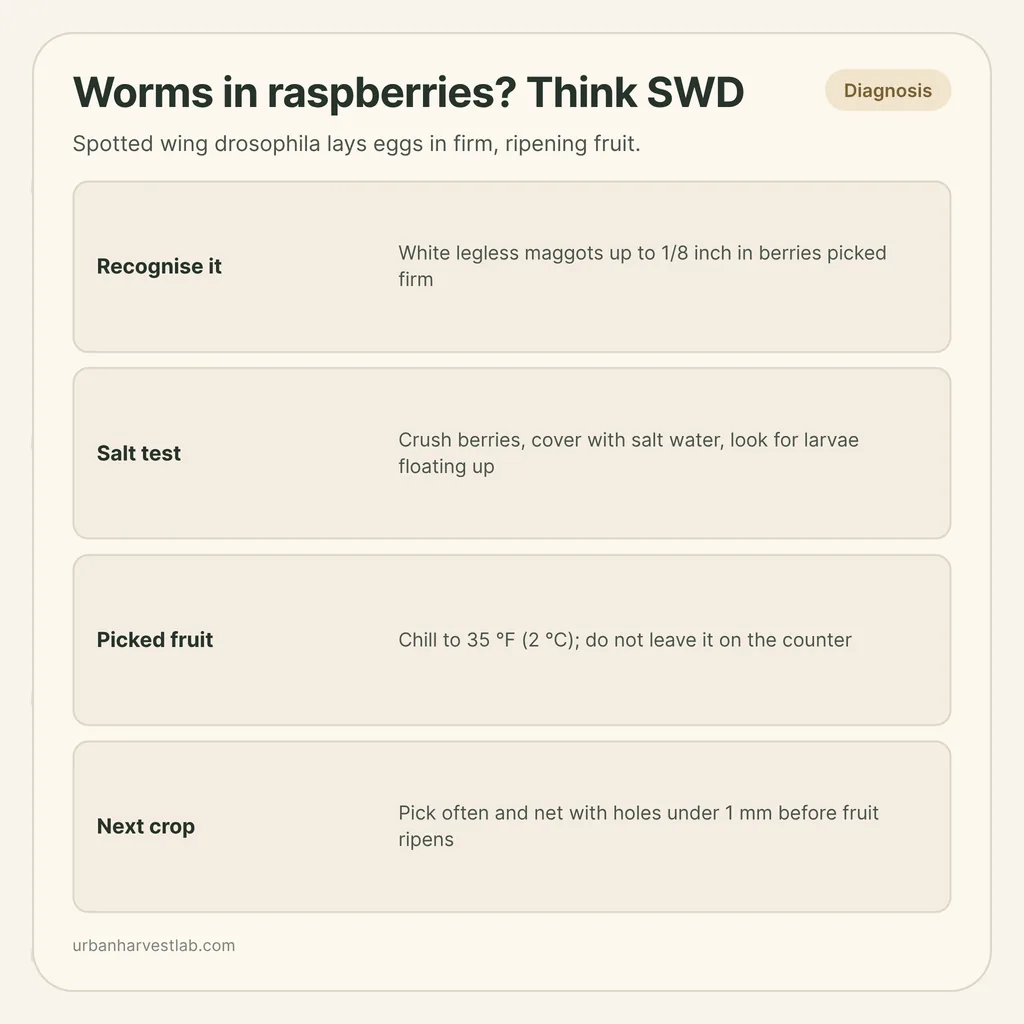
Troubleshoot the system before you change the inputs.
Symptoms
- Small white, legless maggots inside raspberries, blackberries or blueberries that looked firm and sound when picked.
- Tiny scars or slits on intact fruit, then soft, sunken spots; the berry collapses and turns gooey within days.
- Berries that soften within a day or two of picking, sometimes with a sour or fermented smell.
Possible causes
- Spotted wing drosophila, whose females cut into ripening fruit with a serrated egg-laying organ. Populations build through summer, so fall-bearing raspberries and late blueberries are hit hardest.
- Blueberry maggot in blueberries only. A single larva feeds inside each berry, and the damage may go unnoticed until after harvest.
- Ordinary vinegar flies, which live on overripe or fermenting fruit and do not attack intact fruit, so they cannot explain maggots in firm berries.
Quick fixes
- Run a salt test on a sample to confirm larvae.
- Pick all ripe fruit often, chill it straight away and bin damaged or fallen berries in a sealed bag.
- Net the plants with openings under 1 mm before the next crop colours, sealing the base.
Small white maggots in raspberries or blueberries that looked perfectly good when you picked them are most likely spotted wing drosophila (SWD). The fix has two parts: pick often and chill the fruit now, and keep the flies off the next crop with very fine netting. Sprays are a poor fit for a few pots, because they cannot reach larvae already inside the berry.
If the flies you see are hovering over fruit in the kitchen, that is a different problem, covered in fruit flies versus fungus gnats.
Why SWD gets into firm fruit
Most vinegar flies lay on rotting or damaged fruit and leave healthy fruit alone. SWD does not. University of Wisconsin Extension says its females have a serrated egg-laying organ that lets them cut into healthy fruit. Iowa State puts the timing at fruit that is just prior to harvest, as sugars begin to accumulate and the berry starts to change colour. University of Connecticut says the same thing: eggs go into soft, thin-skinned fruit that is just beginning to color.
That is why your berries looked fine. Colorado State describes eggs hatching in 12 to 72 hours, with larvae fully grown in about 5 to 7 days. University of Wisconsin adds that females lay from one to three eggs per fruit, that a female can lay more than 300 eggs over about two weeks, and that a generation can take as little as eight to nine days.
Populations therefore snowball. Iowa State says the flies do not appear in noticeable quantities until mid-July or later, and University of Minnesota Extension puts the highest numbers in August and September. Wisconsin names fall-bearing raspberries as the crop at highest risk, and University of Vermont lists late-season blueberries as well.
Is it SWD? Check what you are looking at
| What you see | Most likely | How to tell |
|---|---|---|
| White legless maggots, up to about 1/8 inch, in raspberries, blackberries or blueberries picked firm | SWD | Salt test shows larvae; sunken soft spots and tiny scars on the skin |
| One larva per berry, in blueberries only | Blueberry maggot | University of Wisconsin says a single larva feeds inside each fruit and may be up to 5/16 inch |
| Small flies over a fruit bowl, no maggots in firm fruit | Common vinegar flies | Colorado State says they feed on overripe fruit and do not attack intact fruit |
University of Minnesota Extension describes the SWD maggot as white, cylindrical and tapering at one end, with no legs or conspicuous head, reaching 1/8 inch. The adult fly is only 2 to 3 mm long. Males are the easy ones: a dark spot near the tip of each clear wing. Females have no spot, and Minnesota notes that high magnification is needed to see the serrated egg-laying organ, so do not rely on spotting a female.
Look at the skin as well. University of Wisconsin lists small scars or slits on intact fruit as the first symptom, followed by soft, sunken spots as larvae feed. Cornell adds fruit that is softer than it should be, with dull sunken areas and tiny drops of sap. Minnesota warns that symptoms may not show until after harvest.
The salt test
When you cannot see anything but the fruit is going soft, a salt soak shows whether larvae are inside. The method is the same everywhere. Crush a sample of berries lightly so the skins break, cover them with salt water, wait, then look for tiny larvae floating up. University of Wisconsin suggests a sealed plastic bag or glass dish and backlighting the container to help you see them.
The strength and the wait vary by institution:
| Institution | Salt solution | Wait |
|---|---|---|
| University of Wisconsin | 1/4 cup salt in 4 cups water | 1 hour |
| Cornell | 1 tablespoon salt per cup of water | 15 to 30 minutes |
| University of Vermont | 1 cup salt per gallon of water | 30 minutes |
Cornell recommends a sample of 50 ripe fruit and describes larvae as 1 to 3 mm long. Vermont suggests at least a cup of berries. Any of the three will tell a home grower whether to act, and if you see larvae, treat the plant as infested.
Fruit already picked
Do not leave it on the counter. University of Minnesota Extension warns that if berries sit at room temperature, larvae can hatch after picking, and mature larvae often crawl out of fruit stored on the counter.
- Chill it. Colorado State says fruit refrigerated to 35 °F (2 °C) will not develop further and the insects present die within about 3 days. University of Vermont says chilling or freezing right after harvest slows or stops egg hatch and larval growth. Wisconsin makes the point that preserving fruit soon after harvest limits further deterioration.
- Eating it. Iowa State states that infested fruits are safe to eat and that there is no known risk to human health. Minnesota says the same. Iowa State also notes that infested fruit does not store well, so use it quickly rather than saving it. If you would rather not eat it, that is a fair choice.
- Culls. Seal damaged and fallen fruit in a plastic bag. Cornell and Colorado State both say clear bags left in the sun kill the larvae, and Cornell also mentions freezing. Wisconsin warns that adults emerging from fruit in a nearby compost pile can travel back to the crop, and Minnesota says composting is unreliable and that SWD can survive being buried as deep as 18 inches.
Stopping the next wave
Pick more often. Wisconsin’s point is that the longer fruit sits on the plant, the greater the window for SWD to attack. Colorado State recommends picking all ripe fruit at least twice a week, and says every 3 or 4 days can stop the insects developing in the crop. University of Vermont recommends picking ripe fruit daily and chilling at once. Clear fallen and overripe berries each time.
Net the plants. For a few pots this is the strongest option. University of Vermont says a better option for home gardeners with just a few plants is to exclude the female fly with netting, with holes smaller than one millimetre, placed over the plants just before the fruit ripens and sealed at the soil line. Iowa State agrees on openings under 1 mm and says the cover must be in place before the first flies arrive and completely sealed. University of Minnesota Extension reports good results with 80-gram insect netting and warns that coarser netting lets the flies through. If you want to browse insect netting on Amazon, check the listed mesh opening against those figures before buying.
A few handling details come from the same sources:
- Colorado State says to drape the netting so it does not touch the fruit, otherwise eggs can be laid through the mesh.
- Netting also keeps out pollinators. Minnesota says raspberries are primarily wind-pollinated, so the cover should not need to come off for pollination, while Wisconsin warns that plants needing insect pollination may not suit netting. Check your raspberries and your blueberries against that before covering them at flowering.
- Every time you open the cover, flies can get in. Vermont says to replace it immediately after picking, and Minnesota lists the need to open the cover at each harvest as a drawback.
Consider timing. Colorado State says early-ripening June-bearing types can largely avoid damage because SWD numbers are low when the crop ripens. Wisconsin adds that some yellow or golden raspberry varieties may be less attractive to SWD than darker ones. Colorado State also notes the flies prefer dense shade, so pruning to open the canopy helps.
What about sprays and traps?
Traps tell you flies have arrived and are not a control. Wisconsin says the traps do not provide meaningful control, and Colorado State says that alone they have not proved effective. A cup trap with apple cider vinegar and a drop of soap is the standard monitor, as in Minnesota’s and Iowa State’s instructions.
Insecticides are limited by what they can reach. Minnesota and Wisconsin both say they target adults before they lay eggs and will not kill larvae already in the fruit, so once berries are infested the answer is sanitation. For organic home use, Wisconsin names spinosad and pyrethrins and says spinosad performed better in university trials. It says insecticidal soaps and horticultural oils such as neem work poorly and are not recommended. Colorado State says spinosad gives control for about 5 to 7 days.
Anything you spray on fruit you will eat needs a label that lists that crop, and a waiting period before harvest. Minnesota’s advice is to apply in the evening to avoid killing honeybees and other pollinators, and Colorado State says no pesticide of any type may go on a flowering crop while bees are foraging. Choosing a treatment for edible plants covers the label rules.
Sources
- University of Minnesota Extension: Spotted wing drosophila
- University of Wisconsin Extension: Spotted Wing Drosophila
- University of Wisconsin Extension: Blueberry Maggot
- Iowa State University Extension: Spotted Wing Drosophila in Home Gardens
- University of Vermont Extension: Spotted Wing Drosophila Causes Problems for Home Gardeners
- Colorado State University Extension: Spotted-wing Drosophila, Management in Home Plantings
- Cornell University: What to do about SWD-infested fruit
- University of Connecticut IPM: Spotted Wing Drosophila
Berries in pots and pest choices
Grow the berries SWD goes for, and check what a treatment label allows before you spray anything you will eat.
Common questions
Why are there worms in my raspberries?
The usual cause is spotted wing drosophila (Drosophila suzukii). University of Minnesota Extension says its larvae feed on healthy, intact, ripening fruit, and that fruit that looked normal at picking may be soft and maggot-infested a day or two later. The maggots are white, legless and up to about 1/8 inch long.
Is it safe to eat raspberries that have spotted wing drosophila larvae?
Iowa State and University of Minnesota extension both state there is no known risk to human health from eating them. Iowa State adds that infested fruit does not store well, and University of Vermont Extension says chilling or freezing right after harvest slows or stops egg hatch and larval growth.
How do you do the salt test for SWD?
Crush a sample of berries lightly in a sealed bag or dish, cover them with salt water and look for small larvae floating out. University of Wisconsin uses a quarter cup of salt in four cups of water for one hour, Cornell uses 1 tablespoon per cup for 15 to 30 minutes, and University of Vermont uses 1 cup per gallon for 30 minutes.
What size netting keeps spotted wing drosophila out?
Iowa State, Colorado State and University of Vermont all point to openings of about 1 mm or smaller, and Vermont says holes smaller than 1 mm are necessary. University of Minnesota Extension reports good results with 80-gram insect netting and warns that coarser netting lets the flies through. It has to be in place before the fruit colours and sealed at the base.
Related guides

Fruit flies vs fungus gnats: which one is in your kitchen?
Fruit flies breed in fermenting food and drains. Fungus gnats breed in damp potting mix. Where the flies gather tells you which one you have, and the fix for each is different.
Choosing a pest treatment for plants you are going to eat
Once you know which pest you have, the next question is what you can treat it with without compromising the food. The answer is a ladder of methods, and the label on any product you buy sets the legal limits of the top rung.

How to grow blueberries in pots: acidic mix, a second variety and the right water
Blueberries are fussy about acidity, not about space. Here is the pot size, the mix, the pollination partner and the watering that keep a container bush fruiting.