
Troubleshoot the system before you change the inputs.
Symptoms
- Tiny flies hovering around the fruit bowl, the bin, the sink drain or an open drink.
- Small dark flies resting on, or walking across, the soil of a potted plant, and drifting up when you water.
- Flies at both the plant and the kitchen counter at the same time.
Possible causes
- Fruit flies: overripe fruit, fermenting food, residue in bottles and cans, a soiled mop or a drain that holds food waste.
- Fungus gnats: potting mix that stays damp at the surface, so females have somewhere to lay eggs and larvae have fungi and organic matter to feed on.
- Both: a household where food waste and overwatered pots sit within a few steps of each other.
Quick fixes
- Watch where the flies gather for a day: fruit and drains point to fruit flies, pots point to fungus gnats.
- Set a vinegar-and-soap jar by the fruit and a yellow sticky card by the pot, and see which one catches the flies.
- For fruit flies, find and remove the breeding material; for fungus gnats, let the top inch of the mix dry between waterings.
Fruit flies vs. fungus gnats
| Clue | Fruit flies | Fungus gnats |
|---|---|---|
| Where you see them | Over ripe fruit, open drinks, bins and drains | Near potted plants, on and above the soil |
| Colour | Dull tan to brownish yellow or brownish black; eyes usually bright red (UMD) | Dark brown or black (Wisconsin) |
| Adult size | About 1/8 inch (UMD) | About 1/8 inch (Wisconsin) |
| How they move | Hover around the food source | Weak fliers that run across the soil (UC IPM) |
| Breeding site | Fermenting and rotting food, drains, soiled mops | Moist potting mix rich in fungi and organic matter |
| Life cycle | 8 to 10 days (UMD, Wisconsin) | About 17 days at 75 °F (UC IPM) |
| Vinegar trap | Catches adults | Does not work for monitoring (Wisconsin) |
| Main fix | Remove the fermenting food or residue | Let the top inch of mix dry; treat larvae if numbers stay high |
Flies hovering over the fruit bowl, a drink or a drain are fruit flies. Small dark flies that stay near a potted plant and walk across its soil are fungus gnats. They are close to the same size, so the question is really where they came from and what they are feeding on, because that decides what you do next.
If the flies are in your plants and you are still not sure it is flies at all, the herb pest identification chart lays out the other small insects that show up on potted herbs.
Start with where they are
Fruit flies are the genus Drosophila. University of Wisconsin Extension says adults “can be found hovering around overly ripe fruit (e.g., apples and bananas), open beer or soft drink containers, and bread, and near garbage disposals or waste cans.” University of Maryland Extension describes them as pests of the kitchen, with populations greatest indoors in late summer and fall.
Fungus gnats behave differently. UC IPM says they are “relatively weak fliers and usually don’t move around much indoors,” and that they often stay near potted plants and run across the potting mix. Wisconsin adds that you usually notice them flying around windows and lamps, or resting on the soil of potted plants.
So watch for a day. If the cloud is over the produce, the bin or the sink, it is fruit flies. If it lifts off a pot when you water, it is gnats. If you see both, you have two separate problems that happen to share a room.
Look closer, but do not trust size
Size is a poor discriminator here. University of Maryland Extension gives fruit flies as about 1/8 inch, dull tan to brownish yellow or brownish black. Wisconsin Extension gives adult fungus gnats as approximately 1/8 inch, dark brown or black. Same size, similar darkness.
Two features help more:
- Eyes. University of Maryland Extension says fruit flies’ eyes are usually bright red. You need good light or a magnifier to see it.
- Build. Wisconsin describes fungus gnats as delicate flies with dark, translucent wings, and says a magnifying glass shows a rounded Y-shaped set of veins near the wing tips. NC State Extension describes them as small, dark flies with long legs and antennae, and ones that are often mistaken for fruit flies.
Colour on its own will mislead you. Use it to support what the location already told you.
Why each one is there
The two flies are not interested in the same thing.
Fruit flies breed in fermenting food. Wisconsin says eggs are laid near the surface of fermenting and rotting material and the larvae feed on the yeast associated with it. The breeding site is often hidden. Wisconsin’s list includes onions, potatoes and squash stored out of sight, the bottom of trash cans where caked vegetable matter collects, bottles and cans waiting for recycling, mops and buckets soiled with garbage-laden water, floor drains holding fermenting organic matter, and “rotting bulbs, or wet, decaying plant material.” Wisconsin notes that banana peels or apple cores swept under furniture or appliances can support significant numbers of flies. University of Maryland Extension adds that damp mops or towels may hold enough food and moisture for development.
Fungus gnats breed in damp potting mix. Females lay eggs in moist soil, and the larvae feed on fungi and decaying organic matter there. Wisconsin calls them insects commonly associated with overwatered houseplants. UC IPM says they thrive in moist conditions, especially where decaying vegetation and fungi are abundant, and names moist compost and organic fertilizers as favourite breeding spots.
The overlap is a rotting plant part or soggy saucer, which can feed either one. If the pot itself is the damp problem, the overwatered vs underwatered guide helps you read the root zone.
A simple two-trap test
If watching does not settle it, let the flies decide.
- Vinegar jar by the produce. University of Maryland Extension’s recipe: pour apple cider vinegar into the bottom of a glass jar, add a drop of dish soap, cover the top with plastic wrap secured with a rubber band, and poke a tiny hole in it. The hole lets flies in but makes it hard for them to get out.
- Yellow sticky card by the pot. UC IPM says yellow sticky traps can be cut into smaller squares, attached to skewers and placed in pots to trap adults. Wisconsin recommends yellow cards for monitoring gnats and notes that vinegar traps do not work for that job.
A jar that fills up points to fruit flies. A card that fills up points to gnats. You can also check for larvae: Wisconsin suggests laying potato slices on the soil and checking them for maggots after three to four days, and UC IPM specifies raw potato chunks placed with the cut side down.
Fixing fruit flies
University of Maryland Extension is blunt: the primary control is sanitation. Eliminate the larval food and development sites. That means:
- Keep fruit in the refrigerator.
- Rinse and drain bottles and cans before recycling.
- Squeeze mops out thoroughly and dry them.
- Check for hidden produce and for food residue in the bottom of the bin and in drains.
Wisconsin makes the same point: the only way to completely stop a fruit fly problem is to find and eliminate the breeding sites. Indoor flying-insect sprays containing pyrethrins control only the adults present at the time of spraying and leave no residual protection, so they do not end the problem.
Food scraps you are saving for composting are a common source. Open scraps are exactly the fermenting material the larvae need. A sealed bokashi bucket keeps them in a closed container instead of on the counter, and the bucket’s lid is part of how the method works.
Because the cycle takes only 8 to 10 days, according to both University of Maryland Extension and University of Wisconsin Extension, a clean-up followed by a trap usually shows results within a couple of weeks.
Fixing fungus gnats
Here the potting mix is the target, not the kitchen. Wisconsin calls changing the watering the single most important step: let the top inch of soil dry out before you water, or water from below to keep the surface dry. UC IPM gives the same advice, to allow the surface of container soil to dry between waterings. Wisconsin also suggests a half-inch to one-inch layer of coarse sand or fine gravel on top to make the surface less attractive for egg-laying.
Adults are mostly a nuisance. Wisconsin says they do not feed on or damage plants, and larval root damage is rare in home settings. Seedlings and young plants are the exception UC IPM flags, since large numbers of larvae can damage roots and stunt growth.
For larvae, both extension sources point to Bti, a biological insecticide that targets fly larvae in the soil. UC IPM says infestations may need repeated applications at about five-day intervals, while Wisconsin says several applications spaced five to seven days apart. Follow the product label. The full routine is in the guide to fungus gnats in herb pots.
Be patient. UC IPM puts a generation at about 17 days at 75 °F, and Wisconsin says it may take three to four weeks of modified watering to get gnats in check. Gnats that come back after a week are normal, not a sign the method failed.
When it is neither
Tiny bugs that jump rather than fly are probably springtails, which need a different response. The springtails vs fungus gnats comparison covers that test. Small flies with short, bristle-like antennae are shore flies, which UC IPM separates from fungus gnats by their antennae.
Common mistakes
- Hanging a vinegar trap beside a plant and concluding there are no gnats when it stays empty.
- Cleaning the kitchen thoroughly while the damp pot on the windowsill keeps producing gnats.
- Spraying the air. Wisconsin says spraying the air with insecticides is ineffective for fungus gnats, and that adults rest on the soil surface where treatments should go.
- Judging by size or colour alone.
- Stopping treatment after one week because the flies seem gone.
Sources
Small flies and soil pests
Once you know which tiny insect it is, these guides cover the fix and the look-alikes.
Common questions
How can I tell fruit flies from fungus gnats?
Look at where they are. Fruit flies gather around overripe fruit, open drinks, bins and drains, and their eyes are usually bright red, according to University of Maryland Extension. Fungus gnats are dark brown or black, stay near potted plants and run across the soil. Size will not help, since both are about 1/8 inch.
Why do I have tiny flies near my houseplants but not near the fruit?
That pattern points to fungus gnats. University of Wisconsin Extension describes fungus gnats as insects commonly associated with overwatered houseplants, with larvae that feed on decaying organic matter and fungi in the soil.
Will a vinegar trap work for fungus gnats?
No. University of Wisconsin Extension says vinegar traps and other methods used to monitor fruit flies do not work for monitoring fungus gnats. A yellow sticky card placed near the plant is the monitoring tool it recommends.
How fast do fruit flies and fungus gnats multiply?
Fruit flies complete their life cycle in 8 to 10 days, according to University of Maryland Extension. UC IPM puts the fungus gnat generation at about 17 days at 75 °F, so expect gnats to take longer to clear even after the soil starts drying.
Related guides
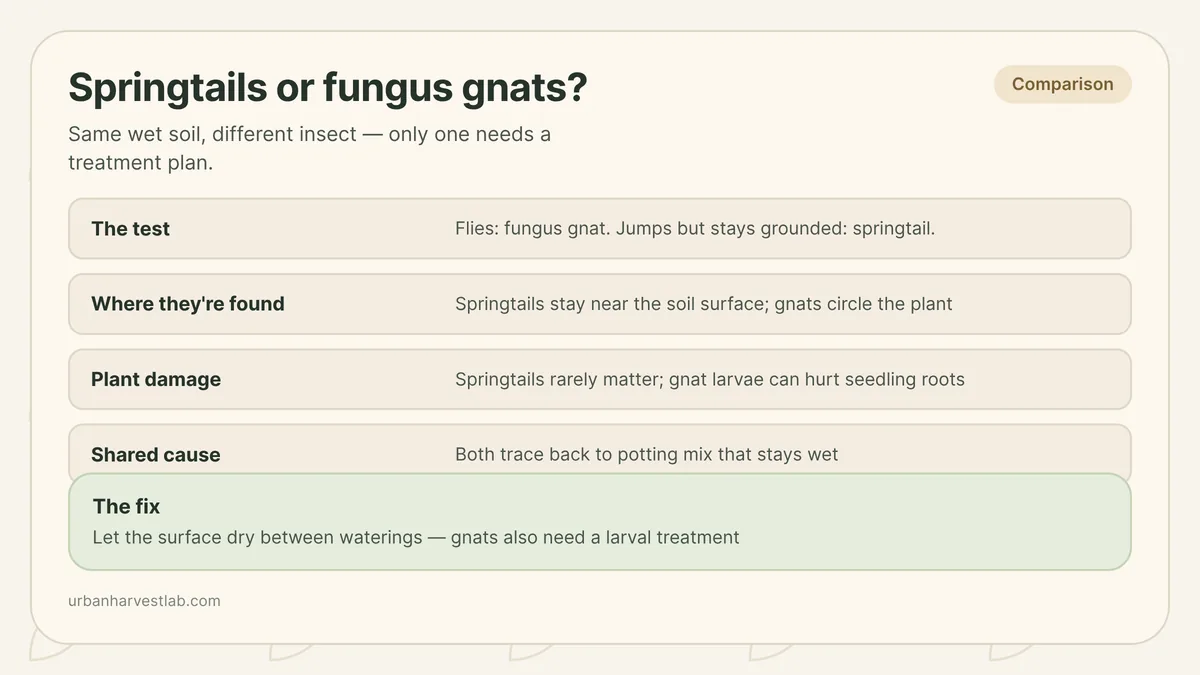
Tiny bugs in plant soil: springtails or fungus gnats?
If the bugs in your potting soil jump but stay grounded, they are springtails. If they lift off and buzz around the plant, they are fungus gnats. Both are pointing at the same watering habit.
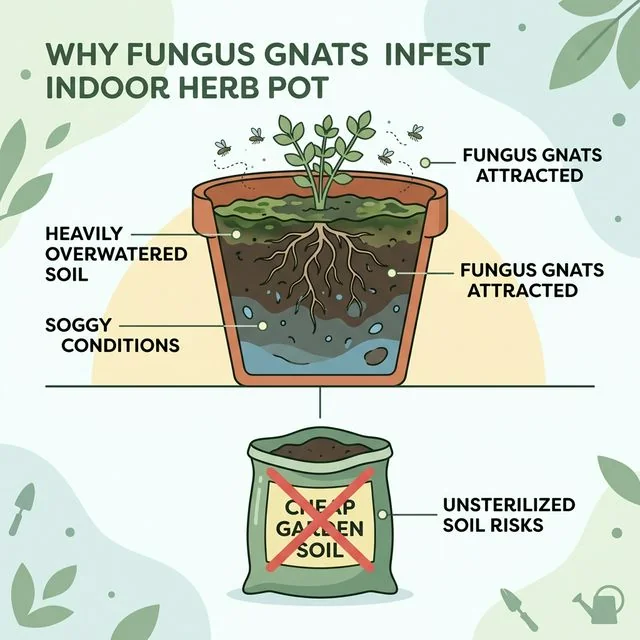
Why fungus gnats keep coming back in herb pots
Fungus gnats are the absolute bane of indoor gardeners. If a cloud of tiny black flies eradicates your peace every time you walk past your basil plant, you are treating the symptom, not the cause.
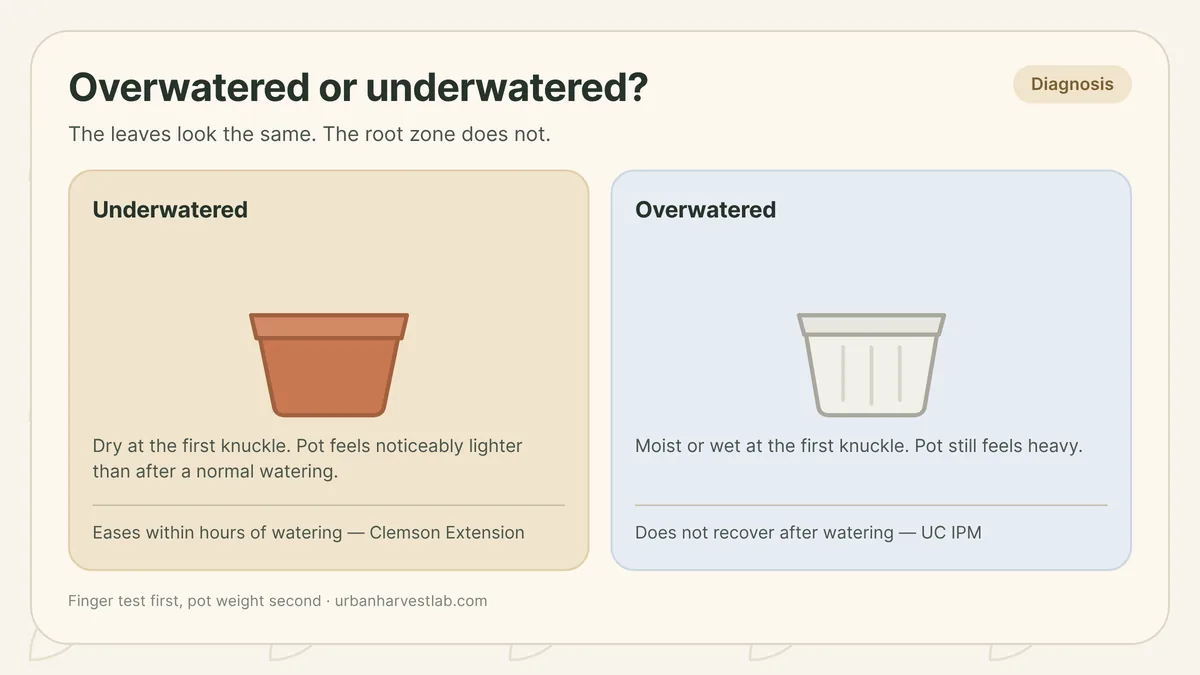
Overwatered vs underwatered: how to tell which one you have
Reading the root zone directly, with a finger test, pot weight, and how the plant responds to being watered, settles what the leaves alone cannot.