
Container raspberries: the numbers by source
| Question | Figure | Source |
|---|---|---|
| Pot depth | At least 2 feet | Oregon State Extension |
| Pot volume | 20 to 30 gallons | Oregon State Extension |
| Pot size, compact variety | At least 40 cm (16 in) wide and 30 cm (12 in) deep | Royal Horticultural Society |
| Canes kept, summer-bearing | 4 to 5 per 20- to 30-gallon pot | Oregon State Extension |
| Canes kept, everbearing | 5 to 8 per 20- to 30-gallon pot | Oregon State Extension |
| Start thinning when canes reach | About 2 feet tall | Oregon State Extension |
| Picking interval | Every 3 to 4 days | Oregon State Extension |
| Feeding | Organic liquid fertiliser monthly through the season | Royal Horticultural Society |
Raspberries fruit in a large pot if you buy a type suited to containers, hold the canes up on a support and thin and prune them every year. Oregon State Extension says the best types for pots are everbearing raspberries pruned for two crops a season, and the RHS adds that a compact, dwarf variety is the safer choice for a small space. One plant is enough: the RHS notes raspberries are self-fertile.
The pot, the type and the pruning are linked. A bigger pot carries more canes, a summer-bearing plant is pruned differently from an everbearing one, and Oregon State says the canes need a trellis to hold them up and protect them from wind.
Choose the type first
Raspberry canes live two years, and the type you buy decides how you prune them. Oregon State Extension defines the terms. A primocane is the first-year cane, which usually produces no fruit, although everbearing types do fruit on it. A floricane is the second-year cane, which fruits on side branches and dies after fruiting.
- Everbearing (fall-bearing, autumn-fruiting). Fruit on the tips of new canes in late summer and fall, and on the same canes again the following early summer. Oregon State rates these as the best container type. It warns that fall frost curtails fruiting on the new canes in all production regions, so a cold-climate balcony may lose the late crop.
- Summer-bearing. One crop on last year’s canes. Oregon State says red or yellow summer-bearing raspberries may also be grown in containers or raised beds using similar methods. The RHS says early summer-fruiting varieties can be ready from June, with later ones still ripening into September.
- Compact varieties. The RHS names a compact, dwarf variety such as ‘Ruby Beauty’ as the choice for containers. Oregon State also stresses choosing cultivars adapted to your hardiness zone, which matters more in a pot than in the ground (see winter, below).
Oregon State says everbearing cultivars give lower yields, and that summer-bearing cultivars give a higher yield on their floricanes, which helps if you want fruit for jam or the freezer.
Pot size, mix and position
Oregon State says raspberries are relatively deep rooted and need a pot or raised bed a minimum of 2 feet deep. It says a 20- to 30-gallon container works well, but careful pruning is needed so the plant does not get too big for it. The RHS is more modest: a pot at least 40 cm (16 in) wide and 30 cm (12 in) deep, planted with a compact variety.
The small pot works, with more watering and feeding. The large one gives the plant more root room and more cane slots. A 20- to 30-gallon pot of wet mix is heavy, so check your balcony’s weight limit before you fill it.
Drainage is not optional. Oregon State says raspberries are sensitive to wet or heavy soils and susceptible to root rot, and that the potting mix and the container must drain well. Its recommended mix is one part perlite or pumice, one part finely ground bark and two parts garden or potting soil. If you are choosing between those amendments, the perlite, pumice and rice hulls comparison covers the differences, and the pot drainage guide covers the holes.
Plant at the level the plant grew before. Oregon State says to set the plant so the container mix is level with the soil it came in, and the RHS says the same: centre it in the pot at the same level it was previously growing. If you buy a bare-root plant, Oregon State cuts the canes to 6 inches when they are longer. Do not bury the crown under organic mulch, which Oregon State says can promote rot.
Put the pot in good sun. Oregon State says plants tolerate partial shade but yield and fruit quality may be lower, and the RHS agrees that raspberries fruit in light shade with a smaller, less robust crop. The RHS also prefers a sheltered site, because strong wind can deter pollinating insects and snap thin fruiting side branches. On an exposed balcony, the windproof balcony guide shows how to anchor and screen a tall pot.
Support the canes
Oregon State says raspberries require trellising to support the canes, protect them from wind damage and keep fruit from touching the ground. Its most common frame for everbearing types is a simple T-trellis: a post with a cross arm about 1.5 feet wide at roughly knee height, with the canes held inside it.
In a pot the RHS keeps it simpler: insert sturdy bamboo canes or poles and tie in new growth as it grows. If you rent and cannot drill into walls or railings, the no-drilling trellis guide covers ways to support a plant without holes.
Water and feed
The RHS says container raspberries need regular watering and feeding, and to keep the compost consistently moist through the growing season. Oregon State frames it as a floor: the rooting area should be wet enough that the soil does not fully dry out between irrigation cycles. It also points out that fruit is mostly water, so sufficient irrigation during fruiting is essential for yield and quality.
Do not swing to waterlogged. The same root-rot warning applies, and a pot that drains well is what lets you water freely. For feeding, the RHS suggests an organic general-purpose liquid fertiliser monthly throughout the growing season.
Thin, then prune
Pruning is what keeps a raspberry inside its pot. It has two jobs: limit how many new canes grow, and remove canes that have finished fruiting.
Thin during the season. Oregon State says container plantings need thinning of new canes on top of winter pruning. Wait until the earliest primocanes are about 2 feet tall, then keep about 4 to 5 (summer-bearing) or 5 to 8 (everbearing) per 20- to 30-gallon container. Remove the ones that are thinner or shorter than average, and those at the outside edge of the pot. The RHS adds that any suckers sprouting outside the intended growing area should be removed.
Summer-bearing: cut the fruited canes. Oregon State says to remove the dying floricanes after harvest, immediately if there are cane diseases, or to wait until they are fully dead and prune in winter. Do not prune or tip the primocanes you are keeping during the growing season. The RHS says the same in plain terms: cut all the old, woody, fruited stems right down to ground level.
Everbearing: choose one crop or two.
- Two crops. After the fall harvest, remove the dead tips of the remaining canes, the part that fruited. These canes then produce the early summer crop, and the late-summer-to-fall crop comes from the top of new canes. The RHS says to expect a modest summer crop and a slightly reduced autumn crop this way.
- One crop. Cut all the canes to just above ground level in late winter (March in Oregon State’s region, February in the RHS’s). You get a single fall crop on the new canes, larger than the one the RHS says the two-crop method gives.
On a cold balcony where frost cuts the fall fruit short, the two-crop method gives the plant a second chance. Where frost is mild, the single cut is simpler.
Pick, store and get through winter
Oregon State says to pick every three to four days, depending on cultivar and weather. Do not wash raspberries before storing them, because wet fruit decays faster. The RHS says autumn-fruiting types start cropping in August and often continue into October.
Winter is the container’s real risk. Penn State Extension notes that the roots of above-ground container plants can be the same temperature as the winter air, and advises going two zones colder when choosing for containerized plants, using larger pots for insulation and providing some protection. Water the plant well before the soil freezes, and check moisture through winter, because dry soil freezes faster than moist soil. Do not leave clay, ceramic or glazed pots exposed, since they may crack. You can move pots to an unheated garage, shed, cold frame or basement, then remove covers gradually in spring.
If you want a second fruit for the same balcony, strawberries in containers and blueberries in pots each need a different mix and watering routine.
Sources
Fruit, supports and big pots
The pages that make a container raspberry work on a balcony.
Common questions
Can you grow raspberries in pots?
Yes. Oregon State Extension says the best types for containers are everbearing raspberries pruned to give two crops a season, and that summer-bearing red or yellow types also grow in containers. The RHS says raspberries suit containers if you choose a compact variety, and that a single plant is enough because raspberries are self-fertile.
How big a pot do raspberries need?
The two sources differ. Oregon State Extension asks for a pot or raised bed at least 2 feet deep and says 20 to 30 gallons works well, with careful pruning to stop the plant outgrowing it. The RHS says at least 40 cm (16 in) wide and 30 cm (12 in) deep for a compact variety, with regular watering and feeding. The smaller pot is a compact-variety minimum, so expect to prune and water harder in it.
How do you prune raspberries in a pot?
Oregon State Extension thins new canes (primocanes) once the earliest are about 2 feet tall, keeping 4 to 5 for summer-bearing or 5 to 8 for everbearing types per 20- to 30-gallon container. Fruited canes of summer-bearing types are removed straight after harvest or in winter. Everbearing types give two crops if you only remove the dead tips of the canes, or one larger crop if you cut everything to just above ground level in late winter.
Do raspberries need a trellis in a container?
Yes, some support. Oregon State Extension says raspberries require trellising to hold canes up, protect them from wind damage and keep fruit off the ground. The RHS suggests sturdy bamboo canes or poles and tying in new growth. A short T-trellis with a cross arm about 1.5 feet wide at knee height is the most common shape for everbearing types in the ground.
Related guides

How to grow blueberries in pots: acidic mix, a second variety and the right water
Blueberries are fussy about acidity, not about space. Here is the pot size, the mix, the pollination partner and the watering that keep a container bush fruiting.
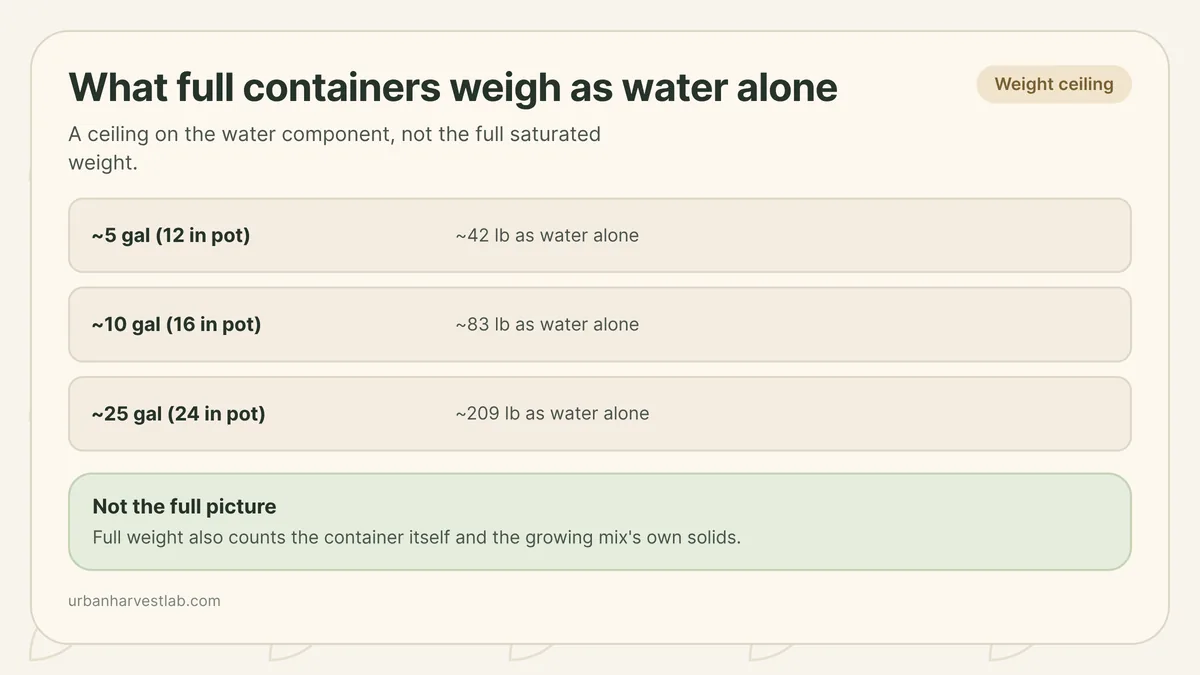
Balcony weight limit: calculate what your container garden really weighs
A balcony's real weight allowance comes from its own structural documentation, not a one-size figure online. What you can calculate yourself is exactly how much your containers weigh once every one of them is soaked through.
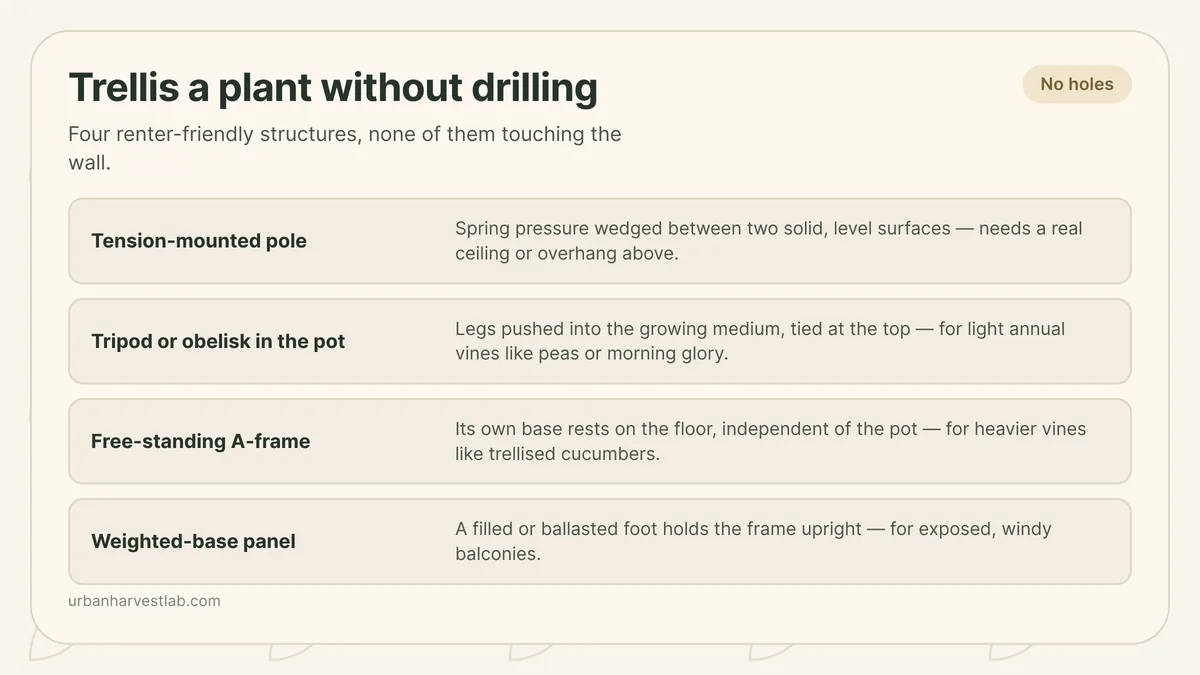
How to trellis a plant without drilling a single hole
A container has no ground to sink a post into, so a renter-friendly trellis has to get its stability from somewhere else. Four approaches do that without touching a wall, railing, or ceiling.