Troubleshoot the system before you change the inputs.
Symptoms
- Silvery, papery patches or fine stippling on leaves, sometimes with a bronzed cast
- Tiny dark specks of dried excrement scattered across the damaged tissue
- Distorted, curled, or dead growing tips on new leaves
Possible causes
- Thrips rasping and feeding on leaf and shoot tissue
- A new plant carried a small population indoors without an inspection
- Warm indoor conditions let several generations build before the damage became obvious
Quick fixes
- Confirm the insect with a hand lens, or shake foliage over white paper to check for movement
- Isolate the plant immediately and check every neighboring pot for the same signs
- Read the product label before spraying anything on a herb you intend to eat
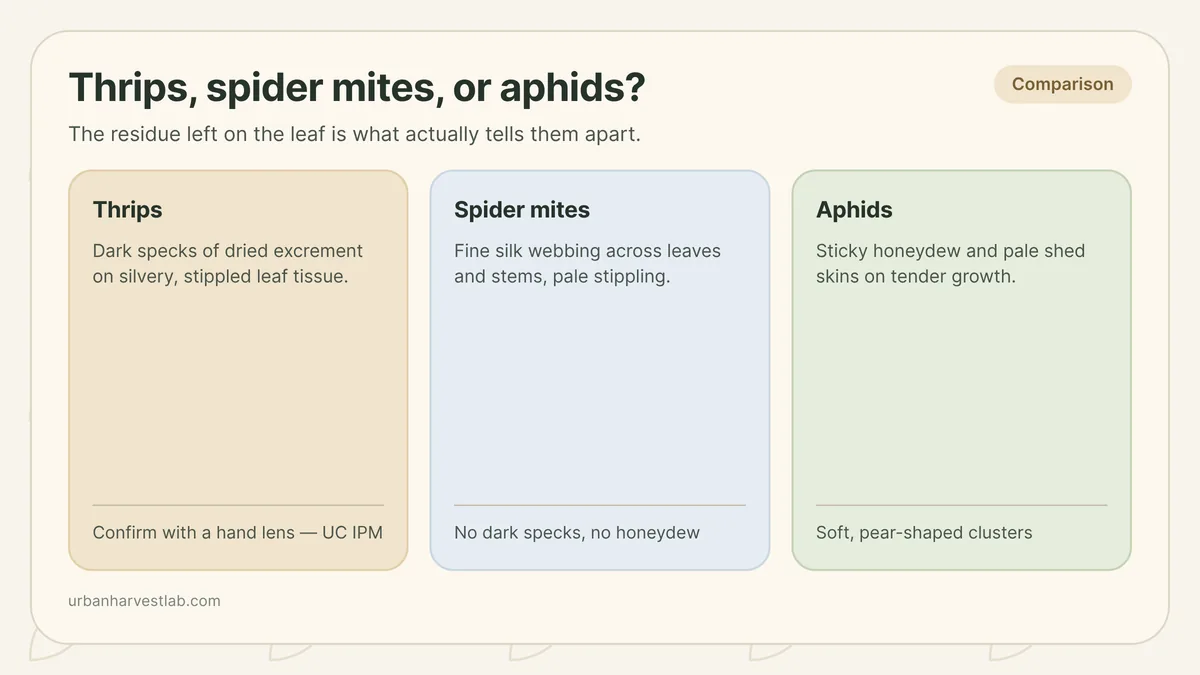
Thrips compared with spider mites and aphids
| Clue | Thrips | Spider mites | Aphids |
|---|---|---|---|
| Visible insect | Slender, under 1/20 inch, pale to dark with narrow, fringed wings | Tiny eight-legged specks under 1/20 inch with two eyespots | Soft, pear-shaped clusters with a pair of tail cornicles |
| Tell-tale residue | Dark specks of dried excrement on the leaf surface | Fine silk webbing across leaves and stems | Sticky honeydew and pale shed skins |
| Typical damage | Silvery, stippled patches and distorted new growth | Fine, pale stippling, sometimes bronzing, no dark specks | Curled tender growth and stunted shoots |
Thrips on herbs show up as silvery, papery patches or fine stippling on the leaves, tiny dark flecks of dried excrement scattered across that damage, and slender insects you need a hand lens to actually see. All three signs together are what separate thrips from a spider mite problem or an aphid colony on the same plant, and each of those calls for a different response.
If your herb is yellow, wilting, or generally unwell without any insect activity, start with the broader potted herb problem guide instead. Light, root-zone moisture, and container drainage cause more indoor herb trouble than any pest, and treating for thrips will not fix any of them.
Confirm it’s thrips, not a look-alike
Move the plant into bright light and go over the newest leaves and growing tips with a hand lens. UC IPM describes adult thrips as “less than 1/20 inch long,” translucent white or yellowish to dark brown or black, with long narrow wings edged in long fringes. Clemson Cooperative Extension gives a slightly different size convention for houseplant thrips, “less than 1/16 inch in length,” yellowish to blackish with the same fringed wings — the two extension services use different rulers, so treat both figures as roughly the same insect rather than picking one as correct.
The discriminator that actually settles the question is not size. It is the frass. UC IPM’s identification point is “dark specks of excrement” left on the leaf where thrips have been feeding — a mark spider mites do not leave, because mites cause only stippling and, in a heavier infestation, fine silk webbing. Aphids leave neither: their tell is sticky honeydew and pale shed skins clustered on tender growth, plus a pair of small tube-like cornicles near the rear of the insect that no other pest on a houseplant has. If you see webbing, you likely have spider mites; if you see honeydew and cornicled insects, you likely have aphids; if you see dark excrement specks alongside silvery or stippled leaf tissue, you likely have thrips — or check the herb pest identification chart if none of those signs match what you’re seeing. When webbing, honeydew, and specks are all absent and you still cannot see an insect, work through the spider mite signs page before assuming thrips, since early damage from the two pests can look similar to the naked eye.
Thrips damage itself has a distinct look once you know to check for it. UC IPM describes “distorted, curled, galled, or dead shoot tips and leaves” along with “scabby, silvery to dark brown discoloration.” Clemson’s houseplant summary for thrips damage adds “silvery/speckled leaf appearance; early leaf drop; flower bud death; streaked/distorted flowers” — useful if your herb is flowering, since thrips will feed inside buds where you cannot see them without pulling the bud apart.
Old stippling and old curling do not go away once the insects are gone; judge whether control is working by watching new leaves as they expand, not by staring at leaves that were already damaged.
Isolate the plant and check its neighbors
Move the infested herb away from other plants so leaves cannot touch. Check every neighboring pot immediately, then again over the following two weeks, since thrips walk and fly short distances between plants that are close together. Wash your hands and any tools you used on the infested plant before handling anything else.
Estimate how much of the plant is affected. A thrips population confined to one or two growing tips is a different decision than stippling across most of the canopy on a plant you were about to harvest heavily.
Monitor before and after you act
Two low-effort checks tell you whether thrips are present and, later, whether a treatment worked. UC IPM recommends bright yellow sticky traps to catch flying adults, and shaking foliage or flowers over a sheet of white paper to dislodge and count the insects directly. Repeat the paper-shake test after any treatment; a falling count over successive checks is a better signal than a single clean-looking leaf, because new damage on a leaf that was healthy at the last check means the population is still active.
Treat only what the label allows on that crop
This is where a legal rule, not a preference, governs what you can spray. The EPA states plainly that pesticide labels “are legally enforceable,” and every one of them carries the statement that using the product in a manner inconsistent with its labeling is a violation of federal law. The National Pesticide Information Center puts the practical consequence in one sentence: if your fruit or vegetable is not listed on the label, you cannot apply the product to it. A neem or insecticidal soap product labeled for ornamentals only, with no herb or vegetable listed, may not lawfully go on basil, mint, or any other herb you plan to eat, regardless of how “natural” the ingredient is.
Pre-harvest interval works the same way. NPIC defines it as the wait time between a pesticide application and when the crop can be harvested, and the label states how long that wait is for that crop. Crucially, that interval is set per product and per crop, not by the active ingredient in the abstract — wait times for the same herb can differ between two products that both contain the same ingredient, because the EPA sets residue tolerances product by product. Some labeled uses carry a zero-day interval, meaning the crop can be harvested the same day it was sprayed, but that is stated on the specific label, not assumed.
Among the contact options UC IPM lists for thrips are insecticidal soap, horticultural oil, and neem oil, plus spinosad, which the agency notes moves a short distance into sprayed leaf tissue and lasts about a week or more once applied — though UC IPM says it should not be sprayed on flowering plants. The same agency’s conditions for the oils apply here: use a high volume of water, don’t spray drought-stressed plants or anything above 90°F, and leave two weeks between an oil application and any sulfur product. Clemson Cooperative Extension adds the caution that applies to the soap too: test insecticidal soap, or any other insecticide, on a small part of the plant before treating the whole thing. For the actual dilution rate, application interval, and the harvest wait specific to your product, the neem oil guide walks through reading that label correctly.
Coverage matters more than which product you pick: thrips hide in leaf folds, unopened buds, and the undersides of leaves. Colorado State University Extension explains why: soaps and oils act strictly as contact materials with no residual effect, so the spray has to physically reach the insect, usually on leaf undersides and other protected sites.
Expect to repeat the check, not just the spray
UC IPM gives thrips a full life cycle, egg to adult, in as little as two weeks under warm conditions, with up to about eight generations possible in a year. That speed is why a single application that kills every visible adult can still leave eggs or pupae behind to restart the population within days. Plan on re-checking with the same paper-shake or hand-lens test rather than assuming one spray finished it: UC IPM says thrips sprays may need to be repeated, without giving an interval, and the two-week generation time above is what sets the horizon for how soon a new population can show up.
Prevent the next infestation
Clemson’s general framing for houseplant pests applies directly here: infestations “most often come into the home on newly purchased plants or on those that have been outside for the summer,” and stressed plants tend to be more susceptible. Inspect any new herb, including one you’re moving from a balcony back indoors for the season, before it sits next to the rest of your collection. The potted herb care guide covers the routine watering and light habits that keep herbs from becoming the stressed, susceptible plants Clemson describes.
Give plants enough space between pots that you can actually see the undersides of leaves during normal watering. A colony that has to be searched for with a flashlight is a colony that gets missed until the damage is already extensive.
Common mistakes
- Assuming any silvery leaf damage is spider mites and skipping the frass check.
- Spraying a product without confirming the herb is listed on that label.
- Treating once and considering the problem solved without a follow-up check.
- Spraying a flowering herb with spinosad, which UC IPM says should not go on flowering plants.
- Judging success by old, already-stippled leaves instead of new growth.
Sources
- UC Statewide IPM Program: Thrips (Pest Notes 7429)
- UC Statewide IPM Program: Spider Mites (Pest Notes 7405)
- UC Statewide IPM Program: Aphids (Pest Notes 7404)
- Clemson Cooperative Extension HGIC: Common Houseplant Insects & Related Pests
- US EPA: Introduction to Pesticide Labels
- National Pesticide Information Center: Preharvest Interval
Rule out the other usual suspects
Similar-looking leaf damage often comes from a different pest entirely, so confirm the insect before you treat.
Common questions
What does thrips damage look like on herbs?
Look for silvery or bronzed patches, fine stippling, and tiny dark specks of dried excrement on the leaf surface. Distorted or curled new growth is common too, but the dark specks are the detail that separates thrips from spider mites or aphids.
Can I eat herbs that had thrips?
The extension sources cover control, not edibility of damaged tissue. Wash the harvest well and discard visibly soiled or heavily damaged leaves as a handling judgement. If you treated the plant with a pesticide, follow that product's harvest interval for the specific crop before cutting anything.
Will thrips come back after one treatment?
Often, yes. UC IPM reports thrips can complete a generation in as little as two weeks under warm conditions, so eggs or pupae a spray missed can restart the population within days. Plan on repeat inspections rather than a single application.
Do I need to throw the plant away?
Not usually. Isolating the herb, removing the worst-damaged tips, and repeating inspections resolves most indoor infestations. Discarding makes more sense for a cheap, heavily damaged annual herb that keeps reinfesting the plants around it.
Related guides
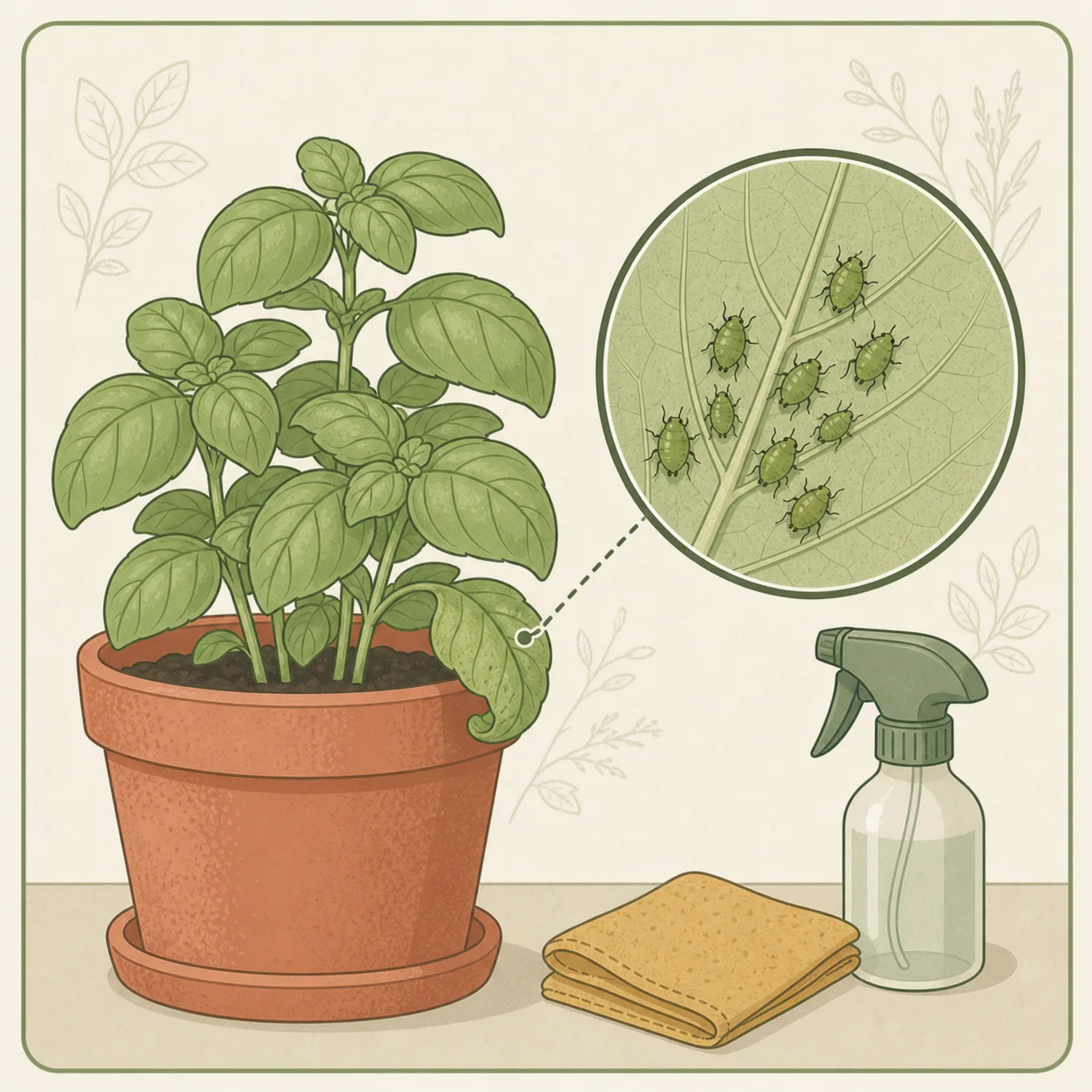
Aphids on indoor herbs: identify, isolate, and control them
Aphids are manageable when you find the colony, isolate the plant, remove most insects physically, and repeat inspections through the next generation.
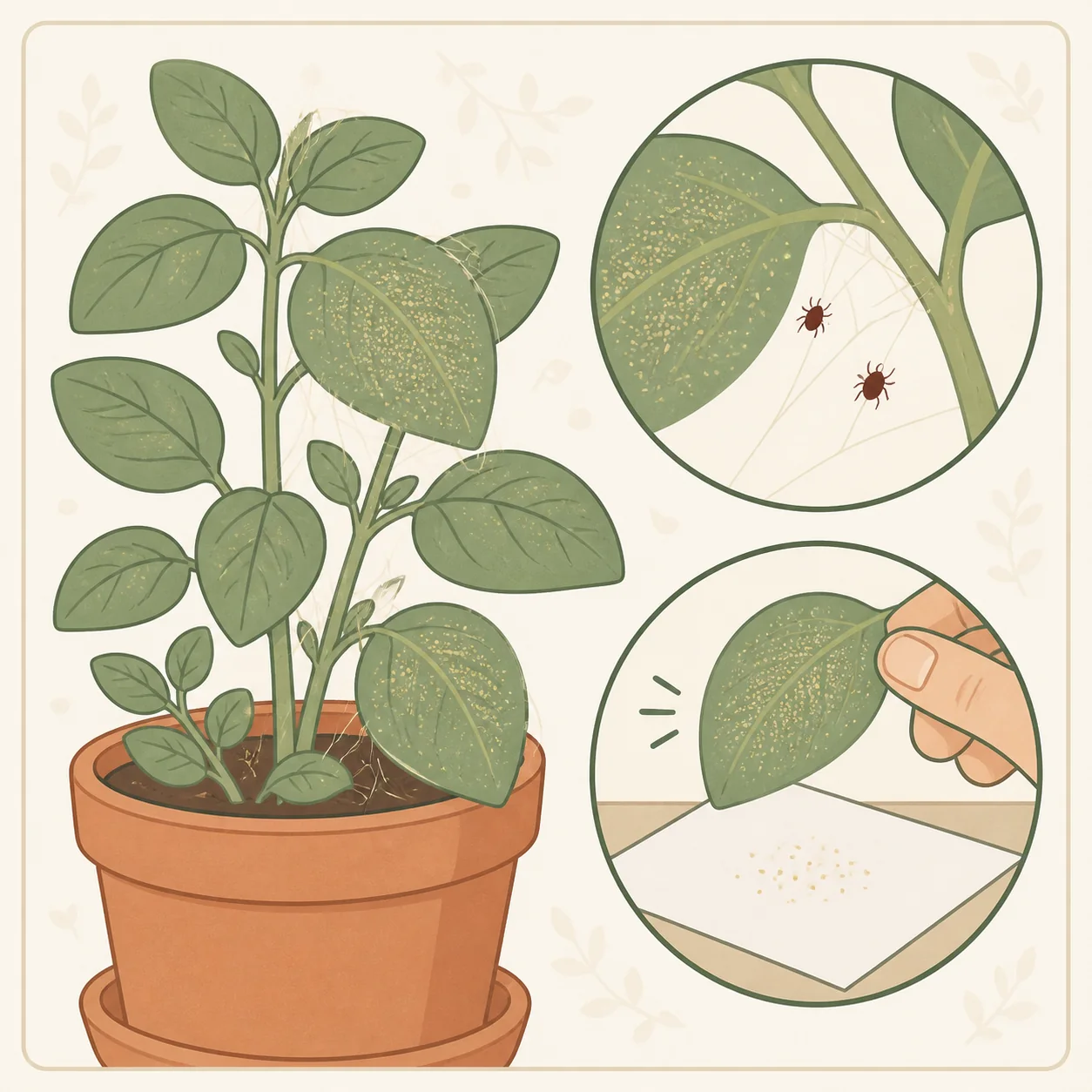
Spider mites on indoor herbs: signs, paper test, and control
Spider mites are easiest to control before webbing is obvious. Look for fine pale stippling and confirm moving specks over white paper.
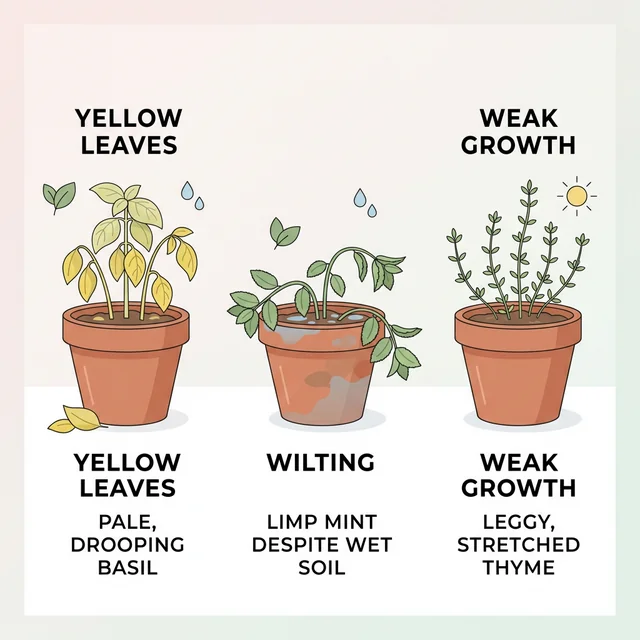
Common potted herb problems: yellow leaves, wilting, and weak growth
Common potted herb problems usually show up as yellow leaves, wilting, or weak growth, but the useful diagnosis starts with light, drainage, and root stress.