Troubleshoot the system before you change the inputs.
Symptoms
- Stems and the lowest leaves look greasy, then dry out and turn bronze or russet.
- Damage starts at the base of the plant and moves upward.
- No webbing.
- Green leaves above the bronzed ones look fine at first.
Possible causes
- Tomato russet mite, an eriophyid mite too small to see without a hand lens.
- Spider mites, which often produce webbing.
- Broad mites, which are 0.2 mm long and can leave the lower leaves unaffected.
Quick fixes
- Look at bronzed leaves and the green leaves just above them with a lens of at least 14X.
- Mark how far the bronzing reaches and check again in 2 to 3 days to see whether it is spreading.
- If the mites are confirmed, use a product whose label lists tomatoes and follow it, with thorough coverage of stems and leaf undersides.
- Keep petunias and potatoes away from tomato pots, since they host the same mite.
Russet mites compared with look-alikes on tomato
| Pest | Where damage starts | What you see | Size and clue |
|---|---|---|---|
| Tomato russet mite | Base of the plant, stems and lower leaves | Greasy bronze, leaves dry out, no webbing | About 1/5 mm; needs at least a 14X lens |
| Spider mites | Not given by these sources | Often webbing | Rounder and larger, usually two spots |
| Broad mites | Not the base: lower leaves can stay unaffected | Not given by these sources | 0.2 mm; lower leaves can stay unaffected |
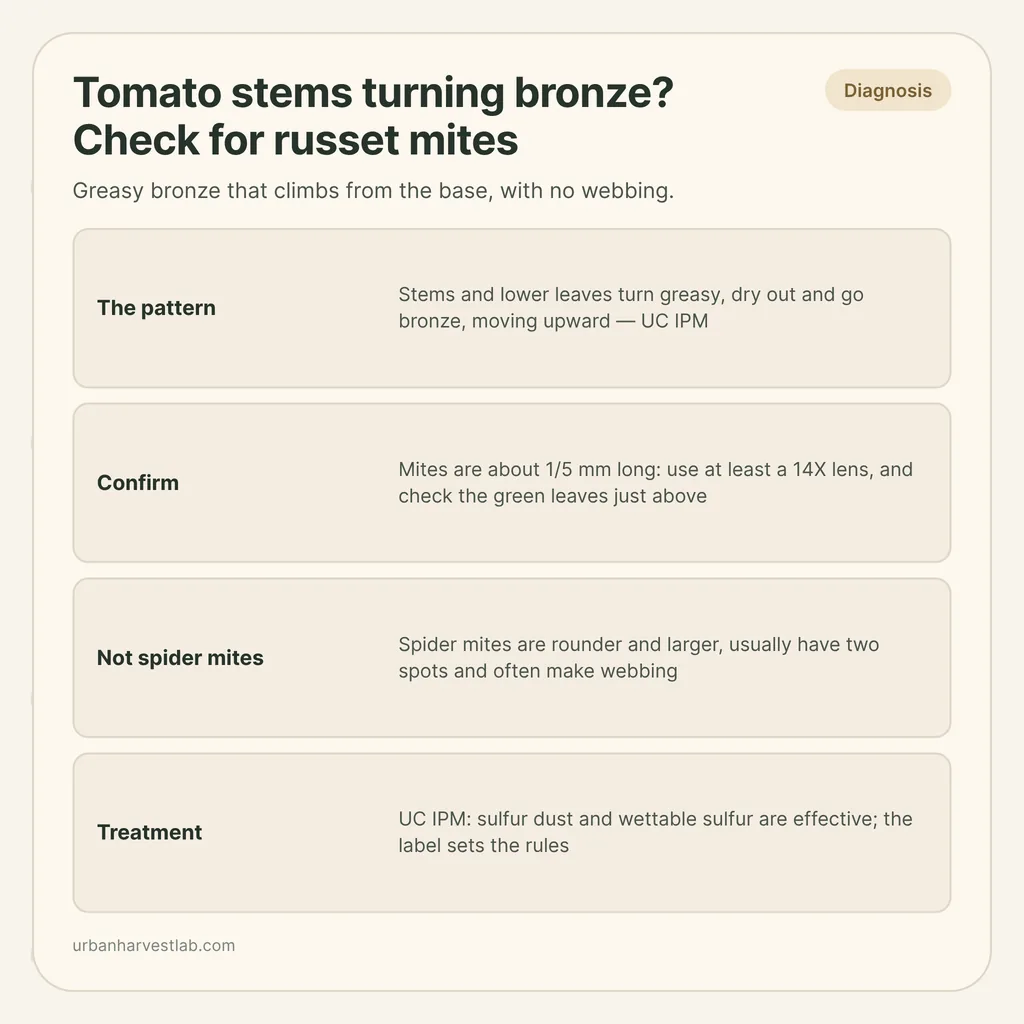
Stems and lower leaves that turn greasy, then dry out and go bronze, with the damage climbing up from the base of the plant and no webbing, are the classic sign of tomato russet mite. UC IPM describes the pest as so small that you need at least a 14X lens to see it, which is why it is usually found by its damage rather than by looking for it.
If the leaves are yellowing rather than bronzing, start with tomato leaves turning yellow. If the leaf edges are rolling or the new growth is twisted, see tomato leaves curling. Bronze that begins on the stem and low on the plant is the russet mite pattern.
What bronzing from the base up looks like
UC IPM’s home garden page says leaves and stems damaged by the mites “develop a greasy appearance, then dry out and turn bronze.” The damage “starts at the base of the plant and moves upward.” The agricultural guidelines add that the lower leaves dry out, giving the plant an unhealthy appearance, and that the colour of stems and leaves frequently becomes greasy bronze or russet.
Timing helps. UC IPM says damage would first be present in mid to late summer, when plants are half grown or larger. In hot weather, when mite numbers explode, plants may be defoliated, and UC IPM warns that left uncontrolled the pest can kill plants.
On a balcony, that means a tomato that looked fine in early summer and has a bare, bronze lower stem by mid to late summer. UC IPM notes that the loss of leaves can expose fruit to sunburn; white patches on tomatoes covers what that looks like.
Confirm the mite before you spray anything
Russet mites are about 1/5 mm long and are conical and yellowish, tan or pink. UC IPM says you need at least a 14X lens to see them. By the time you notice damage, the agricultural guidelines say, there may be hundreds of yellowish, conical mites on the green leaves immediately above the bronzed ones.
So look in two places:
- The bronzed leaves and stem.
- Green leaves just above the damage, because UC IPM says the mites may move up the plant above the most obvious damage.
If you do not own a lens, browse 14X hand lenses on Amazon.
Then check whether it is still spreading. UC IPM’s guidelines suggest marking the edge of the damaged area and looking again in 2 or 3 days. Immediate treatment is necessary when symptoms begin to spread.
Russet mite, spider mite or broad mite
UC IPM says not to confuse russet mites with spider mites, “which are rounder and larger, usually have two spots, and often produce webbing.” If you see fine webbing, read spider mites on indoor herbs, which covers the paper test and the treatment for those.
Broad mites are a third candidate. University of Maryland Extension describes them as 0.2 mm long, and says the lower leaves can stay unaffected. Russet mite runs the other way: base first, stems included.
What UC IPM says to do
UC IPM’s home garden advice is short: “Both sulfur dust and wettable sulfur are effective for russet mite control.” The agricultural guidelines say mined sulfur dust or sprays are acceptable on organically certified produce, and give these cautions: thorough coverage is required, do not apply when temperatures are in excess of 90°F or during a heavy dew or fog, and do not use sulfur if an oil was applied recently or will be in the near future. University of Maryland Extension also lists horticultural oils for broad mites on tomato, and warns that both oils and sulfur can cause phytotoxicity problems in hot, humid conditions.
The product label sets the dose, the crops it may go on and the wait before you eat the fruit. Check that the label lists tomatoes. Choosing a pest treatment for plants you are going to eat walks through how to read a label for that.
Spraying will not turn bronze tissue green again. University of Maryland Extension says of broad mite damage that symptoms can stay visible for several weeks after mites are gone, so judge the result by whether new growth comes through clean, not by the old leaves.
Stop it coming back
UC IPM tells growers to avoid planting tomatoes near petunias or any solanaceous plant such as potato, because they are other hosts of the russet mite. The agricultural guidelines add that nightshades and morning glory should be removed where infestations recur in successive years. In a container garden, that means giving tomatoes a spot away from petunia pots and potatoes, and pulling nightshade weeds that grow in or beside your pots.
Sources
Tomato and mite problems
Bronzing overlaps with yellowing, curling and spider mite damage, so use these pages to tell them apart.
Common questions
Why are my tomato stems turning bronze?
The pattern UC IPM describes for tomato russet mite: leaves and stems develop a greasy appearance, then dry out and turn bronze, starting at the base of the plant and moving upward. Confirm with a hand lens of at least 14X before treating anything.
How do I tell russet mites from spider mites?
UC IPM says spider mites are rounder and larger, usually have two spots and often produce webbing. Russet mites are conical and yellowish, tan or pink, and the damage starts on the stems and lower leaves.
Can russet mites kill a tomato plant?
Yes, if they are not controlled. UC IPM Pest Management Guidelines say that left alone this pest can kill plants, and that in hot weather, when mite numbers explode, plants may be defoliated.
Is sulfur safe to spray on my tomatoes?
UC IPM lists sulfur dust and wettable sulfur as effective and acceptable on organic produce, but says not to apply above 90 F or during heavy dew or fog, and not near an oil application. Whether a product may be used on tomatoes at home is decided by its label.
Related guides

Tomato leaves curling: heat, water swings, herbicide, pests, or virus
Most curling tomato leaves are a harmless response to heat or uneven watering. Twisted new growth, bronzing, or stunting points elsewhere.
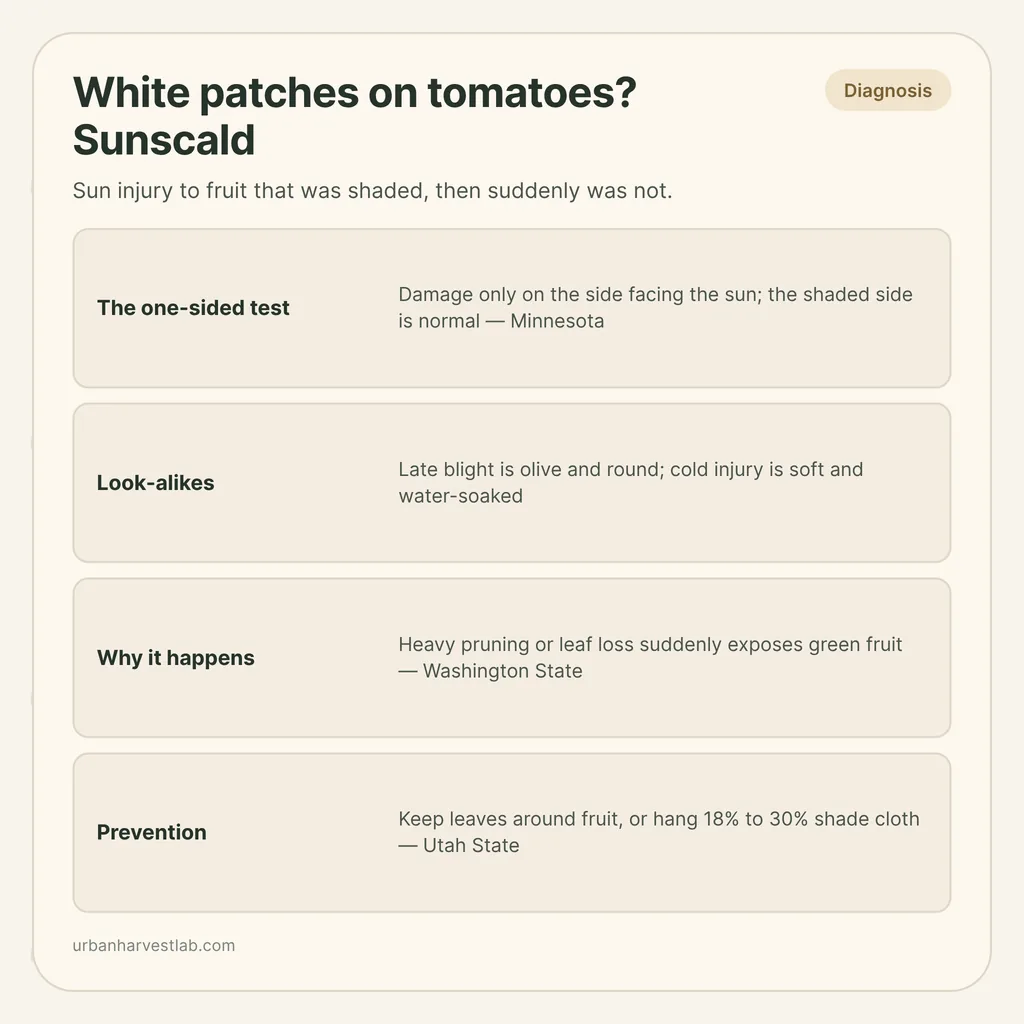
White patches on tomatoes? How to spot sunscald and stop it
A tomato or pepper that was shaded by leaves and then suddenly was not can bleach on the exposed side. The damage stays on that fruit, but the next ones are avoidable.

Tomato leaves turning yellow in pots: read the pattern first
Which leaves yellow, and in what pattern, tells you whether a potted tomato is hungry, waterlogged, short of magnesium or diseased.