
Troubleshoot the system before you change the inputs.
Symptoms
- Lower, older leaves turn a uniform pale yellow while new growth at the top stays green but small.
- Yellowing runs between the veins of lower leaves, leaving the veins green.
- Lower leaves yellow while the potting mix stays wet for days and growth stalls.
- Yellow halos form around brown spots on the oldest leaves.
Possible causes
- Nitrogen has been used up or washed out of the pot by frequent watering.
- Magnesium is low, or excess potassium or a mix pH below 6.0 is blocking its uptake.
- The mix stays saturated, so roots lose oxygen and cannot take up water and nutrients.
- The pot has been allowed to dry out for an extended time, which yellows the lower leaves first.
- A leaf-spot fungus such as early blight or Septoria is working up from the lowest leaves.
- A soil-borne wilt fungus such as Fusarium is blocking the stem.
Quick fixes
- Push a finger into the mix to the first joint, as Clemson advises, and check the drainage hole and saucer before changing anything else.
- If the mix is dry, water it first. Feed only once the mix is moist and the uniform lower-leaf yellowing still fits nitrogen.
- If yellowing sits between green veins, check mix pH and look for a magnesium source in your fertilizer label.
- Remove spotted lower leaves and stop splashing water onto the foliage.
- If one side of the plant yellows and the cut stem is brown inside, treat it as a disease, not a feeding problem.
Yellow tomato leaves: what the pattern points to
| What you see | Where it starts | Most likely cause |
|---|---|---|
| Uniform pale yellow across the whole leaf, slow growth | Oldest, lowest leaves | Nitrogen shortage |
| Yellow between the veins, veins stay green | Lower, older leaves | Magnesium shortage |
| Yellow lower leaves, mix stays wet, growth sluggish | Lower leaves, then up the plant | Waterlogged roots |
| Brown spots, often with yellow halos | Oldest leaves, near the soil | Early blight or Septoria |
| Yellow on one side of the stem, wilting, browned inner stem | One side of the plant | Fusarium wilt |
Yellow leaves on a potted tomato mean something different depending on where they start and what the yellow looks like: uniform pale yellow on the oldest leaves is usually nitrogen, yellow between green veins is magnesium, yellow with a soggy pot is a root problem, and yellow around brown spots or on one side of the plant is disease. Look at the pattern before you reach for fertilizer, and work down the sections below in order, because several causes overlap in a pot.
For a general decision tree across plant types, start with the yellow leaves cause finder.
Nitrogen: even yellow on the oldest leaves
UC IPM describes the pattern this way: “Slow growth and uniform yellowing of older leaves are usually the first symptoms of nitrogen (N) deficiency.” The University of Maryland Extension tomato key makes the same call: “Older leaves first, then newer leaves: nitrogen.” The plant moves nitrogen out of old leaves to feed new growth, so the lowest leaves pale first and new leaves stay greener but smaller.
A pot is where this happens. UC IPM lists “containers or planter boxes” among the settings where the deficiency turns up, and frequent watering flushes nitrogen out through the drainage hole. Fruiting crops draw heavily on whatever is left. The University of Maryland Extension suggests light feeding about every two weeks for container tomatoes, and Penn State Extension describes a diluted soluble feed every two to four weeks after a slow-release charge at planting. If you have not fed in a month and the lowest leaves are fading evenly, resume a routine from the fertilizer schedule for container vegetables.
Feed into moist mix, not bone-dry mix, and follow the label rate.
Magnesium: yellow between green veins
If the veins stay green while the tissue between them yellows, you are not looking at nitrogen. The University of Kentucky says of magnesium deficiency: “It appears on the lower leaves (older growth) as yellowing between the leaf veins.” It names two causes beyond a shortage in the mix: “excess potassium in the soil which causes reduced uptake of magnesium,” and “low soil pH (below 6.0).” Its remedy is “magnesium oxide or magnesium sulfate,” and a mix with a pH problem needs the pH addressed first. The container soil pH page covers testing, and nutrient lockout explains why adding more fertilizer to a blocked mix often fails.
Heavy use of a high-potassium product aimed at fruiting is one way to land here. Potassium shortage is a separate lower-leaf pattern: UC IPM describes older foliage “yellowish or brown at the tips and margins and between veins,” with curled edges.
Waterlogged roots look like hunger
This is the cause that gets misdiagnosed as nitrogen. UC IPM warns that nitrogen-deficiency symptoms are easily confused with problems that restrict roots: “aeration deficit, cool soil temperature, mechanical injury to roots.” Missouri Botanical Garden lists “stunted slow growth with yellowing leaves” among the signs of overwatering and explains why: roots in waterlogged soil cannot get oxygen, and the longer the air is cut off, the greater the root damage.
Check these before you feed:
- Clemson’s check is to push a finger into the mix to the first joint. Soggy at that depth days after watering is the signal.
- Lift the pot. A pot that stays heavy has not dried.
- Look at the drainage holes and the saucer. Standing water in the saucer keeps the bottom of the mix saturated.
- Ask whether the plant wilts in the afternoon even though the mix is wet. That is a root signal, covered in tomato plant wilting.
Feeding a plant whose roots are not working only adds salts.
Dry pots yellow the lower leaves too
The opposite mistake looks similar. Clemson’s houseplant disorders factsheet says lower leaves yellow when “plants are allowed to become too dry for an extended time.” A wilted plant that perks up within hours of watering was dry. One that stays limp after watering points back to the roots. Water first, and feed only after the mix is moist and the pattern still fits nitrogen. The test is laid out in overwatered vs underwatered, where Clemson notes that the symptoms of over- and underwatering are similar. Watering rhythm for tomatoes is in how often to water container vegetables. A pot that is too small for the plant dries out and floods in cycles, so check it against the tomato pot size guidance.
Spots plus yellow: leaf diseases
Early blight and Septoria both start low. Clemson describes early blight as “small, brown lesions mostly on the older foliage.” Penn State Extension says “As the spots expand, tissue surrounding the spots may turn yellow” and that damage is usually “limited to the lower third of the tomato plant.” For Septoria, Penn State says “Severely spotted leaves turn yellow, die, and fall off the plant,” and Clemson places infection “on the lower leaves near the ground, after plants begin to set fruit.”
If you see distinct brown spots, identify them on brown spots on tomato leaves, which covers early blight, Septoria and bacterial spot.
One-sided yellowing: Fusarium
Clemson describes Fusarium wilt: “Often leaves on only one side of the stem turn golden yellow at first.” Cut the stem lengthwise and, per Clemson, “the lower stem will have a dark brown discoloration of the water-conducting vessels.” The University of Maryland Extension describes lower leaves that “turn yellow and then brown,” with wilting that shows “some recovery at night,” and notes that Fusarium is more common than Verticillium. Clemson adds that the fungus is soil-borne and travels up from the roots. Feeding and watering changes do not fix it. For the wilt diagnosis and what to do with the plant, see tomato plant wilting.
What to do with the yellow leaves themselves
Yellow leaves do not turn green again. Judge recovery by the new growth. Remove leaves that are fully yellow or spotted so they stop shading the stem, and keep water off the foliage if spots are present. If new leaves at the top are coming in green and normal size, you caught it.
Sources
- UC IPM, Nitrogen Deficiency
- University of Maryland Extension, Key to Common Problems of Tomatoes
- University of Maryland Extension, Maintaining Container Grown Vegetables
- Penn State Extension, Tomato Diseases and Disorders in the Home Garden
- Penn State Extension, Container Vegetable Gardening: Four Keys to Success
- Clemson HGIC, Tomato Diseases & Disorders
- University of Kentucky, Interveinal Chlorosis (Scouting Guides for Problems of Vegetables)
- Clemson HGIC, Houseplant Diseases & Disorders
- Clemson HGIC, Indoor Plants – Watering
- UC IPM, Common Nutrient Deficiency Symptoms
- Missouri Botanical Garden, Overwatering
Narrow down the cause
Water, feeding and spotting are the three branches most potted tomatoes fall into.
Common questions
Why are the bottom leaves of my potted tomato turning yellow?
Three causes account for most cases. Uniform pale yellowing of the oldest leaves with slow growth is nitrogen shortage, per UC IPM. Yellowing between green veins on those same lower leaves is magnesium, per the University of Kentucky. Yellowing around brown spots, limited to the lower third of the plant, is early blight, per Penn State Extension.
Should I fertilize a tomato with yellow leaves?
Only if the pattern fits. Uniform yellowing of the oldest leaves with slow growth is the nitrogen pattern, and a container tomato is a setting where UC IPM expects it. If the mix is soggy, or the yellowing is one-sided or spotted, feeding does not address the cause and a damaged root system cannot use it anyway.
Can overwatering make tomato leaves yellow?
Yes. Missouri Botanical Garden lists stunted growth with yellowing leaves among the symptoms of overwatering, because roots in waterlogged mix lose their oxygen. UC IPM adds that root problems from poor aeration or cool soil can look just like nitrogen deficiency.
Are yellow tomato leaves with brown spots a disease?
Usually. Early blight and Septoria leaf spot both start on the oldest leaves, and the tissue around the spots turns yellow as they expand. Severely spotted leaves yellow, die and drop. Spotting is covered in the brown spots on tomato leaves guide.
Related guides

Tomato leaves curling: heat, water swings, herbicide, pests, or virus
Most curling tomato leaves are a harmless response to heat or uneven watering. Twisted new growth, bronzing, or stunting points elsewhere.

Tomato plant wilting even though you water it: heat, roots, or disease
Midday droop that clears by evening is usually heat. Wilt that stays after watering points to rotting roots or a vascular disease, and a cut stem tells you which.
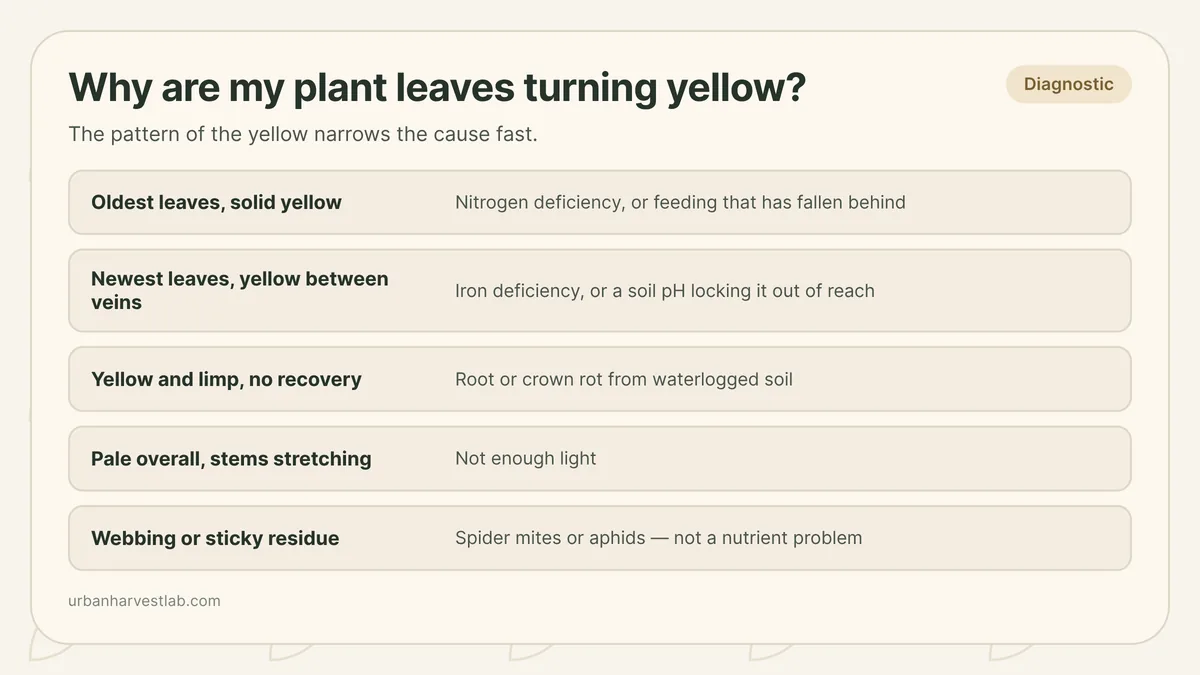
Why are my plant leaves turning yellow? Find the likely cause
Yellow leaves have a short list of real causes, and the pattern of the yellowing narrows it fast, once you know what to look for.