Troubleshoot the system before you change the inputs.
Symptoms
- A cloud of tiny white insects lifts off the plant and resettles when the foliage is disturbed.
- Flat, oval, scale-like immature insects are visible on the underside of leaves when held up to the light.
- Leaves are sticky, or blackened with sooty mold, and ants are active on the stems.
- Leaves yellow, dry, or drop from otherwise well-watered plants, especially tomatoes, peppers, and other vegetables.
Possible causes
- Whitefly adults flew in and laid eggs on the undersides of leaves, and the population built up unnoticed through several overlapping generations.
- A new vegetable start already carried eggs or nymphs when it came home from the nursery.
- Heat or drought stress left the plant more susceptible, and the first treatment missed the sessile nymphs hidden under leaves.
Quick fixes
- Confirm by disturbing the plant and watching for adults flying up, then check leaf undersides for nymphs.
- Start with a strong water spray to knock down numbers, then hang a yellow sticky trap to monitor.
- Choose a soap or oil product labeled for the vegetable and the outdoor setting, cover leaf undersides fully, and repeat rather than expecting one spray to finish the job.
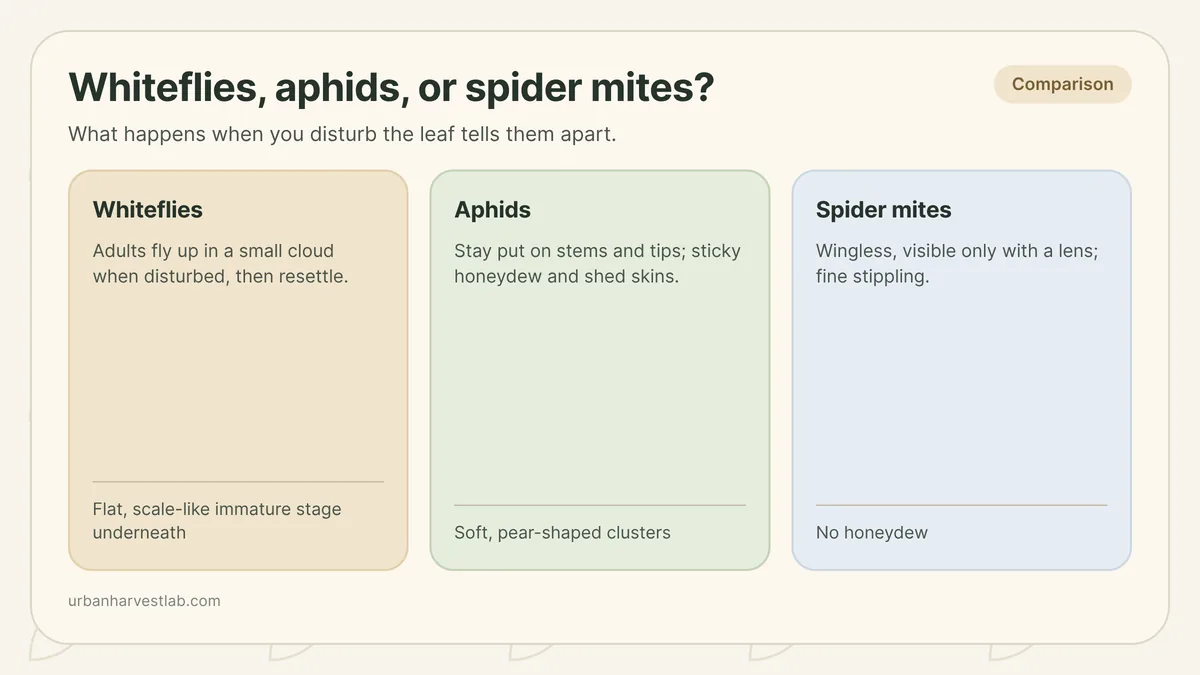
Whiteflies compared with other balcony vegetable pests
| Clue | Whiteflies | Aphids | Spider mites |
|---|---|---|---|
| When disturbed | Adults fly up in a small cloud and resettle | Stay put on stems and tips | Wingless; stay on the leaf, visible only with a 10x lens |
| Leaf underside | Flat, scale-like immature stage | Soft pear-shaped clusters | Fine stippling, sometimes webbing |
| Residue | Honeydew and sooty mold common | Sticky honeydew and shed skins | No honeydew |
| Typical damage | Yellowing, weak growth, leaf drop | Curled tender growth | Pale or bronze stippling |
Whiteflies on a balcony vegetable show up as tiny white insects that lift off the plant in a small cloud when you brush the leaves, then settle straight back down. That flying-up response, together with flat immature insects on the underside of the leaves, is enough to confirm whiteflies without guessing from yellow leaves alone.
Start there before treating anything. If you cannot get adults to fly up and the leaves look damaged in another way, check the broader potted herb and vegetable problem guide for water, light, and root causes that mimic pest damage.
Confirm the insect first
Whiteflies are tiny, sap-sucking insects that fly around plants when disturbed, according to UC Statewide IPM’s pest note on the group, and that response is the fastest field test available: tap a leaf cluster or brush the plant with your hand and watch what lifts off (UC IPM). Adults are pale yellowish underneath with two pairs of chalky-white wings, and most species stay under about 1/10 to 1/16 inch long, though the giant whitefly can reach roughly 0.19 inch (UC IPM; Clemson Cooperative Extension). At rest, the wings sit roof-like over the body, which is one reason a resting whitefly can be mistaken for a speck of debris until it moves.
Turn a leaf over for the second confirmation. Eggs are tiny and oblong, laid directly on the leaf underside, and the insect passes through four nymphal stages before becoming a winged adult (UC IPM). The newly hatched first-stage crawler is barely visible even with a hand lens, but the later stages are flat, oval, and immobile, looking more like a pale scale insect than anything with legs (UC IPM). That immobile, scale-like immature stage is the detail that separates whiteflies from aphids, which stay soft-bodied and clustered at every life stage, and from spider mites, which stay mobile rather than settling into a scale-like shape. If the insect itself is still in question, the pest identification chart compares the common herb pests side by side.
Sticky leaves or black sooty mold growing on the honeydew are common signs of an established infestation, and ants tending that honeydew will interfere with the very predators that would otherwise help keep the population down, so ant activity on a balcony vegetable is a reason to look harder, not a separate problem (UC IPM). Honeydew alone does not name the pest, though: soft scale, aphids, mealybugs, and whiteflies all produce it, so pair the sticky residue with the flying-up test or the flat nymphs before deciding which one you have.
Know which vegetables are at risk
The two whitefly species most likely on a balcony both have very broad, overlapping host ranges; it is the tree-feeding whitefly species that are host-restricted, not these two. Greenhouse whitefly feeds on most vegetables and herbaceous ornamentals, so a mixed planter of tomatoes, peppers, and herbs is all fair game to it. Sweetpotato whitefly also has a very broad host range that includes cole crops, cucurbits, tomatoes, and peppers (UC IPM). A container planting that mixes several of those crops can carry whiteflies from one pot to the next even if only one plant looked infested at first.
Why a stressed plant gets hit harder
Stressed plants tend to be more susceptible to pests, and whiteflies are no exception (Clemson Cooperative Extension). A balcony vegetable baking against a south-facing rail in a heatwave, or drying out between waterings because the pot is too small for the heat, is an easier target than one kept evenly watered and shaded through the worst of the afternoon. If a heatwave is the underlying stressor, the container heatwave guide covers keeping the plant itself out of trouble; treat that as step one, because a spray applied to a wilted, heat-stressed plant risks leaf injury on top of the pest problem.
New vegetable starts are a common entry point too: a seedling can already carry eggs or nymphs from the nursery bench, so inspect leaf undersides before it joins the rest of the balcony planting rather than after.
Monitor before and during treatment
Yellow sticky traps, hung at a rate of about one trap for every two large plants with the sticky side facing the foliage but out of direct sunlight, are most useful for monitoring and detecting whiteflies rather than controlling them (UC IPM). Use them to track whether numbers are rising or falling through a treatment cycle, not as the treatment itself. Check the traps on the same schedule as your leaf inspections so a rising trap count and a rising nymph count line up.
Bring the population down
Start physical before chemical. UC IPM recommends hosing adults off with a strong, direct stream of water aimed at the leaf undersides, a reasonable first move on a sturdy vegetable before reaching for a spray; the settled nymphs stay put on the leaf and are what the follow-up spray has to reach. Natural enemies such as lacewings and lady beetles also help suppress whiteflies outdoors, which is one more reason to avoid a broad-spectrum insecticide that would kill them along with the pest (UC IPM).
When a spray is needed, insecticidal soaps and oils are the preferred options over broad-spectrum products (UC IPM). Insecticidal soap works by disrupting the insect’s cell membranes, causing rapid dehydration, and it is effective on small, soft-bodied arthropods including whiteflies, aphids, young scales, and mites (Colorado State University Extension). It has no residual effect, so coverage is what makes it work: spray directly onto the insects, especially on the undersides of leaves, and expect to miss some on the first pass (Colorado State University Extension). Dish soap is not a substitute; household detergents can injure plants and are not labeled as pesticides, so use a product actually formulated as insecticidal soap (Colorado State University Extension). Certain plants are also sensitive to insecticidal soap sprays and may be injured by it (Colorado State University Extension), so Clemson Cooperative Extension’s instruction is to test insecticidal soap, or any other insecticide, on a small part of the plant before treating the entire plant.
Horticultural oil, applied as roughly a 1 to 2 percent solution in a high volume of water, works the same way by coating and suffocating the insect, but it should not go on a plant that is already drought-stressed, and it should not be applied when the temperature is over 90°F (UC IPM). That temperature ceiling matters most on a balcony in summer, since the surface a container plant sits on can run hotter than the air temperature the forecast reports. Neem oil is one of the plant-based oils gardeners reach for in this category; its active component, azadirachtin, interferes with insect feeding and hormone systems rather than killing on contact, which is why it needs the same thorough coverage and repeat schedule as any other oil rather than a single knockdown spray (National Pesticide Information Center).
Expect to repeat. Whiteflies quickly build up resistance to most pesticides, so a single application rarely finishes the job, and rotating between physical removal, soap, and oil works better than spraying the same product on a fixed schedule (UC IPM).
Check the label before you spray an edible crop
A pesticide label is legally enforceable, and every label carries some version of the statement that using the product in a way inconsistent with its instructions is a violation of federal law (US EPA). If your vegetable is not listed on the label, that means you cannot legally apply the product to it, so confirm the crop by name before buying (National Pesticide Information Center). The wait time between spraying and harvest, the pre-harvest interval, is set per product and per crop rather than being a fixed number for a given active ingredient, and some labeled products allow harvest the same day, listed as a zero-day interval, while others do not (National Pesticide Information Center). Read the directions for use, the harvest interval, and the crop list on the specific container in hand rather than assuming a number from a different product or a different pest.
Common mistakes on a balcony planting
- Assuming yellow leaves are a watering problem without turning a leaf over to check for nymphs.
- Spraying only the top of the leaf, where whiteflies are rarely found.
- Treating a wilted, heat-stressed plant with oil instead of addressing the heat first.
- Relying on sticky traps alone instead of also spraying or physically removing insects.
- Buying a product labeled for ornamentals and using it on a tomato or pepper anyway.
- Giving up after one spray instead of planning several passes over multiple weeks.
Sources
- UC Statewide IPM Program, Pest Notes: Whiteflies
- Clemson Cooperative Extension HGIC, Common Houseplant Insects & Related Pests
- Colorado State University Extension, Insect Control: Soaps and Detergents
- National Pesticide Information Center, Neem Oil General Fact Sheet
- National Pesticide Information Center, Preharvest Interval
- US EPA, Introduction to Pesticide Labels
Separate whiteflies from other balcony problems
Compare whiteflies with other sap-feeders and check whether heat stress is compounding the infestation.
Common questions
How do I know it is whiteflies and not another pest?
Disturb the plant. Whiteflies are tiny, sap-sucking insects that fly around plants when disturbed, so a cloud of small white insects lifting off and resettling within a minute is the clearest field test. Aphids do not fly up in a cloud, and spider mites are too small to see without magnification.
Do whiteflies spread from tomatoes and peppers to other balcony vegetables?
Yes. Greenhouse whitefly feeds on most vegetables and herbaceous ornamentals, and sweetpotato whitefly also has a very broad host range that includes cole crops, cucurbits, tomatoes, and peppers, so a mixed balcony planting can carry whiteflies between several of those at once.
Are sticky traps enough to control whiteflies?
No. Yellow sticky traps hung at a rate of about one trap for every two large plants are most useful for monitoring and detecting whiteflies rather than controlling them, so pair them with physical removal or a labeled spray rather than relying on traps alone.
Why does the same spray keep failing?
Whiteflies quickly build up resistance to most pesticides, and sprays rarely reach the sessile nymphs on the underside of leaves in one pass. Cover leaf undersides thoroughly, repeat on a schedule, and rotate control methods rather than repeating the same product.
Related guides
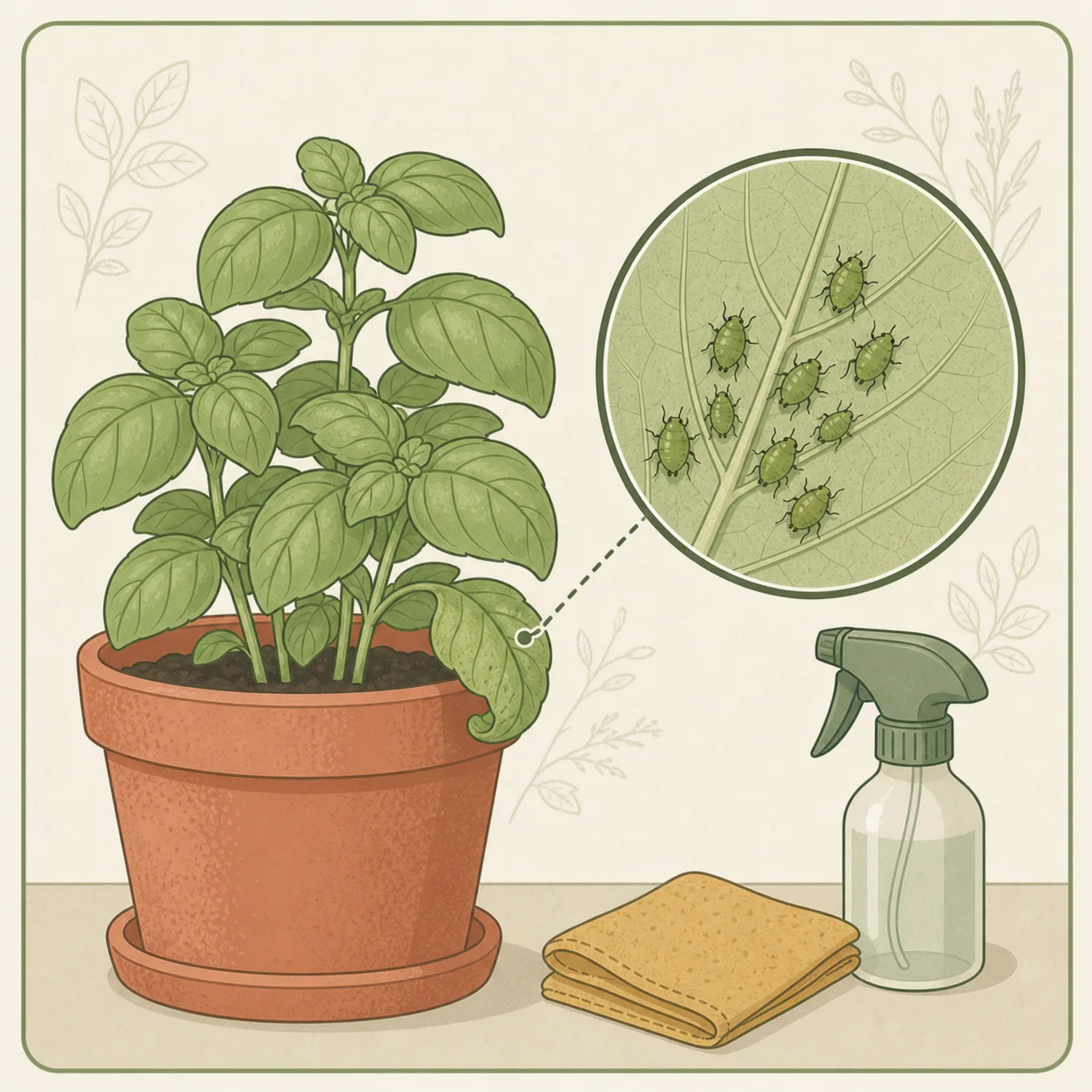
Aphids on indoor herbs: identify, isolate, and control them
Aphids are manageable when you find the colony, isolate the plant, remove most insects physically, and repeat inspections through the next generation.
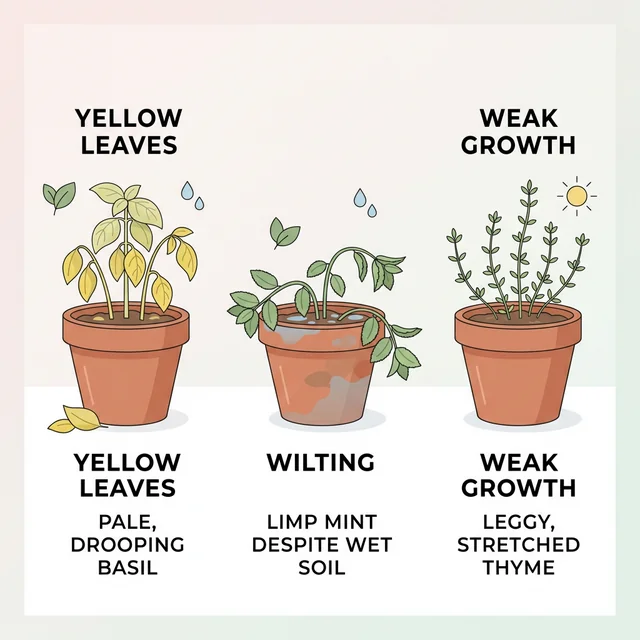
Common potted herb problems: yellow leaves, wilting, and weak growth
Common potted herb problems usually show up as yellow leaves, wilting, or weak growth, but the useful diagnosis starts with light, drainage, and root stress.
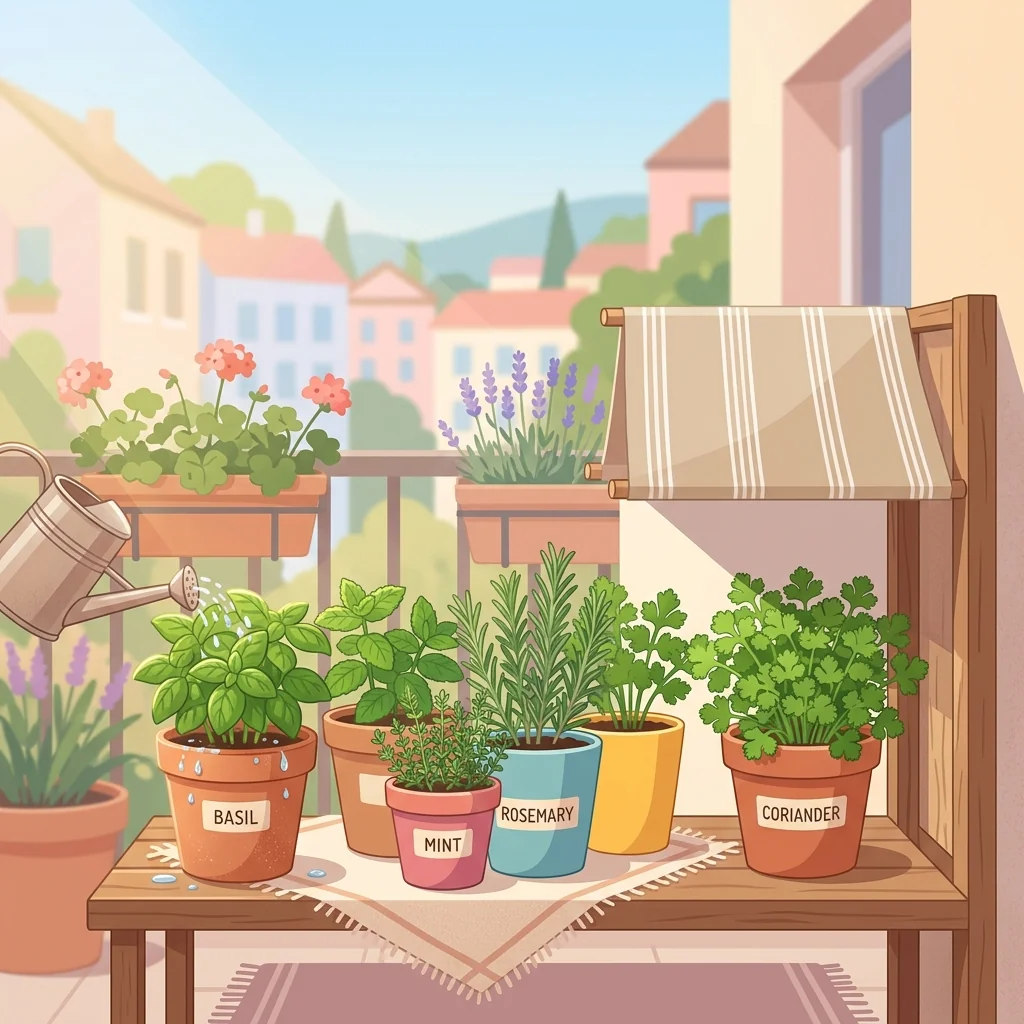
How often to water herbs in summer (heat-proof guide)
Summer heat can double how fast pots dry out. Here is how often to water each herb in hot weather, plus the shading and mulching tricks that keep pots alive in a heat wave.