
What each common peroxide use rests on
| Use | What is documented | Where that leaves it |
|---|---|---|
| Drench to cure root rot | USDA lists registered peroxide products for dips and drenches against Pythium, Phytophthora and similar root pathogens, used under product labels | Evidence is for labelled commercial products, not a home dilution of pharmacy peroxide |
| Root dip for algae or decay | Orchid trial: 3% for 3 minutes caused minor root damage and algae survived; 6% and 12% permanently damaged roots | A cost with no demonstrated benefit at 3% |
| Oxygenating the soil | USDA: dilute solutions degrade with a 1.4 hour aerobic soil half-life, to water and oxygen | The oxygen is brief; air spaces in the mix and drainage are what roots need |
| Mould on microgreens | Purdue lists diluted peroxide as an optional mould deterrent and gives no concentration | An optional extra at best; airflow and watering come first |
| Fungus gnat larvae | UC IPM's fungus gnat note names Bti and Steinernema nematodes and does not list peroxide | Use the controls the extension note names |
Hydrogen peroxide is a genuine disinfectant and a registered fungicide, but poured on a pot it breaks down into water and oxygen within hours and cannot repair roots that are drowning. The popular claim that it “oxygenates” soil or cures root rot rests on that brief burst of oxygen. The documented risks, to roots, soil life and your own eyes and skin, are better supported than the benefits.
If a plant is wilting in wet soil, the first job is working out whether the pot is too wet, and overwatered versus underwatered lays out how to tell. For water-culture systems, root rot prevention in hydroponics covers temperature, oxygen and cleaning. Peroxide only makes sense once you know why the roots are failing.
What peroxide does in a pot
USDA’s technical evaluation of hydrogen peroxide for organic crop production explains the mechanism: it produces “destructive hydroxyl free radicals” that attack the membranes and DNA of cells. That is why it kills fungal spores. It does not discriminate, so the same chemistry reaches root cells.
It also does not last. USDA reports that dilute peroxide in aerobic soil has a half-life of 1.4 hours, and that it “degrades rapidly to water and oxygen in the environment and provides no residual activity.” Both halves of that sentence matter. No residue is good news for food safety. It also means a single drench protects nothing a day later, and the oxygen it releases is gone almost as fast.
Roots in a pot suffer from the opposite problem to a quick puff of oxygen. The Missouri Botanical Garden explains that roots in waterlogged soil “cannot absorb the oxygen needed to function normally” and that “the longer the air is cut off, the greater the root damage.” The dying roots then decay. What restores air is soil that drains and dries between waterings, not a chemical that fizzes for a few minutes.
Where the evidence is real
USDA does list hydrogen peroxide products as registered for use as a pre-plant dip for root and stem rot caused by Pythium, Phytophthora, Rhizoctonia, Fusarium or Thielaviopsis on seeds, seedlings, bulbs or cuttings, and as a soil drench at seeding or transplanting. Those are commercial products with a label that sets the strength, the method and the safety gear.
The label is the point. As an example of how far these products sit from a pharmacy bottle, USDA describes one 27% product that is diluted 1:100 into a spray of about 0.3%, and notes that stronger solutions than the label prescribes may cause leaf necrosis. That is a foliar spray figure for one product, not a root drench rate, and it does not transfer to the brown bottle in your bathroom cabinet. No university or government source reviewed here gives a dilution for drenching a potted herb with household peroxide, so a number from a blog is a guess.
For microgreens, Purdue Extension lists “diluted hydrogen peroxide or baking soda solution to deter mold” as an optional item, without a concentration. Before reaching for it, check that what you see is mould and not harmless root hairs, which microgreens mold versus root hairs shows. For fungus gnat larvae, UC IPM’s pest note names Bti and Steinernema nematodes, which it says work between 60 and 90 °F, and does not list peroxide.
What a controlled test found
A 2021 Kansas State University trial by Goossen and Williams, published in HortTechnology, dipped the roots of phalaenopsis orchids once, for 3 minutes, in 0%, 3%, 6% or 12% hydrogen peroxide, then watched them for 27 days. Root health, rated from 1 to 5, fell from 5 to 1.13 at 12% and from 5 to 4.13 at 3%. The 6% and 12% dips “damaged root health permanently,” while 3% “only caused minor damage.” The 3% dip also failed to kill the algae.
Orchids are not herbs, and a three-minute dip is not a drench. But the result undercuts the usual reassurance that 3% is harmless: even the mild strength cost the roots something and delivered nothing measurable. The authors add that the long-term effects of the 3% dip are unknown, and advise growers to “focus on altering care and watering practices.” The study covered only orchids; the same logic plausibly applies to other potted plants, since rot in any container starts with waterlogged roots.
What it does to the rest of the soil
A pot of potting mix is not sterile, and much of what lives in it helps. USDA warns that nematodes, earthworms, snails and grubs “are also at risk depending on the concentration and volume of hydrogen peroxide applied to soil,” and that mycorrhizal fungi and nitrogen-fixing bacteria may be harmed by large-scale soil treatments. It cites dilute drenches that reduced reproduction in a root-knot nematode, which suggests beneficial nematodes could be affected too. USDA judges these effects manageable at the population level for controlled applications, because the peroxide degrades fast and leaves no residue. In a small pot or a worm bin the treated volume is the whole habitat, so repeated drenches are the case to avoid.
Handling it safely
Strength changes the risk a great deal. USDA, drawing on ATSDR, says dilute peroxide on skin can cause irritation and temporary bleaching, and that in the eyes it causes stinging pain and tearing, while solutions of 5% or more “can cause injury to the eye surface.” Concentrated solutions cause severe skin burns with blistering, and swallowing solutions of 10% or more can burn the digestive tract. Household 3% typically causes mild stomach irritation and vomiting if swallowed. Peroxide products sold for pesticide use are classed as corrosive to eyes and skin.
Practical consequences: keep it in its original bottle and away from children, wear eye protection if you are handling anything stronger than the pharmacy bottle, and read the label of any product you buy for plants rather than mixing your own from a stronger stock.
What to do instead for rotting roots
Tip the plant out of its pot. Missouri Botanical Garden suggests checking the root zone, and soil that has lacked oxygen “usually smells sour or rotten.” Cut away roots that have gone soft with clean scissors, discard the wet mix rather than reusing potting soil that carried the rot, repot into fresh mix in a pot with drainage holes, and water only once the top of the mix has dried to the depth the species wants. If leaf tips are scorched and a white crust sits on the surface, salt buildup may be adding to the stress.
None of that needs peroxide, and all of it addresses the cause the sources point to: too little air around the roots.
Sources
- USDA Agricultural Marketing Service, Technical Evaluation Report: Hydrogen Peroxide, Crops (2015)
- Goossen and Williams (Kansas State University), “Characterizing the Phytotoxic Effects of Hydrogen Peroxide Root Dips on Hybrid Phalaenopsis Orchid Plants,” HortTechnology 31(6), 2021
- Missouri Botanical Garden, Overwatering
- Purdue Extension, Grow Microgreens at Home
- UC IPM, Pest Notes: Fungus Gnats
Fix the cause of rotting roots
Peroxide treats a symptom at best. These pages cover the watering, drainage and soil problems that rot roots in the first place.
Common questions
Does hydrogen peroxide cure root rot in potted plants?
The evidence does not support it as a cure. Rot sets in when waterlogged soil cuts off the air roots need, and peroxide leaves the soil within hours. The one controlled trial found, on orchids, advised changing care and watering practices instead of dosing roots.
What strength of hydrogen peroxide is safe for plant roots?
No dilution for home potting soil comes from a university or government source reviewed here, so none is given. In an orchid root-dip trial, 3% for three minutes caused minor damage and 6% and 12% caused permanent damage. A registered product follows its own label.
Does hydrogen peroxide add oxygen to the soil?
It releases oxygen as it breaks down, but USDA reports a soil half-life of about 1.4 hours for dilute solutions under aerobic conditions. The oxygen is short-lived, and roots in a waterlogged pot need air spaces that last between waterings.
Can hydrogen peroxide hurt the soil?
USDA notes that nematodes, earthworms, mycorrhizal fungi and nitrogen-fixing bacteria are at risk depending on the concentration and volume applied, and that dilute drenches reduced reproduction in a root-knot nematode. USDA still judges the effects manageable at the population level for controlled applications, because the peroxide degrades fast.
Related guides
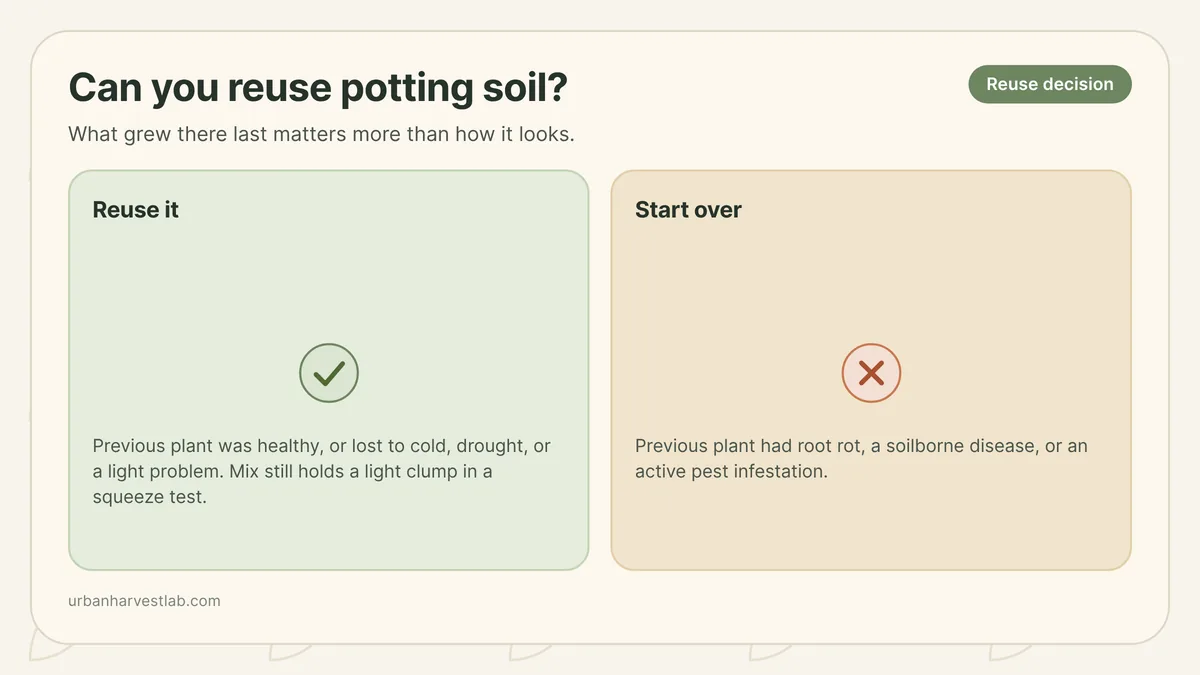
Can you reuse potting soil? When it's safe and when not to
Whether last season's mix belongs back in a pot depends less on how it looks than on what grew in it and why that plant left.
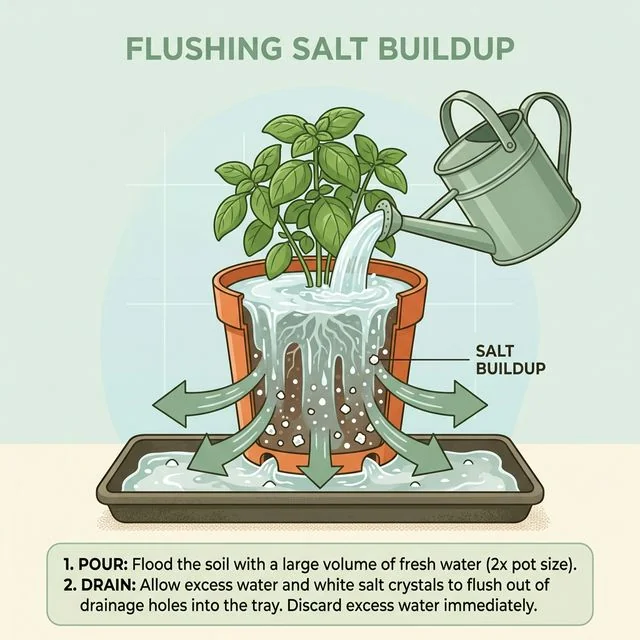
Salt buildup in herb pots: when to flush and when to repot
Every time you water your plants with liquid fertilizer, you are leaving heavy chemical salts behind. If you don't periodically wash them out, your herbs will suffer from chemical burn and nutrient lockout.
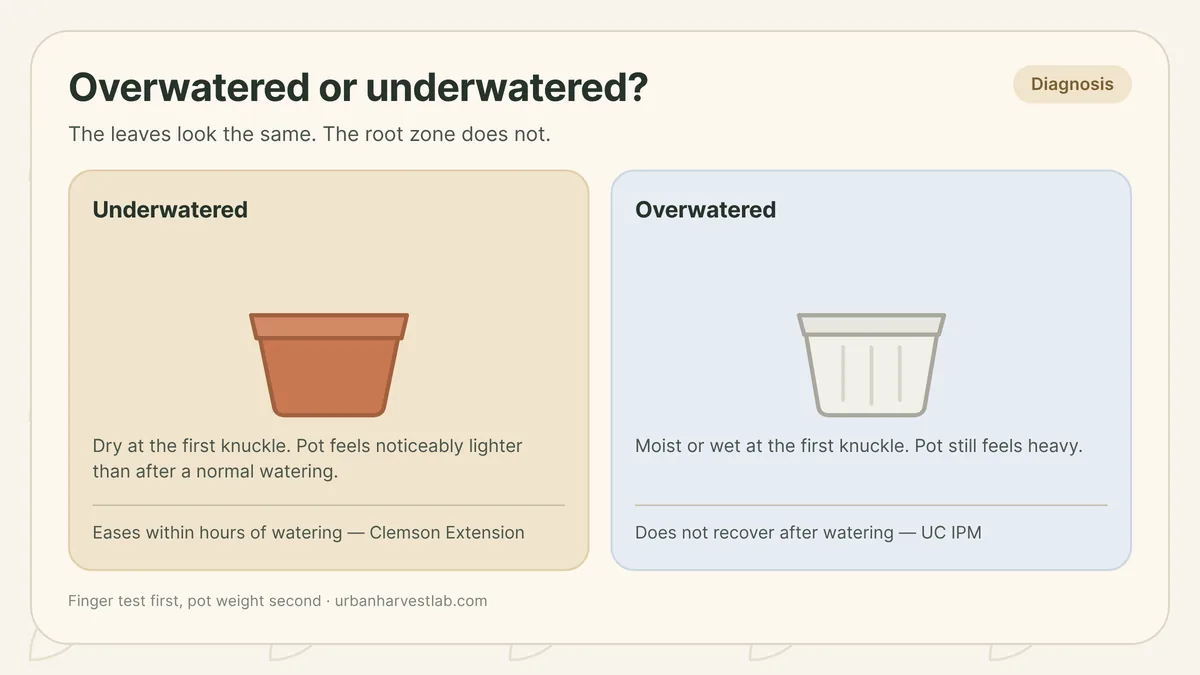
Overwatered vs underwatered: how to tell which one you have
Reading the root zone directly, with a finger test, pot weight, and how the plant responds to being watered, settles what the leaves alone cannot.