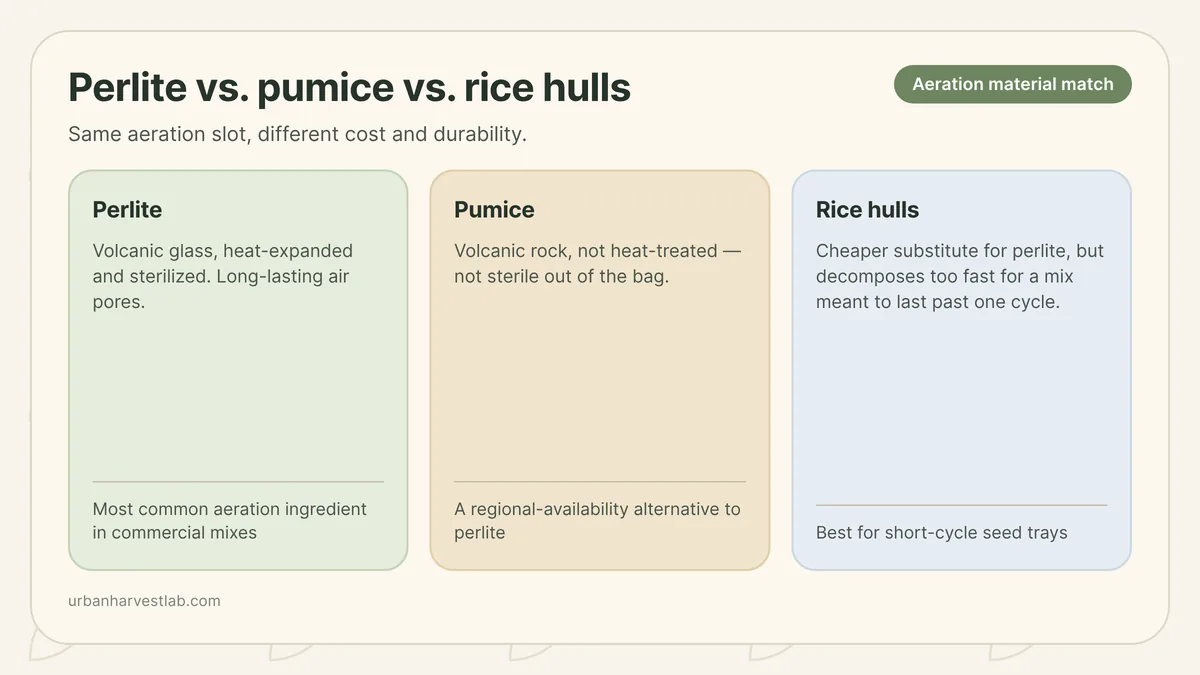
Perlite vs pumice vs rice hulls in the aeration slot of a mix
| Property | Perlite | Pumice | Rice hulls |
|---|---|---|---|
| What it is | Volcanic material expanded with heat, 'puffed up like popcorn' | Volcanic rock, not heat-treated | Hull removed from rice grain (agricultural byproduct) |
| Sterility | Heat-treated in production | Not heat-treated, not sterile | — |
| Cost | Most common aeration component in commercial mixes | — | Cheaper substitute for perlite |
| Durability in the mix | Long-lasting air pores | — | Decomposes too fast for a long-lived mix |
| Weight | Light; dry handling produces dust | — | — |
| Best fit | General-purpose, multi-season mixes | Local substitute where available | Short-cycle seed trays, budget batches |
Perlite is the most durable of the three, with air pores that Iowa State University Extension describes as long-lasting rather than a one-season fix. Rice hulls cost less than perlite but break down too quickly for a mix meant to last past one seedling cycle. Pumice is an unprocessed volcanic rock that is not heat-treated the way perlite is, so it is not sterile.
If you are choosing the whole mix rather than one ingredient in it, how to make potting mix for container vegetables covers the full recipe. What follows sets the three materials competing for that one aeration slot against each other. Vermiculite solves a different problem — moisture retention rather than air — and gets its own comparison against perlite in vermiculite vs perlite.
Volcanic rock, expanded glass, and a rice byproduct
Perlite is expanded volcanic glass. Iowa State University Extension describes it as material “puffed up like popcorn” during heat processing, and calls it the most common aeration component in a soilless mix because that structure creates air pores that hold up over time. UConn Extension’s own list of what goes into a soilless mix names perlite alongside peat, vermiculite, sphagnum moss, and composted bark — the standard aeration ingredient in that lineup, not a substitute for one. It is also the material most growers have already handled: the white flecks visible in almost any bagged soilless mix.
Rice hulls are an agricultural byproduct — the husk removed from the rice grain — sold as a substitute for perlite in commercial and homemade mixes. Iowa State’s own framing is specific about where the swap works: rice hulls suit short-cycle seedling crops, not a mix meant to hold its structure for a year or more, because they decompose faster than perlite does.
Pumice is also a volcanic rock, but it gets to a mix by a different route than perlite: it is not heat-treated, so it is not sterile straight out of the bag. Extension sources describe perlite’s and vermiculite’s properties in detail but do not put a number on pumice’s, so pumice is worth comparing on what it is rather than on measured performance.
Cost: the one clean comparison is rice hulls against perlite
The clearest sourced cost signal sits between perlite and rice hulls. Iowa State positions rice hulls as “a cheaper perlite substitute,” which is the reason growers reach for them at all rather than for any performance advantage. Perlite itself already sits at the inexpensive end of aeration materials generally, which is part of why it is the default aggregate in most bagged soilless mixes rather than a premium add-on.
If cost is the deciding factor for your batch, get a quote from your own local supplier rather than assuming perlite’s typical pricing carries over — availability for a mined volcanic rock varies more by region than a manufactured aggregate does.
Durability: how long the structure holds up in the pot
Perlite’s job is to survive repeated watering cycles. Iowa State calls its air pores “long-lasting,” which is exactly why it remains the default aeration ingredient across multiple growing seasons in the same container rather than something you replace with the mix each year.
Rice hulls trade that longevity for their lower price. Iowa State’s framing is direct about the tradeoff: rice hulls decompose too fast for a long-lived houseplant mix, even while they hold up fine across one seedling cycle. A tray of quick greens or a spring seed-starting batch rarely asks the hulls to last past the point where they have already done their job.
Pumice’s durability across seasons is a different question from its sterility, and only the sterility half is documented here: pumice is not heat-treated the way perlite is, which is a statement about pathogen risk, not about how many seasons a pumice-amended mix holds its structure before it needs replacing.
Handling: dust and compaction
Perlite’s main handling complaint is dust, not weight. Dry perlite “creates significant dust,” per Iowa State, which is a real hazard to breathe or get in your eyes while filling containers indoors. Dampen a bag before working with it, or wear a mask for a large batch.
Handling changes the outcome more than which of the three materials you chose. Iowa State found that tapping a filled container down reduces air-filled pore space from about 15% to 9%, and firmly pressing the mix down reduces it again to roughly 4% — the same handling effect vermiculite vs perlite covers for that pairing. Fill to level, brush off the excess, and let watering settle the mix rather than packing it down.
Neither rice hulls nor pumice carries perlite’s specific dust warning. If a lightweight mix matters — a rooftop container, a hanging basket, a balcony with a load limit — weigh a filled sample pot yourself rather than assume any one of the three is meaningfully lighter.
Sterility is where pumice and perlite genuinely differ
Perlite is produced by heat-expanding volcanic material, and that heat step sterilizes it; pumice is not heat-treated. That matters most for seed starting and rooting cuttings, where a heat-treated component carries a lower assumed pathogen load than one that has not been processed — the one place in this comparison where perlite’s processing gives it a documented edge.
Which one your container actually needs
For a seed tray or a mix you plan to empty and replace each season, rice hulls’ faster breakdown is not a downside — the price advantage is the reason to reach for them, and the shorter lifespan matches a shorter mix anyway. A tray that gets tipped out after one crop of microgreens or one batch of seedlings does not ask the hulls to outlast a full growing season, so the tradeoff that rules them out of a perennial mix does not come into play. Seed-starting mix vs. potting mix covers the rest of what changes about a mix built for that job.
For a mix that needs to hold its structure through multiple seasons in the same pot — a perennial herb, a long-season vegetable, most houseplants — perlite’s documented longevity is the safer default, and it is also the more common aeration component in commercial mixes, so it is what most bagged potting soil already contains before you add anything to it. A container that gets repotted or refreshed only every year or two is exactly the case where a material that keeps its air pores intact matters more than one that is merely cheap up front.
For a container built specifically for propagation, where sterility is the priority, perlite’s heat-treatment step is the one sourced advantage pumice does not share. Outside that specific use, choosing pumice over perlite is closer to a regional-availability and personal-preference decision than one this comparison can resolve with a number — growers near a source of mined pumice sometimes prefer it precisely because it is the locally available rock rather than a shipped-in manufactured aggregate. Once the aeration slot is settled, best potting mix for potted herbs covers how it fits into the rest of the recipe.
Sources
Building the rest of the mix
These guides cover the whole recipe, the moisture-retentive ingredient that solves a different problem, and where a seed-starting mix differs from a general potting mix.
Common questions
What is the difference between perlite and pumice?
Perlite is volcanic material expanded with heat until it puffs up like popcorn, which is also the step that sterilizes it. Pumice is a volcanic rock too, but it is not heat-treated the same way, so it is not sterile out of the bag. Extension sources describe perlite's air pores as long-lasting, but not pumice's.
Is pumice better than perlite for a potting mix?
Neither is a universal upgrade over the other. Perlite is the more common aeration component in commercial soilless mixes and is heat-treated in production, which sterilizes it; pumice is an unprocessed alternative some growers prefer where it is available locally. The choice often comes down to local availability and price rather than a documented performance gap.
Can rice hulls replace perlite?
For a short-cycle seed tray, yes -- rice hulls are described as a cheaper perlite substitute for exactly that use. For a mix meant to hold its structure across a full growing season or longer, rice hulls decompose faster than perlite does, so they are a weaker fit for a long-lived houseplant or perennial mix.
Is pumice sterile like perlite?
No. Perlite is heat-treated in production, which is also what sterilizes it. Pumice is not heat-treated, so it carries more risk of introducing something a heat-treated material would not, which matters most for seed starting and rooting cuttings.
Related guides
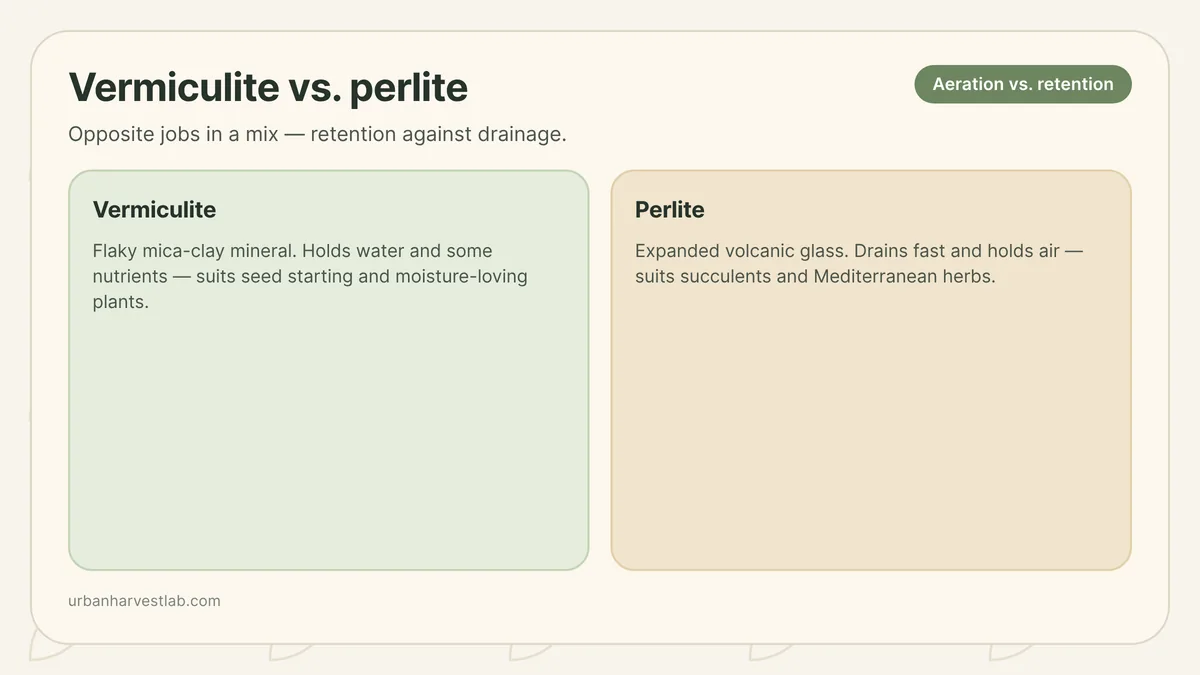
Vermiculite vs perlite: what each one actually does in a mix
Vermiculite and perlite solve opposite problems in a growing medium. Here is which one your container actually needs, and when the answer is both.
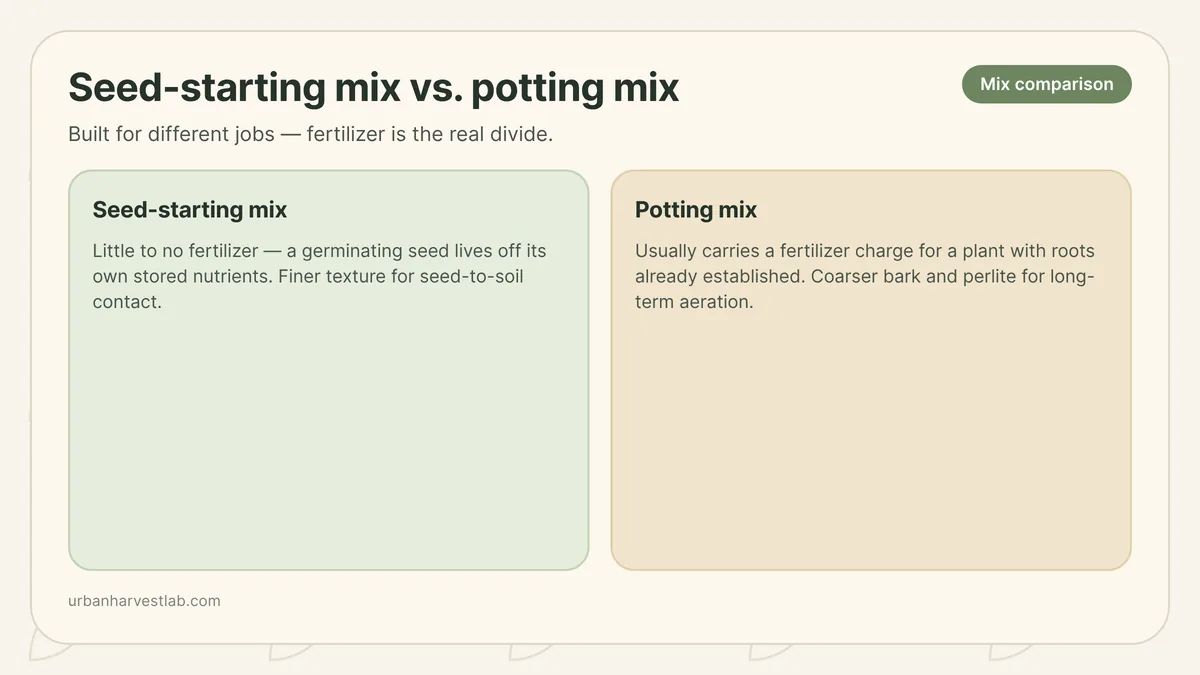
Seed-starting mix vs. potting mix: why your seedlings need a different bag
Potting mix is built to feed an established plant; seed-starting mix is built to stay out of a germinating seed's way. The difference is fertilizer content and particle size, and it matters before the first true leaf appears.
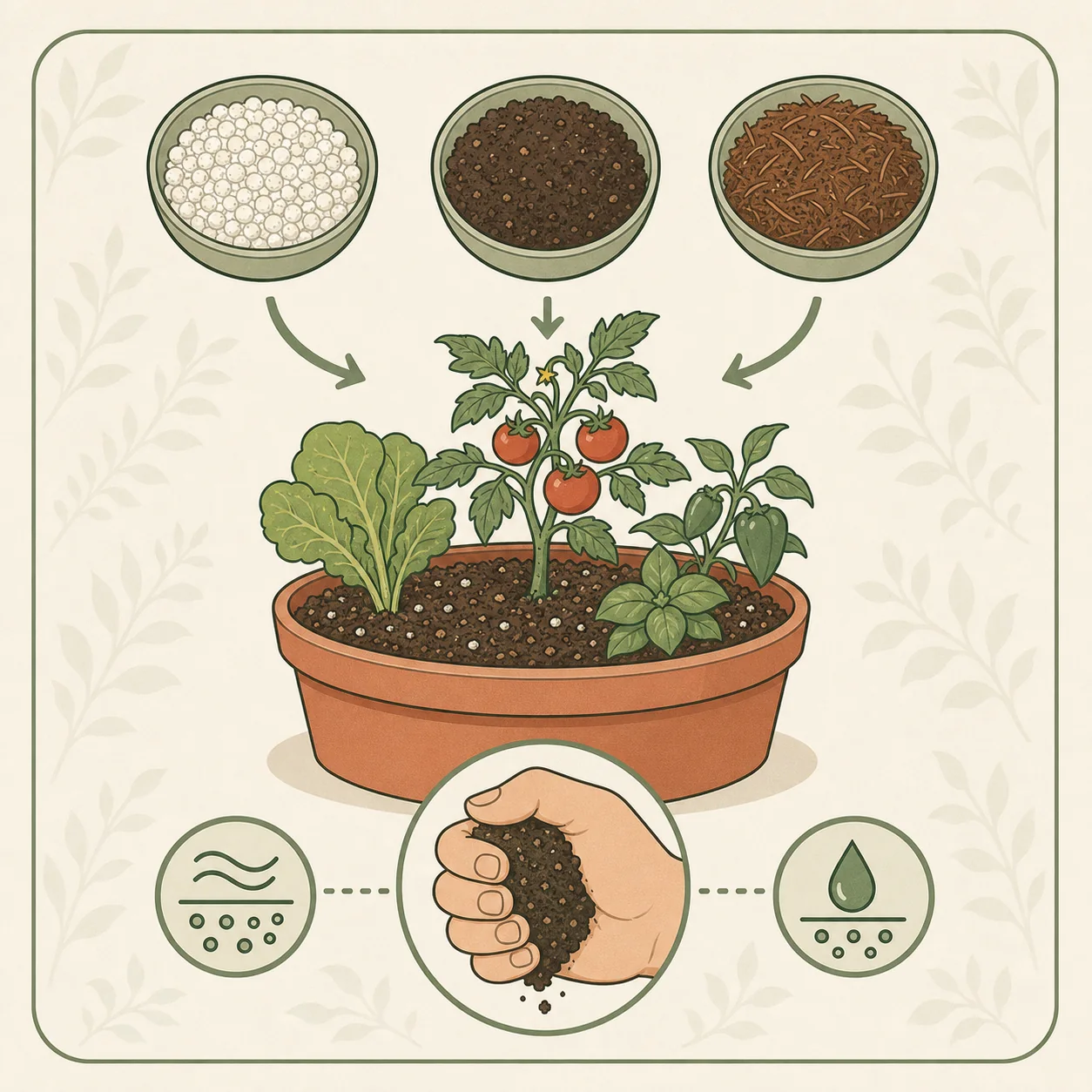
How to make potting mix for container vegetables
A useful potting mix recipe describes the job of each ingredient and gives you a way to correct the result. The goal is stable air and moisture, not a magic ratio.