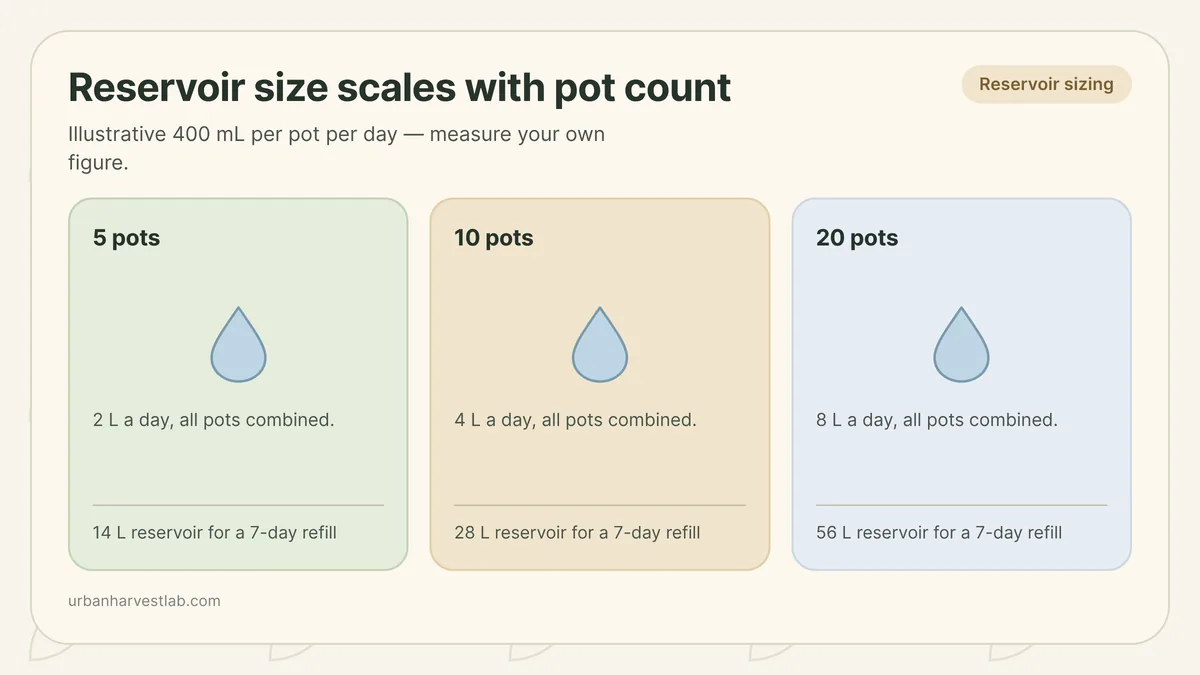
How reservoir size scales with pot count, using an illustrative 400 mL per pot per day to show the arithmetic — measure your own figure instead of reusing this one
| Pots | Daily total | Reservoir for 3 days | Reservoir for 7 days |
|---|---|---|---|
| 5 | 2 L | 6 L | 14 L |
| 10 | 4 L | 12 L | 28 L |
| 20 | 8 L | 24 L | 56 L |
A balcony drip system needs two numbers you already control: how much water your pots use in a day, and how many days you want to go between refills. Multiply those together for the reservoir size, then divide the daily volume by your emitters’ combined flow rate to find out how many minutes a day the line needs to run. Everything else — tubing, stakes, a filter — is fixed hardware that does not change with pot count.
Reservoir, tubing, emitters: the whole system
A balcony drip system with its own reservoir has no connection to an outdoor tap. Instead, a container of water — a jerry can, a rain barrel, a large jug — sits somewhere above or level with the pots, and gravity (or a small pump, if the reservoir has to sit low) pushes water through a length of drip tubing. Individual emitters, sometimes called drippers, branch off that main line into each pot at a slow, steady rate measured in liters or gallons per hour.
That is the whole system: a reservoir, a supply line, emitters, and a way to trigger it (a manual valve, or a battery timer if you want it automatic). None of it needs plumbing. It sits alongside the simpler options covered in the small-space herb gardening hub as one way to keep a row of pots watered without carrying a can to each one.
The two design questions are the same regardless of how many pots you have: how many emitters, and how large a reservoir.
Find your own daily water number first
There is no single gallons-per-pot-per-day figure that holds across a balcony, because the two things that move it most — pot size and weather — vary too much from one setup to the next. Iowa State University Extension replaces a fixed number with a test: water a container “when the potting mix is dry at a depth of 1 to 2 inches,” and expect the frequency that follows to swing “from once or twice a day (small container, hot, windy weather) to once or twice a week (large container, cool weather).” That range is the starting point for a sizing calculation — not a number to plug in directly, but the boundary your own pots will fall somewhere inside. The by-herb detail behind that range is covered in how often to water potted herbs; sizing a drip system only needs the number that test produces for your own pots.
To turn that into a number the calculator below can use, water a pot by hand for three or four days the way you normally would, and measure what actually goes in — a kitchen measuring cup or a jug with graduations works fine. Do that once for a representative pot of each size you have — a small windowsill pot and a large planter will not use the same amount. If you have not settled on pot sizes yet, start with sizing herb pots by container. Either way, you end up with a daily estimate specific to your balcony rather than a number borrowed from somewhere else. If your pots vary a lot in size, run the calculator once per size group and add the reservoir volumes together.
Size your own system
Live estimate
Enter your own measured daily water use per pot — not a guess — along with the emitter flow rate printed on the packaging.
Reservoir size needed
—
for the refill interval you set
- Total emitters
- —
- Daily water, all pots
- —
- Combined flow rate
- —
- Daily line runtime
- —
Fill in pot count, emitters per pot, daily water estimate, and emitter flow rate.
Work it out by hand
The calculator is doing four multiplications you can just as easily do at the kitchen table.
Take 10 pots, each measured at 16 fl oz of water a day, one 0.5-GPH emitter per pot, and a target of 5 days between refills:
- Total daily water:
10 pots × 16 fl oz = 160 fl oz, which is160 ÷ 128 = 1.25 gal. - Total flow rate:
10 emitters × 0.5 GPH = 5 GPH. - Daily runtime:
1.25 gal ÷ 5 GPH × 60 = 15 minutes a day. - Reservoir size:
1.25 gal × 5 days = 6.25 gal.
Change any one input and the other three move with it — double the pots and, everything else equal, both the runtime and the reservoir size double too.
Positioning the reservoir and running the line
A gravity-fed system needs the reservoir to sit above the pots it feeds; the greater the height difference, the more consistent the flow through the tubing. A shelf, a railing bracket, or an upturned crate under the container is usually enough on a balcony. If there is nowhere higher to put it — a ground-level container garden against a wall, for instance — a small battery-powered pump replaces gravity and lets the reservoir sit level with or below the pots.
The flow rate printed on an emitter’s packaging is measured at a supply pressure a gravity-fed reservoir does not reach, so the runtime the calculator above gives is a starting figure, not a guarantee — time one actual fill into a measuring jug once the system is running and adjust the number you feed back in from there.
Run the main supply line along the back of the row, out of the main walking path, and branch a short length of narrower tubing off it into each pot with a single emitter pushed into the soil near the base of the plant. A pot much larger than the rest of the row, or one holding more than one plant, is the case for adding a second emitter rather than relying on one to cover the whole surface. Stake the tubing down at a few points so wind does not walk it out of the pots — the same wind that Iowa State’s frequency range already flags as the reason a small, exposed container can need water once or twice a day.
A simple in-line filter ahead of the emitters, and flushing the line with clean water before the first use, is the standard precaution against the fine particulate that clogs narrow-bore drippers over a season.
Adjust after the first week
Treat the first calculator result as a starting point, not a fixed setting. After a week, check a few pots with the same finger-depth test used to build your original estimate — dry at 1 to 2 inches deep is Iowa State’s trigger point. If the mix is staying wetter than that between waterings, shorten the runtime or drop to a lower-flow emitter; if pots are drying out well before the next scheduled watering, lengthen the runtime or move to a shorter refill interval and a larger reservoir. A pot found bone dry — because the reservoir ran out or an emitter clogged — will not be fixed by simply restarting the line: Iowa State University Extension’s fix for a fully dried-out container is to stand the whole pot in a tub of water for 20 to 30 minutes to remoisten the mix before putting it back on the drip line.
Weather changes the answer more than anything else does. A run of hot, windy days will pull pots toward the “once or twice a day” end of Iowa State’s range even on a system that was sized correctly for a cooler week, so re-check rather than assuming a single setting holds all season.
Judge the adjustment by the root zone, not the leaves. Clemson Cooperative Extension points out that “the symptoms of over-watering and underwatering are similar,” both leading to poor root health — so a drooping plant on a drip system does not by itself tell you whether to lengthen the runtime or shorten it. The finger-depth test settles that question when a wilted leaf cannot.
When a full drip system is more than you need
A reservoir, tubing, and a dozen emitters is worth building when hand-watering ten or more pots has become the daily chore you are trying to get out of. It is more setup than a smaller balcony needs.
For five pots or fewer, a self-watering pot does a similar job per-container, with a built-in reservoir and a wick instead of a pump line — no tubing to run, no emitters to clog, at the cost of building or buying that system pot by pot rather than once for the whole row. If the real problem is a single upcoming trip rather than an everyday routine, the wick and capillary-mat methods in watering potted herbs while on vacation solve that without any of the hardware here.
Somewhere between those two and a full drip system is a middle case: a dozen pots you water daily anyway, where a simpler shared reservoir with wicks into each pot might do the job without tubing at all. Size that the same way — daily water per pot times pot count times refill interval — even without emitters or a flow rate in the picture.
Common mistakes that throw the numbers off
- Reusing someone else’s per-pot figure. A number measured on a large, shaded pot will undersize a system built around small, sun-exposed pots, and the other way around. Measure your own.
- Ignoring the emitter’s actual rated flow. Two emitters that look identical can carry very different GPH or L/h ratings; the number on the packaging, not the appearance of the part, goes into the calculation.
- Sizing the reservoir for an average day instead of the driest one. A refill interval built around a mild week will come up short the first time a hot, windy stretch pushes water use toward the top of Iowa State’s frequency range.
- Skipping the finger-depth check after installation. The calculator gives a starting runtime and reservoir size, not a permanent setting — confirm it against the actual soil before leaving it unattended for a week.
Sources
Watering setups worth comparing
A drip line is one way to keep balcony pots watered without a tap. These cover the other routes and the routine underneath all of them.
Common questions
How many drip emitters do I need for 10 pots?
Start at one emitter per pot, so 10 pots means 10 emitters, and add a second emitter only to a pot that is unusually large or holds more than one plant. Divide your target daily water volume by the total flow rate printed on the emitter packaging to check the line can actually deliver that much in a reasonable run time.
How big should the reservoir be for a balcony drip system?
Multiply your estimated daily water use per pot by the number of pots, then by how many days you want between refills. A reservoir sized for three to seven days gives a workable buffer without needing a tank too heavy to lift and refill.
Do I need a pump for a balcony drip system with a reservoir?
Not necessarily — a reservoir set higher than the pots pushes water through the tubing on gravity alone for many setups, but it delivers less than the emitter's rated flow, since that rating is measured at a supply pressure gravity does not reach. A small pump buys back a predictable rate, and becomes necessary once the reservoir has to sit level with or below the pots it is feeding.
Is a drip system worth building for just a few pots?
For five pots or fewer, a wick setup or a self-watering pot is usually quicker to build and maintain than a full drip line with tubing, emitters, and a reservoir. Save the drip system for ten pots and up, where watering each container by hand has become the real chore.
Related guides
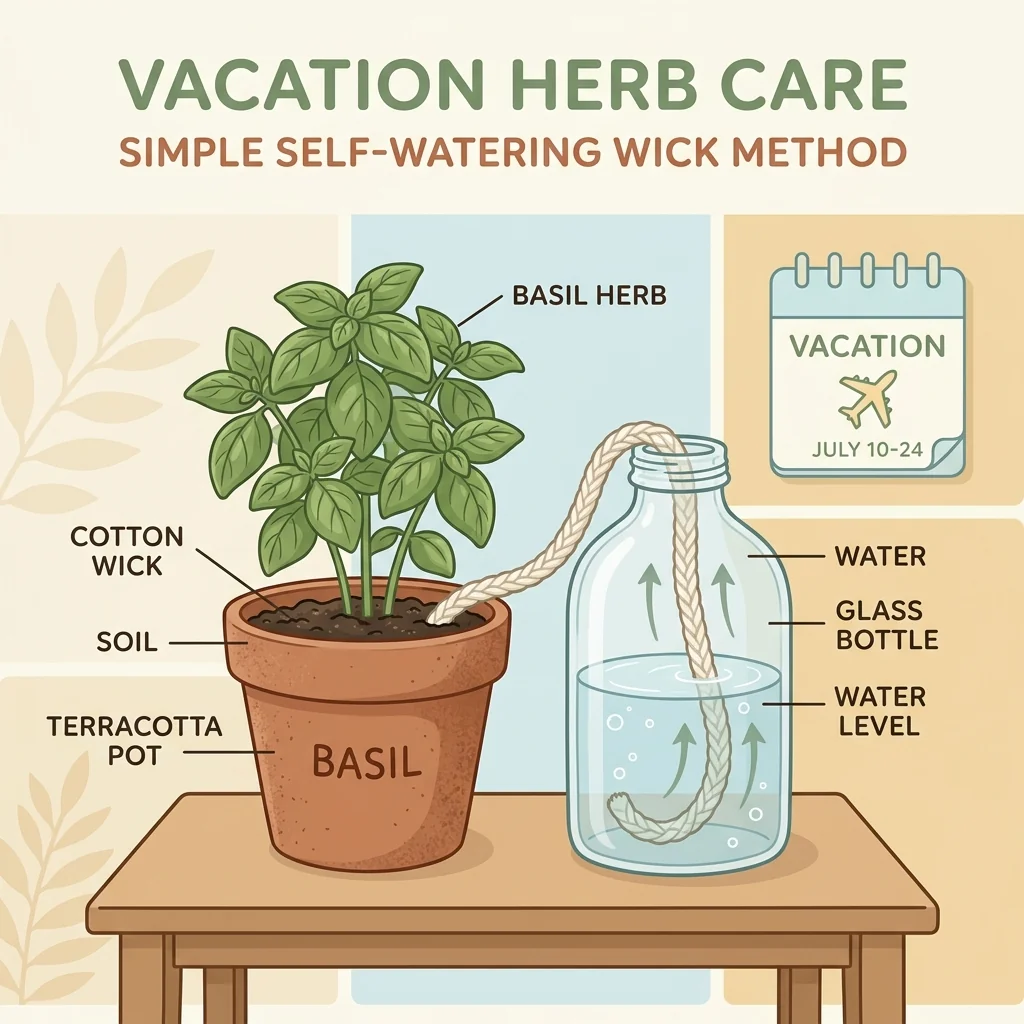
How to water potted herbs while on vacation: 5 foolproof methods
Potted herbs are notoriously sensitive to drying out. If you leave your apartment for a week without a plan, you will return to a graveyard of crispy, brown basil and dead mint. Here are five simple, passive self-watering systems you can build in minutes.
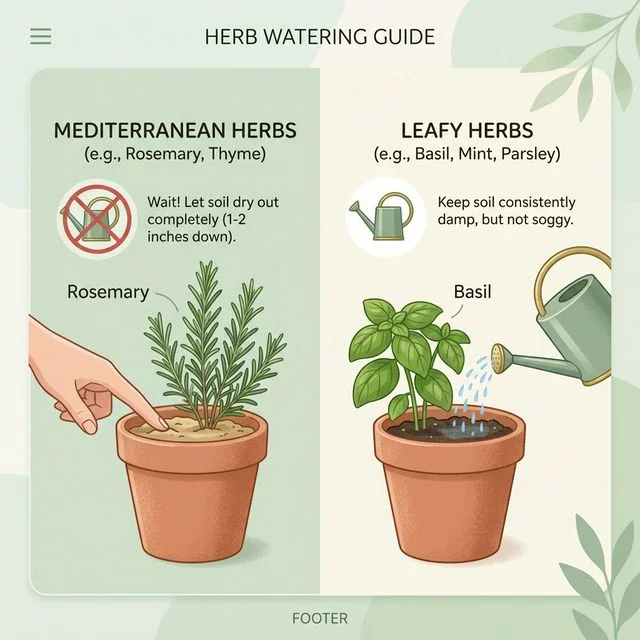
How often to water potted herbs: a by-herb chart
Most potted herbs should be checked often but watered only when the root zone is actually drying. Judge the pot instead of following a rigid calendar.
Small-space herb gardening: start here for apartments, balconies, and indoor setups
A navigation hub for apartment, balcony, and indoor herb gardening that connects the core setup, herb selection, light, container, and care guides in the right order.