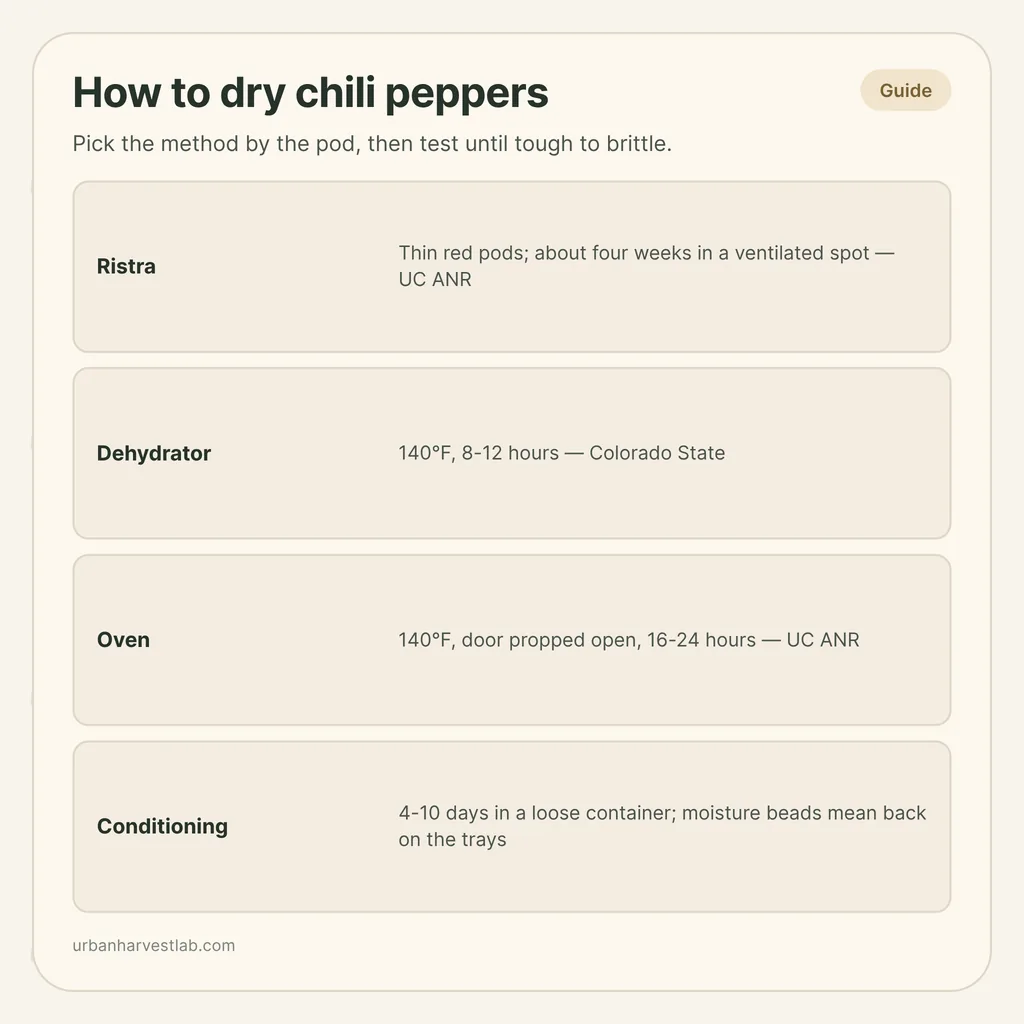
Three ways to dry chili peppers, as extension services describe them
| Method | Settings and time | Best for |
|---|---|---|
| Ristra (air drying) | Dry, well-ventilated spot; about four weeks (UC ANR) | Mature red pods with thin walls and pliable stems |
| Dehydrator | 140°F (Colorado State); 8-12 hours (Colorado State, UC ANR) | Sliced or thick-walled pods |
| Oven | 140°F with the door propped open; 16-24 hours (UC ANR) | A small batch when you have no dehydrator |
Colorado State Extension dries sliced pods at 140°F in a dehydrator or oven; Utah State Extension hangs thin pods on a string in a dry, well-ventilated spot. Either way, the peppers are finished when they are tough to brittle, and they need a few days in a loosely covered container before they go into a jar.
Peppers are not herbs. The method in drying herbs at home suits thin leaves; a pod with a wall of flesh holds far more water. NMSU’s postharvest guide puts the moisture of field-picked red chile at 65 to 80 percent, and commercial chile is dried to 8 to 12 percent.
Pick the method by the pod
Thin red pods with pliable stems suit a string (NMSU, Utah State). Thick-walled pods are better sliced and dried in a dehydrator or oven, as Colorado State directs, because NMSU says they may deteriorate on a ristra. UC ANR warns that high humidity can spoil pods hanging on a string.
Hang a ristra
Utah State Extension describes the method in one line: tie the stems of chile pods onto a string and hang them in a dry, well-ventilated location.
NMSU Extension says green chile is not acceptable for a ristra, because pods that have not matured only shrivel and turn a dull orange. Choose pods that are mature but still fresh, red, free of blemishes and straight, with pliable stems. NMSU also warns that many modern New Mexican-type cultivars have been bred for thick walls. Those pods do not readily dry, or may deteriorate rather than dry, when hung on a ristra. Small, thin pods suit a string better.
UC ANR’s version for a few pods: cut a slit in each stem, thread light string or heavy thread through with a large crafting needle, and hang the string in a well-ventilated room, because high humidity can cause the peppers to spoil. It expects about four weeks. NMSU Extension adds that a ristra should hang out of direct sunlight to keep its color, and away from moisture to prevent mold.
One warning for ristras bought or kept as decoration: NMSU says pods sprayed with plastic, shellac or insecticide are not edible and are for decoration only.
Dry slices in a dehydrator
Colorado State Extension’s steps for hot peppers:
- Wash the peppers and drain them well.
- Put gloves on. Remove the stem, core, partitions and seeds, and cut into 1/4 to 3/8-inch strips or rings.
- Spread the pieces in single layers on the trays.
- Dry at 140°F. Turn large pieces every 3 to 4 hours if needed.
- Watch the last stretch. Colorado State notes that vegetables scorch easily toward the end of drying.
Total time is 8 to 12 hours in a dehydrator. UC ANR’s dehydrator method also removes stems and cores and cuts 3/8-inch disks, and gives the same 8 to 12 hours. NMSU Extension’s chile program gives a wider dehydrator range of 125-140°F and says drying generally takes 8 to 24 hours depending on pod size and the machine. A larger pod or a thicker slice lands at the long end.
If you do not own a dehydrator yet, you can browse food dehydrators on Amazon; the oven method below works without one.
Dry them in the oven
UC ANR says to make sure the oven can be set to 140°F, because any higher temperature will cook, not dehydrate, the peppers. NMSU Extension recommends testing the oven’s lowest setting with an oven thermometer, since a thermostat that does not go that low cooks the food instead of drying it.
UC ANR’s setup:
- Place the peppers in a single layer on a tray or cooling rack rather than directly on the oven rack.
- Prop the oven door open two to six inches for the whole drying time.
- UC ANR expects 16 to 24 hours, about twice a dehydrator’s 8 to 12; NMSU says an oven takes 2 to 3 times longer.
NMSU Extension notes that oven-dried food is usually darker, more brittle and less flavorful than dehydrator food, and suggests lowering the oven to 120°F near the end, if possible, to prevent scorching.
Test, condition and store
Dried peppers should be tough to brittle, according to Colorado State Extension. Clemson Extension gives brittle, about 10 percent moisture, for vegetables in general, and says they do not need conditioning; Colorado State still calls for conditioning peppers.
Do not jar them straight from the tray. Colorado State has you cool the pieces, then put them loosely in a large plastic or glass container, about two-thirds full, lightly covered, in a dry, well-ventilated place for 4 to 10 days. Shake the container daily. If beads of moisture form inside, the peppers go back on the trays, and the conditioning repeats.
Then store small amounts in moisture-vapor-proof containers, labeled with the date. Utah State Extension stores dried chile in plastic bags or glass jars at room temperature, while NMSU’s slides say “for optimal long-term storage USDA recommends that even dehydrated food be placed in a fridge or freezer.” Colorado State says properly stored dried vegetables keep 6 to 12 months and adds to discard anything with off odors or mold. UC ANR notes that plastic freezer bags are not rodent proof.
If pods came off a ristra or sat outside, UC ANR pasteurizes dried peppers to kill insects and eggs: freeze them in a sealed bag at 0°F or below for 48 hours, or spread them on a tray in an oven preheated to 160°F for 30 minutes.
Handle the heat
Utah State Extension says handling pungent chile can burn hands and eyes: wear plastic gloves and keep your hands away from your eyes. Capsaicin sits mostly in the white membranes and seeds, according to NMSU Extension, and Utah State notes that neither heating nor freezing reduces the heat of a chile, but removing the veins does. That is why removing the partitions and seeds, as Colorado State directs, also takes the sting down.
If the harvest tastes mild, the reason lies in variety, ripeness and weather rather than in how you dried it; see why peppers are not hot. Plants that are still healthy at frost can go indoors instead of being pulled: overwintering peppers covers it, and pepper pot size helps you plan next year’s containers.
Sources
- Utah State University Extension, How to Preserve Chiles
- Colorado State University Extension, Preserve Smart: Drying Peppers-Hot
- UC ANR, Drying peppers
- NMSU, Using Chile to Make Ristras and Chile Sauce (E-327)
- NMSU, Postharvest Handling of Dehydrated Chiles (H-236)
- NMSU Extension, Preserving Red Chile: dehydrating
- Clemson Extension, Drying Vegetables
Peppers, from pot to pantry
Related guides for the plant before harvest and the plant after it.
Common questions
What temperature should I dry chili peppers at?
Colorado State Extension dries hot peppers at 140°F in an oven or dehydrator, and UC ANR warns that any higher oven temperature will cook the peppers rather than dehydrate them. NMSU Extension gives a dehydrator range of 125-140°F for chile.
How long does it take to dry chili peppers?
Colorado State Extension gives 8-12 hours in a dehydrator and up to twice as long in a conventional oven; UC ANR gives 16-24 hours for the oven. A string of whole pods in a ventilated room takes about four weeks, according to UC ANR.
Can I air-dry jalapeños on a string?
NMSU Extension says thick-walled chile cultivars do not readily dry on a ristra and may deteriorate instead. Slicing the pods and using a dehydrator or oven is the safer route for fleshy types.
How do I know the peppers are dry enough to store?
Colorado State Extension describes dried peppers as tough to brittle. After drying, it has you hold them loosely in a container for 4 to 10 days; if beads of moisture form inside, they go back on the trays.
Related guides

Overwintering pepper plants: how to carry one through to spring
Frost kills a pepper plant back every winter, but the plant itself is not actually an annual. Here is the tender-perennial method for carrying one over instead of starting from seed again.
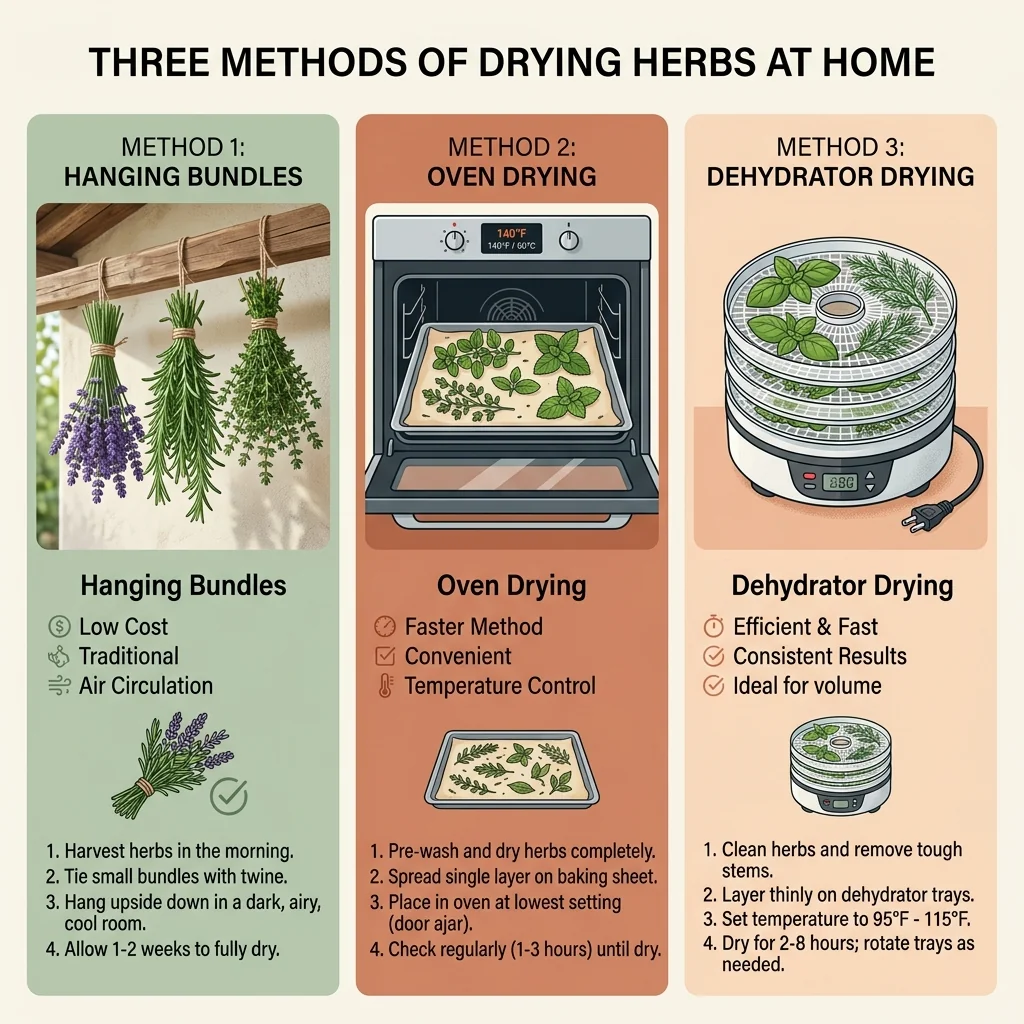
How to dry herbs at home (air, oven, dehydrator)
Drying is the best way to preserve woody herbs like rosemary, thyme, and oregano. Here are three methods, the temperatures to use, and which herbs to skip.
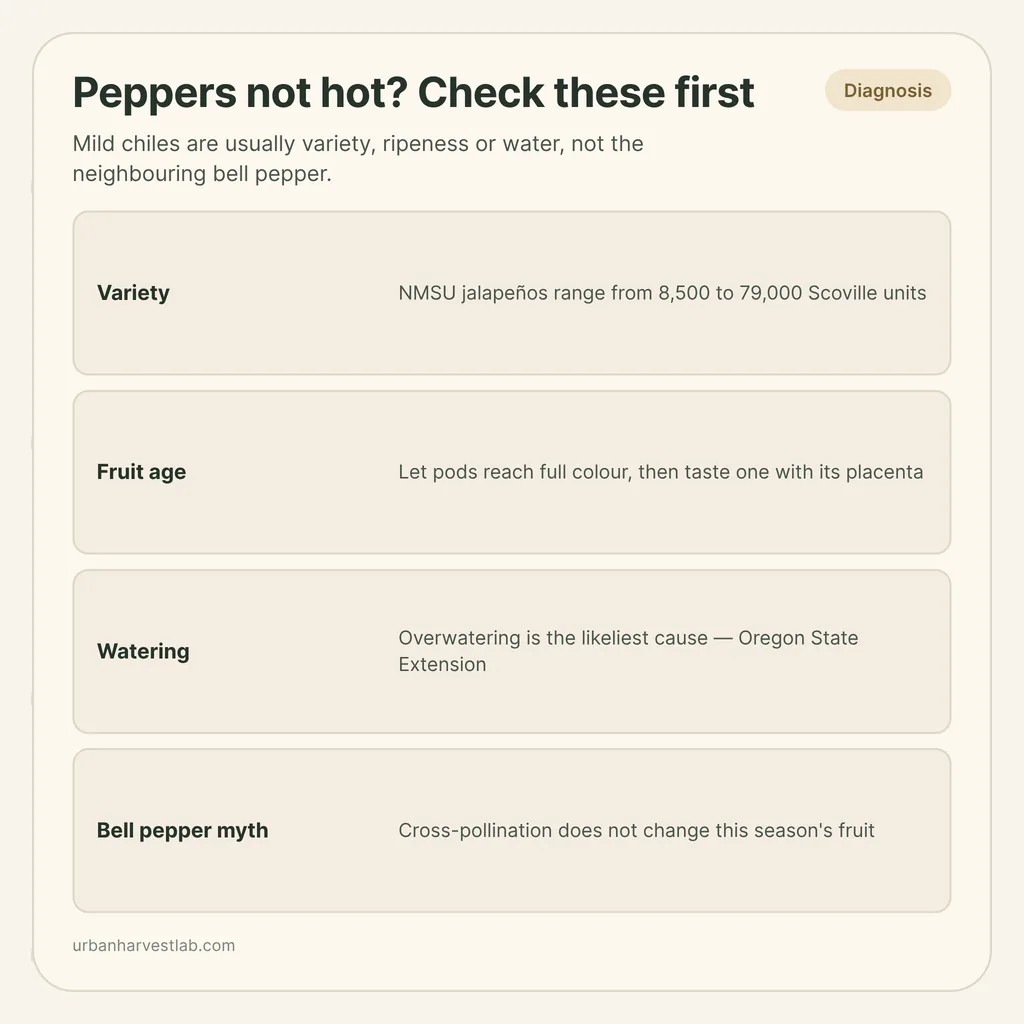
Why are my peppers not hot? Variety, ripeness, water and weather
Heat in a chile pepper is set by genetics first, then by weather, growing conditions and fruit age. Cross-pollination from a nearby bell pepper does not change this year's fruit.