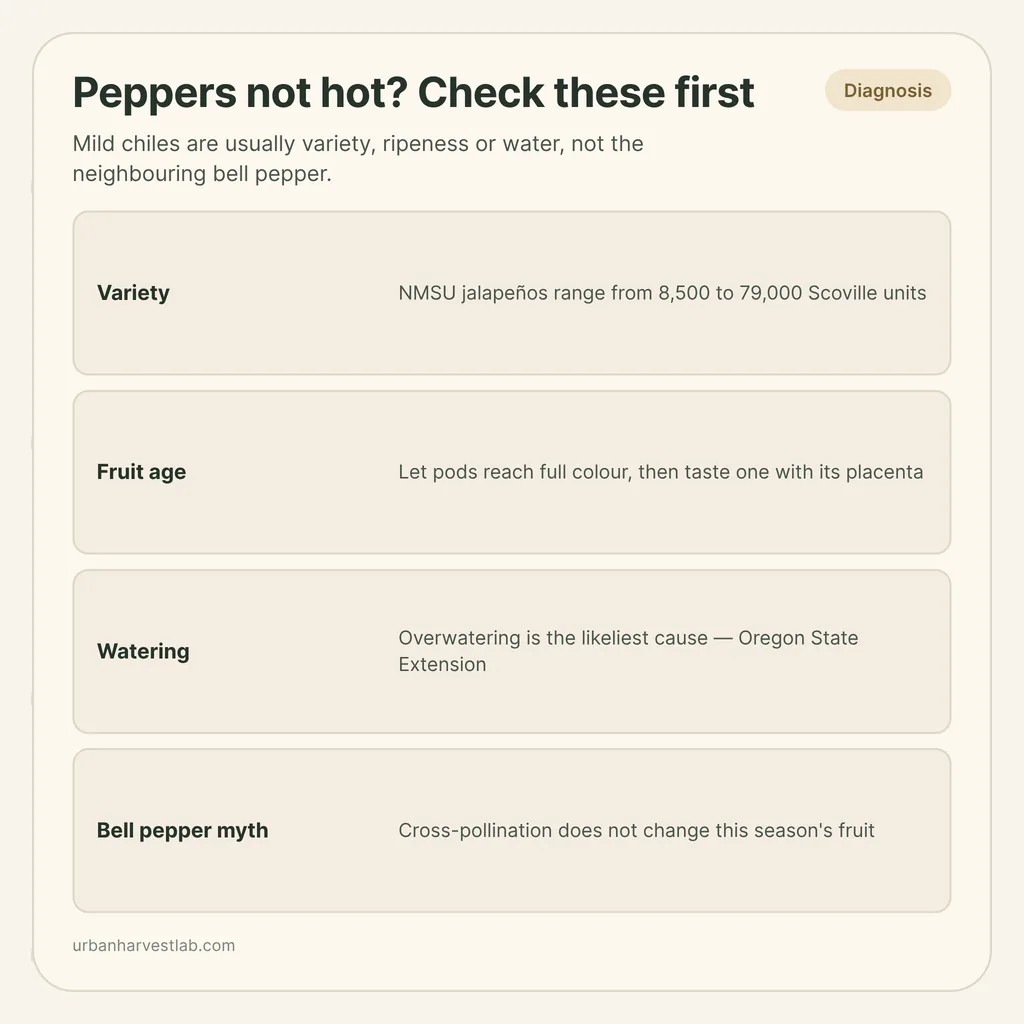
Troubleshoot the system before you change the inputs.
Symptoms
- Jalapeños, habaneros or other chiles taste mild or have almost no burn.
- The plant is healthy and fruiting, and fruit shape and colour look normal for the variety.
- Pods were picked early and green, or the plant sits in soil that stays wet.
Possible causes
- A variety that is mild or bred for no heat, or a pod at the low end of its normal range.
- Fruit picked before it matured, since NMSU lists fruit age as a factor in heat.
- Overwatering, which Oregon State Extension names as the most likely cause of mild jalapeños and habaneros.
- A cool or otherwise different season from the one the heat rating was measured in.
Quick fixes
- Check the seed packet or plant tag for the variety and its heat rating before changing anything else.
- Let pods reach full colour and taste one before judging the plant.
- Water when the top of the mix is dry rather than on a schedule, and make sure the pot drains.
- Ignore the bell pepper next door; it is not the cause.
Mild chile peppers are usually a variety, fruit-age or watering issue, not a pollination one. New Mexico State University (NMSU) says genetics, weather, growing conditions and fruit age all affect heat. Start with what you planted, then look at how ripe the pods were and how wet the pot stays.
A plant that sets no fruit at all has a different problem, covered in pepper plant not producing. Here the plant fruits fine and the pods taste weak.
What makes a pepper hot
The burn comes from capsaicinoids. NMSU’s Chile Pepper Institute describes them as compounds produced in glands on the fruit’s placenta, the pale ribs inside the pod. The seeds are not the source of heat, though they touch the placenta and pick up some of it.
That matters for the fixes below. The pod makes its own heat as it develops, so what changes the result is what the plant experienced while the fruit grew, plus the genes it started with.
Check the variety first
Genetics set the range, and the range is wide. NMSU’s cultivar list shows how far apart named varieties of the same type sit:
| Type | Variety | Heat (Scoville units) |
|---|---|---|
| Jalapeño | NuMex Primavera | 8,500 |
| Jalapeño | NuMex Vaquero | 33,000 |
| Jalapeño | NuMex Orange Spice | 79,000 |
| Habanero | NuMex Suave Orange | 335 |
| Habanero | NuMex Suave Red | 774 |
A habanero that measures 335 is milder than many jalapeños, and NMSU lists one habanero cultivar, NuMex Trick-or-Treat, at 0. NMSU describes a no-heat cultivar as one with capsaicinoids under 10 parts per million, below what people can sense. If your seedlings came from a generic “hot pepper” tray, a mild variety is a real possibility. Check the tag or packet.
Even a standard variety is a range, not a fixed number. Oregon State Extension gives jalapeños a natural range of 2,500 to 8,000 Scoville units, and NMSU says the heat levels it publishes are averages that can vary by year and growing location. A mild pod can be a normal pod.
Check the pod’s age
NMSU lists fruit age among the factors behind heat. A Texas A&M habanero study listed fruit maturity alongside genetics and location, and harvested fully coloured, mature fruit for its measurements. The same study found capsaicin is unevenly distributed, concentrated in the placenta and cross-walls, so taste the ribs, not just the outer flesh.
So before you decide the plant is mild, let a few pods reach full colour, then taste one with its placenta. The ripeness page, when container vegetables are ripe, covers colour stages for peppers.
Overwatering is the likeliest garden cause
Oregon State Extension, answering a gardener whose jalapeños and habaneros had no heat, said overwatering could lead to reduced heat, and that it seemed the most likely cause. It added that water stress can significantly affect capsaicinoid accumulation, and that nutrient deficiencies can stunt growth and fruit development.
A container makes this easy to get wrong, because a pot with poor drainage stays wet around the roots. Water when the top of the mix is dry and let excess run out. The schedule and the finger test are in how often to water container vegetables, and overwatered versus underwatered helps if you cannot tell which you have.
Should you deliberately stress the plant?
Be careful here. NMSU says growers may subject plants to different amounts of stress that can produce hotter pods, and Oregon State suggests allowing more stress on the plants. But the evidence has limits.
In a Khon Kaen University and NMSU trial, nine cultivars were given reduced water, water cut by 25, 50 and then 75 percent by volume at 10, 20 and 30 days after flowering, so the last stage got a quarter of the control plants’ water. Capsaicinoid levels increased in every cultivar except the high-heat group. Yield fell in the low-heat group. In other words, stress raised heat in the mild cultivars that would benefit, and it cost those same plants some of their crop. The trial used controlled, gradual reductions, not a pot left to dry out in a heat wave.
For a balcony, that means a modest step: stop watering on a timer and water only when the mix is dry. Do not let a pot wilt hard repeatedly. A plant that drops its flowers has no pods to be hot, as the not-producing page explains.
The season matters too
The Texas A&M study grew the same habanero genotypes at three Texas locations. Fruit at Weslaco was larger and held more capsaicin and dihydrocapsaicin than fruit from Uvalde or College Station. Same genes, different place, different heat. Treat a cool or unusual summer as one reason a familiar variety tastes different this year.
The cross-pollination myth
The common explanation is that a bell pepper planted nearby “cooled down” the chiles. Oregon State Extension answered exactly this question. Cross-pollination between hot and bell peppers could theoretically affect the seeds of the next generation, but it does not impact the heat level of the current season’s fruit. The pod’s flesh and placenta are the parent plant’s tissue.
What the myth is partly right about is next year. If you save seed from fruit on a plant that sat beside another variety, those seeds may grow into plants with mixed traits, including a different heat. For saved seed, separate varieties. For this season’s peppers, the neighbour is not the problem.
What to do, in order
- Find the variety name and its heat rating. If it is a mild type, nothing is wrong.
- Let pods reach full colour before judging, and taste the placenta.
- Ease off watering: water when the mix is dry, with drainage that works.
- Treat an unusual season as a possible factor, not a defect.
- Skip the hunt for a bell pepper to move away. For next year, choose a variety with a higher published rating, and save seed only from isolated plants.
Sources
- New Mexico State University, “The Chile Cultivars of New Mexico State University, 1913-2022” (Circular 706)
- Oregon State University Extension, “My hot peppers weren’t hot. Why?”
- Phimchan, Techawongstien, Chanthai and Bosland, “Impact of Drought Stress on the Accumulation of Capsaicinoids in Capsicum Cultivars with Different Initial Capsaicinoid Levels,” HortScience 47(9), 2012
- Butcher et al., “Environmental and Genotypic Variation of Capsaicinoid and Flavonoid Concentrations in Habanero Peppers,” HortScience 47(5), 2012
Related pepper pages
Fruit set, pot size and watering each have their own page once you know where your plant falls short.
Common questions
Why are my hot peppers not hot?
Start with the variety, then fruit age, watering and weather. New Mexico State University says genetics, weather, growing conditions and fruit age affect capsaicinoid content. Oregon State Extension names overwatering as the most likely cause of mild jalapeños and habaneros.
Does growing bell peppers next to chiles make the chiles milder?
No. Oregon State Extension says cross-pollination between hot and bell peppers could affect the seeds of the next generation, but not the heat of the current season's fruit. Only seed you save from those fruit would carry mixed genes.
Can I make my peppers hotter by stressing the plant?
Possibly, with a cost. In a Khon Kaen University and NMSU trial, capsaicinoids rose under drought in every cultivar except the high-heat group, but yield fell in the low-heat group. NMSU says only that stress may produce hotter pods. A pot that dries out completely also risks flower and fruit drop.
Are my jalapeños just a mild batch?
Possibly. Oregon State Extension gives jalapeños a natural range of 2,500 to 8,000 Scoville units, and NMSU says listed heat levels are averages that vary by year and growing location. A pod at the low end of the range tastes mild even when nothing went wrong.
Related guides

Pepper plant not producing: why flowers drop and no fruit forms
Flowers that open and fall without setting fruit point to temperature, nitrogen, water, shade or wind. Work through them in order and match each to what you see.
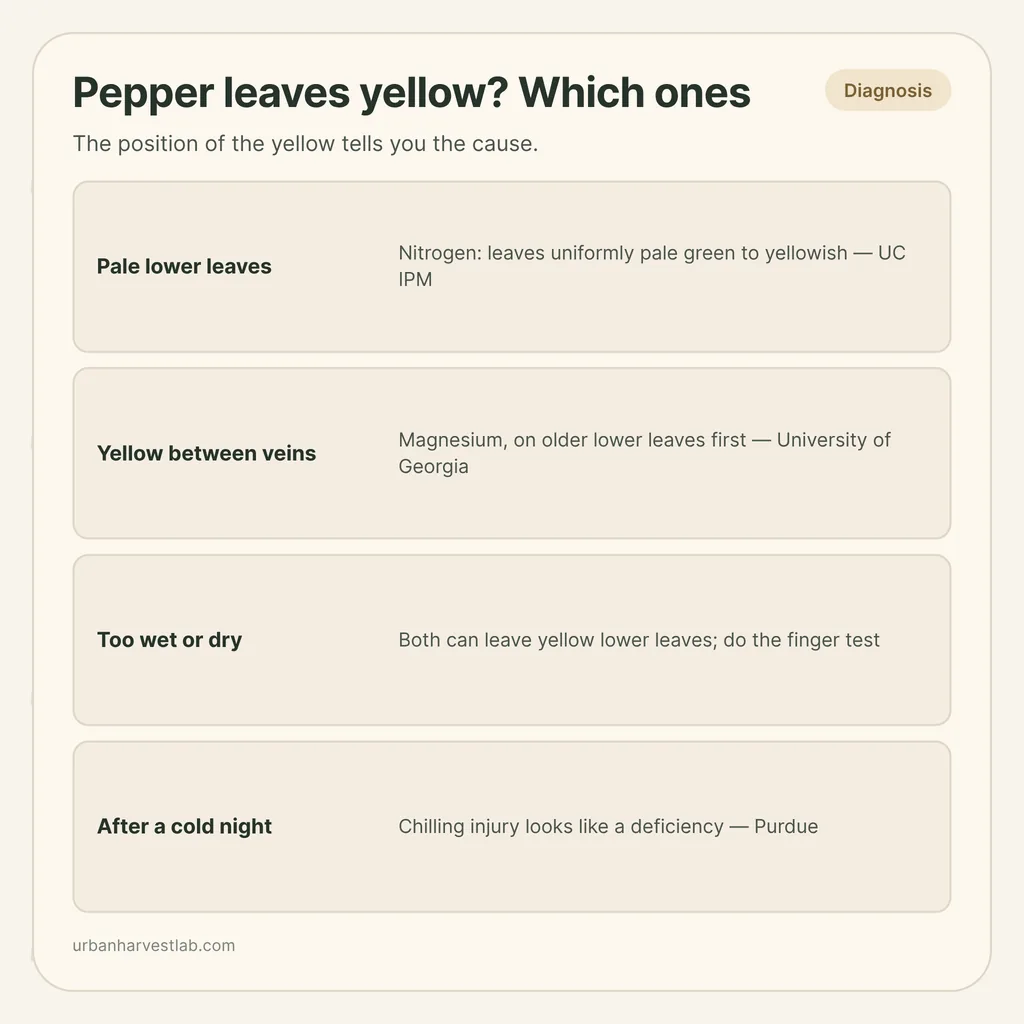
Pepper leaves turning yellow: which leaves, and why
Lower leaves going pale is often hunger, a cold snap or a soggy pot. Spots or yellow new growth point elsewhere. Here is how to sort them.
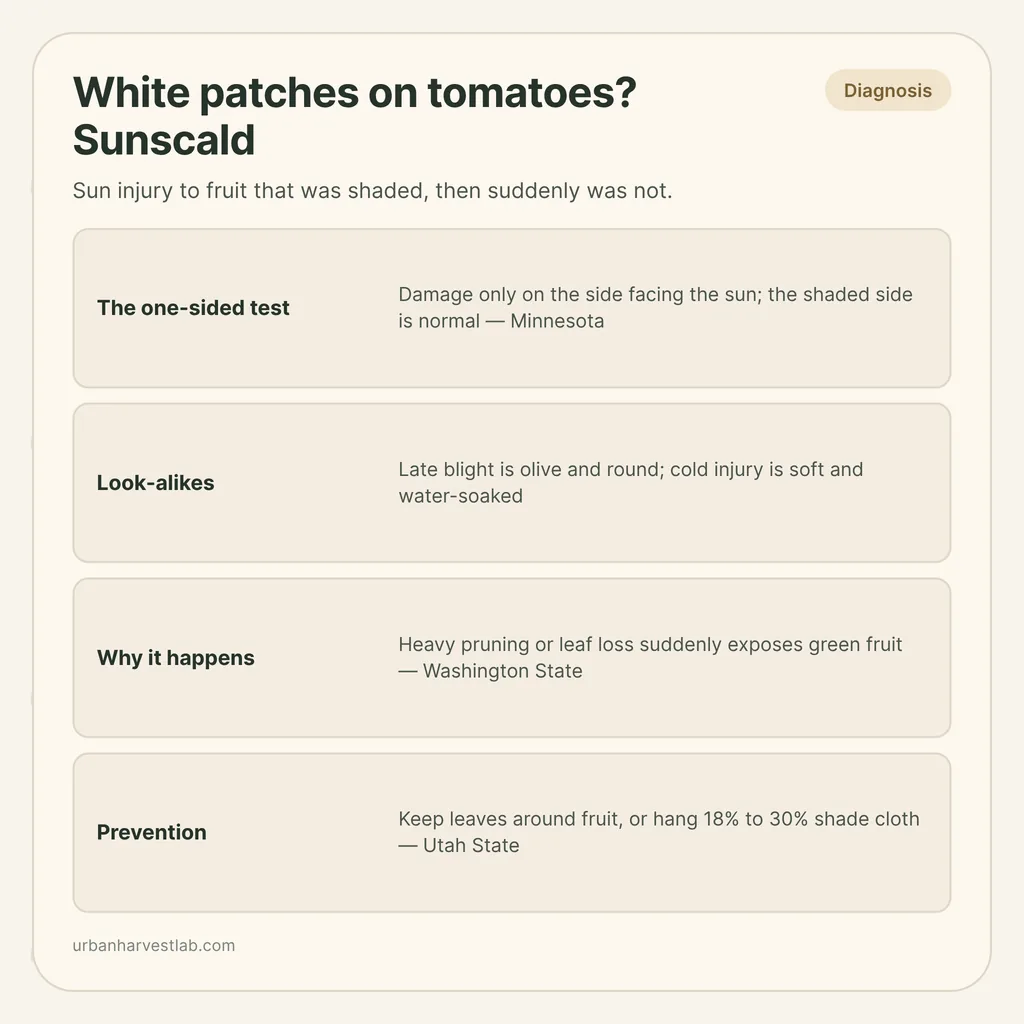
White patches on tomatoes? How to spot sunscald and stop it
A tomato or pepper that was shaded by leaves and then suddenly was not can bleach on the exposed side. The damage stays on that fruit, but the next ones are avoidable.