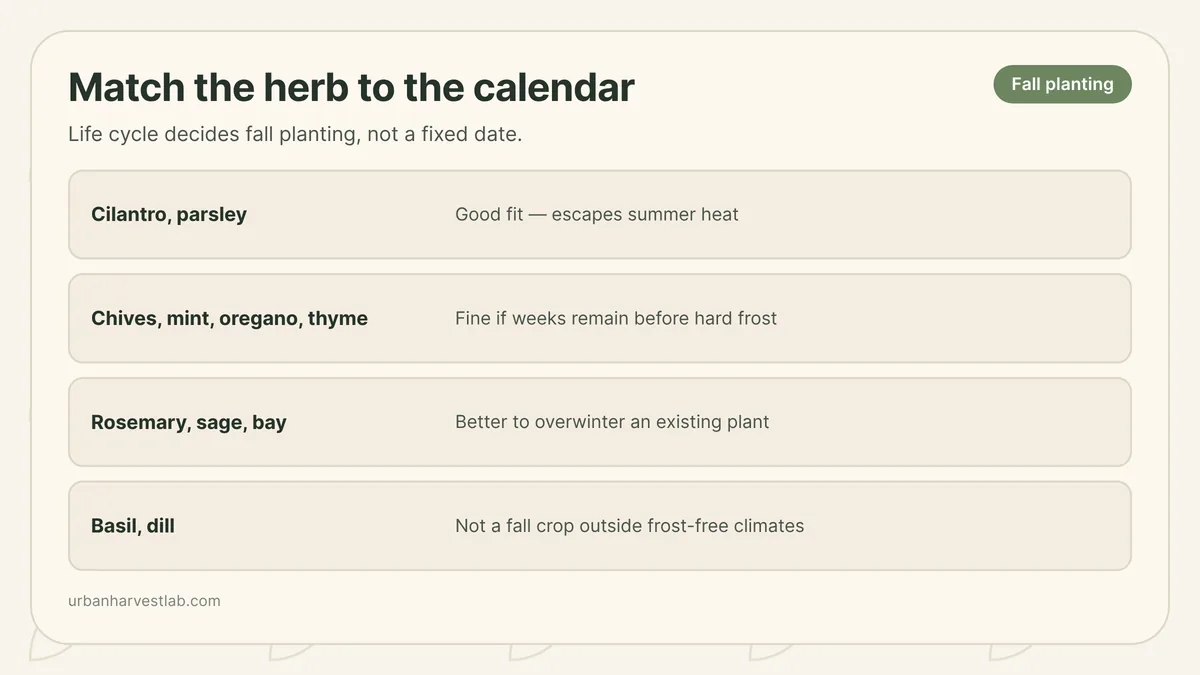
Cool-season herbs such as cilantro and parsley are the ones fall planting genuinely suits, and cold-hardy perennials like chives, mint, oregano, and thyme can go in too if enough weeks remain before a hard frost. Heat-loving annuals like basil and dill are a different story: they are not fall crops in most of the country, no matter how they are started. Which group your herb falls into, and how much time is actually left in your season, matters more than any single fall-planting date. For the wider seasonal picture beyond herbs, Small-Space Herb Gardening: Start Here for Apartments, Balconies, and Indoor Setups lays out the rest of the setup these choices fit into.
What to sow now, and what to wait on
Whether a herb belongs in the ground this fall comes down to which of three groups it falls into: a cool-season herb escaping summer heat, a cold-hardy perennial racing the first frost to root in, or a tender perennial that is being managed for winter rather than started fresh. Clemson Cooperative Extension classifies culinary herbs by life cycle — annual, biennial, herbaceous perennial, or perennial evergreen shrub — and that classification, not a single planting calendar, decides which group a given herb sits in. Basil, cilantro, and dill are annuals: each completes its life cycle in one growing season regardless of care, and none survives a real frost. Parsley is a biennial, flowering and declining in its second year even under good conditions. Chives, mint, and oregano are herbaceous perennials that die back and regrow from the root system each year. Rosemary and sage are perennial evergreen shrubs, and bay laurel is hardy to only around 0°F, according to Clemson.
The same question — “should I plant this in fall?” — has three different answers depending on which group the herb is in. An annual planted in fall is racing a life cycle that is already ending for the year. A biennial or a cold-hardy perennial planted in fall is trying to establish roots before winter dormancy. A tender perennial shrub is usually not being planted new outdoors at all this late in the season; it is being managed for winter instead.
Cool-season herbs: cilantro and parsley do better away from summer heat
Cilantro and parsley are the two herbs where fall genuinely earns its reputation as a good planting window, and the reason is heat, not cold tolerance. Both tend to struggle in the peak of summer heat, so gardeners in areas with hot summers and mild winters often get better, longer-lasting growth by sowing in late summer or early fall instead, letting the plants mature through cooler weather. Penn State Extension also names cilantro specifically, along with lemon balm and chives, as tolerating lower light levels than most herbs — as little as two to six hours of direct sun — against Clemson Cooperative Extension’s baseline of at least six hours of sun a day for almost all herbs, a bar a shortening fall day is less likely to clear.
How well this works depends heavily on climate. In a region with mild, frost-light winters, a fall-sown cilantro or parsley planting can keep producing for months. In a region with an early, hard winter, the same planting may only get a few weeks of growth before cold ends it. This is a case where the general “sow the cool-season herbs when the heat breaks” advice needs to be checked against your own first hard frost, not applied on a fixed date. Finding your first and last frost dates on a balcony or in a container garden covers how to work that out for your own location rather than relying on a single number.
Cold-hardy perennials: chives, mint, oregano, and thyme, if there is time to root in
Chives, mint, oregano, and thyme are herbaceous perennials, and a fall planting of any of them is really a race against the calendar: the plant needs enough mild weeks left to grow new roots into the surrounding soil or potting mix before the ground cools and growth slows for winter. Where that window exists — enough mild weeks remain for roots to grow into the mix before the ground cools — a fall planting gives the perennial a head start on root development before winter dormancy sets in.
Where that window does not exist, the safer move is not to force a fall planting but to wait. A perennial herb planted too close to the first hard frost has not had time to establish and is more vulnerable to being heaved out of the soil by freeze-thaw cycles or simply not surviving in a container, where roots are more exposed to cold than they are in the ground. For an outdoor container left in place over winter rather than moved, overwintering rosemary and thyme in pots covers the RHS’s sheltered-outdoor option in full.
Tender perennials: rosemary, sage, and bay are a fall-management question, not a fall-planting one
Rosemary and sage are perennial evergreen shrubs, and bay laurel is only hardy to around 0°F, per Clemson — figures that describe established, in-ground plants in favorable climates, not a new container transplant heading into its first winter. In practice, fall is rarely the moment to start these three from scratch outdoors. It is the moment to decide what happens to a plant that is already growing.
University of Illinois Extension names sage, rosemary, and bay specifically as herbs commonly overwintered indoors as tender perennials — the practical decision this time of year is to bring an existing plant in before frost rather than start new stock outdoors, and overwintering rosemary and thyme in pots covers the full method.
What to skip: basil and dill are not fall herbs in most climates
Basil is the clearest example of an herb that fall planting does not suit. Penn State Extension gives basil’s temperature bounds directly: soil needs to have warmed to at least 60°F before planting, germination happens around 70°F, and the leaves discolor below 40°F. A fall planting is moving in the opposite direction on all three counts, with cooling soil, cooling air, and a shrinking number of warm days ahead rather than behind it. Dill is in the same annual, heat-season category. Outside a genuinely warm, frost-free climate where fall still behaves like summer, both are better started at their normal spring or early-summer window than pushed into autumn.
The one fall herb everyone actually means: garlic
When people search for herbs to plant in fall, they are often thinking of garlic without naming it, since garlic is the crop most often meant by a fall planting question, so cloves can vernalize through winter cold before sprouting in spring. A reader who actually means cool-season vegetables rather than herbs or garlic will find that ground covered in growing salad greens in containers for fall. Garlic is a bulb crop rather than a culinary herb by the annual/biennial/perennial classification above, and its own planting depth, spacing, and timing are different enough to need their own explanation. Growing garlic in containers covers that timing in full.
Match the herb to the calendar, not the other way around
| Herb group | Examples | Fall planting verdict |
|---|---|---|
| Cool-season annual/biennial | Cilantro, parsley | Good fit in most climates; avoids summer bolting |
| Cold-hardy herbaceous perennial | Chives, mint, oregano, thyme | Fine if enough weeks remain before hard frost to root in |
| Tender perennial shrub | Rosemary, sage, bay | Better managed by overwintering an existing plant than starting new |
| Heat-loving annual | Basil, dill | Not a fall crop outside frost-free climates |
Once you know which group an herb sits in, the remaining decision is how much of the growing season is actually left where you garden. Balcony vegetable garden calendar: what to do each season walks through what else moves in and out of a container garden as the seasons turn, alongside the herb decisions covered here.
Sources
For the planting window and the classic fall crop
These guides cover the frost timing behind fall planting and the one crop that actually defines it.
Common questions
What herbs can you plant in fall?
Cool-season herbs like cilantro and parsley are the best fit, since they tend to struggle in summer heat and grow better in cooler conditions. Cold-hardy perennials such as chives, mint, oregano, and thyme can also be planted in fall in many climates, as long as enough weeks remain before a hard frost for roots to establish.
Can you plant basil in fall?
Not in most climates. Basil is a heat-loving annual that discolors below 40 degrees Fahrenheit and does not tolerate frost at all, so a fall planting has little growing season left before cold stops it. It only makes sense in a warm, frost-free climate where the season is effectively still summer.
Is it too late to plant herbs in fall?
It depends on which herb and how far you are from your first hard frost, not on the calendar month. A perennial herb needs several weeks of mild weather to root in before frost; a cool-season annual like cilantro needs less time and can often still be sown once summer heat breaks.
Can you plant rosemary or sage in fall?
New in-ground or new container plantings of rosemary and sage have little time to establish before cold weather in most climates. An existing potted plant is generally better moved indoors for winter than a new one started outdoors this late in the season.
Related guides
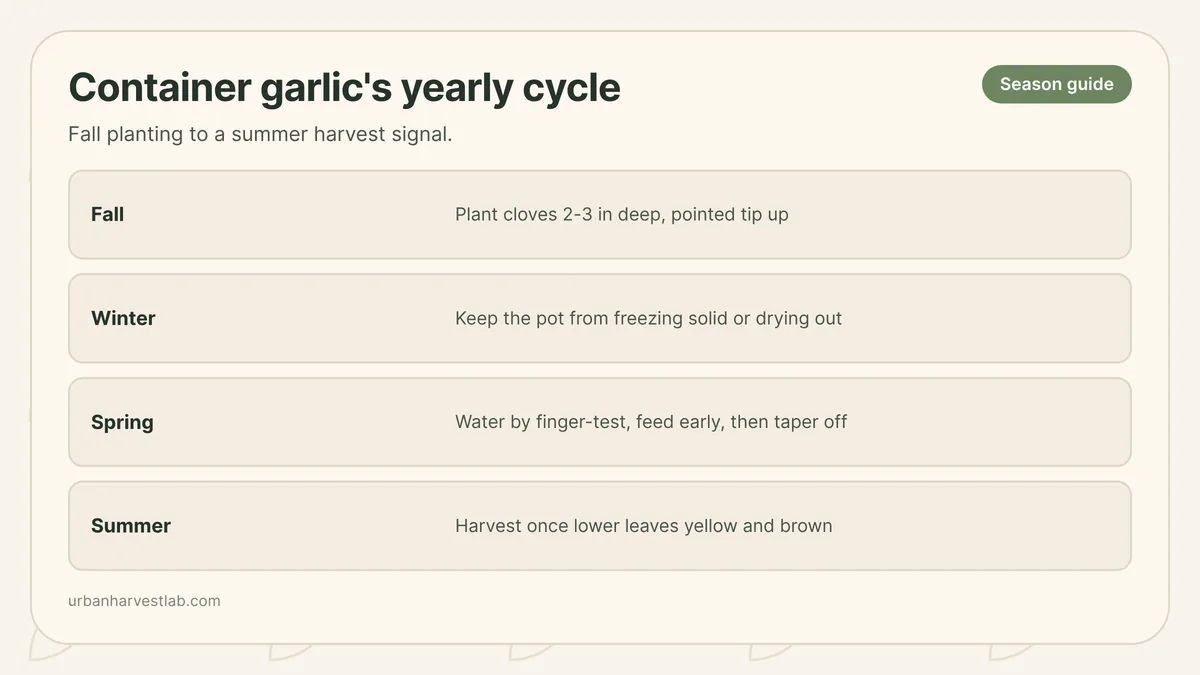
Growing garlic in containers: fall planting to summer harvest
Container garlic runs the same yearly cycle as garlic in the ground, but a pot freezes and dries out faster than garden soil. Here is the full process, season by season.
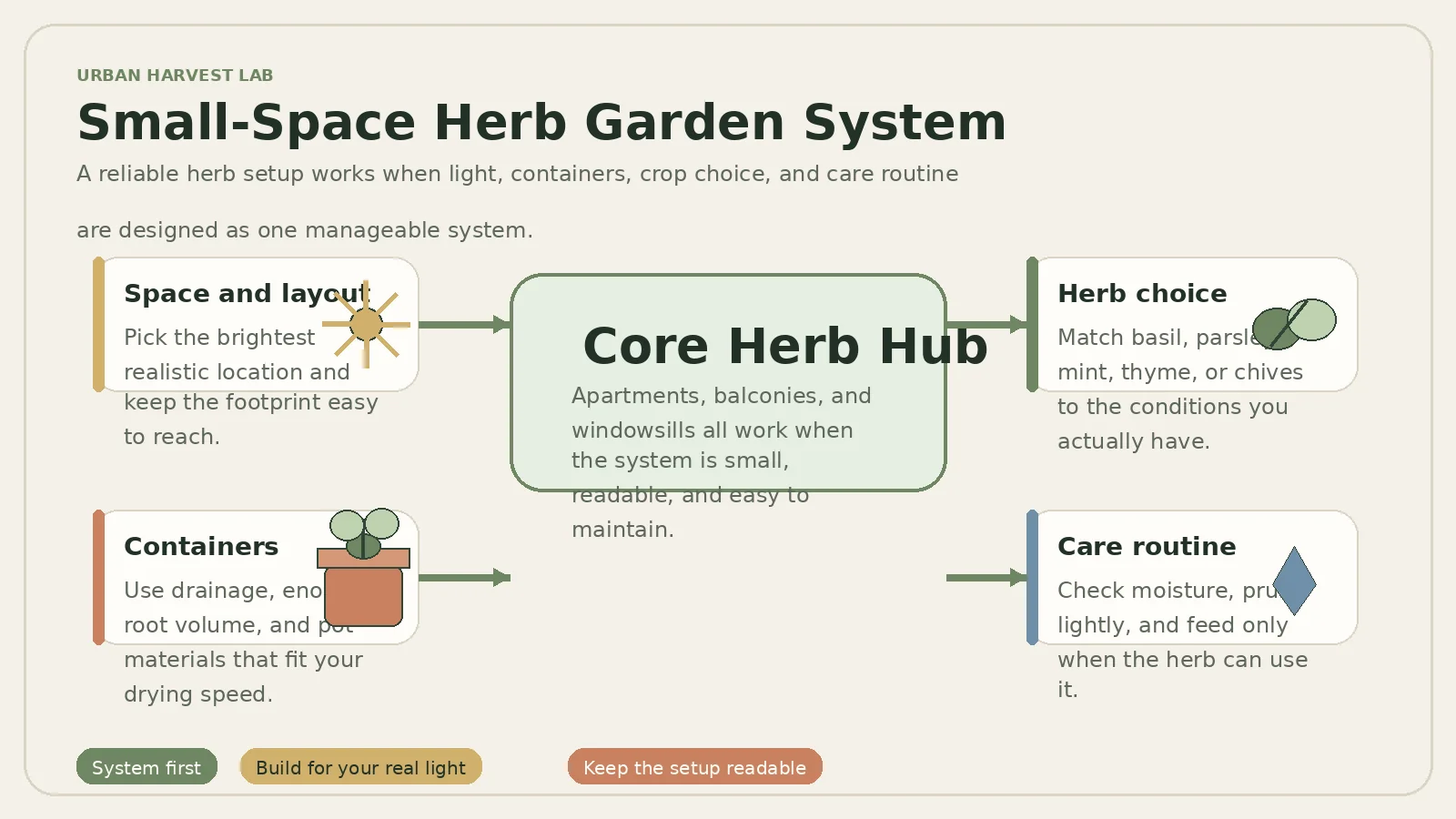
Small-space herb gardening: start here for apartments, balconies, and indoor setups
A navigation hub for apartment, balcony, and indoor herb gardening that connects the core setup, herb selection, light, container, and care guides in the right order.
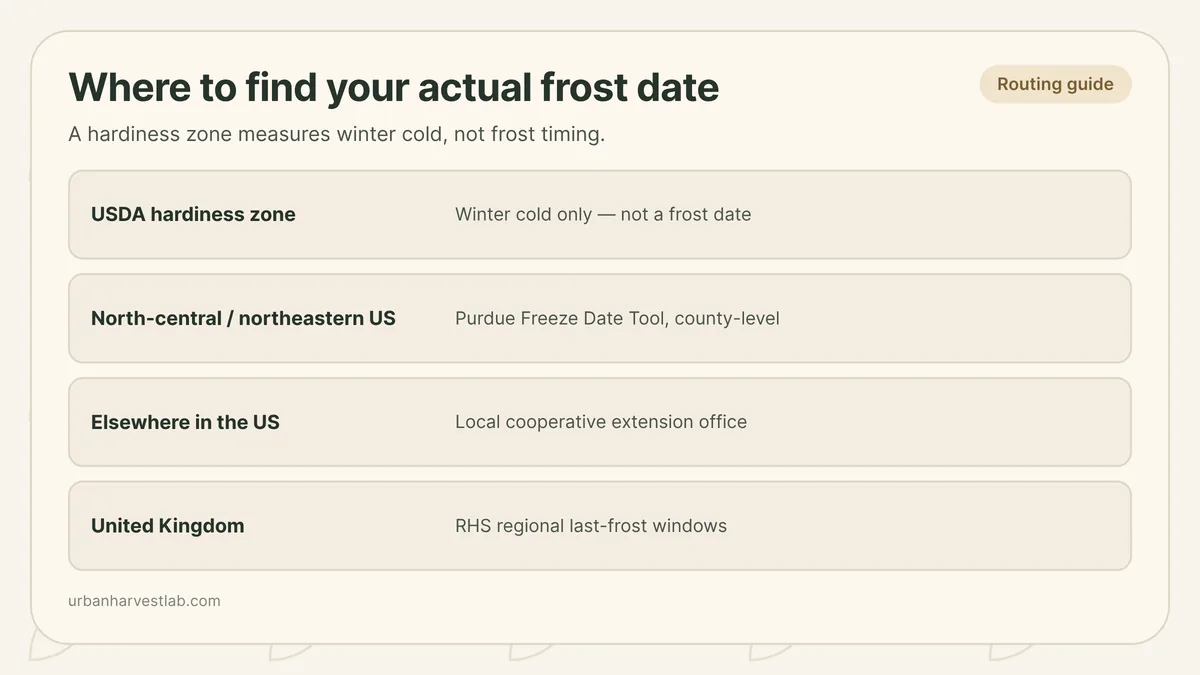
First and last frost dates for a balcony: start with your zone
Your hardiness zone tells you how cold winter gets, not when frost starts or ends. Look up the zone's temperature band, then use the tools built to answer the date question directly.