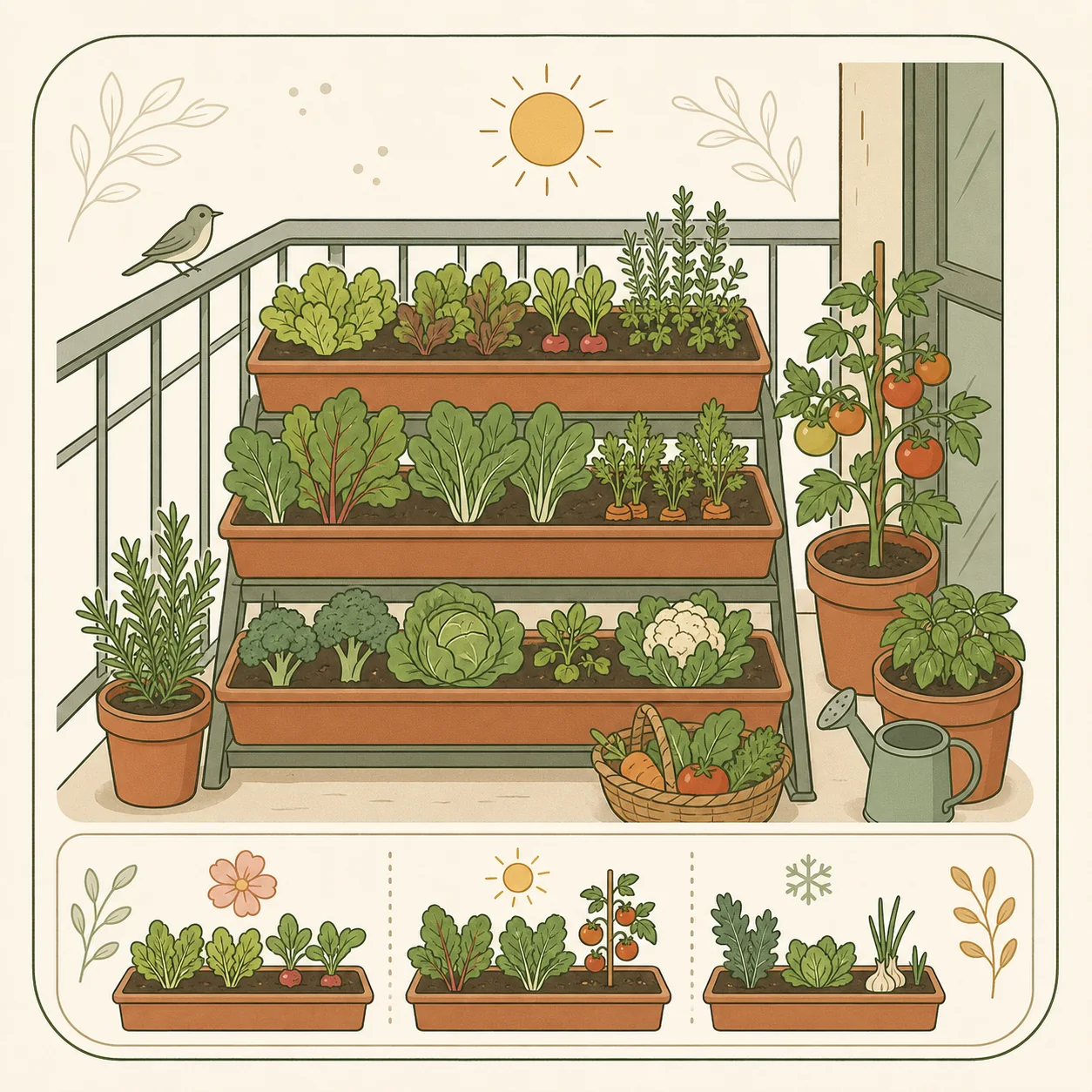
The four seasonal jobs on a balcony
| Season gate | Main job | Suitable crop direction | Main risk |
|---|---|---|---|
| Before last frost | Map light and prepare containers | Indoor starts and hardy greens | Starting warm crops too early |
| Nights reliably mild | Plant warm-season crops | Tomatoes, peppers, basil, beans | Cold setbacks and crowding |
| Peak heat | Protect roots and maintain water | Heat-tolerant herbs and fruiting crops | Containers drying too fast |
| Nights cooling | Clear tired plants and sow again | Greens, radish, parsley, cilantro | Waiting too long to restart |
A balcony vegetable garden calendar should tell you what decision to make next, not pretend that every balcony in March has the same weather. A north-facing balcony in Madrid, a windy high-rise in Chicago, and a sheltered balcony in London can share a calendar method, but not identical planting dates.
Combine the broader balcony herb garden setup with the crop constraints in best vegetables for small balconies. The calendar only works after you know how much direct sun reaches the growing area and how quickly its pots dry.
Build the calendar around four gates
Write down four local markers: average last frost, the point when nights stay above about 50°F/10°C, the hottest four to six weeks, and average first frost. Treat these as planning references rather than guarantees. A forecast close to planting day is more useful than a climate average when tender crops are involved.
The second gate is light. Track direct sun at three moments during the year if possible: near the spring equinox, midsummer, and early autumn. Buildings and balcony roofs can make summer light very different from spring light. A space that supports lettuce in April may become too hot in July, while another loses direct light when the sun rises higher.
The third gate is container readiness. Before sowing, check that drainage holes are open, old roots are removed, and the mix still springs back rather than collapsing into a dense block. Large fruiting crops also need enough root volume; use the container depth guide before committing half the balcony to tomatoes.
The last gate is your maintenance capacity. Count how many pots you can water carefully on the hottest weekday. That number, not the amount of floor space, is often the real size of the garden.

Late winter: audit before you sow
Late winter is for observation and preparation. Note where wind funnels through railings, where runoff can drain without bothering neighbors, and which surfaces become hot. Clean trays and pots. Check stored seed dates and germination notes. Order only what fits the plan.
Start slow warm-season crops indoors only if you have strong light and a realistic transplant date. A weak seedling held indoors for too long is not an early start; it is a delayed plant. Greens and herbs that tolerate cool conditions are usually lower-risk first sowings.
Create three lists: crops to direct sow, crops to transplant, and crops you will buy as starts. This prevents the common mistake of giving every crop the same start date.
Early spring: run a cool-season wave
When hard freezes are receding, begin with crops that prefer cool roots: lettuce, arugula, radish, spinach where conditions suit it, parsley, cilantro, and peas on a support. Sow modest amounts every one or two weeks instead of one oversized batch. The goal is a sequence of harvests.
Keep one or two containers empty for warm-season plants. Filling every pot in early spring forces you either to uproot productive greens too soon or delay tomatoes and peppers later.
Cold wind can damage balcony plants even when ground-level temperatures look acceptable. Use a sheltered position and temporary cover that cannot blow loose. Remove covers during bright, mild periods to prevent overheating.
Late spring: use night temperature as the handoff
Tender plants respond to actual conditions, not enthusiasm. Move tomatoes, peppers, basil, and tender beans outside gradually, increasing exposure over several days. If nights turn cold, bring small plants back or delay transplanting.
This is the point to install supports. Adding a trellis after roots and stems fill the pot causes avoidable damage. It is also the moment to decide which cool-season crops will finish, which will move into afternoon shade, and which containers will be replanted.
Do not plant every warm crop on the same day. A staged handoff spreads work and reduces the cost of one cold event.
Summer: manage the root zone, not just the leaves
Summer is a water and heat-management season. Check pots early in the day and water according to root-zone moisture, not a fixed alarm. During a heatwave, a small pot can need more than one check, but repeated shallow sips are not a substitute for watering the entire root ball.
Group containers with similar needs and shade the pot itself where intense sun heats roots. Mulch can slow evaporation, but keep organic mulch away from soft stems and observe whether it causes the surface to remain wet for too long. Read watering herbs in summer heat for the same container physics.
Harvest fruiting crops regularly. Remove plants that are clearly finished or diseased instead of letting them occupy the best light. Sow small trays of replacement greens in a cooler position if your climate allows.
Late summer and autumn: start before the balcony looks empty
Autumn crops need a head start. Count backward from the period when growth slows, adding time because shortening days make plants develop more slowly than seed packets suggest. Sow leafy greens, radish, cilantro, and parsley while warm crops are still producing.
As nights cool, stop pushing tired fruiting plants with extra fertilizer. Decide whether each plant has a plausible final harvest. Clearing one declining container can make room for a productive autumn crop.
Track which varieties tolerated wind, heat, and limited root volume. Variety notes are more valuable next year than a generic shopping list.
Winter: protect selectively or reset cleanly
In mild climates, hardy greens and woody herbs may continue with slower growth. In cold climates, exposed containers can freeze more severely than garden soil. Protection changes the rate of temperature loss; it does not turn a balcony into a warm climate.
Choose deliberately between harvesting, protecting, and bringing a plant indoors. Inspect anything moving inside for pests first. Empty failed annual containers, clean reusable parts, and store dry materials out of weather.
End the year with a one-page record: sowing dates, first and last harvest, major failures, and the maximum number of pots you maintained comfortably. That record becomes next year’s accurate balcony calendar.
Common calendar mistakes
- Treating an average frost date as a guarantee.
- Starting more seedlings than the balcony can hold.
- Ignoring seasonal changes in shade and wind.
- Filling every container with a long-season crop.
- Planning planting dates but not removal dates.
- Scaling the garden beyond the available watering time.
Sources and further reading
Before acting on this calendar, replace its climate markers with dates from a nearby weather station or extension service. Record that source beside the plan so next year’s adjustments use the same baseline.
- USDA Plant Hardiness Zone Map for long-term minimum-temperature context, not exact planting dates.
- Penn State Extension: Container Vegetable Gardening for container, crop, medium, and watering fundamentals.
Build the seasonal plan
Match the calendar to crop choice, container volume, summer watering, and the actual light on your balcony.
Common questions
What month should I start a balcony vegetable garden?
Start planning six to eight weeks before your average last frost, but use local frost dates and night temperatures rather than a universal month. Cool-season greens can begin earlier than tomatoes, peppers, and basil.
Can I plant vegetables on a balcony all year?
In mild climates you can often keep hardy greens and herbs moving through winter. Cold climates need protection or a seasonal pause, while very hot climates may pause tender leafy crops in midsummer.
How many crops should a beginner schedule?
Start with one long-season crop, one repeatable leafy crop, and two herbs. That is enough to learn the site without creating an unmanageable watering routine.
Related guides
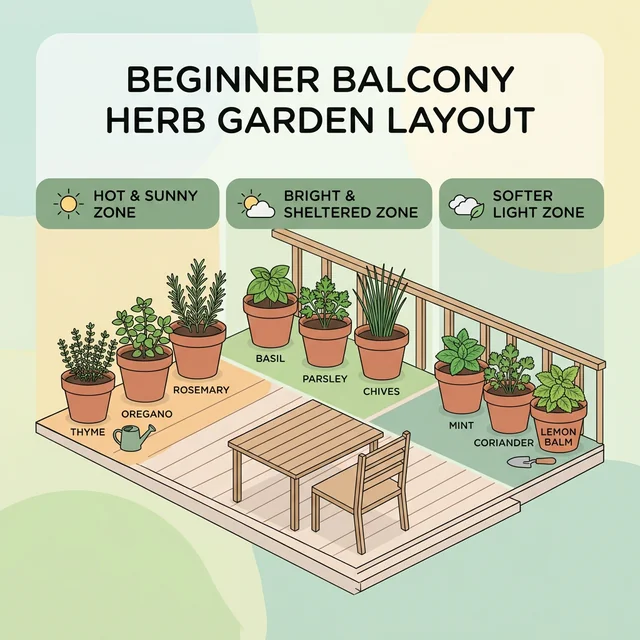
Balcony herb garden for beginners: easy step-by-step
A practical beginner guide to starting a balcony herb garden that stays simple to water, easy to read, and realistic to maintain.
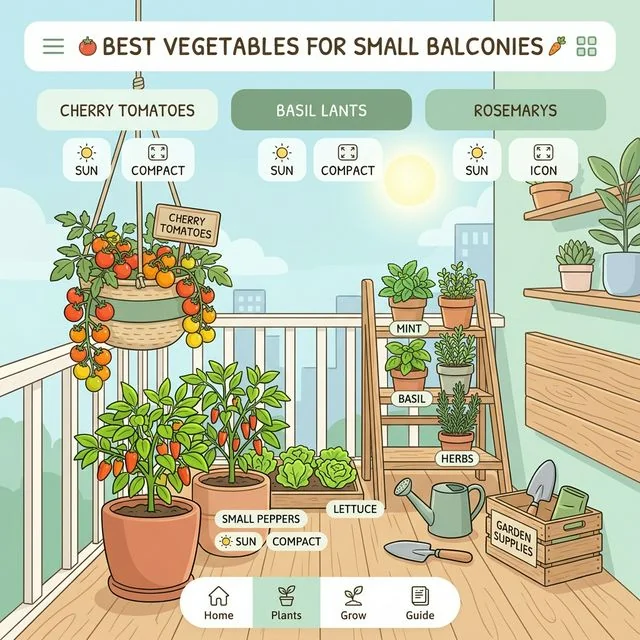
Best vegetables for small balconies: what produces well in tight spaces
Not every vegetable belongs on a balcony. These are the crops most likely to reward limited square footage without turning watering and support into a daily headache.
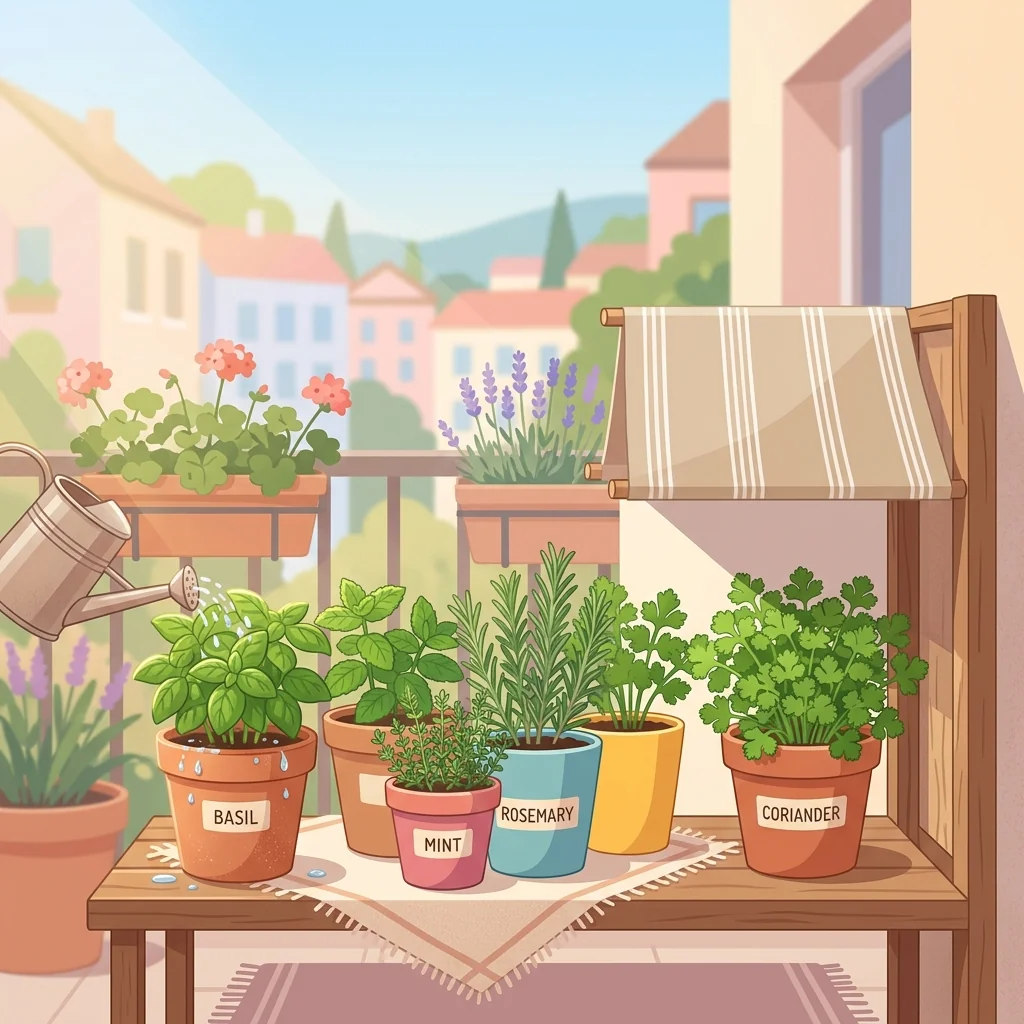
How often to water herbs in summer (heat-proof guide)
Summer heat can double how fast pots dry out. Here is how often to water each herb in hot weather, plus the shading and mulching tricks that keep pots alive in a heat wave.