What a grafted plant changes, and what it does not
| Question | Grafted plant | Own-root plant |
|---|---|---|
| Roots | A rootstock chosen to resist or tolerate soilborne disease (NC State) | The variety's own roots |
| Price | Higher; cost is a recognised barrier to adoption (University of Tennessee, ISHS) | Lower |
| Yield evidence | Higher in some Tennessee trial pairings, equal in others, all in-ground | Baseline |
| Planting depth | Union stays above the soil line (WSU) | Burying the stem is not a problem for the plant itself |
| Extra upkeep | Check weekly for rootstock shoots and remove them (WSU) | None for this reason |
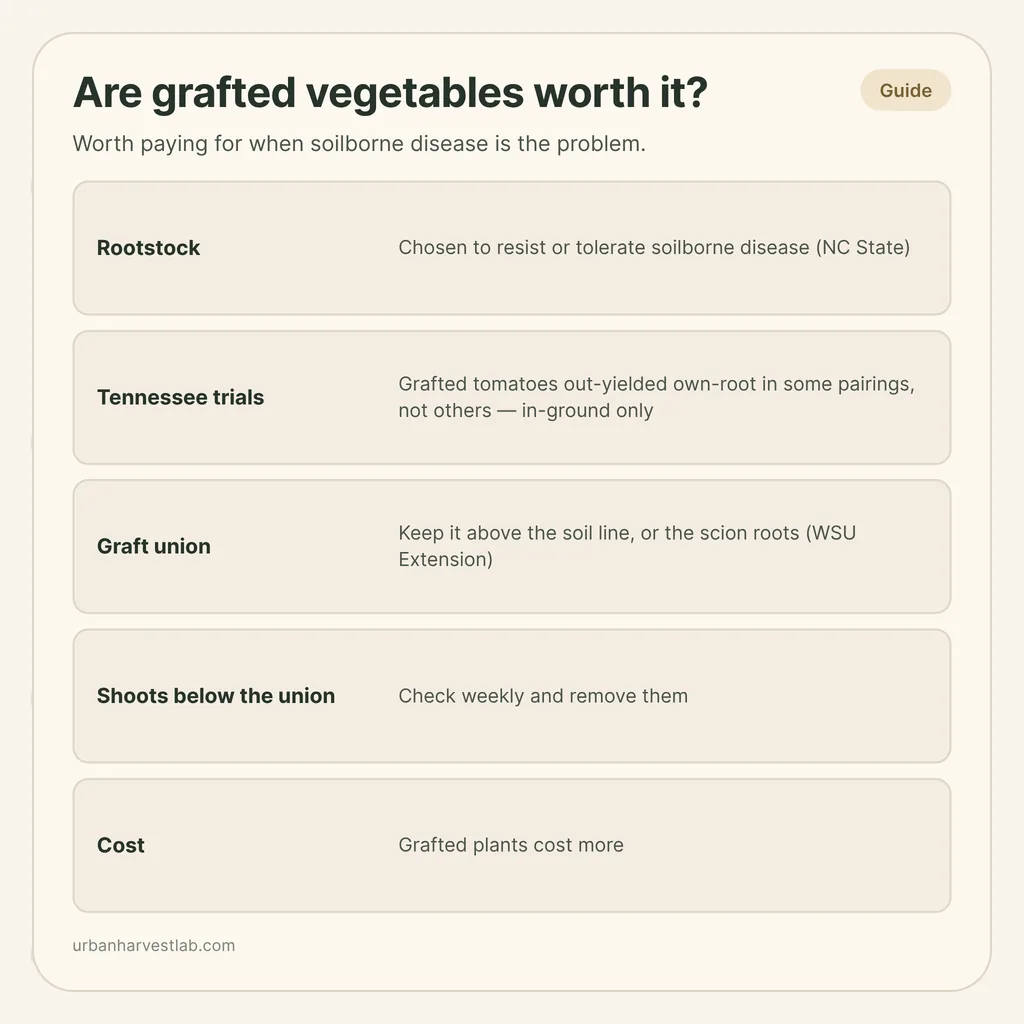
Grafted plants are worth paying for when soilborne disease is your problem, and a gamble when it is not. The rootstock is bred to resist soil pathogens; the yield gains reported in extension trials are mixed and come from in-ground plots, not pots. If you do buy one, pick a plant habit that suits your space (see compact vegetable varieties), keep the graft union above the soil and pull shoots that grow below it.
What you are paying for
A grafted vegetable is two plants joined at the stem. NC State’s grafting slides describe the split: the rootstock is “chosen for its genetic ability to resist or tolerate soilborne disease”, while the above-ground scion is chosen for fruit quality. The scion is the tomato, cucumber or eggplant you actually want to eat. The rootstock is a related plant you do not harvest.
The International Society for Horticultural Science working group on vegetable grafting lists what resistant rootstocks can control: Fusarium wilt, Verticillium wilt, bacterial wilt and root-knot nematodes. It also lists the drawbacks that still limit adoption, namely incomplete disease resistance in rootstocks, mixed results on fruit quality, excessive vegetative growth, and the high cost of grafted transplants.
Prairie View A&M’s cucumber grafting fact sheet adds the usual selling point: grafted plants are vigorous and less susceptible to disease, “and therefore positioned to provide higher yields”. Note the wording. It describes a position, not a result you can bank on.
What the trials actually found
The best evidence for home gardeners comes from the University of Tennessee, which grew grafted and own-root tomatoes side by side from 2016 to 2018. All grafted plants sat on the ‘Emperador’ rootstock. The results were uneven:
- 2016: grafted ‘Big Beef’ made 22.2 lb of usable fruit per plant against 17.2 lb for the own-root plant.
- 2017: grafted ‘Big Beef’ made 33.4 lb against 27.2 lb. ‘Celebrity’, a hybrid determinate, made 30.2 lb grafted and 26.8 lb own-root, and the trial did not call that difference significant.
- 2018: ‘Big Beef’ did no better grafted (27.3 lb) than own-root (27.8 lb). The heirlooms did: ‘Cherokee Purple’ made 21.7 lb against 17.9 lb, and ‘Pineapple’ 17.1 lb against 14.5 lb.
The University of Tennessee authors’ summary is cautious: grafted hybrids out-yielded their own-root counterparts “in only 40%” of the trials, and indeterminate types showed more potential for benefit than determinate ones. Heirloom indeterminates came out ahead in all three trials where they were grown. The authors also write that “additional cultivars should be trialed together to confirm these trends.” In 2018 there were “no consistent trends toward more fruit”, although fruit weight tended to be higher in grafted plots.
Two details matter for your decision. First, the trial reports that the results came “in the absence of known pressure from soilborne diseases (Fusarium, Vericillium)”, so the differences were attributed to root mass, water and nutrient uptake and plant growth, not to disease protection. Second, these were in-ground rows with plastic mulch and drip irrigation. No container trial is included, and the yields above do not tell you what happens in a pot on a balcony.
Does it make sense in a pot?
The rootstock’s headline benefit is protection from pathogens living in the soil. Whether that applies to you depends on one question, which NC State’s slides put in four words: “What diseases do I have?”
- You have lost tomatoes, eggplants or cucumbers to wilts or nematodes in the ground you will be planting into, or in reused pot soil: this is the case the rootstock is built for. Moving crops to fresh mix is a separate route; see crop rotation in containers.
- You have no history of those diseases: the disease benefit has little to act on. Any yield gain would rest on the vigor effect, and the Tennessee evidence for that varies by variety.
- You grow a heirloom indeterminate you love: this is where the Tennessee trials showed the most consistent gain, so it is the most reasonable place to spend the extra money.
- You grow a compact determinate in a small pot: Tennessee’s hybrid determinates did not out-yield their own-root versions in either of the two trials where they were grown. Start with the varieties that suit your container and the pot size your tomato needs.
The cost is the other half of the sum. Tennessee notes that grafted plants cost more, though gardeners “may be willing to pay for more reliable production”. If the money is better spent on a larger pot or a variety known to resist common diseases, see heirloom versus hybrid seeds.
Cucumbers and eggplants
Cucumbers are grafted onto squash rootstock. Purdue says squash rootstock “has proven to be an effective approach to improving cucumber’s cold tolerance”, with the benefit aimed at early-season production under protection, and also states that grafted cucumber plants are not readily available in the market. Expect to search for them, or to graft your own.
Eggplant and tomato are grafted by the same methods, and WSU Extension treats them together. WSU notes that home gardeners as well as commercial growers are becoming aware of grafting’s potential to manage soilborne diseases and adverse soil conditions.
Planting a grafted plant
The graft union is the slightly thickened, often angled join low on the stem, sometimes with a clip still on it. Everything about planting follows from keeping it out of the soil.
- Do not bury it. WSU Extension: “make sure that the graft union remains above the soil line. If the graft union is buried, the scion will root into the soil”, and the rootstock’s advantages are nullified. The Tennessee trial set the union about 1 inch above the soil. This is the opposite of the usual tomato habit of burying the stem, so leave the lower stem exposed even if the plant is leggy.
- Leave the clip on if the site is windy. WSU says to keep silicone clips on for a few weeks for support in windy places, and that they fall off as the stem thickens.
- Remove rootstock shoots. WSU: check at least once a week for rootstock regrowth and remove it immediately, because many commercial rootstocks are extremely vigorous and quickly overtake the scion. Tennessee also removed suckers from below the graft union.
Decision in short
Buy grafted if you have had soilborne wilts or nematodes, or if you are growing an heirloom indeterminate and accept a price premium for a possible gain. Skip it if you are growing a compact determinate in a pot of fresh mix and want to spend on volume instead. Either way, the trials give you a pattern and not a promise.
Sources
- University of Tennessee Institute of Agriculture: 2016-2018 Tennessee Garden Vegetable Trials, grafted and ungrafted tomatoes
- Washington State University Extension: Vegetable grafting, eggplants and tomatoes (FS052E)
- NC State University: Tomato grafting technique
- International Society for Horticultural Science: Vegetable grafting working group
- Purdue University: How to splice graft cucumber plants (HO-328-W)
- Prairie View A&M University: Cucumber grafting using the hole insertion method
Choosing varieties and pots for tomatoes
Pick the right plant habit, pot volume and seed type before paying extra for a rootstock.
Common questions
Are grafted tomato plants worth it?
It depends on what you are trying to fix. University of Tennessee trials found grafted indeterminate heirlooms out-yielded their own-root versions in all three trials reported, and grafted hybrid tomatoes in about 40 percent of trials, all in the ground. If you have had wilt diseases in the soil you plant into, the rootstock targets exactly that problem. If you have not, the benefit is less certain, and the Tennessee trial did not include pots.
How deep do you plant a grafted tomato?
Keep the graft union, the slightly thickened join near the base of the stem, above the soil line. WSU Extension warns that if it is buried the scion roots into the soil and the rootstock advantage is lost. The University of Tennessee trial set the union about 1 inch above the soil. This also means the usual advice to bury tomato stems does not apply to grafted plants.
What do you do with shoots growing below the graft union?
Remove them. Those shoots come from the rootstock, not your chosen variety. WSU Extension recommends checking weekly for rootstock regrowth and removing it immediately, because many commercial rootstocks are extremely vigorous and will quickly overtake the scion.
Do grafted cucumbers and eggplants work the same way?
The principle is the same: a different rootstock under the fruiting top. Cucumbers are grafted onto squash rootstock; Purdue notes grafted cucumber plants are not readily available in the market, and reports squash rootstock improving cold tolerance. WSU Extension covers eggplant grafting alongside tomato.
Related guides

What 'patio', 'bush', 'dwarf' and 'determinate' mean on a seed packet
Four words on a seed packet decide whether a plant fits your balcony, and they do not mean the same thing. Here is what each one tells you and what it leaves out.
Heirloom vs hybrid seeds: how to choose the packet for a pot
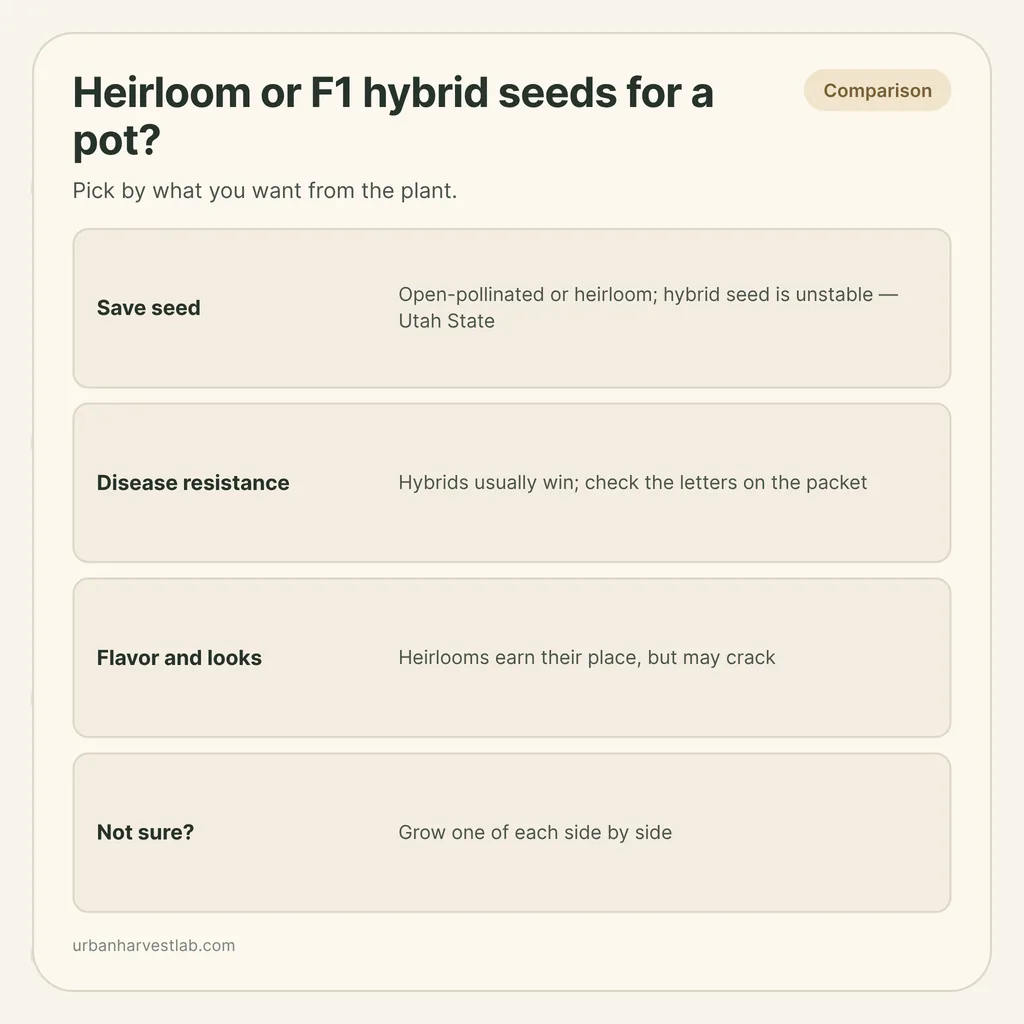
Heirloom, open-pollinated and F1 describe how a variety was bred, not how good it is. Here is what each label tells you and which one to pick for your pots.
Crop rotation in pots: what actually matters
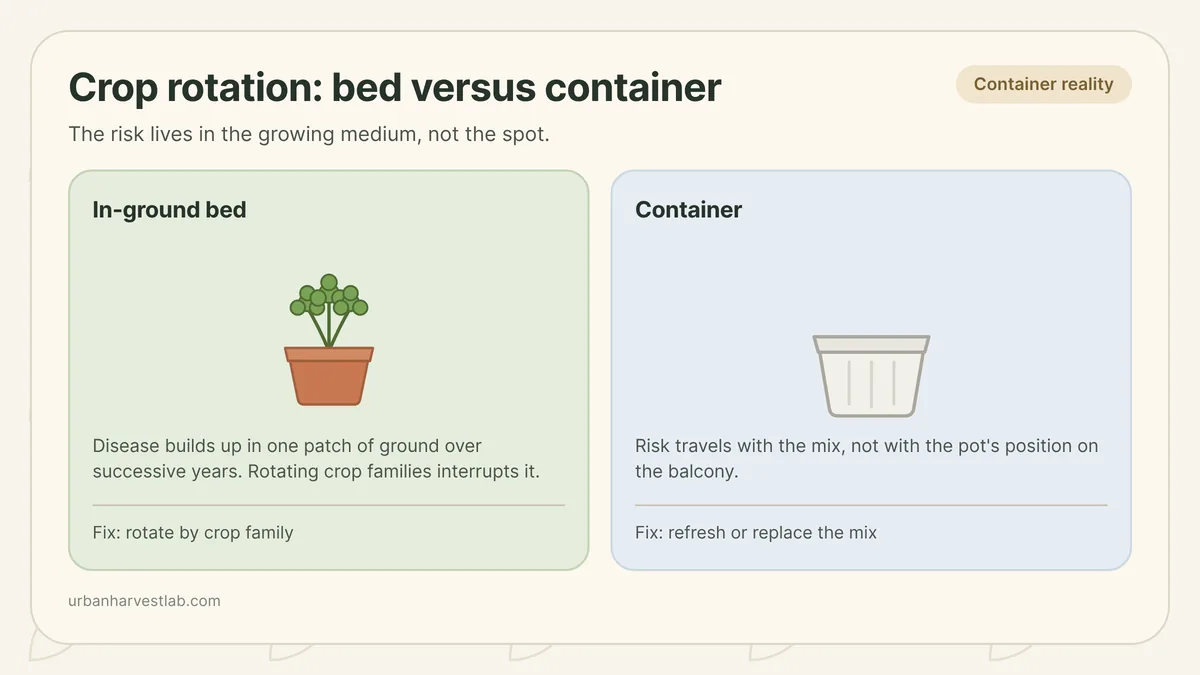
The rotation habit that protects an in-ground vegetable patch does not transfer cleanly to a pot, because the thing it was protecting against lives in the soil, not the spot.