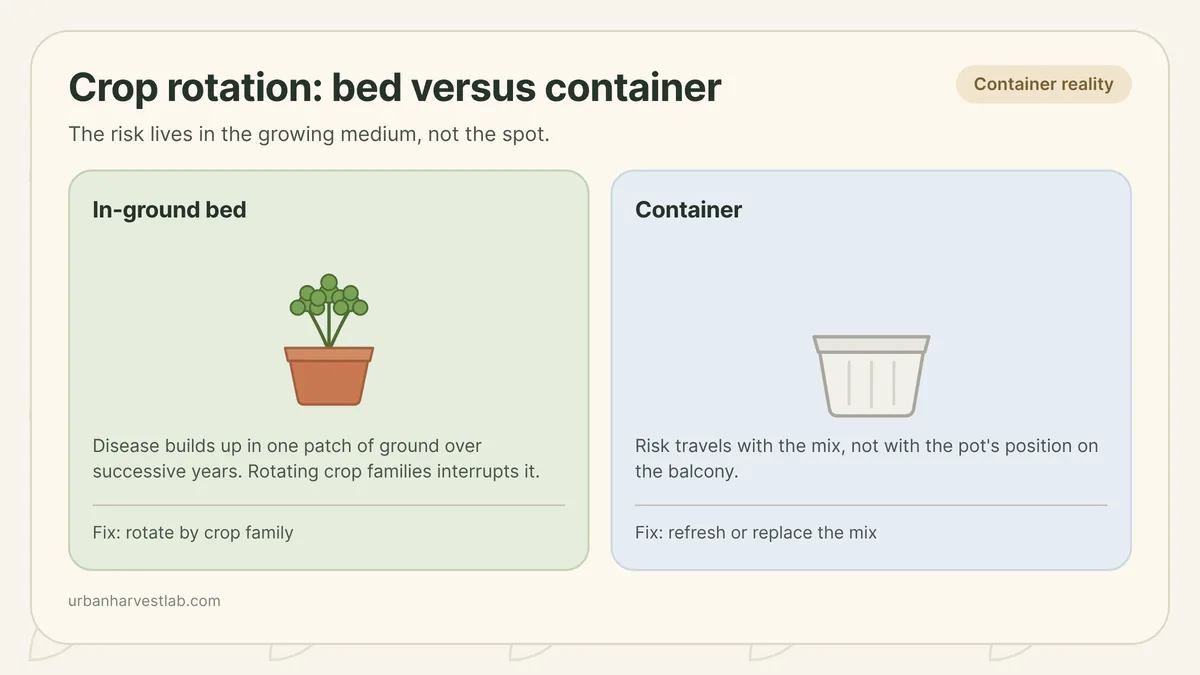
Crop rotation: garden bed vs. container
| Factor | In-ground bed | Container |
|---|---|---|
| Soil-borne disease risk | Builds up in one patch of ground over successive years | Tied to what is left in one specific batch of mix, not to a location |
| Nutrient depletion | Drawn down from a fixed volume of earth that is not replaced | Managed by a feeding schedule and periodic mix refresh, not by resting a spot |
| What actually lowers risk | Which bed a crop grows in, and how recently a related crop grew there | Whether the mix is refreshed, amended, or replaced between plantings |
| What relocating the plant does | Puts distance between a crop and last year's soil | Helps with light or crowding; does nothing if the old mix comes along unchanged |
Rotating crops between containers the way you would rotate them between garden beds solves a much smaller problem than the same advice solves in the ground. In-ground rotation exists mainly to keep soil-borne pests and diseases from building up in one patch of earth, and to spread nutrient demand across different parts of a garden over several years. Neither problem works the same way in a pot, because a container holds a small, contained volume of growing medium that gets fed, topped up, or replaced between plantings — not a fixed piece of ground that stays put for a decade. The medium is what actually carries the risk, and the medium is also the part a grower already handles between seasons — worth knowing early if you are still setting up the basics of a container vegetable garden.
Why crop rotation exists in the ground
A garden bed is the same patch of soil, season after season, unless a gardener actively works to change that. Planting the same crop family in that patch year after year gives soil-dwelling pests and pathogens tied to that family a place to persist between plantings, and it draws down whatever nutrients that crop uses heavily from the same fixed volume of earth. Rotating a different, unrelated crop family through that bed the following year is how an in-ground gardener interrupts both patterns at once — the pest or pathogen finds nothing to feed on, and a different set of nutrients gets drawn down instead.
An in-ground rotation plan is usually built around a handful of broad families: nightshades such as tomatoes, peppers, and eggplant; brassicas such as broccoli, cabbage, and kale; legumes such as beans and peas; and alliums such as onions and garlic. Moving a bed from one family to an unrelated one the following year is what actually breaks the pest-and-nutrient link between seasons. That family grouping stops being the useful unit once the growing medium itself is something a grower can swap out — a container that held this year’s tomatoes does not carry a nightshade-specific risk forward into next year’s brassica planting the way a bed does, because the medium the risk lives in does not have to carry forward unchanged either.
What’s different in a pot
A container does not hold a fixed piece of ground. It holds a batch of mix, usually peat- or coir-based, that a gardener bought, filled, watered, and — eventually — emptied out or topped up. That batch is finite and portable in a way a garden bed is not, and both of the mechanisms behind in-ground rotation change shape once the growing medium is something a person actively manages rather than a piece of land left in place.
A bagged mix is only ever treated once: UConn Extension’s Home Garden Education Office notes that commercial potting soil containing real mineral soil is heat-treated to around 180°F to kill pathogens and weed seed before it is bagged, at the factory, not every season. So whatever takes hold in the mix while a plant lives in it stays there afterward unless something is done about it — a pot’s position on the balcony has no bearing on that at all.
The medium carries the risk — not the pot’s location
Reusing potting mix covers how to tell whether a given batch is a reasonable candidate for the next crop or one that needs replacing: a plant that finished its season normally, or was lost to cold, drought, or a light problem, generally leaves behind mix worth keeping, while a plant lost to a soil-borne disease, root rot, or an active pest infestation leaves behind mix worth treating differently — and that call has nothing to do with which corner of the balcony the pot sat in.
Moving that same unrefreshed mix to a different pot, or to a different spot on the balcony, does not change what is living in it. A soil-dwelling pest such as fungus gnat larvae, or a fungal pathogen behind a root rot, travels with the material, not with the square footage it used to occupy. If the mix carries a problem, dealing with the mix — discarding it, amending it heavily, or starting over with a fresh batch — is what changes the outcome, not repositioning the pot.
Nutrient depletion works out differently too: it is a scheduled maintenance step tied to the mix’s age and condition, not to how long a particular crop has occupied a particular spot — cutting a spent season’s batch roughly half and half with fresh material, the way refresh old potting soil covers, is the fix for that draw-down, not a rotation. Longer-season fruiting crops such as tomatoes, cucumbers, eggplant, and peppers are typically fed on a running schedule instead — University of Maryland Extension’s figure for container-grown fruiting vegetables is light feeding roughly every two weeks through the growing season — which is a more direct answer to nutrient demand than resting a location for a year would be.
When relocating a container still helps
None of this means where a pot sits is irrelevant. Moving a container to catch more sun, get it out of a wind tunnel, or give a sprawling plant more elbow room is a real reason to relocate it, and it can noticeably change how a crop performs. The distinction is what that move is solving. It changes light, airflow, and crowding. It does not, by itself, address a soil-borne disease or a depleted mix, because both of those travel with the container rather than staying behind in a spot the way they would in an in-ground bed.
A gardener who has had recurring trouble with one particular container — repeated wilting, stunted growth, a pest that keeps coming back — is often better served by inspecting and likely replacing that pot’s mix than by simply shifting the same batch to a new location and hoping the change of scenery helps.
A simple routine between plantings
Rather than tracking which family of vegetable occupied which pot last year, a container routine that actually addresses the two things in-ground rotation manages looks more like this:
- Check what grew in the container last and how that plant’s season ended before deciding whether to reuse the mix as is.
- Refresh or amend mix that is otherwise clean but has lost structure or nutrients, rather than packing a new plant into spent material and hoping for the best.
- Feed fruiting crops on a running schedule through the season instead of relying on a rested spot to supply nutrients on its own.
- Plan the next crop for a container by timing, not by family — succession planting in containers covers lining up what goes in once the current planting finishes, which is a more useful planning question for a small space than which family grew there last.
None of this requires tracking a multi-year rotation chart for a handful of pots, or remembering which family of vegetable sat where last summer. It requires paying attention to the mix itself each time a container gets reused, which is a smaller and more manageable job than the one crop rotation was built to solve in the ground — and one a small-space grower with a dozen pots can actually keep up with, unlike a bed-by-bed rotation plan scaled down to fit a balcony.
Sources
Managing what actually happens in the pot
These cover the growing medium and the planning decisions that do the real work behind the rotation question.
Common questions
Do you need to rotate crops in containers the way you would in a garden bed?
Not in the same way. In-ground rotation exists mainly to manage soil-borne pests and disease building up in one patch of ground, and to spread out nutrient demand across a garden over years. A container holds a much smaller, more contained volume of growing medium, and that medium is usually refreshed or replaced between plantings, so the position a pot sits in matters far less than what happens to the mix inside it.
What matters more than rotating pots?
Not the pot's position — the mix's condition. Whatever risk in-ground rotation manages travels with the growing medium, not with the spot on the balcony a container happens to occupy, so refreshing or replacing the mix between plantings is what actually does that job. Reusing potting mix covers how to tell whether a specific batch is safe to reuse or needs replacing.
Can you grow tomatoes in the same pot every year?
Often, yes, as long as the mix is amended or partly replaced each season and the previous plant did not leave behind a soilborne problem. The pot itself is not the limiting factor; the condition of what is inside it is.
Does moving a container to a different spot help with pests or disease?
Only if the medium moves with it in a better state. Relocating a pot can help with light, wind, or crowding, but a soil-dwelling pest or pathogen lives in the mix, not in the spot on the balcony.
Related guides
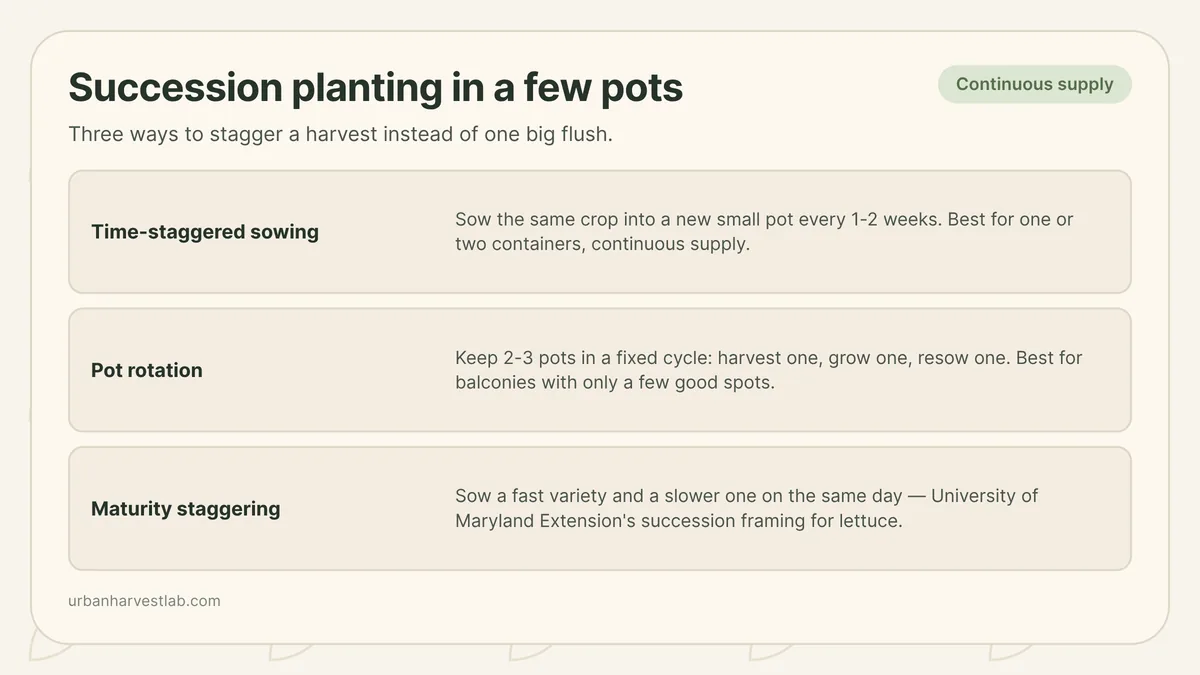
Succession planting in containers: how to stagger a harvest from a few pots
Succession planting in containers is a sowing rhythm: a few pots restarted on a schedule keep producing, where one large planting ripens together and then quits together.
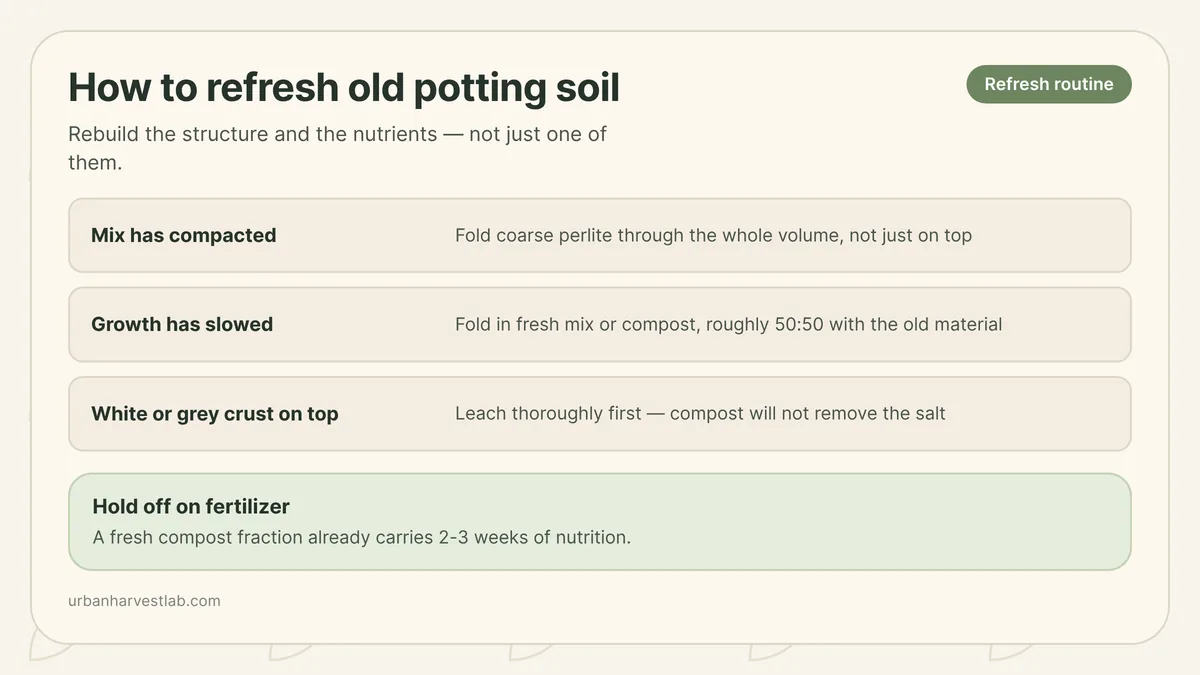
How to refresh old potting soil for another season
Old potting mix has usually lost two things at once: its air-filled structure and its nutrients. Fixing one without the other is why a refreshed pot still underperforms.
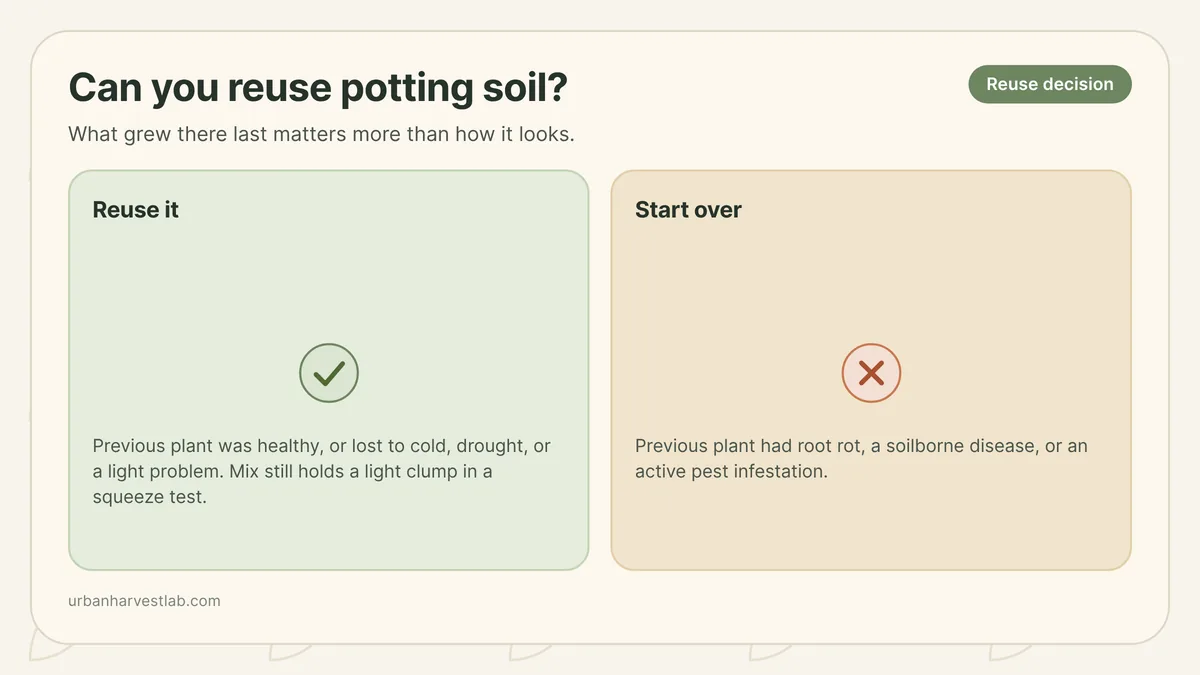
Can you reuse potting soil? When it's safe and when not to
Whether last season's mix belongs back in a pot depends less on how it looks than on what grew in it and why that plant left.